Introduction
Retail Merchandising Tools help retailers decide what to sell, where to sell it, how much to buy, how to price it, and how to present it across stores and digital channels. In plain English, these tools connect assortment planning, allocation, pricing, inventory visibility, space planning, product data, and store execution so merchandising teams can move faster and make better decisions. Modern merchandising is no longer just about shelves and displays; it is about linking demand, product data, supplier workflows, and omnichannel inventory into one operating model.
This category matters because retailers are dealing with tighter margins, more channels, faster trend cycles, and higher expectations around localized assortments and inventory accuracy. Common use cases include assortment planning, merchandise financial planning, allocation, pricing and markdown management, B2B wholesale buying, in-store execution, and product information management for digital merchandising. Buyers should evaluate planning depth, pricing and allocation support, integration quality, data model flexibility, usability, analytics, omnichannel readiness, security controls, and deployment fit.
Best for: retail planners, merchandising managers, category managers, omnichannel operations leaders, fashion and apparel brands, specialty retail, department stores, and multi-location chains.
Not ideal for: very small retailers with simple inventory needs, single-store operators using basic POS tools, or teams that only need lightweight stock tracking instead of full planning and merchandising workflows.
Key Trends in Retail Merchandising Tools
- Unified planning and execution is becoming the standard, with platforms tying assortment planning, allocation, pricing, replenishment, and inventory together.
- AI-assisted forecasting and planning is now central to modern merchandising, especially for demand alignment, assortment optimization, and exception handling.
- Omnichannel inventory visibility is a core requirement because retailers need consistent product, stock, and assortment decisions across stores and digital channels.
- Category planning and allocation precision are getting more attention as retailers try to reduce stockouts and overstocks at the store level.
- Product information management and digital merchandising matter more than ever because richer, cleaner product data improves time to market and consistency across channels.
- Wholesale and supplier-connected merchandising is growing, with platforms like NuORDER helping brands and retailers coordinate assortments and orders more directly.
- Cloud deployment dominates this category, especially for faster rollout, easier collaboration, and ongoing platform updates.
- Data interoperability is now a buying priority, including APIs, marketplace ecosystems, ERP connectivity, and in-store execution links.
How We Selected These Tools (Methodology)
- Prioritized tools with strong market visibility and adoption in retail merchandising, planning, assortment, and in-store execution.
- Looked for feature completeness across merchandise planning, assortment planning, allocation, pricing, product data, and execution.
- Favored platforms with clear support for omnichannel retail operations.
- Evaluated whether the vendor showed evidence of retail-specific workflows, not just generic inventory or analytics features.
- Considered integration and ecosystem strength, including ERP, POS, supplier, and product-data connectivity.
- Included a mix of enterprise platforms and modern mid-market tools so the list is useful across business sizes.
- Considered operational fit for apparel, specialty retail, and general merchandise.
- Reviewed available signals around cloud delivery, scalability, and retail-focused architecture.
- Assessed whether each tool contributes to one or more critical merchandising pillars: planning, pricing, allocation, product data, supplier collaboration, or store execution.
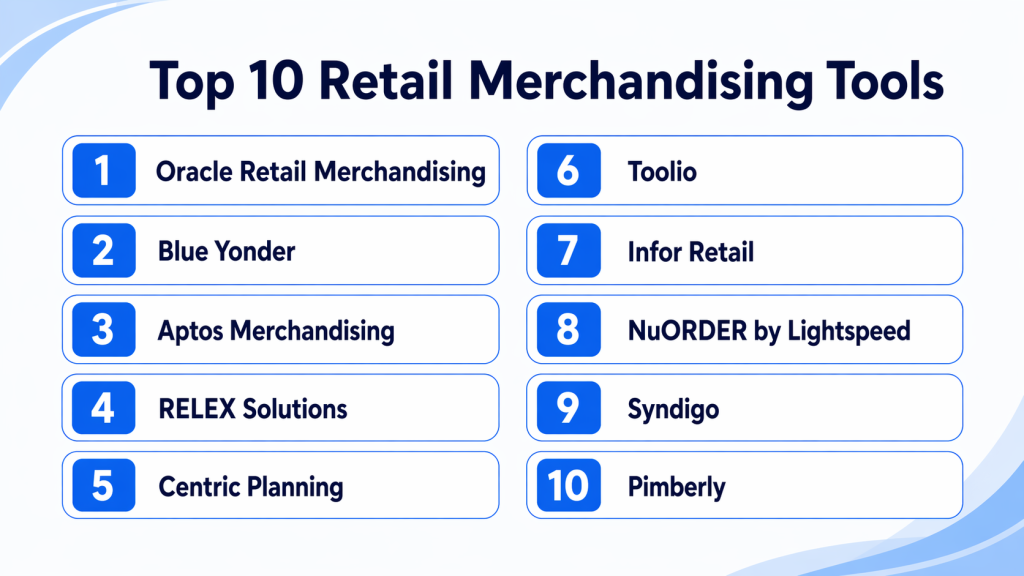
Top 10 Retail Merchandising Tools
#1 — Oracle Retail Merchandising
Short description : Oracle Retail Merchandising is one of the most established enterprise merchandising platforms in the market. It is built for large retailers that need a strong operational backbone for inventory, pricing, allocation, invoice matching, and merchandising insights. It is especially well suited for retailers running complex multi-store, multi-channel environments. The platform is designed to connect merchandising decisions with broader retail operations. It fits best where scale, process control, and integrated workflows matter most.
Key Features
- Retail merchandising foundation
- Allocation workflows
- Retail pricing tools
- Invoice matching
- Merchandising insights
- Data store and operational visibility
Pros
- Strong enterprise-grade breadth
- Good fit for large, process-heavy retail organizations
- Deep connection between merchandising and pricing operations
Cons
- Can be heavy for smaller teams
- Likely requires structured implementation and change management
Platforms / Deployment
- Web
- Cloud
Security & Compliance
Not publicly stated in the retrieved sources.
Integrations & Ecosystem
Oracle positions this as part of a broader retail suite spanning merchandising, planning, omnichannel, and supply chain operations. That makes it attractive for enterprises standardizing on a broader Oracle retail stack.
- Oracle retail product ecosystem
- Planning and optimization connections
- Omnichannel integrations
- Supply chain integrations
Support & Community
Large-enterprise vendor support model with extensive product collateral and implementation ecosystem. Community strength is stronger in enterprise retail circles than in open user communities.
#2 — Blue Yonder
Short description : Blue Yonder is a major retail platform vendor with strong merchandising relevance in general merchandise and broader supply chain-linked retail operations. It is best for larger retailers that want merchandising decisions tied closely to inventory availability, execution, and efficiency. The platform is particularly appealing when merchandising cannot be separated from broader supply chain planning. It fits retailers managing complexity across channels and large assortments. It is more platform-oriented than lightweight.
Key Features
- Merchandise operations support
- Inventory availability visibility
- Integrated retail execution orientation
- Broad retail and supply chain connection
- General merchandise support
Pros
- Strong for large operational environments
- Good fit where merchandising and supply chain must work together
Cons
- Likely overkill for smaller retailers
- May require broader platform adoption to unlock full value
Platforms / Deployment
- Web
- Cloud
Security & Compliance
Not publicly stated in the retrieved sources.
Integrations & Ecosystem
Blue Yonder is strongest when used in an ecosystem where planning, order management, and commerce are connected.
- Retail operations integrations
- Order management alignment
- Commerce ecosystem support
Support & Community
Strong enterprise vendor presence and partner ecosystem. Best suited to organizations comfortable with formal implementation models.
#3 — Aptos Merchandising
Short description : Aptos Merchandising is aimed at retailers that need enterprise inventory and merchandising control without losing sight of store operations. It focuses on helping merchandising teams manage inventory across the enterprise and is well aligned with unified commerce retail environments. It works well for retailers that need solid merchandising operations and execution support, especially in store-centric businesses. It is more operational than flashy, which can be a strength for disciplined retail teams. It suits mid-market and enterprise retailers.
Key Features
- Enterprise inventory management
- Merchandising process support
- Store and enterprise visibility
- Unified commerce alignment
- Retail operations focus
Pros
- Strong operational orientation
- Good fit for retail teams balancing stores and enterprise control
Cons
- Less visible than some larger category leaders
- Publicly available detail is lighter than some competitors
Platforms / Deployment
- Web
- Cloud
Security & Compliance
Not publicly stated.
Integrations & Ecosystem
Aptos is generally positioned within broader retail operations and commerce workflows.
- Retail operations connectivity
- Commerce ecosystem alignment
- Enterprise merchandising support
Support & Community
Primarily vendor-led support and implementation. Better suited to formal buying cycles than self-serve adoption.
#4 — RELEX Solutions
Short description : RELEX is a strong choice for retailers that care deeply about assortment planning, allocation accuracy, store-specific optimization, and merchandising tied to space and replenishment. It is particularly compelling for retailers trying to improve margins while reducing underperforming assortment decisions. RELEX stands out for linking planning decisions to execution realities like space, replenishment, and product performance. It is a serious option for data-driven retailers. It fits both grocery-adjacent complexity and general merchandise environments.
Key Features
- Assortment planning
- Store-level assortment analysis
- Space-aware planning support
- Allocation and replenishment alignment
- Performance-based assortment optimization
Pros
- Strong planning depth
- Useful for retailers with local assortment complexity
- Good balance of retail science and execution relevance
Cons
- May be more specialized than basic retail suites
- Adoption likely needs strong data maturity
Platforms / Deployment
- Web
- Cloud
Security & Compliance
Not publicly stated.
Integrations & Ecosystem
RELEX is strongest when connected to execution systems and operational planning layers.
- Planning system connectivity
- Allocation and replenishment alignment
- Store and assortment workflow support
Support & Community
Strong vendor-led retail expertise and implementation support. Best for teams ready to work in structured planning processes.
#5 — Centric Planning
Short description : Centric Planning is built for retailers and brands that need faster, more data-led merchandise planning and allocation decisions. It is especially relevant in apparel, fashion, and category-heavy environments where planning accuracy can have a direct impact on margin and inventory risk. Centric emphasizes planning transformation rather than just operational recordkeeping. That makes it attractive to merchandising leaders modernizing outdated spreadsheet-heavy workflows. It fits brands and retailers that want stronger planning discipline.
Key Features
- Retail planning support
- Merchandise financial planning relevance
- Allocation support
- Assortment planning orientation
- Data-led planning workflows
Pros
- Strong fit for fashion and specialty retail
- Good for replacing manual planning processes
Cons
- More planning-centric than execution-centric
- Smaller retailers may not need this depth
Platforms / Deployment
- Web
- Cloud
Security & Compliance
Not publicly stated.
Integrations & Ecosystem
Centric fits into planning-led retail environments and can pair well with PLM, ERP, and downstream execution tools.
- Planning workflow integrations
- Product and assortment alignment
- Retail operating model compatibility
Support & Community
Vendor-led support model with strong category focus in retail and branded merchandise environments.
#6 — Toolio
Short description : Toolio is a modern merchandise planning platform focused on helping retailers manage merchandise financial planning, assortment planning, item/store planning, and open-to-buy workflows. It is a strong option for growing brands that want a more modern and agile approach than legacy enterprise suites. Toolio feels especially relevant for digitally forward retail teams that still need serious merchandising discipline. It is best for brands that want planning depth without the heaviness of some traditional enterprise platforms. It suits growth-stage and mid-market retailers well.
Key Features
- Merchandise financial planning
- Open-to-buy support
- Assortment planning
- Item/store planning
- Modern planning workflows
Pros
- Modern planning-first design
- Strong fit for agile retail teams
- Good choice for brands moving beyond spreadsheets
Cons
- Narrower enterprise operations scope than large suites
- Best value comes when planning maturity already exists
Platforms / Deployment
- Web
- Cloud
Security & Compliance
Not publicly stated.
Integrations & Ecosystem
Toolio positions itself around core planning modules and can connect into broader merchandising environments.
- Planning integrations
- PLM-related connectivity
- Assortment and merchandise workflow alignment
Support & Community
Modern vendor experience with product education and planning-focused materials. Community is smaller than older enterprise suites.
#7 — Infor Retail
Short description : Infor’s retail software portfolio is built for retailers that want merchandising connected to finance, logistics, supply chain, workforce, and broader retail operations. It is particularly relevant in apparel, footwear, and fashion-adjacent environments where retail operations need to stay tightly coordinated. Infor is not always marketed as a pure merchandising specialist, but it matters because merchandising decisions often live inside broader retail operating systems. It is best for retailers wanting a more end-to-end operating model. It suits complex retail businesses.
Key Features
- Retail-specific software stack
- Real-time AI insights
- Inventory and logistics alignment
- Fashion and apparel relevance
- Ecosystem and marketplace connectivity
Pros
- Broad operational coverage
- Good fit where merchandising must align with finance and supply chain
Cons
- Less focused as a pure-play merchandising tool
- Could be heavier than needed for smaller brands
Platforms / Deployment
- Web
- Cloud
Security & Compliance
Not publicly stated.
Integrations & Ecosystem
Infor benefits from a broader enterprise ecosystem and marketplace model.
- Retail operations integrations
- ERP and finance alignment
- Marketplace ecosystem
Support & Community
Strong enterprise support model with implementation partner presence.
#8 — NuORDER by Lightspeed
Short description : NuORDER by Lightspeed is a strong merchandising-adjacent tool for brands and retailers working across wholesale buying, assortment decisions, and supplier-connected ordering. It is especially useful when merchandising involves collaboration between brands, buyers, and multi-location retail networks. NuORDER Assortments is specifically positioned to help identify merchandising gaps and improve inventory allocation. This makes it relevant for assortment-led commerce rather than just order capture. It is a smart fit for wholesale-driven retail ecosystems.
Key Features
- Assortments workflow
- Merchandising gap identification
- Inventory allocation support
- Wholesale buying connectivity
- Multi-location retail relevance
Pros
- Excellent for wholesale-connected merchandising
- Useful for brand-retailer collaboration
- Helps bridge buying and assortment decisions
Cons
- Not a full traditional end-to-end merchandising suite
- Best value is in wholesale-centric operating models
Platforms / Deployment
- Web
- Cloud
Security & Compliance
Not publicly stated.
Integrations & Ecosystem
NuORDER benefits from Lightspeed’s retail and POS ecosystem.
- Lightspeed ecosystem alignment
- Supplier and catalog workflows
- Retail ordering integrations
Support & Community
Strong vendor-led support, especially for retail brands and buyers working in wholesale processes.
#9 — Syndigo
Short description : Syndigo is highly relevant for merchandising teams that depend on clean, accurate product content and strong in-store execution. Its in-store solutions focus on accurate, GS1-compliant data to improve stocking, displays, and sales. While it is not a classic merchandise planning suite, it plays an important merchandising role where product data quality directly impacts execution quality. It is especially useful for retailers with complex product content and store execution requirements. It fits omnichannel retailers that need better data discipline.
Key Features
- In-store execution support
- GS1-compliant product data handling
- Stocking support
- Display and shelf execution support
- Product data accuracy workflows
Pros
- Strong data quality angle
- Useful where merchandising execution depends on trusted product content
Cons
- Not a full planning-led merchandising platform
- Best used as part of a broader merchandising stack
Platforms / Deployment
- Web
- Cloud
Security & Compliance
Not publicly stated.
Integrations & Ecosystem
Syndigo is strongest as a product-content and execution layer inside broader retail ecosystems.
- Product data workflows
- In-store execution alignment
- Retail operations support
Support & Community
Vendor-led support with a strong focus on data operations and retail execution use cases.
#10 — Pimberly
Short description : Pimberly is a PIM-led merchandising tool that helps retailers centralize, enrich, and distribute product data across channels. It is especially useful for fashion, apparel, and e-commerce-heavy businesses where rich product data and fast assortment changes matter. Pimberly’s strength is not classic financial planning; it is merchandising readiness through product content, automation, and time-to-market improvement. That makes it valuable for digital merchandising and category expansion. It is best for retailers treating product data as a merchandising asset.
Key Features
- Centralized product information management
- Product data enrichment
- Digital asset handling
- Channel distribution support
- Time-to-market acceleration
Pros
- Strong for digital merchandising
- Helpful for apparel and catalog complexity
- Good fit for omnichannel product-data workflows
Cons
- Not a full traditional merchandise planning suite
- Less suitable as the only merchandising system for large enterprises
Platforms / Deployment
- Web
- Cloud
Security & Compliance
Not publicly stated.
Integrations & Ecosystem
Pimberly is strongest when connected to commerce, content, and downstream channel systems.
- PIM and DAM workflows
- Channel syndication support
- Product content ecosystem alignment
Support & Community
Vendor-led support model with strong relevance for product-content-heavy retail teams.
Comparison Table (Top 10)
| Tool Name | Best For | Platform(s) Supported | Deployment | Standout Feature | Public Rating |
|---|---|---|---|---|---|
| Oracle Retail Merchandising | Large retailers | Web | Cloud | End-to-end merchandising foundation | N/A |
| Blue Yonder | Enterprise retail operations | Web | Cloud | Merchandising tied to supply chain execution | N/A |
| Aptos Merchandising | Mid-market and enterprise store-led retail | Web | Cloud | Enterprise inventory and merchandising control | N/A |
| RELEX Solutions | Assortment-heavy retailers | Web | Cloud | Assortment planning with space and replenishment relevance | N/A |
| Centric Planning | Fashion and specialty retail | Web | Cloud | Data-led planning and allocation workflows | N/A |
| Toolio | Modern growth retailers and brands | Web | Cloud | MFP, OTB, assortment, item/store planning | N/A |
| Infor Retail | Complex retail operating models | Web | Cloud | Retail operations linked to inventory and AI insights | N/A |
| NuORDER by Lightspeed | Wholesale-connected brands and retailers | Web | Cloud | Assortments and buyer-supplier collaboration | N/A |
| Syndigo | Product-data-driven store execution | Web | Cloud | GS1-compliant in-store data execution | N/A |
| Pimberly | Digital merchandising and product data teams | Web | Cloud | Centralized product information and enrichment | N/A |
Evaluation & Scoring of Retail Merchandising Tools
| Tool Name | Core (25%) | Ease (15%) | Integrations (15%) | Security (10%) | Performance (10%) | Support (10%) | Value (15%) | Weighted Total (0–10) |
|---|---|---|---|---|---|---|---|---|
| Oracle Retail Merchandising | 9 | 6 | 8 | 7 | 9 | 8 | 6 | 7.65 |
| Blue Yonder | 9 | 6 | 8 | 7 | 9 | 8 | 6 | 7.65 |
| Aptos Merchandising | 8 | 7 | 7 | 6 | 8 | 7 | 7 | 7.25 |
| RELEX Solutions | 9 | 7 | 7 | 6 | 8 | 8 | 7 | 7.65 |
| Centric Planning | 8 | 8 | 7 | 6 | 8 | 7 | 7 | 7.40 |
| Toolio | 8 | 8 | 7 | 6 | 8 | 7 | 8 | 7.55 |
| Infor Retail | 8 | 6 | 8 | 6 | 8 | 7 | 6 | 7.10 |
| NuORDER by Lightspeed | 7 | 8 | 7 | 6 | 8 | 7 | 8 | 7.35 |
| Syndigo | 7 | 7 | 7 | 6 | 8 | 7 | 7 | 7.05 |
| Pimberly | 7 | 8 | 7 | 6 | 7 | 7 | 8 | 7.20 |
These scores are comparative, not absolute. A higher score does not mean one tool is universally better; it means it looks stronger across the weighted criteria for a broad range of merchandising buyers. Enterprise retailers may still prefer a heavier platform with a slightly lower value score, while growth brands may get better outcomes from a simpler tool with stronger ease-of-use.
Which Retail Merchandising Tool Is Right for You?
Solo / Freelancer
Most solo retailers do not need a full merchandising suite. A lighter stack built around POS, inventory, and product content tools is usually enough. Among the tools here, Pimberly is useful if digital product content is the pain point, while NuORDER by Lightspeed can help when supplier and buying workflows matter more than enterprise planning.
SMB
Small and growing retail teams usually benefit from tools that improve planning discipline without creating enterprise-level overhead. Toolio is a strong fit for growth brands that need modern merchandise planning, while Pimberly works well for catalog-heavy digital merchandising. NuORDER by Lightspeed is a good pick for brands with wholesale relationships and multi-location assortment needs.
Mid-Market
Mid-market retailers typically need stronger assortment, allocation, and product-data workflows. Centric Planning, Toolio, and Aptos Merchandising are good options here because they balance seriousness with more practical adoption paths than some heavyweight suites. RELEX is especially strong when store-specific assortment and allocation precision matter.
Enterprise
Large retailers with broad assortments, multiple channels, and complex operating models should look first at Oracle Retail Merchandising, Blue Yonder, RELEX, and Infor Retail. These platforms make the most sense when merchandising decisions must connect tightly to pricing, execution, inventory, and supply chain processes.
Budget vs Premium
For better value and faster time to productivity, Toolio, Pimberly, and NuORDER by Lightspeed are more approachable. For premium enterprise depth, Oracle Retail Merchandising, Blue Yonder, and RELEX stand out.
Feature Depth vs Ease of Use
If depth matters most, go with Oracle, Blue Yonder, or RELEX. If usability and speed matter more, Toolio and Pimberly are easier to justify. Centric Planning sits nicely in the middle for many specialty retail teams.
Integrations & Scalability
If you already run a large retail stack, Oracle, Infor, and Blue Yonder deserve attention. If you want a merchandising tool that can still fit into a growing stack without dominating it, Toolio, Centric, and NuORDER are easier starting points.
Security & Compliance Needs
Where product data, inventory, pricing, and store execution flow through a broader enterprise environment, choose vendors with strong enterprise operating maturity and structured implementation models. For most buyers here, Oracle, Blue Yonder, Infor, and RELEX are safer bets for large-scale governance-heavy environments, while smaller brands can focus first on operational fit and integration quality.
Frequently Asked Questions (FAQs)
1. What do retail merchandising tools actually do?
They help retailers plan assortments, manage buys, allocate inventory, support pricing decisions, improve product presentation, and connect merchandising choices to sales and inventory outcomes.
2. Are retail merchandising tools the same as inventory tools?
No. Inventory tools tell you what stock you have. Merchandising tools help decide what product mix you should carry, where it should go, and how it should perform.
3. Who usually owns these platforms inside a company?
Most often merchandising, planning, category management, or retail operations teams. In bigger companies, IT and data teams are also deeply involved because integrations matter.
4. Do smaller retailers need a merchandising platform?
Not always. Small retailers can often start with POS, inventory, and reporting tools. Dedicated merchandising software becomes more valuable once assortments, locations, or channels become harder to manage manually.
5. What is the difference between assortment planning and merchandise planning?
Merchandise planning usually covers higher-level financial and inventory planning. Assortment planning gets more specific about which products, variants, and categories should be carried in each channel or store.
6. Can these tools help with markdowns and pricing?
Some can. Oracle explicitly highlights retail pricing, while broader merchandising suites often connect planning to pricing and clearance decisions.
7. Are PIM tools really part of merchandising?
Yes, in many retail environments. If product content is inconsistent, merchandising quality suffers across e-commerce, in-store execution, and omnichannel operations. That is why tools like Pimberly and Syndigo matter.
8. How long does implementation usually take?
It depends on scope. Modern planning tools can roll out faster than large enterprise suites, but enterprise merchandising programs often require broader process redesign and systems integration.
9. What is the biggest mistake buyers make?
Choosing a tool based only on feature lists. The real question is whether the platform matches your retail operating model, data maturity, channel complexity, and team workflow.
10. Should retailers buy one suite or a best-of-breed stack?
There is no universal answer. Large retailers often benefit from a suite. Growing brands often move faster with a focused stack that combines planning, product data, and commerce tools.
Conclusion
Retail merchandising is no longer a narrow back-office function. It now sits at the center of assortment strategy, inventory productivity, supplier collaboration, store execution, and digital product experience. That is why the best tool depends less on brand recognition and more on how your merchandising team actually works. Enterprise retailers may need the operational depth of Oracle Retail Merchandising, Blue Yonder, or RELEX. Growth brands may move faster with Toolio, Centric Planning, or Pimberly. Retailers with strong wholesale and supplier workflows may get more value from NuORDER by Lightspeed, while data-heavy execution teams may benefit from Syndigo. The smartest next step is to shortlist three tools, map them against your planning and execution gaps, and run a focused pilot that validates integrations, workflows, and reporting before making a full commitment.