Introduction
Last-Mile Delivery Platforms are software solutions designed to manage and optimize the final step of the delivery journey—from a distribution hub to the customer’s doorstep. This phase is often the most complex and expensive part of logistics, making efficiency and visibility critical for businesses.
With rising customer expectations for fast, accurate, and real-time deliveries, businesses are increasingly relying on these platforms to streamline operations. From route optimization and driver tracking to automated dispatching and customer communication, last-mile delivery platforms help organizations improve speed, reduce costs, and enhance customer experience.
Real-world use cases include:
- E-commerce and retail delivery operations
- Food and grocery delivery services
- Courier and logistics companies
- Field service and maintenance scheduling
- Healthcare and pharmaceutical deliveries
What buyers should evaluate:
- Route optimization and dispatch automation
- Real-time tracking and visibility
- Customer communication features
- Scalability for high delivery volumes
- Integration with order management systems
- Mobile app support for drivers
- Analytics and reporting capabilities
- Cost and pricing flexibility
Best for: Logistics companies, e-commerce businesses, delivery startups, and enterprises managing large delivery fleets.
Not ideal for: Businesses with minimal delivery needs or those operating with fixed and predictable routes.
Key Trends in Last-Mile Delivery Platforms
- AI-driven dispatching and route optimization
- Real-time delivery visibility and tracking
- Hyperlocal and same-day delivery optimization
- Automation of delivery workflows
- Integration with e-commerce and ERP systems
- Sustainability-focused delivery planning
- Mobile-first driver experiences
- Customer experience enhancements (notifications, ETAs)
- Data-driven delivery analytics
How We Selected These Tools (Methodology)
- Strong industry adoption and market presence
- Comprehensive feature capabilities
- Proven scalability and performance
- Integration flexibility with logistics ecosystems
- Availability of security and access controls
- Ease of use and onboarding
- Suitability for SMB to enterprise use cases
- Balance between innovation and reliability
- Vendor support and product maturity
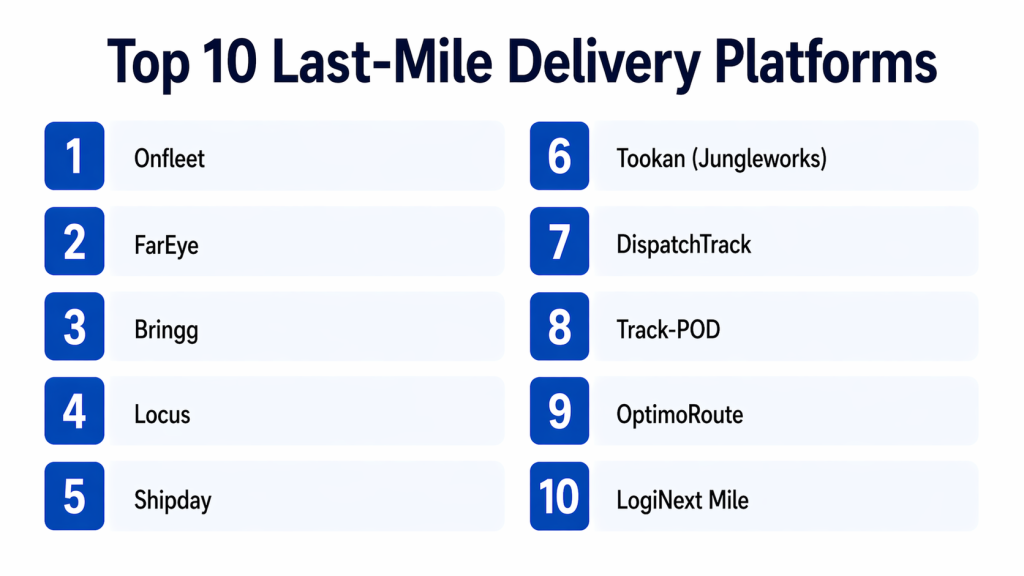
Top 10 Last-Mile Delivery Platforms
#1 — Onfleet
Short description: Onfleet is a leading last-mile delivery platform offering route optimization, driver tracking, and customer communication. It is widely used by logistics and delivery businesses to streamline operations and improve delivery efficiency.
Key Features
- Route optimization
- Real-time tracking
- Customer notifications
- Driver management
- Analytics dashboard
Pros
- Strong customer experience features
- Highly scalable
Cons
- Premium pricing
- Setup complexity
Platforms / Deployment
Web / iOS / Android
Cloud
Security & Compliance
Encryption, role-based access
Integrations & Ecosystem
API-driven platform with integrations across CRM, e-commerce, and logistics systems.
Support & Community
Strong documentation and support.
#2 — FarEye
Short description: FarEye is an enterprise-grade logistics platform focused on predictive delivery and real-time visibility. It is ideal for large-scale delivery operations.
Key Features
- AI-based routing
- Predictive analytics
- Delivery tracking
- Fleet management
- Customer communication
Pros
- Enterprise scalability
- Advanced analytics
Cons
- Complex implementation
- Higher cost
Platforms / Deployment
Web / Mobile
Cloud
Security & Compliance
Not publicly stated
Integrations & Ecosystem
Supports integration with ERP and logistics platforms.
Support & Community
Enterprise-level support.
#3 — Bringg
Short description: Bringg is a last-mile delivery and fulfillment platform designed for enterprises. It helps businesses manage deliveries across multiple channels and partners.
Key Features
- Delivery orchestration
- Real-time tracking
- Partner management
- Customer communication
- Analytics
Pros
- Strong orchestration capabilities
- Enterprise-ready
Cons
- Complex setup
- Premium pricing
Platforms / Deployment
Web / Mobile
Cloud
Security & Compliance
Not publicly stated
Integrations & Ecosystem
Extensive integrations with e-commerce and logistics systems.
Support & Community
Enterprise support.
#4 — Locus
Short description: Locus provides AI-powered delivery optimization with a focus on automation and efficiency. It helps businesses scale their delivery operations effectively.
Key Features
- AI route optimization
- Dispatch automation
- Real-time tracking
- Analytics
- Fleet optimization
Pros
- Advanced AI capabilities
- Scalable
Cons
- Learning curve
- High cost
Platforms / Deployment
Web / Mobile
Cloud
Security & Compliance
Not publicly stated
Integrations & Ecosystem
Supports integrations with enterprise systems.
Support & Community
Strong support.
#5 — Shipday
Short description: Shipday is a simple and affordable delivery management platform designed for small businesses. It provides tracking and route planning capabilities.
Key Features
- Order tracking
- Route planning
- Driver management
- Notifications
- Mobile app
Pros
- Easy to use
- Budget-friendly
Cons
- Limited advanced features
- Basic integrations
Platforms / Deployment
Web / iOS / Android
Cloud
Security & Compliance
Not publicly stated
Integrations & Ecosystem
Basic integrations supported.
Support & Community
Moderate support.
#6 — Tookan
Short description: Tookan is a delivery and workforce management platform designed for businesses handling on-demand deliveries. It helps automate operations and track deliveries.
Key Features
- Task management
- Real-time tracking
- Route optimization
- Notifications
- Reporting
Pros
- Flexible use cases
- Easy onboarding
Cons
- UI limitations
- Limited enterprise depth
Platforms / Deployment
Web / iOS / Android
Cloud
Security & Compliance
Not publicly stated
Integrations & Ecosystem
API-based integrations available.
Support & Community
Good support resources.
#7 — DispatchTrack
Short description: DispatchTrack is a delivery management platform focused on improving last-mile visibility and customer experience.
Key Features
- Route optimization
- Real-time tracking
- Delivery notifications
- Analytics
- Driver management
Pros
- Strong visibility features
- Good customer experience tools
Cons
- Pricing not transparent
- Requires setup effort
Platforms / Deployment
Web / Mobile
Cloud
Security & Compliance
Not publicly stated
Integrations & Ecosystem
Integrates with logistics and ERP systems.
Support & Community
Reliable support.
#8 — Track-POD
Short description: Track-POD is a delivery management solution focused on proof of delivery and route optimization. It is suitable for logistics and courier services.
Key Features
- Proof of delivery
- Route optimization
- Driver tracking
- Analytics
- Reporting
Pros
- Strong delivery tracking
- Affordable
Cons
- Limited customization
- UI could improve
Platforms / Deployment
Web / Mobile
Cloud
Security & Compliance
Not publicly stated
Integrations & Ecosystem
Supports integration via API.
Support & Community
Good documentation.
#9 — OptimoRoute
Short description: OptimoRoute combines route optimization with delivery scheduling, helping businesses manage deliveries efficiently.
Key Features
- Route optimization
- Scheduling
- Tracking
- Proof of delivery
- Analytics
Pros
- Easy to use
- Strong scheduling
Cons
- Limited integrations
- Fewer advanced features
Platforms / Deployment
Web / Mobile
Cloud
Security & Compliance
Not publicly stated
Integrations & Ecosystem
Supports API and data import/export.
Support & Community
Reliable support.
#10 — LogiNext Mile
Short description: LogiNext Mile is an advanced last-mile delivery optimization platform designed for enterprises. It focuses on automation and real-time insights.
Key Features
- AI-driven routing
- Real-time tracking
- Delivery analytics
- Automation
- Fleet management
Pros
- Advanced capabilities
- Enterprise scalability
Cons
- Complex implementation
- Premium pricing
Platforms / Deployment
Web / Mobile
Cloud
Security & Compliance
Not publicly stated
Integrations & Ecosystem
Enterprise integrations with logistics systems.
Support & Community
Enterprise-grade support.
Comparison Table
| Tool Name | Best For | Platforms | Deployment | Standout Feature | Public Rating |
|---|---|---|---|---|---|
| Onfleet | Last-mile delivery | Web, Mobile | Cloud | Customer communication | N/A |
| FarEye | Enterprise logistics | Web, Mobile | Cloud | Predictive routing | N/A |
| Bringg | Enterprise delivery | Web, Mobile | Cloud | Delivery orchestration | N/A |
| Locus | AI logistics | Web, Mobile | Cloud | AI optimization | N/A |
| Shipday | SMB delivery | Web, Mobile | Cloud | Simplicity | N/A |
| Tookan | On-demand delivery | Web, Mobile | Cloud | Task management | N/A |
| DispatchTrack | Visibility | Web, Mobile | Cloud | Tracking | N/A |
| Track-POD | Proof of delivery | Web, Mobile | Cloud | POD features | N/A |
| OptimoRoute | Scheduling | Web, Mobile | Cloud | Optimization | N/A |
| LogiNext Mile | Enterprise | Web, Mobile | Cloud | Automation | N/A |
Evaluation & Scoring of Last-Mile Delivery Platforms
| Tool Name | Core | Ease | Integrations | Security | Performance | Support | Value | Weighted Total |
|---|---|---|---|---|---|---|---|---|
| Onfleet | 9 | 8 | 9 | 8 | 9 | 9 | 7 | 8.6 |
| FarEye | 9 | 7 | 9 | 7 | 9 | 9 | 6 | 8.4 |
| Bringg | 9 | 7 | 9 | 7 | 9 | 9 | 6 | 8.4 |
| Locus | 9 | 7 | 8 | 7 | 9 | 8 | 6 | 8.2 |
| Shipday | 7 | 9 | 6 | 6 | 7 | 7 | 9 | 7.5 |
| Tookan | 8 | 8 | 7 | 6 | 8 | 8 | 8 | 7.9 |
| DispatchTrack | 8 | 7 | 8 | 6 | 8 | 8 | 7 | 7.8 |
| Track-POD | 7 | 8 | 7 | 6 | 7 | 7 | 8 | 7.4 |
| OptimoRoute | 8 | 9 | 7 | 6 | 8 | 8 | 8 | 8.0 |
| LogiNext Mile | 9 | 7 | 9 | 7 | 9 | 9 | 6 | 8.4 |
How to interpret scores: These scores compare tools across key factors like features, usability, integrations, and value. Higher scores indicate stronger overall performance, while lower scores may reflect trade-offs in simplicity or advanced capabilities.
Which Last-Mile Delivery Platform Is Right for You?
Solo / Freelancer
Choose Shipday or Circuit-type tools for simplicity and affordability.
SMB
Go with Shipday, Tookan, or Track-POD for ease of use and cost efficiency.
Mid-Market
Onfleet and DispatchTrack offer a balance of features and scalability.
Enterprise
FarEye, Bringg, Locus, and LogiNext Mile are best for large operations.
Budget vs Premium
- Budget: Shipday, Track-POD
- Premium: FarEye, Bringg
Feature Depth vs Ease of Use
- Advanced: Bringg, FarEye
- Easy: Shipday, Tookan
Integrations & Scalability
- Strong: Onfleet, Bringg
- Basic: Shipday
Security & Compliance Needs
Enterprise tools provide better security capabilities.
Frequently Asked Questions (FAQs)
1. What is a last-mile delivery platform?
A last-mile delivery platform manages the final stage of delivery from warehouse to customer. It helps optimize routes, track deliveries, and improve efficiency.
2. How much do these platforms cost?
Pricing varies depending on features, delivery volume, and users. Some platforms offer subscription pricing, while others use usage-based models.
3. Are these platforms suitable for small businesses?
Yes, many tools are designed for SMBs with simple interfaces and affordable pricing.
4. Do these platforms support real-time tracking?
Most modern platforms provide real-time tracking and delivery updates.
5. Can they integrate with existing systems?
Yes, many platforms offer APIs and integrations with ERP, CRM, and e-commerce tools.
6. How long does implementation take?
Implementation ranges from a few hours to several weeks depending on complexity.
7. Are these platforms secure?
Security varies by vendor, but many offer encryption and access controls.
8. Can they handle high delivery volumes?
Yes, enterprise tools are designed for large-scale operations.
9. What industries use these platforms?
Logistics, e-commerce, food delivery, healthcare, and transportation industries.
10. Is it easy to switch platforms?
Switching is possible but requires planning for data migration and integration.
Conclusion
Last-mile delivery platforms have become a cornerstone of modern logistics, enabling businesses to handle the most complex and costly part of the delivery journey with greater efficiency and control. By leveraging features like real-time tracking, intelligent route optimization, and automated dispatching, these platforms help organizations reduce operational costs while significantly improving delivery speed and customer satisfaction. From small businesses managing a handful of deliveries to large enterprises coordinating thousands of shipments daily, there is a solution tailored to every scale and requirement. However, choosing the right platform depends heavily on your specific operational needs, budget constraints, and integration requirements. While some tools prioritize simplicity and quick onboarding, others deliver advanced capabilities designed for complex logistics environments. The key is to evaluate your priorities—whether it is ease of use, scalability, automation, or analytics—and align them with the platform’s strengths. A practical approach is to shortlist a few tools, test them in real-world scenarios, and validate how well they integrate with your existing systems before making a long-term commitment.