Introduction
Restaurant Delivery Dispatch Tools help businesses assign delivery orders to drivers, optimize routes, track deliveries in real time, and manage last-mile logistics efficiently. In simple terms, these platforms act as the control center for food delivery operations, ensuring orders move from kitchen to customer as fast and accurately as possible.
These tools are critical because delivery has become a core revenue channel for restaurants. Dispatch software automates driver assignment, reduces delivery time, and improves customer satisfaction through real-time updates and optimized routing. For example, modern systems can automatically select the most cost-effective driver and route while keeping customers informed throughout the delivery process.
Common use cases include managing in-house delivery fleets, integrating with third-party delivery platforms, optimizing delivery routes, tracking driver performance, and reducing operational costs. Buyers should evaluate automation, routing intelligence, real-time tracking, integrations, scalability, and ease of use.
Best for: cloud kitchens, QSR chains, multi-location restaurants, and delivery-first brands.
Not ideal for: small restaurants with minimal delivery volume or those relying entirely on third-party aggregators.
Key Trends in Restaurant Delivery Dispatch Tools
- AI-powered dispatch and route optimization
- Real-time GPS tracking and ETA prediction
- Integration with delivery aggregators (Uber Eats, DoorDash)
- Automated driver assignment and batching
- Multi-channel order management from POS and apps
- Cloud-based dispatch platforms
- Customer notifications and tracking links
- Data analytics for delivery performance
- Fleet optimization and cost reduction
- Focus on last-mile efficiency
How We Selected These Tools (Methodology)
- Evaluated adoption across restaurant and logistics sectors
- Assessed dispatch automation and routing capabilities
- Reviewed integration with POS, OMS, and delivery platforms
- Analyzed scalability for high-volume delivery operations
- Considered real-time tracking and analytics features
- Evaluated ease of use for dispatchers and drivers
- Reviewed mobile apps and driver interfaces
- Assessed vendor ecosystem and integrations
- Considered pricing flexibility and ROI
- Ensured a mix of SMB and enterprise tools
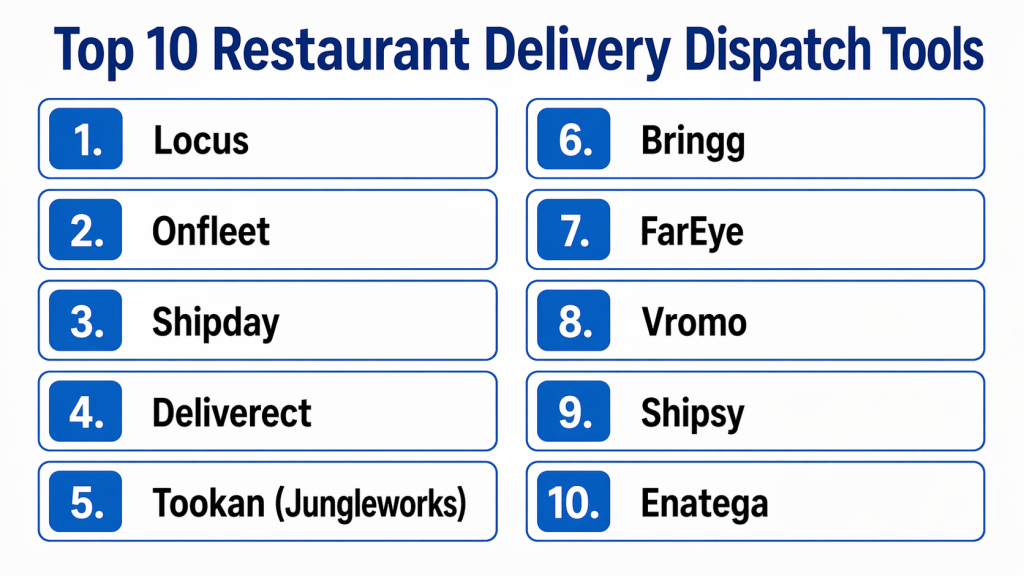
Top 10 Restaurant Delivery Dispatch Tools
#1 — Locus
Short description : Locus is an AI-powered delivery dispatch platform that connects routing, driver assignment, and real-time tracking into a single system for large-scale delivery operations.
Key Features
- AI-driven dispatch optimization
- Route planning and automation
- Real-time tracking
- Delivery analytics
- Control tower visibility
Pros
- Advanced AI capabilities
- Enterprise scalability
Cons
- Complex implementation
- Premium pricing
Platforms / Deployment
- Web / Cloud
Security & Compliance
- Not publicly stated
Integrations & Ecosystem
Locus integrates with enterprise logistics and restaurant systems.
- POS systems
- APIs
- Logistics tools
Support & Community
- Enterprise support
#2 — Onfleet
Short description : Onfleet provides delivery dispatch and route optimization tools with real-time tracking and driver communication.
Key Features
- Dispatch automation
- Route optimization
- Driver tracking
- Customer notifications
- Analytics dashboards
Pros
- Easy to use
- Strong tracking features
Cons
- Limited POS features
- Pricing tiers
Platforms / Deployment
- Web / Mobile / Cloud
Security & Compliance
- Not publicly stated
Integrations & Ecosystem
- POS systems
- APIs
- Delivery tools
Support & Community
- Documentation and support
#3 — Shipday
Short description : Shipday is a popular delivery management tool designed for restaurants and small businesses to manage drivers and deliveries efficiently.
Key Features
- Driver management
- Route planning
- Real-time tracking
- Proof of delivery
- Analytics
Pros
- Affordable
- Easy setup
Cons
- Limited enterprise features
- Basic analytics
Platforms / Deployment
- Web / Mobile / Cloud
Security & Compliance
- Not publicly stated
Integrations & Ecosystem
- POS systems
- APIs
- Delivery apps
Support & Community
- Vendor support
#4 — Deliverect
Short description : Deliverect connects online ordering platforms with restaurant systems and supports delivery dispatch workflows.
Key Features
- Order aggregation
- Delivery platform integration
- Dispatch management
- Analytics
- Automation
Pros
- Strong integrations
- Multi-channel support
Cons
- Requires setup
- Subscription cost
Platforms / Deployment
- Web / Cloud
Security & Compliance
- Not publicly stated
Integrations & Ecosystem
- Uber Eats, DoorDash
- POS systems
- APIs
Support & Community
- Vendor support
#5 — Tookan (Jungleworks)
Short description : Tookan is a delivery management platform offering dispatch, tracking, and route optimization for restaurants and logistics businesses.
Key Features
- Task assignment
- Route optimization
- Driver tracking
- Delivery analytics
- Customer notifications
Pros
- Flexible workflows
- Scalable
Cons
- UI complexity
- Learning curve
Platforms / Deployment
- Web / Mobile / Cloud
Security & Compliance
- Not publicly stated
Integrations & Ecosystem
- APIs
- POS systems
Support & Community
- Vendor support
#6 — Bringg
Short description : Bringg is an enterprise delivery orchestration platform focused on last-mile delivery optimization.
Key Features
- Dispatch automation
- Route optimization
- Fleet management
- Analytics
- Delivery orchestration
Pros
- Enterprise-grade
- Advanced analytics
Cons
- Expensive
- Complex
Platforms / Deployment
- Web / Cloud
Security & Compliance
- Not publicly stated
Integrations & Ecosystem
- Logistics platforms
- APIs
Support & Community
- Enterprise support
#7 — Circuit for Teams
Short description : Circuit offers route planning and delivery management tools with simple dispatch workflows.
Key Features
- Route optimization
- Delivery tracking
- Driver management
- Mobile apps
- Notifications
Pros
- Simple UI
- Good for SMBs
Cons
- Limited advanced features
- Not enterprise-focused
Platforms / Deployment
- Web / Mobile / Cloud
Security & Compliance
- Not publicly stated
Integrations & Ecosystem
- APIs
- Delivery tools
Support & Community
- Vendor support
#8 — FarEye
Short description : FarEye provides a full delivery orchestration platform with dispatch, tracking, and logistics optimization.
Key Features
- Dispatch automation
- Route optimization
- Delivery tracking
- Analytics dashboards
- Workflow automation
Pros
- Strong enterprise features
- Logistics integration
Cons
- Complex setup
- Premium pricing
Platforms / Deployment
- Web / Cloud
Security & Compliance
- Not publicly stated
Integrations & Ecosystem
- Logistics systems
- APIs
Support & Community
- Enterprise support
#9 — Upper Route Planner
Short description : Upper is a route planning tool designed for delivery businesses to optimize routes and manage dispatch efficiently.
Key Features
- Route planning
- Delivery tracking
- Driver management
- Analytics
- Automation
Pros
- Easy to use
- Affordable
Cons
- Limited enterprise features
- Basic integrations
Platforms / Deployment
- Web / Mobile / Cloud
Security & Compliance
- Not publicly stated
Integrations & Ecosystem
- APIs
- Delivery tools
Support & Community
- Vendor support
#10 — Track-POD
Short description : Track-POD is a delivery management platform offering dispatch, tracking, and proof-of-delivery features.
Key Features
- Dispatch management
- GPS tracking
- Proof of delivery
- Route optimization
- Reporting
Pros
- Strong tracking
- Reliable
Cons
- UI limitations
- Learning curve
Platforms / Deployment
- Web / Mobile / Cloud
Security & Compliance
- Not publicly stated
Integrations & Ecosystem
- APIs
- Delivery tools
Support & Community
- Vendor support
Comparison Table (Top 10)
| Tool Name | Best For | Platform(s) Supported | Deployment | Standout Feature | Public Rating |
|---|---|---|---|---|---|
| Locus | Enterprise | Web | Cloud | AI dispatch | N/A |
| Onfleet | SMB–Enterprise | Web/Mobile | Cloud | Real-time tracking | N/A |
| Shipday | SMB | Web/Mobile | Cloud | Easy setup | N/A |
| Deliverect | Multi-channel | Web | Cloud | Order aggregation | N/A |
| Tookan | SMB–Enterprise | Web/Mobile | Cloud | Flexible workflows | N/A |
| Bringg | Enterprise | Web | Cloud | Delivery orchestration | N/A |
| Circuit | SMB | Web/Mobile | Cloud | Route simplicity | N/A |
| FarEye | Enterprise | Web | Cloud | Logistics integration | N/A |
| Upper | SMB | Web/Mobile | Cloud | Route optimization | N/A |
| Track-POD | SMB–Enterprise | Web/Mobile | Cloud | Proof of delivery | N/A |
Evaluation & Scoring of Restaurant Delivery Dispatch Tools
| Tool Name | Core (25%) | Ease (15%) | Integrations (15%) | Security (10%) | Performance (10%) | Support (10%) | Value (15%) | Weighted Total |
|---|---|---|---|---|---|---|---|---|
| Locus | 9 | 6 | 9 | 7 | 9 | 8 | 6 | 8.1 |
| Onfleet | 8 | 9 | 8 | 7 | 8 | 7 | 8 | 8.2 |
| Shipday | 7 | 9 | 7 | 7 | 7 | 7 | 9 | 7.8 |
| Deliverect | 8 | 7 | 9 | 7 | 8 | 7 | 7 | 7.9 |
| Tookan | 8 | 7 | 8 | 7 | 8 | 7 | 7 | 7.7 |
| Bringg | 9 | 6 | 9 | 8 | 9 | 8 | 6 | 8.2 |
| Circuit | 7 | 9 | 7 | 7 | 7 | 7 | 8 | 7.6 |
| FarEye | 9 | 6 | 9 | 8 | 9 | 8 | 6 | 8.2 |
| Upper | 7 | 9 | 7 | 7 | 7 | 7 | 8 | 7.6 |
| Track-POD | 8 | 7 | 8 | 7 | 8 | 7 | 7 | 7.7 |
Scores are comparative and should be used to shortlist tools based on priorities like automation, scalability, and integrations.
Which Restaurant Delivery Dispatch Tool Is Right for You?
Solo / Small Restaurant
- Shipday or Upper for simple dispatch and affordability
SMB
- Onfleet, Circuit, or Tookan for balanced features
Mid-Market
- Deliverect or Track-POD for integrations and scalability
Enterprise
- Locus, Bringg, or FarEye for advanced logistics optimization
Budget vs Premium
- Budget → Shipday, Circuit
- Premium → Locus, Bringg
Feature Depth vs Ease of Use
- Easy → Shipday
- Advanced → Locus
Integrations & Scalability
- Choose tools with POS and aggregator integrations
Security & Compliance Needs
- Enterprise tools offer stronger control
Frequently Asked Questions (FAQs)
1. What is a delivery dispatch tool?
It assigns orders to drivers and tracks deliveries in real time.
2. Why is it important for restaurants?
It improves delivery speed, reduces errors, and enhances customer experience.
3. Can it reduce delivery costs?
Yes, by optimizing routes and driver assignments.
4. Does it support third-party delivery apps?
Yes, many tools integrate with aggregators.
5. Can small restaurants use it?
Yes, SMB-friendly tools are available.
6. Does it track drivers in real time?
Yes, GPS tracking is a core feature.
7. Is it cloud-based?
Most modern tools are cloud-based.
8. Can it automate dispatching?
Yes, AI-based automation is common.
9. How long does implementation take?
Cloud tools deploy quickly; enterprise tools take longer.
10. What is the biggest benefit?
Faster deliveries and better customer satisfaction.
Conclusion
Restaurant delivery dispatch tools have become essential for managing modern food delivery operations, especially as customer expectations for speed and accuracy continue to rise. These platforms help automate driver assignments, optimize routes, and provide real-time visibility into delivery operations, significantly improving efficiency and reducing costs. SMBs can start with simple tools like Shipday or Circuit, while growing businesses should explore Onfleet or Deliverect for better integrations. Large enterprises benefit from advanced platforms like Locus, Bringg, or FarEye that offer full delivery orchestration. The best approach is to evaluate your delivery volume, integration needs, and budget, then pilot a few tools to find the best operational fit.