Introduction
Product Lifecycle Management (PLM) tools are software platforms that help organizations manage the entire lifecycle of a product—from initial concept and design to manufacturing, service, and end-of-life. PLM systems centralize product data, streamline collaboration, and ensure that engineering, manufacturing, and business teams stay aligned throughout development.
In modern product-driven industries, PLM is no longer just about data storage. It plays a strategic role in accelerating innovation, improving product quality, and reducing time-to-market. With the rise of digital transformation, PLM tools now integrate with CAD, ERP, MES, and IoT systems to create a unified product ecosystem.
Common use cases include:
- Product design and engineering collaboration
- Bill of Materials (BOM) management
- Change and configuration management
- Supplier and manufacturing collaboration
- Compliance and product traceability
Key evaluation criteria:
- Product data management (PDM) capabilities
- Integration with CAD, ERP, and MES systems
- Change and configuration management
- Scalability across product lines
- Collaboration and workflow automation
- Security and access control
- Cloud vs on-premise flexibility
- Ease of implementation and customization
Best for: Manufacturing companies, product engineering teams, automotive, aerospace, electronics, and enterprises managing complex product lifecycles.
Not ideal for: Small businesses without complex product development processes or minimal collaboration needs.
Key Trends in Product Lifecycle Management (PLM) for Beyond
- Cloud-native PLM platforms
- Digital twin integration for product simulation
- AI-driven design and lifecycle optimization
- Integration with IoT and smart products
- Real-time collaboration across global teams
- Low-code customization for workflows
- Enhanced cybersecurity for product data
- Integration with supply chain and manufacturing systems
- SaaS-based PLM adoption
- Model-based systems engineering (MBSE)
How We Selected These Tools (Methodology)
- Evaluated adoption across engineering and manufacturing industries
- Assessed product data and lifecycle management capabilities
- Compared integration with CAD, ERP, and MES systems
- Reviewed scalability and enterprise readiness
- Analyzed collaboration and workflow features
- Considered ease of use and customization
- Included both enterprise and modern cloud PLM tools
- Focused on real-world product development scenarios
- Balanced innovation with reliability
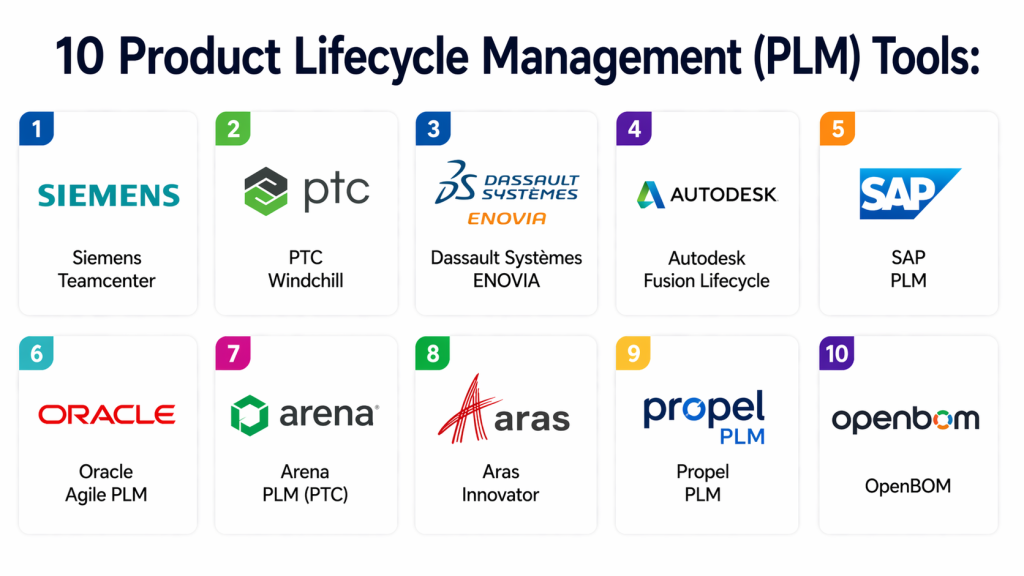
Top 10 Product Lifecycle Management (PLM) Tools
#1 — Siemens Teamcenter
Short description:
Teamcenter is an enterprise PLM platform designed for complex product development, offering strong data management and collaboration capabilities.
Key Features
- Product data management
- BOM management
- Change management
- Workflow automation
- Integration with CAD systems
Pros
- Highly scalable
- Strong enterprise capabilities
Cons
- Complex implementation
- High cost
Platforms / Deployment
Cloud / On-premise
Security & Compliance
RBAC, encryption
Integrations & Ecosystem
Deep integration with Siemens ecosystem and engineering tools.
- CAD
- ERP
- MES
Support & Community
Enterprise support.
#2 — PTC Windchill
Short description:
Windchill is a PLM platform offering advanced product data management and collaboration for engineering teams.
Key Features
- PDM capabilities
- Change management
- Collaboration tools
- Workflow automation
- Integration with CAD
Pros
- Strong engineering focus
- Scalable
Cons
- Learning curve
- Expensive
Platforms / Deployment
Cloud / On-premise
Security & Compliance
RBAC
Integrations & Ecosystem
Integrates with CAD and enterprise systems for product lifecycle management.
- CAD
- ERP
Support & Community
Strong support.
#3 — Dassault Systèmes ENOVIA
Short description:
ENOVIA is a PLM platform focused on collaboration and product innovation within the Dassault ecosystem.
Key Features
- Product lifecycle management
- Collaboration tools
- Change management
- Data management
- Integration with 3DEXPERIENCE
Pros
- Strong collaboration features
- Enterprise-ready
Cons
- Complex interface
- High cost
Platforms / Deployment
Cloud / On-premise
Security & Compliance
RBAC
Integrations & Ecosystem
Integrates with Dassault ecosystem for end-to-end product development.
- CAD
- Simulation tools
Support & Community
Enterprise support.
#4 — Autodesk Fusion Lifecycle
Short description:
Fusion Lifecycle is a cloud-based PLM platform designed for product development and lifecycle management.
Key Features
- Cloud-based PLM
- Workflow automation
- BOM management
- Change tracking
- Collaboration tools
Pros
- Easy to deploy
- User-friendly
Cons
- Limited enterprise depth
- Subscription cost
Platforms / Deployment
Cloud
Security & Compliance
RBAC
Integrations & Ecosystem
Integrates with Autodesk tools and business applications.
- CAD
- APIs
Support & Community
Strong support.
#5 — SAP PLM
Short description:
SAP PLM provides lifecycle management integrated with SAP ERP for enterprise manufacturing environments.
Key Features
- Product data management
- Change management
- Compliance tracking
- Integration with ERP
- Workflow automation
Pros
- Strong ERP integration
- Enterprise-grade
Cons
- Complex implementation
- SAP dependency
Platforms / Deployment
Cloud / On-premise
Security & Compliance
RBAC, encryption
Integrations & Ecosystem
Deep integration with SAP ecosystem.
- ERP
- Supply chain
Support & Community
Global enterprise support.
#6 — Oracle Agile PLM
Short description:
Oracle Agile PLM is a comprehensive lifecycle management solution focused on product innovation and compliance.
Key Features
- Product lifecycle management
- Change management
- Compliance tracking
- Supplier collaboration
- Analytics tools
Pros
- Strong compliance features
- Enterprise-ready
Cons
- Legacy UI
- Complex deployment
Platforms / Deployment
Cloud / On-premise
Security & Compliance
RBAC
Integrations & Ecosystem
Integrates with Oracle ecosystem and enterprise systems.
- ERP
- Analytics
Support & Community
Enterprise support.
#7 — Arena PLM (PTC)
Short description:
Arena PLM is a cloud-based platform focused on product design and collaboration.
Key Features
- BOM management
- Change management
- Supplier collaboration
- Document control
- Workflow automation
Pros
- Easy collaboration
- Cloud-native
Cons
- Limited advanced features
- Subscription cost
Platforms / Deployment
Cloud
Security & Compliance
RBAC
Integrations & Ecosystem
Integrates with CAD and enterprise tools.
- CAD
- APIs
Support & Community
Strong support.
#8 — Aras Innovator
Short description:
Aras Innovator is an open and flexible PLM platform offering customization and scalability.
Key Features
- Open architecture
- Product data management
- Workflow automation
- Change management
- Integration capabilities
Pros
- Highly customizable
- Flexible
Cons
- Requires setup
- Technical expertise needed
Platforms / Deployment
Cloud / On-premise
Security & Compliance
RBAC
Integrations & Ecosystem
Supports integration with enterprise and engineering systems.
- APIs
- ERP
Support & Community
Active community.
#9 — Propel PLM
Short description:
Propel PLM is a cloud-based platform built on Salesforce for product lifecycle and quality management.
Key Features
- Product lifecycle management
- Quality integration
- Workflow automation
- Collaboration tools
- Analytics
Pros
- Cloud-native
- Strong integration
Cons
- Salesforce dependency
- Cost
Platforms / Deployment
Cloud
Security & Compliance
RBAC
Integrations & Ecosystem
Integrates with Salesforce ecosystem and enterprise systems.
- CRM
- ERP
Support & Community
Enterprise support.
#10 — OpenBOM
Short description:
OpenBOM is a lightweight PLM platform focused on BOM management and collaboration for small teams.
Key Features
- BOM management
- Collaboration tools
- Data synchronization
- Cloud-based
- Integration tools
Pros
- Easy to use
- Affordable
Cons
- Limited enterprise features
- Smaller ecosystem
Platforms / Deployment
Cloud
Security & Compliance
Varies / N/A
Integrations & Ecosystem
Integrates with CAD and business tools.
- CAD
- APIs
Support & Community
Growing community.
Comparison Table (Top 10)
| Tool Name | Best For | Platform(s) Supported | Deployment | Standout Feature | Public Rating |
|---|---|---|---|---|---|
| Teamcenter | Enterprise | Web | Cloud/On-prem | Scalability | N/A |
| Windchill | Engineering | Web | Cloud/On-prem | PDM | N/A |
| ENOVIA | Collaboration | Web | Cloud/On-prem | Innovation | N/A |
| Fusion Lifecycle | SMB | Web | Cloud | Ease of use | N/A |
| SAP PLM | SAP users | Web | Cloud/On-prem | ERP integration | N/A |
| Oracle Agile | Compliance | Web | Cloud/On-prem | Governance | N/A |
| Arena PLM | Cloud teams | Web | Cloud | Collaboration | N/A |
| Aras Innovator | Customization | Web | Cloud/On-prem | Flexibility | N/A |
| Propel PLM | Salesforce users | Web | Cloud | Integration | N/A |
| OpenBOM | Small teams | Web | Cloud | Simplicity | N/A |
Evaluation & Scoring of Product Lifecycle Management (PLM) Tools
| Tool Name | Core (25%) | Ease (15%) | Integrations (15%) | Security (10%) | Performance (10%) | Support (10%) | Value (15%) | Weighted Total (0–10) |
|---|---|---|---|---|---|---|---|---|
| Teamcenter | 9 | 7 | 9 | 9 | 9 | 9 | 7 | 8.6 |
| Windchill | 9 | 7 | 9 | 8 | 9 | 9 | 7 | 8.5 |
| ENOVIA | 9 | 6 | 9 | 8 | 9 | 9 | 7 | 8.4 |
| Fusion Lifecycle | 8 | 9 | 8 | 8 | 8 | 8 | 8 | 8.2 |
| SAP PLM | 9 | 6 | 9 | 9 | 9 | 9 | 7 | 8.5 |
| Oracle Agile | 8 | 6 | 8 | 8 | 8 | 8 | 7 | 7.8 |
| Arena PLM | 8 | 9 | 8 | 8 | 8 | 8 | 8 | 8.2 |
| Aras Innovator | 9 | 6 | 9 | 8 | 8 | 8 | 9 | 8.3 |
| Propel PLM | 8 | 8 | 9 | 8 | 8 | 8 | 8 | 8.2 |
| OpenBOM | 7 | 9 | 7 | 6 | 7 | 7 | 9 | 7.5 |
How to interpret scores:
These scores provide a comparative view of PLM tools based on functionality, scalability, and ecosystem strength. Higher scores indicate enterprise-ready solutions, while lower scores may still be ideal for smaller or specialized use cases.
Which Product Lifecycle Management (PLM) Tool Is Right for You?
Solo / Freelancer
OpenBOM or lightweight PLM tools are sufficient for basic product data management.
SMB
Fusion Lifecycle and Arena PLM offer ease of use and scalability.
Mid-Market
Aras Innovator and Propel PLM provide flexibility and customization.
Enterprise
Teamcenter, Windchill, and SAP PLM are ideal for large-scale operations.
Budget vs Premium
- Budget: OpenBOM, Aras
- Premium: Siemens, SAP
Feature Depth vs Ease of Use
- Deep features: Teamcenter, Windchill
- Easy to use: Fusion Lifecycle, OpenBOM
Integrations & Scalability
Choose tools with strong CAD, ERP, and MES integrations.
Security & Compliance Needs
Enterprise users should prioritize tools with strong access control and compliance features.
Frequently Asked Questions (FAQs)
What is PLM?
PLM is software used to manage the entire lifecycle of a product.
How does PLM differ from PDM?
PDM focuses on data management, while PLM covers the full lifecycle.
Is PLM cloud-based?
Many modern PLM tools are cloud-native.
What industries use PLM?
Manufacturing, aerospace, automotive, electronics.
Does PLM integrate with ERP?
Yes, integration with ERP and MES is common.
Is PLM scalable?
Enterprise PLM systems support global operations.
Do I need technical expertise?
Yes, especially for implementation and integration.
What are the benefits of PLM?
Improved collaboration, faster development, and better product quality.
How long does implementation take?
It varies depending on complexity.
Can I switch PLM tools later?
Yes, but migration can be complex.
Conclusion
Product Lifecycle Management (PLM) tools are essential for organizations looking to streamline product development, improve collaboration, and maintain control over complex product data. As industries move toward digital transformation, PLM platforms are evolving to support cloud deployment, real-time collaboration, and integration with engineering and manufacturing systems. The tools covered in this guide range from enterprise-grade solutions like Siemens Teamcenter and PTC Windchill to flexible and modern platforms like Arena PLM and OpenBOM, each catering to different operational needs. Choosing the right PLM tool depends on your organization’s size, product complexity, and integration requirements. Companies should prioritize scalability, ecosystem compatibility, and ease of collaboration when evaluating solutions. A practical approach is to begin with pilot implementations, validate workflows, and expand usage gradually. As product development becomes more data-driven and interconnected, PLM systems will play a critical role in enabling innovation and operational efficiency. Investing in the right PLM platform today can significantly reduce time-to-market, improve product quality, and enhance cross-functional collaboration. Start by shortlisting a few tools, testing them in real scenarios, and scaling based on measurable outcomes.