Introduction
Subscription Billing Platforms are software solutions that help businesses manage recurring billing, subscriptions, payments, and revenue operations. These tools automate complex billing cycles such as monthly, yearly, usage-based, or tiered pricing models, making them essential for SaaS, media, and subscription-based businesses.
As companies increasingly adopt subscription models, managing billing manually becomes inefficient and error-prone. Subscription billing platforms enable automated invoicing, payment collection, revenue recognition, and customer lifecycle management, ensuring accurate and scalable operations.
Real-world use cases include:
- SaaS subscription billing
- Membership and subscription services
- Usage-based billing (API, cloud services)
- Subscription upgrades, downgrades, and cancellations
- Revenue tracking and reporting
What buyers should evaluate:
- Recurring billing and pricing model flexibility
- Subscription lifecycle management
- Payment gateway integrations
- Revenue recognition and compliance
- Analytics and reporting
- Scalability for growth
- Ease of integration with CRM/ERP
- Customer self-service features
Best for: SaaS companies, subscription-based businesses, digital services, and enterprises managing recurring revenue.
Not ideal for: Businesses with one-time transactions or simple invoicing needs.
Key Trends in Subscription Billing Platforms
- Usage-based and hybrid pricing models
- AI-driven revenue analytics
- Automated subscription lifecycle management
- Global payment support and compliance
- Integration with CRM and ERP systems
- Customer self-service subscription portals
- Real-time billing and invoicing
- Revenue recognition automation
- API-first billing platforms
How We Selected These Tools (Methodology)
- Strong market adoption and credibility
- Comprehensive subscription billing capabilities
- Proven scalability and performance
- Availability of automation and analytics features
- Integration ecosystem with CRM and finance tools
- Ease of use and onboarding
- Fit for SMB to enterprise use cases
- Vendor maturity and reliability
- Support and community strength
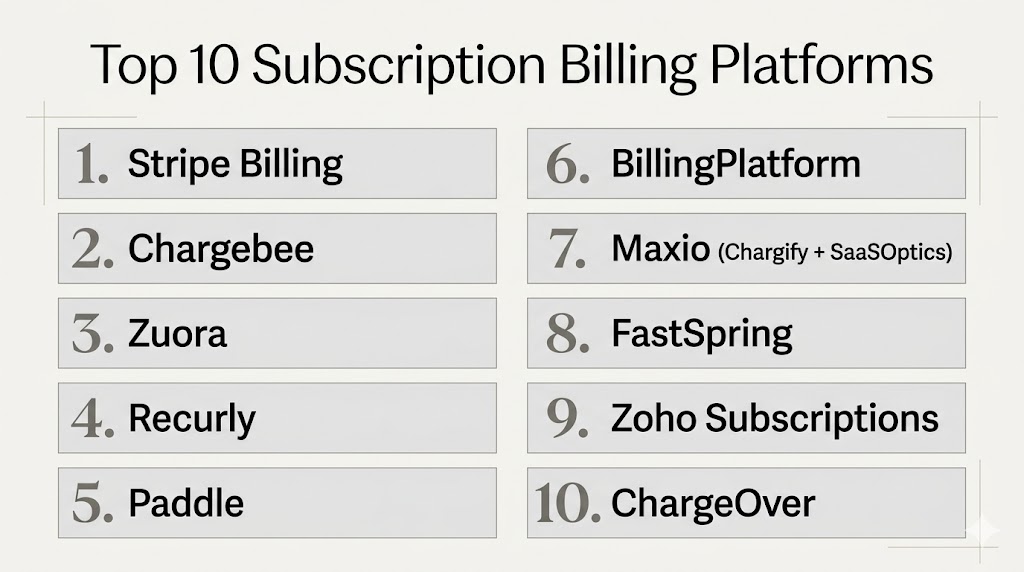
Top 10 Subscription Billing Platforms
#1 — Stripe Billing
Short description: Stripe Billing is a developer-friendly subscription billing platform that supports recurring payments, usage-based billing, and global payment processing.
Key Features
- Recurring billing
- Usage-based pricing
- Payment processing
- API-first architecture
- Subscription management
Pros
- Highly flexible
- Strong developer ecosystem
Cons
- Requires technical setup
- Complex for non-developers
Platforms / Deployment
Web
Cloud
Security & Compliance
Encryption, compliance controls
Integrations & Ecosystem
Strong integrations with payment and SaaS tools
Support & Community
Large developer community
#2 — Chargebee
Short description: Chargebee is a popular subscription billing platform offering automation, revenue management, and global payment support.
Key Features
- Subscription lifecycle management
- Recurring billing
- Revenue recognition
- Payment integrations
- Analytics
Pros
- Easy to use
- Strong automation
Cons
- Pricing complexity
- Limited customization
Platforms / Deployment
Web
Cloud
Security & Compliance
Not publicly stated
Integrations & Ecosystem
Integrates with CRM and accounting tools
Support & Community
Strong support
#3 — Recurly
Short description: Recurly provides subscription billing and revenue optimization features, helping businesses manage recurring revenue efficiently.
Key Features
- Subscription billing
- Revenue analytics
- Payment processing
- Customer management
- Dunning management
Pros
- Strong revenue tools
- Good analytics
Cons
- Expensive
- Limited SMB features
Platforms / Deployment
Web
Cloud
Security & Compliance
Not publicly stated
Integrations & Ecosystem
ERP and payment integrations
Support & Community
Good support
#4 — Zuora
Short description: Zuora is an enterprise subscription billing platform designed for large-scale subscription businesses with complex pricing models.
Key Features
- Subscription management
- Billing automation
- Revenue recognition
- Analytics
- Workflow automation
Pros
- Enterprise scalability
- Advanced features
Cons
- Complex implementation
- High cost
Platforms / Deployment
Web
Cloud
Security & Compliance
Not publicly stated
Integrations & Ecosystem
Enterprise integrations
Support & Community
Enterprise support
#5 — Paddle
Short description: Paddle is a subscription billing platform focused on SaaS companies, offering billing, payments, and compliance in one solution.
Key Features
- Subscription billing
- Payment processing
- Tax compliance
- Analytics
- Customer management
Pros
- All-in-one solution
- Simplifies compliance
Cons
- Limited customization
- Pricing varies
Platforms / Deployment
Web
Cloud
Security & Compliance
Not publicly stated
Integrations & Ecosystem
SaaS integrations
Support & Community
Good support
#6 — ChargeOver
Short description: ChargeOver is a subscription billing tool designed for SMBs with recurring billing and invoicing needs.
Key Features
- Recurring billing
- Invoice automation
- Payment processing
- Customer management
- Reporting
Pros
- Easy to use
- Affordable
Cons
- Limited enterprise features
- Basic analytics
Platforms / Deployment
Web
Cloud
Security & Compliance
Not publicly stated
Integrations & Ecosystem
Accounting integrations
Support & Community
Good SMB support
#7 — FastSpring
Short description: FastSpring is a subscription billing platform focused on SaaS and digital goods, offering global payment processing and compliance.
Key Features
- Subscription billing
- Payment processing
- Tax compliance
- Analytics
- Customer management
Pros
- Global reach
- Easy compliance
Cons
- Limited customization
- Pricing not transparent
Platforms / Deployment
Web
Cloud
Security & Compliance
Not publicly stated
Integrations & Ecosystem
SaaS integrations
Support & Community
Good support
#8 — Zoho Subscriptions
Short description: Zoho Subscriptions is a subscription billing platform designed for SMBs, offering automation and integration within the Zoho ecosystem.
Key Features
- Recurring billing
- Subscription management
- Payment integration
- Reporting
- Customer portal
Pros
- Easy to use
- Affordable
Cons
- Limited enterprise features
- Best within Zoho ecosystem
Platforms / Deployment
Web
Cloud
Security & Compliance
Not publicly stated
Integrations & Ecosystem
Zoho ecosystem integrations
Support & Community
Strong SMB support
#9 — BillingPlatform
Short description: BillingPlatform is an enterprise-grade billing solution supporting complex billing scenarios and revenue management.
Key Features
- Billing automation
- Subscription management
- Revenue analytics
- Workflow automation
- Reporting
Pros
- Highly scalable
- Flexible
Cons
- Complex setup
- High cost
Platforms / Deployment
Web
Cloud
Security & Compliance
Not publicly stated
Integrations & Ecosystem
Enterprise integrations
Support & Community
Enterprise support
#10 — Maxio (Chargify + SaaSOptics)
Short description: Maxio provides subscription billing and financial operations tools for SaaS businesses, combining billing and revenue analytics.
Key Features
- Subscription billing
- Revenue analytics
- Payment processing
- Reporting
- Customer management
Pros
- SaaS-focused
- Strong analytics
Cons
- Limited non-SaaS use cases
- Pricing complexity
Platforms / Deployment
Web
Cloud
Security & Compliance
Not publicly stated
Integrations & Ecosystem
SaaS integrations
Support & Community
Good support
Comparison Table
| Tool Name | Best For | Platforms | Deployment | Standout Feature | Public Rating |
|---|---|---|---|---|---|
| Stripe Billing | Developers | Web | Cloud | API-first | N/A |
| Chargebee | SMB & mid-market | Web | Cloud | Automation | N/A |
| Recurly | Revenue optimization | Web | Cloud | Analytics | N/A |
| Zuora | Enterprise | Web | Cloud | Scalability | N/A |
| Paddle | SaaS | Web | Cloud | All-in-one | N/A |
| ChargeOver | SMB | Web | Cloud | Simplicity | N/A |
| FastSpring | SaaS | Web | Cloud | Global payments | N/A |
| Zoho Subscriptions | SMB | Web | Cloud | Ease of use | N/A |
| BillingPlatform | Enterprise | Web | Cloud | Flexibility | N/A |
| Maxio | SaaS | Web | Cloud | Revenue analytics | N/A |
Evaluation & Scoring of Subscription Billing Platforms
| Tool Name | Core | Ease | Integrations | Security | Performance | Support | Value | Weighted Total |
|---|---|---|---|---|---|---|---|---|
| Stripe | 9 | 7 | 9 | 8 | 9 | 9 | 7 | 8.4 |
| Chargebee | 8 | 9 | 8 | 7 | 8 | 8 | 8 | 8.1 |
| Recurly | 8 | 8 | 8 | 7 | 8 | 8 | 7 | 7.9 |
| Zuora | 9 | 6 | 9 | 8 | 9 | 9 | 6 | 8.2 |
| Paddle | 8 | 8 | 7 | 7 | 8 | 8 | 8 | 7.9 |
| ChargeOver | 7 | 9 | 7 | 6 | 7 | 7 | 9 | 7.8 |
| FastSpring | 8 | 8 | 7 | 7 | 8 | 8 | 7 | 7.8 |
| Zoho | 7 | 9 | 7 | 6 | 7 | 7 | 9 | 7.7 |
| BillingPlatform | 9 | 6 | 8 | 7 | 9 | 8 | 6 | 7.9 |
| Maxio | 8 | 8 | 7 | 7 | 8 | 8 | 7 | 7.8 |
How to interpret scores: Enterprise tools score higher in scalability and features, while SMB tools perform better in ease of use and affordability.
Which Subscription Billing Platform Is Right for You?
Solo / Freelancer
Basic invoicing tools are sufficient.
SMB
Choose Zoho Subscriptions or ChargeOver for simplicity.
Mid-Market
Chargebee and Paddle offer strong balance.
Enterprise
Zuora, Stripe, BillingPlatform are best for complex needs.
Budget vs Premium
- Budget: Zoho, ChargeOver
- Premium: Zuora, Stripe
Feature Depth vs Ease of Use
- Advanced: Zuora, Stripe
- Easy: Zoho, Chargebee
Integrations & Scalability
- Strong: Stripe, Zuora
- Moderate: SMB tools
Security & Compliance Needs
Enterprise tools provide stronger controls.
Frequently Asked Questions (FAQs)
1. What is a subscription billing platform?
A subscription billing platform is software that automates recurring billing, payments, and subscription management. It helps businesses manage customer plans, invoices, and payments efficiently. These platforms are widely used in SaaS and subscription-based models to ensure consistent revenue flow.
2. How does subscription billing software work?
It automatically generates invoices based on billing cycles and pricing models. It also processes payments, manages upgrades or cancellations, and tracks revenue. This reduces manual work and ensures accurate billing across all customers.
3. Is subscription billing software suitable for small businesses?
Yes, many platforms are designed for SMBs with simple pricing models and easy setup. Tools like Zoho Subscriptions and ChargeOver are ideal for smaller teams. They provide essential features without the complexity of enterprise platforms.
4. What are the key benefits of using subscription billing tools?
These tools improve cash flow, reduce billing errors, and automate repetitive tasks. They also provide better visibility into revenue and customer behavior. Overall, they help businesses scale their subscription operations efficiently.
5. Can these platforms handle multiple pricing models?
Yes, most platforms support various pricing models such as fixed, usage-based, tiered, and hybrid billing. This flexibility allows businesses to experiment with pricing strategies. It also ensures accurate billing regardless of complexity.
6. Do subscription billing tools integrate with other systems?
Yes, they commonly integrate with CRM, ERP, accounting, and payment systems. These integrations ensure smooth data flow across departments. They also reduce manual data entry and improve operational efficiency.
7. How secure are subscription billing platforms?
Most platforms offer encryption, role-based access, and compliance features. Security varies by vendor, so it’s important to evaluate specific controls. Enterprise tools generally provide stronger governance and compliance capabilities.
8. Can these tools handle global payments?
Yes, many platforms support multi-currency billing and global payment gateways. This is essential for businesses operating internationally. It helps manage taxes, compliance, and payment processing across regions.
9. How long does it take to implement a billing platform?
Implementation time depends on complexity and integrations. SMB tools can be set up within days, while enterprise platforms may take weeks. Proper planning and onboarding ensure smoother deployment.
10. Is it easy to switch subscription billing platforms?
Switching is possible but requires careful planning for data migration and integrations. Businesses should evaluate compatibility before transitioning. Running a pilot can help ensure a smooth switch.
Conclusion
Subscription billing platforms have become essential for businesses operating on recurring revenue models, enabling them to automate billing processes, manage subscriptions efficiently, and gain better visibility into revenue streams. By reducing manual effort and ensuring accurate invoicing, these platforms help organizations improve cash flow and customer experience. They also provide the flexibility to support various pricing models, making them ideal for scaling subscription-based businesses. Choosing the right platform depends on your business size, complexity, and billing requirements. Enterprise solutions like Zuora and Stripe offer advanced capabilities for large-scale operations, while tools like Zoho Subscriptions and ChargeOver provide simplicity and affordability for smaller teams. A practical approach is to shortlist a few platforms, test their features, and evaluate how well they integrate with your existing systems. Selecting the right solution can significantly enhance efficiency and support long-term business growth.