Introduction
Retail Category Management Tools help retailers organize products into meaningful categories and optimize how those categories perform across stores and digital channels. In simple terms, these tools answer critical questions like what products should be stocked, how much shelf space they should get, how they should be priced, and how they perform compared to competitors. They combine data, analytics, and planning workflows to improve category-level decision-making.
These tools are widely used for assortment planning, planogram creation, shelf space optimization, demand forecasting, and shopper behavior analysis. Retailers rely on them to increase sales per category, improve margins, reduce stockouts, and align merchandising strategies with customer demand. Buyers should evaluate features like space planning, analytics depth, AI capabilities, integration with POS/ERP systems, scalability, usability, real-time insights, and reporting accuracy.
Best for: category managers, merchandising teams, retail analysts, FMCG companies, supermarket chains, and omnichannel retailers managing large product assortments.
Not ideal for: very small retailers with limited product lines or businesses that do not require detailed category-level analytics and planning.
Key Trends in Retail Category Management Tools
- AI-powered category insights and demand forecasting
- Automated planogram creation and shelf optimization
- Real-time analytics for category performance tracking
- Integration with POS, ERP, and supply chain systems
- Shopper behavior analytics and data-driven decision-making
- Cloud-based platforms for scalability and collaboration
- Space optimization tools for maximizing in-store performance
- Omnichannel category management across online and offline channels
- Predictive analytics for assortment and pricing decisions
- Focus on profitability and margin optimization at category level
How We Selected These Tools (Methodology)
- Evaluated market presence in retail and FMCG sectors
- Assessed feature completeness for category planning and analytics
- Reviewed performance and scalability across large datasets
- Analyzed integration capabilities with retail systems
- Considered ease of use for category managers and analysts
- Evaluated AI and automation capabilities
- Reviewed reporting and visualization features
- Assessed suitability for SMB, mid-market, and enterprise
- Considered vendor support and ecosystem strength
- Factored in overall value and ROI potential
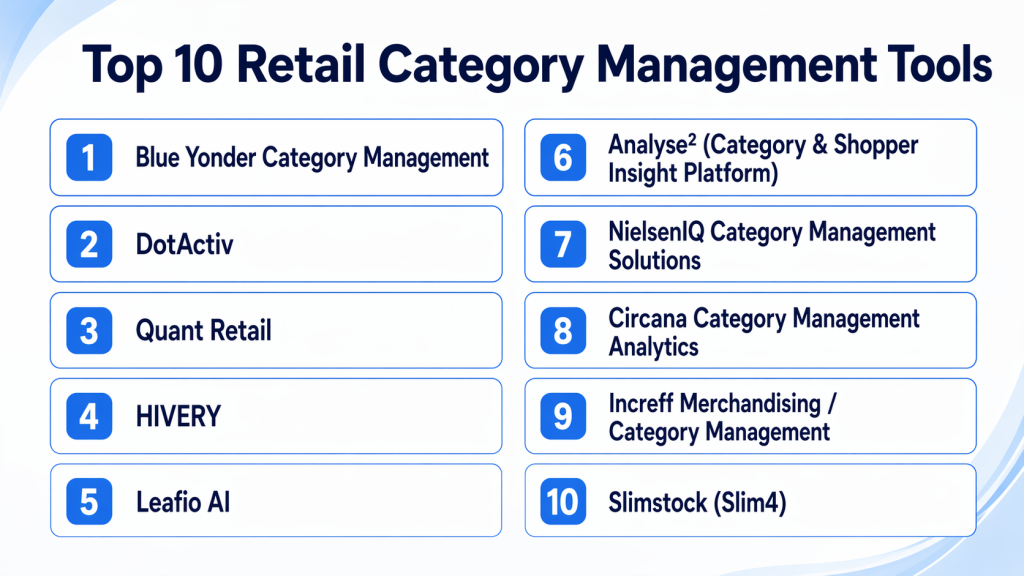
Top 10 Retail Category Management Tools
#1 — Blue Yonder Category Management
Short description : Blue Yonder offers advanced category management capabilities integrated with supply chain and retail operations, helping large retailers optimize assortment and shelf performance.
Key Features
- Assortment planning
- Demand forecasting
- Category analytics
- Inventory optimization
- AI-driven insights
Pros
- Strong enterprise capabilities
- Integrated with supply chain workflows
Cons
- Complex implementation
- Higher cost
Platforms / Deployment
- Web / Cloud
Security & Compliance
- Not publicly stated
Integrations & Ecosystem
- ERP, POS, supply chain systems
- API integrations
- Retail analytics tools
Support & Community
- Enterprise support and documentation
#2 — DotActiv
Short description : DotActiv is a specialized category management tool focusing on planograms, shelf optimization, and data-driven retail analytics for improving in-store performance.
Key Features
- Planogram creation
- Shelf space optimization
- Category performance analytics
- Reporting dashboards
- Data visualization
Pros
- Strong planogram capabilities
- Easy to use
Cons
- Limited enterprise-scale features
- Less focus on AI
Platforms / Deployment
- Web / Windows / Cloud
Security & Compliance
- Not publicly stated
Integrations & Ecosystem
- Retail data systems
- POS integrations
- API support
Support & Community
- Documentation and support services
#3 — Quant Retail
Short description : Quant Retail provides planogram automation and category optimization tools, helping retailers maximize shelf productivity and category performance.
Key Features
- Automated planograms
- Shelf optimization
- Assortment planning
- Analytics dashboards
- Space allocation tools
Pros
- Strong automation
- Efficient space planning
Cons
- Requires training
- Limited broader retail integrations
Platforms / Deployment
- Web / Cloud
Security & Compliance
- Not publicly stated
Integrations & Ecosystem
- Retail systems
- APIs
- Data analytics platforms
Support & Community
- Vendor support and training
#4 — HIVERY
Short description : HIVERY uses AI to optimize category decisions, helping retailers improve assortment, promotions, and space allocation based on real-time data.
Key Features
- AI-driven recommendations
- Category optimization
- Scenario planning
- Data analytics
- Demand insights
Pros
- Strong AI capabilities
- Data-driven decisions
Cons
- Requires quality data
- Limited awareness in smaller markets
Platforms / Deployment
- Web / Cloud
Security & Compliance
- Not publicly stated
Integrations & Ecosystem
- Data platforms
- APIs
- Retail analytics tools
Support & Community
- Vendor support
#5 — Leafio AI
Short description : Leafio AI focuses on demand forecasting and category optimization using AI to improve inventory turnover and reduce stockouts.
Key Features
- Demand forecasting
- Category optimization
- Inventory planning
- AI insights
- Reporting dashboards
Pros
- Strong forecasting
- Useful for inventory-heavy retailers
Cons
- Less planogram focus
- Requires integration effort
Platforms / Deployment
- Web / Cloud
Security & Compliance
- Not publicly stated
Integrations & Ecosystem
- ERP, POS systems
- APIs
- Data tools
Support & Community
- Vendor support
#6 — Analyse²
Short description : Analyse² provides category and shopper insights, helping retailers understand performance, trends, and consumer behavior.
Key Features
- Shopper insights
- Category analytics
- Data visualization
- Performance tracking
- Reporting tools
Pros
- Strong analytics
- Good for decision-making
Cons
- Limited execution tools
- Not a full merchandising suite
Platforms / Deployment
- Web / Cloud
Security & Compliance
- Not publicly stated
Integrations & Ecosystem
- Data platforms
- APIs
- Retail analytics tools
Support & Community
- Vendor support
#7 — NielsenIQ Category Management
Short description : NielsenIQ provides category insights and analytics based on extensive retail data, helping retailers optimize category strategies.
Key Features
- Market data insights
- Category analytics
- Consumer behavior analysis
- Reporting dashboards
- Trend analysis
Pros
- Strong data insights
- Industry-recognized analytics
Cons
- Less execution capability
- Data dependency
Platforms / Deployment
- Web / Cloud
Security & Compliance
- Not publicly stated
Integrations & Ecosystem
- Data systems
- APIs
- Retail analytics platforms
Support & Community
- Vendor support
#8 — Circana
Short description : Circana offers category analytics and shopper insights, helping retailers understand performance trends and optimize strategies.
Key Features
- Category analytics
- Shopper insights
- Market intelligence
- Reporting dashboards
- Trend tracking
Pros
- Strong analytics
- Useful for large retailers
Cons
- Limited operational features
- Data-heavy
Platforms / Deployment
- Web / Cloud
Security & Compliance
- Not publicly stated
Integrations & Ecosystem
- Data platforms
- APIs
- Retail analytics tools
Support & Community
- Vendor support
#9 — Increff Merchandising
Short description : Increff provides category and merchandising solutions focusing on demand forecasting, inventory optimization, and analytics.
Key Features
- Demand forecasting
- Category optimization
- Inventory planning
- Analytics dashboards
- Automation tools
Pros
- Strong optimization features
- Good for growing retailers
Cons
- Limited global presence
- Requires setup effort
Platforms / Deployment
- Web / Cloud
Security & Compliance
- Not publicly stated
Integrations & Ecosystem
- ERP, POS systems
- APIs
- Data platforms
Support & Community
- Vendor support
#10 — Slimstock (Slim4)
Short description : Slimstock focuses on inventory and category planning, helping retailers balance stock levels and improve category performance.
Key Features
- Inventory optimization
- Demand forecasting
- Category planning
- Reporting tools
- Analytics dashboards
Pros
- Strong inventory focus
- Easy to use
Cons
- Limited planogram features
- Less advanced AI
Platforms / Deployment
- Web / Cloud
Security & Compliance
- Not publicly stated
Integrations & Ecosystem
- ERP systems
- APIs
- Retail tools
Support & Community
- Vendor support
Comparison Table (Top 10)
| Tool Name | Best For | Platform | Deployment | Standout Feature | Public Rating |
|---|---|---|---|---|---|
| Blue Yonder | Enterprise | Web | Cloud | AI category optimization | N/A |
| DotActiv | SMB | Web/Windows | Cloud | Planograms | N/A |
| Quant Retail | Mid-market | Web | Cloud | Automated shelf planning | N/A |
| HIVERY | AI optimization | Web | Cloud | AI insights | N/A |
| Leafio AI | Inventory focus | Web | Cloud | Forecasting | N/A |
| Analyse² | Analytics | Web | Cloud | Shopper insights | N/A |
| NielsenIQ | Data insights | Web | Cloud | Market data | N/A |
| Circana | Analytics | Web | Cloud | Trend analysis | N/A |
| Increff | Optimization | Web | Cloud | Demand planning | N/A |
| Slimstock | Inventory | Web | Cloud | Stock optimization | N/A |
Evaluation & Scoring of Retail Category Management Tools
| Tool | Core | Ease | Integrations | Security | Performance | Support | Value | Total |
|---|---|---|---|---|---|---|---|---|
| Blue Yonder | 9 | 7 | 8 | 7 | 9 | 8 | 6 | 8.0 |
| DotActiv | 7 | 9 | 7 | 6 | 7 | 7 | 8 | 7.4 |
| Quant Retail | 8 | 7 | 7 | 6 | 8 | 7 | 7 | 7.5 |
| HIVERY | 8 | 7 | 7 | 6 | 8 | 7 | 7 | 7.5 |
| Leafio | 8 | 7 | 7 | 6 | 8 | 7 | 7 | 7.5 |
| Analyse² | 7 | 7 | 7 | 6 | 7 | 7 | 7 | 7.0 |
| NielsenIQ | 8 | 6 | 7 | 6 | 8 | 7 | 6 | 7.1 |
| Circana | 8 | 6 | 7 | 6 | 8 | 7 | 6 | 7.1 |
| Increff | 8 | 7 | 7 | 6 | 8 | 7 | 7 | 7.5 |
| Slimstock | 7 | 8 | 7 | 6 | 7 | 7 | 8 | 7.3 |
Which Retail Category Management Tool Is Right for You?
Solo / Freelancer
- DotActiv or Slimstock for simple category tracking and inventory optimization.
SMB
- DotActiv, Slimstock, or Increff for affordable and easy-to-use solutions.
Mid-Market
- Quant Retail, HIVERY, Leafio for automation and analytics.
Enterprise
- Blue Yonder, NielsenIQ, Circana for advanced analytics and scale.
Budget vs Premium
- SMB → cost-effective tools
- Enterprise → analytics-heavy platforms
Feature Depth vs Ease of Use
- Simple tools → faster adoption
- Advanced tools → deeper insights
Integrations & Scalability
- Choose tools with strong ERP/POS integrations.
Security & Compliance Needs
- Larger organizations should prioritize compliance and data governance.
Frequently Asked Questions (FAQs)
1. What is category management?
It is the process of managing product categories as business units to improve performance.
2. Why is it important?
It helps retailers increase sales, margins, and customer satisfaction.
3. Do I need AI tools?
AI helps with forecasting and optimization but is not mandatory for small retailers.
4. Can these tools integrate with POS systems?
Yes, most tools support integration with POS and ERP systems.
5. Are these tools expensive?
Costs vary depending on features and scale.
6. What is a planogram?
A visual layout showing product placement on shelves.
7. Can small retailers use these tools?
Yes, SMB-friendly options are available.
8. How long does implementation take?
Cloud tools deploy quickly; enterprise tools take longer.
9. What is the biggest benefit?
Better product placement and increased category performance.
10. Are these tools scalable?
Yes, most modern tools support scaling across locations.
Conclusion
Retail category management tools play a crucial role in helping retailers make smarter decisions about product assortment, placement, and performance. By leveraging analytics, automation, and AI, these tools enable businesses to optimize shelf space, improve inventory efficiency, and enhance customer experience. Small and mid-sized retailers can benefit from user-friendly tools like DotActiv and Slimstock, while enterprises should explore platforms like Blue Yonder, NielsenIQ, and Circana for advanced analytics and large-scale optimization. The best approach is to evaluate your category complexity, data maturity, and integration needs, then run pilot implementations to ensure the tool aligns with your operational workflows and delivers measurable ROI.