Introduction
Corporate Card Management Tools help businesses issue, manage, and control company spending through corporate cards. These platforms provide real-time visibility into employee expenses, automate expense tracking, and enforce spending policies. In simple terms, they replace manual expense reporting and fragmented card usage with centralized control and automation.
As companies scale and adopt distributed teams, managing employee spending becomes more complex. Corporate card tools solve this by offering virtual and physical cards, automated reconciliation, spend controls, and integrations with accounting systems, enabling finance teams to maintain control without slowing down operations.
Common use cases include:
- Issuing corporate cards to employees
- Managing employee and departmental budgets
- Tracking and categorizing expenses in real-time
- Automating expense reporting and reconciliation
- Enforcing spending policies and approvals
Key evaluation criteria:
- Card issuance and management capabilities
- Real-time expense tracking and controls
- Integration with accounting and ERP systems
- Automation of reconciliation and reporting
- Security and fraud prevention features
- Global acceptance and multi-currency support
- Ease of use and employee experience
- Pricing and rewards structure
Best for: Startups, SMBs, enterprises, finance teams, and companies managing employee expenses at scale.
Not ideal for: Very small businesses with minimal spending or organizations that only require basic expense tracking tools.
Key Trends in Corporate Card Management Tools
- Virtual cards for secure and controlled spending
- Real-time expense tracking and alerts
- AI-driven spend categorization and fraud detection
- Integration with accounting and expense platforms
- Automation of reconciliation and reporting workflows
- Mobile-first card management apps
- Policy-based spending controls and approvals
- Global card issuance with multi-currency support
- Cashback and rewards-driven business cards
- Unified spend management platforms emerging
How We Selected These Tools
- Market popularity and adoption
- Card issuance and spend control capabilities
- Integration ecosystem with finance tools
- Automation and AI features
- Ease of use and onboarding experience
- Scalability for growing organizations
- Security and compliance features
- Customer support and reliability
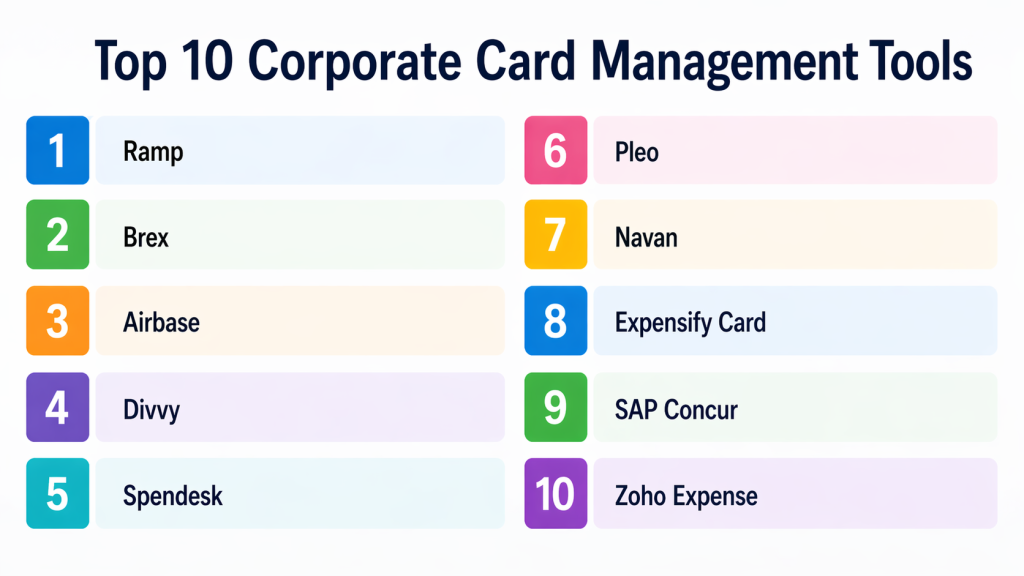
Top 10 Corporate Card Management Tools
1 — Ramp
Short description:
Ramp is a modern corporate card and spend management platform focused on cost control and automation. It provides virtual and physical cards with real-time expense tracking. The platform offers insights to help businesses reduce spending. It is widely used by startups and SMBs.
Key Features
- Corporate card issuance
- Real-time expense tracking
- Automated categorization
- Spend controls and limits
- Savings insights
Pros
- Strong cost optimization
- Easy to use
Cons
- Limited global availability
- Not ideal for complex enterprises
Platforms / Deployment
Web, iOS, Android
Cloud
Security & Compliance
Encryption, access control, fraud monitoring
Integrations & Ecosystem
Ramp integrates with modern finance stacks and accounting tools.
- Accounting software
- ERP systems
- APIs
Support & Community
Good support with onboarding resources.
2 — Brex
Short description:
Brex is a corporate card platform designed for startups and high-growth companies. It offers automated expense tracking, rewards, and spend controls. The platform is known for its strong automation and modern interface. It is ideal for tech-driven businesses.
Key Features
- Corporate cards
- Expense tracking
- Rewards and cashback
- Budget controls
- Automation
Pros
- Great for startups
- Strong rewards program
Cons
- Limited international support
- Eligibility requirements
Platforms / Deployment
Web, iOS, Android
Cloud
Security & Compliance
Encryption, fraud detection
Integrations & Ecosystem
- Accounting tools
- Financial systems
- APIs
Support & Community
Strong support for growing companies.
3 — Airbase
Short description:
Airbase is a comprehensive spend management platform that includes corporate cards, bill payments, and expense management. It centralizes financial operations in one platform. It is suitable for SMBs and mid-market companies. It offers strong automation.
Key Features
- Corporate cards
- Bill payments
- Expense tracking
- Approval workflows
- Reporting
Pros
- All-in-one platform
- Strong automation
Cons
- Pricing varies
- Learning curve
Platforms / Deployment
Web
Cloud
Security & Compliance
Encryption, audit logs
Integrations & Ecosystem
- ERP systems
- Accounting tools
- APIs
Support & Community
Good support and onboarding.
4 — Divvy
Short description:
Divvy combines corporate cards with budgeting and expense management. It helps businesses control spending in real-time. It is easy to use and widely adopted by SMBs. It provides strong visibility into expenses.
Key Features
- Corporate cards
- Budget management
- Expense tracking
- Reporting
- Approvals
Pros
- Strong budgeting features
- User-friendly
Cons
- Limited advanced analytics
- Regional availability
Platforms / Deployment
Web, Mobile
Cloud
Security & Compliance
Encryption, access control
Integrations & Ecosystem
- Accounting tools
- Financial systems
Support & Community
Good support.
5 — Spendesk
Short description:
Spendesk is a spend management platform that includes corporate cards and expense tracking. It helps businesses control spending and manage budgets. It is widely used in Europe. It offers strong visibility and automation.
Key Features
- Corporate cards
- Budget control
- Expense tracking
- Reporting
- Approvals
Pros
- Strong spend control
- Easy to use
Cons
- Limited availability in some regions
- Pricing varies
Platforms / Deployment
Web
Cloud
Security & Compliance
Encryption, compliance controls
Integrations & Ecosystem
- ERP systems
- Accounting tools
Support & Community
Good support.
6 — Pleo
Short description:
Pleo is a smart corporate card platform designed for SMBs. It offers real-time expense tracking and budget control. It simplifies spending for employees. It is easy to adopt.
Key Features
- Corporate cards
- Expense tracking
- Budget control
- Automation
- Reporting
Pros
- Simple and intuitive
- Strong employee experience
Cons
- Limited enterprise features
- Region restrictions
Platforms / Deployment
Web, Mobile
Cloud
Security & Compliance
Encryption, access control
Integrations & Ecosystem
- Accounting tools
- Financial systems
Support & Community
Good support.
7 — Nava
Short description:
Navan combines corporate cards with travel and expense management. It offers real-time visibility and automation. It is suitable for businesses with frequent travel. It integrates travel and expense workflows.
Key Features
- Corporate cards
- Travel management
- Expense tracking
- Reporting
- Automation
Pros
- Travel + expense integration
- Strong automation
Cons
- Complex pricing
- Focus on travel-heavy companies
Platforms / Deployment
Web, Mobile
Cloud
Security & Compliance
Encryption, compliance
Integrations & Ecosystem
- Travel platforms
- ERP systems
Support & Community
Good support.
8 — Expensify Card
Short description:
Expensify Card is part of the Expensify platform, offering corporate cards with expense management. It automates expense tracking and reporting. It is easy to use and popular among SMBs. It simplifies reimbursements.
Key Features
- Corporate cards
- Expense tracking
- Receipt scanning
- Reporting
- Automation
Pros
- Simple integration
- Easy setup
Cons
- Limited advanced features
- Scaling limitations
Platforms / Deployment
Web, Mobile
Cloud
Security & Compliance
Encryption, access control
Integrations & Ecosystem
- Accounting tools
- Payment systems
Support & Community
Good support.
9 — SAP Concur
Short description:
SAP Concur offers corporate cards integrated with its expense management platform. It provides strong compliance and reporting features. It is widely used by enterprises. It is suitable for large organizations.
Key Features
- Corporate cards
- Expense management
- Reporting
- Compliance
- Automation
Pros
- Enterprise-grade
- Strong compliance
Cons
- Expensive
- Complex interface
Platforms / Deployment
Web, Mobile
Cloud
Security & Compliance
Encryption, audit logs
Integrations & Ecosystem
- SAP ecosystem
- ERP systems
Support & Community
Enterprise-level support.
10 — Zoho Expense
Short description:
Zoho Expense includes corporate card tracking within its expense management platform. It is affordable and easy to use. It is ideal for SMBs. It offers automation and reporting.
Key Features
- Expense tracking
- Corporate card tracking
- Automation
- Reporting
- Multi-currency support
Pros
- Affordable
- Strong automation
Cons
- Limited enterprise features
- Advanced features require upgrades
Platforms / Deployment
Web, Mobile
Cloud
Security & Compliance
Encryption, access control
Integrations & Ecosystem
- Zoho ecosystem
- Accounting tools
Support & Community
Good support.
Comparison Table
| Tool Name | Best For | Platforms Supported | Deployment | Standout Feature | Public Rating |
|---|---|---|---|---|---|
| Ramp | SMB | Web, Mobile | Cloud | Cost optimization | N/A |
| Brex | Startups | Web, Mobile | Cloud | Rewards | N/A |
| Airbase | SMB | Web | Cloud | All-in-one platform | N/A |
| Divvy | SMB | Web, Mobile | Cloud | Budget control | N/A |
| Spendesk | SMB | Web | Cloud | Spend visibility | N/A |
| Pleo | SMB | Web, Mobile | Cloud | Ease of use | N/A |
| Navan | Travel-heavy | Web, Mobile | Cloud | Travel integration | N/A |
| Expensify Card | SMB | Web, Mobile | Cloud | Automation | N/A |
| SAP Concur | Enterprise | Web, Mobile | Cloud | Compliance | N/A |
| Zoho Expense | SMB | Web, Mobile | Cloud | Affordability | N/A |
Evaluation and Scoring of Corporate Card Management Tools
| Tool Name | Core 25% | Ease 15% | Integrations 15% | Security 10% | Performance 10% | Support 10% | Value 15% | Weighted Total |
|---|---|---|---|---|---|---|---|---|
| Ramp | 8 | 9 | 8 | 8 | 8 | 8 | 9 | 8.3 |
| Brex | 8 | 8 | 8 | 8 | 8 | 8 | 8 | 8.0 |
| Airbase | 9 | 8 | 8 | 8 | 8 | 8 | 7 | 8.1 |
| Divvy | 8 | 9 | 7 | 8 | 8 | 8 | 8 | 8.1 |
| Spendesk | 8 | 8 | 8 | 8 | 8 | 8 | 7 | 7.9 |
| Pleo | 8 | 9 | 7 | 8 | 8 | 8 | 8 | 8.1 |
| Navan | 8 | 8 | 8 | 8 | 8 | 8 | 7 | 7.9 |
| Expensify | 7 | 9 | 7 | 7 | 7 | 8 | 8 | 7.8 |
| SAP Concur | 9 | 6 | 9 | 9 | 9 | 8 | 6 | 8.1 |
| Zoho Expense | 8 | 9 | 8 | 8 | 8 | 8 | 9 | 8.4 |
These scores are comparative and help evaluate tools based on features, usability, and value.
Which Corporate Card Management Tool Is Right for You
Solo / Freelancer
Expensify and Zoho Expense are suitable.
SMB
Ramp, Brex, and Pleo are ideal.
Mid-Market
Airbase and Spendesk offer scalability.
Enterprise
SAP Concur is the best choice.
Budget vs Premium
Zoho Expense is budget-friendly, SAP Concur is premium.
Feature Depth vs Ease of Use
Ramp offers ease, SAP Concur offers depth.
Integrations and Scalability
Airbase and SAP Concur excel.
Security and Compliance Needs
SAP Concur and Brex are strong.
Frequently Asked Questions
1. What are corporate card management tools?
Corporate card management tools help businesses issue and manage company cards. They track expenses in real-time. They automate reporting and approvals.
2. Why do companies use corporate cards?
Companies use corporate cards to control spending and improve visibility. They reduce reimbursement processes. They improve efficiency.
3. Are these tools secure?
Most tools use encryption and fraud detection. Security depends on the provider. Businesses should evaluate features.
4. Can they integrate with accounting systems?
Yes, most tools integrate with accounting and ERP systems. This ensures accurate financial records. Integration is important.
5. Do they support automation?
Yes, automation is a key feature. It includes expense tracking and approvals. It reduces manual work.
6. Are they suitable for startups?
Yes, tools like Ramp and Brex are designed for startups. They offer flexibility. They support growth.
7. What are common challenges?
Challenges include integration complexity and pricing. Policy setup can also be difficult. Planning is important.
8. Do they offer mobile apps?
Yes, most tools have mobile apps. This allows real-time expense tracking. It improves convenience.
9. Can they handle global operations?
Some tools support multi-currency and global usage. Availability depends on the provider. Enterprises should verify.
10. Which tool is best?
There is no single best tool. It depends on business needs. Testing tools is recommended.
Conclusion
Corporate Card Management Tools have become a key part of modern financial operations, helping businesses control spending, automate workflows, and improve visibility.
These tools eliminate manual expense reporting by integrating corporate cards with real-time tracking and automated reconciliation. Ramp, Brex, and Airbase stand out for startups and growing companies due to their automation and ease of use. For mid-sized businesses, Spendesk and Pleo offer strong balance between usability and control. Enterprise organizations benefit from SAP Concur, which provides advanced compliance and reporting capabilities. The right tool depends on your company size, spending patterns, and integration needs. It is important to evaluate features like spend controls, automation, and global card support before making a decision. Running a pilot can help validate real-world usability and performance. A well-implemented corporate card system improves financial discipline and operational efficiency.