Introduction
Transportation Management Systems (TMS) are software platforms designed to plan, execute, and optimize the movement of goods across supply chains. They help businesses manage freight operations, select carriers, optimize routes, and track shipments in real time—ensuring cost efficiency and timely delivery.
With the growth of global trade, eCommerce, and complex logistics networks, transportation has become a critical component of business success. Manual planning is no longer sufficient. TMS platforms bring automation, visibility, and intelligence into logistics operations, helping companies reduce transportation costs and improve service levels.
Common use cases include:
- Route planning and freight optimization
- Carrier selection and rate management
- Real-time shipment tracking and visibility
- Freight auditing and cost control
- Multi-modal transportation management
What buyers should evaluate:
- Route optimization capabilities
- Carrier network and integrations
- Real-time tracking and visibility
- Multi-modal transport support
- Scalability across regions and volumes
- Automation of workflows and planning
- Integration with ERP, WMS, and OMS
- Reporting and analytics
- Security and compliance
- Pricing and ROI
Best for: logistics companies, manufacturers, retailers, distributors, and enterprises managing transportation operations at scale.
Not ideal for: small businesses with minimal shipping needs or companies relying on simple courier solutions.
Key Trends in Transportation Management Systems (TMS)
- AI-driven route optimization and predictive logistics
- Real-time shipment visibility using IoT and GPS tracking
- Automation of freight planning and execution
- Integration with supply chain and warehouse systems
- Expansion into end-to-end supply chain platforms
- API-first architectures for flexible integrations
- Cloud-based TMS for scalability and accessibility
- Focus on sustainability and carbon tracking
- Digital freight marketplaces and carrier networks
- Advanced analytics for cost optimization
How We Selected These Tools (Methodology)
- Market adoption and industry recognition
- Feature completeness across transportation workflows
- Integration capabilities with supply chain systems
- Scalability for SMB and enterprise use cases
- Automation and optimization capabilities
- Security and compliance readiness
- Ease of use and onboarding
- Vendor ecosystem and support strength
- Performance in handling complex logistics operations
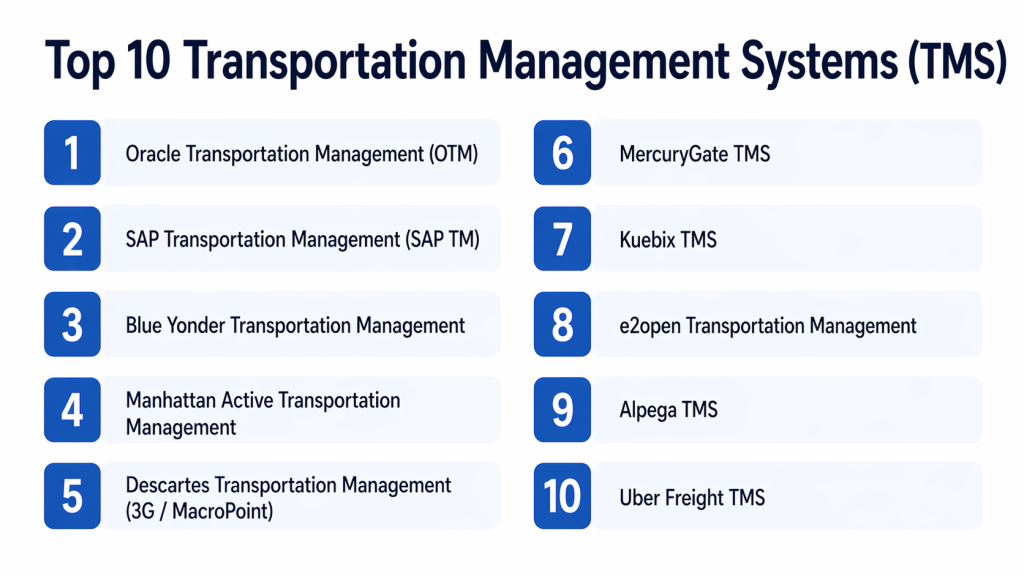
Top 10 Transportation Management Systems (TMS)
#1 — Oracle Transportation Management (OTM)
Short description:
Oracle Transportation Management is a leading enterprise TMS solution designed for complex logistics operations. It provides advanced planning, execution, and optimization capabilities. The platform supports multi-modal transportation and global operations. Known for scalability and deep analytics. Ideal for large enterprises managing complex supply chains.
Key Features
- Route optimization
- Freight planning
- Real-time tracking
- Multi-modal support
- Cost management
- Analytics
Pros
- Highly scalable
- Strong analytics
Cons
- Complex implementation
- Expensive
Platforms / Deployment
Cloud
Security & Compliance
Not publicly stated
Integrations & Ecosystem
- Oracle ERP
- APIs
Support & Community
Enterprise-level support.
#2 — SAP Transportation Management (SAP TM)
Short description:
SAP TM is an enterprise-grade transportation management solution integrated with SAP ERP systems. It helps businesses optimize logistics planning and execution. Suitable for global enterprises. Offers strong automation and compliance features. Ideal for complex supply chains.
Key Features
- Freight planning
- Carrier management
- Route optimization
- Real-time tracking
- Integration with SAP
Pros
- Strong ERP integration
- Enterprise scalability
Cons
- High cost
- Complex setup
Platforms / Deployment
Cloud / On-premise
Security & Compliance
Not publicly stated
Integrations & Ecosystem
- SAP ERP
- APIs
Support & Community
Enterprise support.
#3 — Blue Yonder Transportation Management
Short description:
Blue Yonder TMS focuses on AI-driven logistics optimization. It helps businesses improve efficiency and reduce costs through predictive analytics. Suitable for large enterprises. Offers strong visibility and automation features.
Key Features
- AI optimization
- Route planning
- Real-time visibility
- Analytics
- Automation
Pros
- Advanced AI capabilities
- Strong analytics
Cons
- Complex implementation
- Expensive
Platforms / Deployment
Cloud
Security & Compliance
Not publicly stated
Integrations & Ecosystem
- Supply chain systems
- APIs
Support & Community
Enterprise-level support.
#4 — Manhattan Active Transportation Management
Short description:
Manhattan TMS provides end-to-end transportation planning and execution. It supports omnichannel logistics operations. Known for flexibility and scalability. Ideal for retail and eCommerce enterprises.
Key Features
- Transportation planning
- Execution management
- Route optimization
- Analytics
- Integration capabilities
Pros
- Strong omnichannel support
- Scalable
Cons
- Expensive
- Complex setup
Platforms / Deployment
Cloud
Security & Compliance
Not publicly stated
Integrations & Ecosystem
- ERP systems
- APIs
Support & Community
Enterprise support.
#5 — Descartes Transportation Management
Short description:
Descartes TMS offers logistics management and real-time visibility. It is widely used for route optimization and fleet management. Suitable for logistics providers and enterprises. Known for strong carrier network integration.
Key Features
- Route optimization
- Fleet management
- Real-time tracking
- Carrier integration
- Reporting
Pros
- Strong network integration
- Good visibility
Cons
- Pricing varies
- Learning curve
Platforms / Deployment
Cloud
Security & Compliance
Not publicly stated
Integrations & Ecosystem
- Logistics systems
- APIs
Support & Community
Good support.
#6 — MercuryGate TMS
Short description:
MercuryGate is a flexible TMS platform supporting multi-modal transportation. It offers strong customization and automation features. Suitable for mid-market and enterprise businesses. Known for adaptability.
Key Features
- Multi-modal transport
- Route optimization
- Carrier management
- Automation
- Analytics
Pros
- Flexible
- Scalable
Cons
- Requires setup
- Pricing varies
Platforms / Deployment
Cloud
Security & Compliance
Not publicly stated
Integrations & Ecosystem
- ERP systems
- APIs
Support & Community
Moderate support.
#7 — Kuebix TMS
Short description:
Kuebix is a cloud-based TMS designed for SMBs and mid-market businesses. It offers easy-to-use transportation management features. Known for quick implementation. Suitable for growing businesses.
Key Features
- Shipment planning
- Carrier management
- Tracking
- Reporting
- Automation
Pros
- Easy to use
- Fast setup
Cons
- Limited enterprise features
- Basic customization
Platforms / Deployment
Cloud
Security & Compliance
Not publicly stated
Integrations & Ecosystem
- APIs
- Carrier integrations
Support & Community
Good SMB support.
#8 — e2open Transportation Management
Short description:
e2open TMS is designed for global supply chain operations. It provides visibility and optimization across transportation networks. Suitable for enterprises. Known for integration and scalability.
Key Features
- Network visibility
- Route optimization
- Carrier management
- Analytics
- Automation
Pros
- Strong global capabilities
- Scalable
Cons
- Complex implementation
- High cost
Platforms / Deployment
Cloud
Security & Compliance
Not publicly stated
Integrations & Ecosystem
- Supply chain systems
- APIs
Support & Community
Enterprise support.
#9 — Alpega TMS
Short description:
Alpega TMS focuses on freight management and logistics optimization. It provides strong carrier connectivity. Suitable for mid-market and enterprise businesses. Known for flexibility.
Key Features
- Freight management
- Carrier network
- Route optimization
- Reporting
- Automation
Pros
- Strong carrier network
- Flexible
Cons
- Learning curve
- Pricing varies
Platforms / Deployment
Cloud
Security & Compliance
Not publicly stated
Integrations & Ecosystem
- Logistics platforms
- APIs
Support & Community
Good support.
#10 — Uber Freight TMS
Short description:
Uber Freight TMS is a modern logistics platform leveraging digital freight networks. It connects shippers with carriers efficiently. Suitable for businesses looking for digital freight solutions. Known for ease of use and real-time tracking.
Key Features
- Digital freight matching
- Real-time tracking
- Carrier network
- Analytics
- Automation
Pros
- Modern interface
- Strong network
Cons
- Limited enterprise features
- Newer platform
Platforms / Deployment
Cloud
Security & Compliance
Not publicly stated
Integrations & Ecosystem
- APIs
- Carrier systems
Support & Community
Growing support ecosystem.
Comparison Table (Top 10)
| Tool Name | Best For | Platform(s) Supported | Deployment | Standout Feature | Public Rating |
|---|---|---|---|---|---|
| Oracle TMS | Enterprise | Web | Cloud | Advanced analytics | N/A |
| SAP TM | Enterprise | Web | Hybrid | ERP integration | N/A |
| Blue Yonder | Enterprise | Web | Cloud | AI optimization | N/A |
| Manhattan TMS | Retail | Web | Cloud | Omnichannel | N/A |
| Descartes | Logistics | Web | Cloud | Carrier network | N/A |
| MercuryGate | Mid-market | Web | Cloud | Flexibility | N/A |
| Kuebix | SMB | Web | Cloud | Ease of use | N/A |
| e2open | Enterprise | Web | Cloud | Global visibility | N/A |
| Alpega | Mid-market | Web | Cloud | Carrier connectivity | N/A |
| Uber Freight | SMB | Web | Cloud | Digital freight | N/A |
Evaluation & Scoring of Transportation Management Systems
| Tool Name | Core (25%) | Ease (15%) | Integrations (15%) | Security (10%) | Performance (10%) | Support (10%) | Value (15%) | Weighted Total |
|---|---|---|---|---|---|---|---|---|
| Oracle TMS | 9 | 7 | 9 | 8 | 9 | 8 | 7 | 8.3 |
| SAP TM | 9 | 6 | 9 | 8 | 9 | 8 | 6 | 8.1 |
| Blue Yonder | 9 | 6 | 8 | 8 | 9 | 8 | 6 | 8.0 |
| Manhattan TMS | 9 | 7 | 8 | 8 | 9 | 8 | 7 | 8.2 |
| Descartes | 8 | 7 | 8 | 7 | 8 | 7 | 7 | 7.6 |
| MercuryGate | 8 | 7 | 8 | 7 | 8 | 7 | 7 | 7.6 |
| Kuebix | 7 | 9 | 7 | 6 | 7 | 7 | 8 | 7.5 |
| e2open | 9 | 6 | 8 | 8 | 9 | 8 | 6 | 8.0 |
| Alpega | 8 | 7 | 7 | 7 | 8 | 7 | 7 | 7.5 |
| Uber Freight | 7 | 9 | 7 | 6 | 7 | 7 | 8 | 7.5 |
How to interpret scores:
These scores are comparative and help highlight strengths across functionality, usability, and value. Enterprise tools excel in scalability and integrations, while SMB tools perform better in ease of use and affordability. Choose based on your logistics complexity.
Which Transportation Management System Is Right for You?
Solo / Freelancer
Not required unless handling logistics operations.
SMB
Kuebix and Uber Freight are good options.
Mid-Market
MercuryGate and Alpega provide balanced capabilities.
Enterprise
Oracle, SAP, and Blue Yonder are best suited.
Budget vs Premium
Budget tools focus on simplicity, premium tools offer advanced optimization.
Feature Depth vs Ease of Use
Choose based on operational complexity.
Integrations & Scalability
Ensure compatibility with ERP and supply chain systems.
Security & Compliance Needs
Enterprises should prioritize governance and compliance.
Frequently Asked Questions (FAQs)
1. What is a Transportation Management System?
A TMS is software that helps manage and optimize transportation operations, including planning, execution, and tracking of shipments.
2. Why is TMS important?
It improves efficiency, reduces costs, and provides visibility into logistics operations.
3. Who needs a TMS?
Businesses with complex logistics operations, including manufacturers, retailers, and logistics providers.
4. How does TMS improve efficiency?
By automating route planning and optimizing shipments.
5. Can TMS integrate with ERP systems?
Yes, most TMS tools integrate with ERP systems.
6. What features should a TMS have?
Route optimization, tracking, analytics, and integrations.
7. Is TMS expensive?
Costs vary depending on features and scale.
8. What are common challenges in TMS implementation?
Integration complexity and training requirements.
9. Can TMS handle multiple transport modes?
Yes, most modern systems support multi-modal transport.
10. What are alternatives to TMS?
Manual systems or basic logistics tools, though less efficient.
Conclusion
Transportation Management Systems are essential for optimizing logistics operations in modern supply chains. They provide visibility, automation, and cost optimization across transportation networks, helping businesses improve efficiency and customer satisfaction. From SMB-friendly tools to enterprise-grade platforms, TMS solutions cater to a wide range of needs. The right choice depends on your logistics complexity, scale, and integration requirements. Instead of focusing only on features, evaluate how well the system fits your operational workflows. Shortlist a few options, test them in real scenarios, and validate their performance before making a final decision.