Introduction
Retail Pricing Optimization Tools help retailers set the right price at the right time by using data, automation, and analytics. Instead of relying on manual pricing decisions or static rules, these tools analyze demand signals, competitor pricing, inventory levels, and customer behavior to recommend or automatically adjust prices. In simple terms, they help businesses maximize revenue, protect margins, and stay competitive in fast-changing markets.
These tools are widely used for dynamic pricing in e-commerce, markdown optimization in fashion retail, competitor price tracking, promotional pricing strategies, and margin management across product categories. Buyers evaluating these platforms should look at pricing automation, AI capabilities, real-time data processing, competitor intelligence, integration with POS/ERP systems, scalability, ease of use, reporting depth, and compliance controls.
Best for: retail pricing teams, category managers, e-commerce managers, omnichannel retailers, and brands managing large SKU catalogs across multiple channels.
Not ideal for: very small retailers with fixed pricing strategies or businesses that do not frequently adjust prices based on demand or competition.
Key Trends in Retail Pricing Optimization Tools
- AI-driven pricing models replacing rule-based pricing strategies
- Real-time dynamic pricing based on demand, inventory, and competitor signals
- Integration with e-commerce platforms and POS systems for instant updates
- Elasticity-based pricing to understand how demand reacts to price changes
- Omnichannel pricing consistency across online and offline channels
- Automated promotions and markdown optimization
- Competitor intelligence and price scraping becoming standard
- Cloud-based deployment for scalability and faster implementation
- Predictive analytics for pricing simulations and scenario planning
- Focus on margin optimization rather than just revenue growth
How We Selected These Tools (Methodology)
- Evaluated market presence and adoption among retail and e-commerce businesses
- Assessed pricing intelligence capabilities, including AI and automation
- Reviewed real-time pricing and analytics performance
- Considered integration capabilities with ERP, POS, and e-commerce platforms
- Checked scalability across large SKU catalogs and multiple regions
- Evaluated ease of use and onboarding experience
- Analyzed security and compliance readiness
- Assessed reporting, dashboards, and decision support features
- Considered fit across SMB, mid-market, and enterprise retailers
- Factored in value for cost and ROI potential
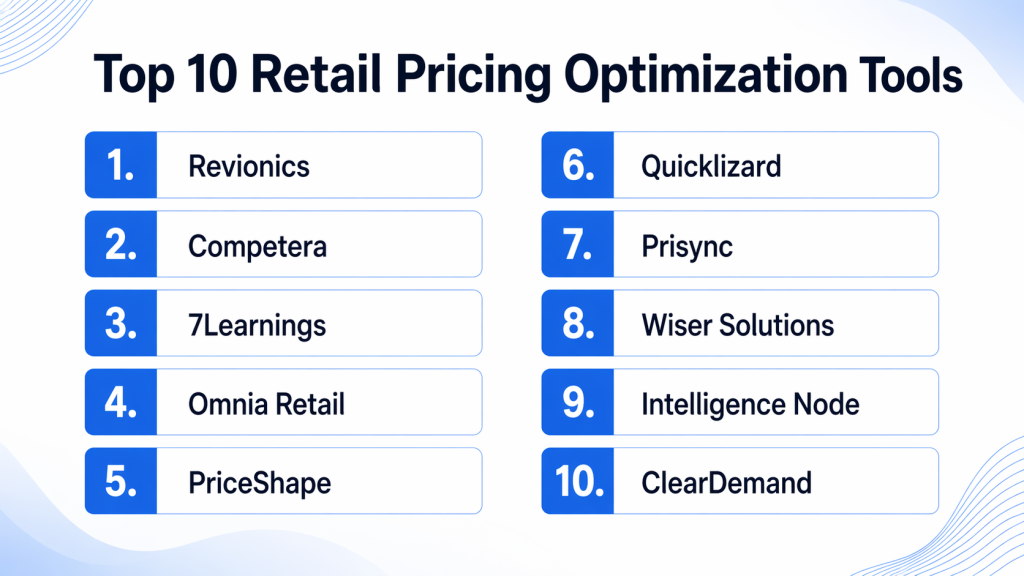
Top 10 Retail Pricing Optimization Tools
#1 — Revionics
Short description : Revionics is a leading enterprise pricing optimization platform designed for large retailers. It uses advanced analytics and machine learning to optimize pricing, promotions, and markdown strategies across large product catalogs.
Key Features
- AI-driven price optimization
- Promotion and markdown optimization
- Price elasticity modeling
- Scenario planning and simulations
- Advanced analytics dashboards
Pros
- Strong enterprise capabilities
- Deep analytics and forecasting
Cons
- High cost
- Requires structured implementation
Platforms / Deployment
- Web / Cloud
Security & Compliance
- Not publicly stated
Integrations & Ecosystem
Revionics integrates with retail ERP, POS, and supply chain systems for end-to-end pricing workflows.
- ERP and POS integration
- Retail analytics tools
- API-based integrations
Support & Community
Enterprise-level support with onboarding and consulting services.
#2 — Competera
Short description : Competera focuses on AI-driven pricing strategies, helping retailers automate pricing decisions and respond quickly to competitor movements and market demand.
Key Features
- AI pricing automation
- Competitor price monitoring
- Demand forecasting
- Price optimization engine
- Real-time pricing updates
Pros
- Strong automation capabilities
- Easy integration with e-commerce systems
Cons
- Requires data maturity
- Limited offline retail focus
Platforms / Deployment
- Web / Cloud
Security & Compliance
- Not publicly stated
Integrations & Ecosystem
- E-commerce platforms
- Pricing and analytics tools
- API support
Support & Community
Vendor support and onboarding assistance.
#3 — 7Learnings
Short description : 7Learnings provides AI-powered pricing optimization with a focus on demand forecasting and elasticity-based pricing for e-commerce and omnichannel retailers.
Key Features
- Machine learning pricing models
- Demand forecasting
- Elasticity analysis
- Scenario simulation
- Automated price recommendations
Pros
- Strong AI and forecasting capabilities
- Accurate demand predictions
Cons
- Requires high-quality data
- Less known in traditional retail
Platforms / Deployment
- Web / Cloud
Security & Compliance
- Not publicly stated
Integrations & Ecosystem
- E-commerce platforms
- Data analytics tools
- API integrations
Support & Community
Vendor-led onboarding and support.
#4 — Omnia Retail
Short description : Omnia Retail provides dynamic pricing and competitor monitoring tools, helping retailers automate pricing strategies and stay competitive in fast-moving markets.
Key Features
- Dynamic pricing automation
- Competitor price tracking
- Rule-based and AI pricing
- Market monitoring dashboards
- Real-time updates
Pros
- Easy to use
- Strong competitor insights
Cons
- Limited advanced analytics
- Less enterprise depth
Platforms / Deployment
- Web / Cloud
Security & Compliance
- Not publicly stated
Integrations & Ecosystem
- E-commerce integrations
- Pricing APIs
- Analytics platforms
Support & Community
Email and chat support with documentation.
#5 — PriceShape
Short description : PriceShape is a pricing tool for e-commerce businesses focused on competitor tracking, dynamic pricing, and automation to maximize revenue and margin.
Key Features
- Competitor price monitoring
- Dynamic pricing rules
- Product-level pricing insights
- Automation workflows
- Dashboard analytics
Pros
- Affordable for SMBs
- Easy implementation
Cons
- Limited enterprise features
- Basic analytics compared to AI tools
Platforms / Deployment
- Web / Cloud
Security & Compliance
- Not publicly stated
Integrations & Ecosystem
- E-commerce platforms
- API integrations
- Data tools
Support & Community
Support via chat and documentation.
#6 — Quicklizard
Short description : Quicklizard offers AI-based dynamic pricing solutions for retailers, focusing on automation and profitability optimization across digital channels.
Key Features
- AI pricing engine
- Real-time price adjustments
- Demand forecasting
- Promotion optimization
- Price testing
Pros
- Strong AI-driven pricing
- Good ROI potential
Cons
- Requires integration effort
- Data dependency
Platforms / Deployment
- Web / Cloud
Security & Compliance
- Not publicly stated
Integrations & Ecosystem
- E-commerce platforms
- ERP systems
- APIs for automation
Support & Community
Vendor support and onboarding assistance.
#7 — Prisync
Short description : Prisync is a competitor price tracking and dynamic pricing tool designed for e-commerce businesses and SMB retailers.
Key Features
- Competitor price monitoring
- Dynamic pricing rules
- Price alerts
- Dashboard reporting
- Market analysis
Pros
- Easy to use
- Cost-effective
Cons
- Limited advanced AI
- Focused on e-commerce
Platforms / Deployment
- Web / Cloud
Security & Compliance
- Not publicly stated
Integrations & Ecosystem
- Shopify, Magento integrations
- API support
- E-commerce tools
Support & Community
Email support and knowledge base.
#8 — Wiser Solutions
Short description : Wiser Solutions provides pricing intelligence, competitor insights, and retail analytics to help brands optimize pricing strategies.
Key Features
- Price intelligence
- Competitor tracking
- Retail analytics
- Pricing dashboards
- Data-driven insights
Pros
- Strong market intelligence
- Useful for omnichannel retail
Cons
- Limited automation
- Less pricing optimization depth
Platforms / Deployment
- Web / Cloud
Security & Compliance
- Not publicly stated
Integrations & Ecosystem
- Retail analytics tools
- API integrations
- Data platforms
Support & Community
Vendor support and documentation.
#9 — Intelligence Node
Short description : Intelligence Node provides retail analytics and pricing intelligence, helping brands optimize pricing and monitor competitors.
Key Features
- Price monitoring
- Market intelligence
- Competitor analysis
- Analytics dashboards
- Trend insights
Pros
- Strong analytics
- Useful for large catalogs
Cons
- Limited automation
- More analytics-focused
Platforms / Deployment
- Web / Cloud
Security & Compliance
- Not publicly stated
Integrations & Ecosystem
- Data analytics platforms
- APIs
- Retail tools
Support & Community
Vendor support and onboarding.
#10 — ClearDemand
Short description : ClearDemand offers pricing and promotion optimization tools, helping retailers improve margins through data-driven decisions.
Key Features
- Price optimization
- Promotion planning
- Demand forecasting
- Analytics dashboards
- Scenario modeling
Pros
- Strong optimization capabilities
- Good for margin improvement
Cons
- Limited awareness
- Requires setup effort
Platforms / Deployment
- Web / Cloud
Security & Compliance
- Not publicly stated
Integrations & Ecosystem
- ERP and POS systems
- APIs
- Retail analytics tools
Support & Community
Vendor support and documentation.
Comparison Table (Top 10)
| Tool Name | Best For | Platform | Deployment | Standout Feature | Public Rating |
|---|---|---|---|---|---|
| Revionics | Enterprise retail | Web | Cloud | AI pricing optimization | N/A |
| Competera | AI pricing | Web | Cloud | Automated pricing decisions | N/A |
| 7Learnings | Demand forecasting | Web | Cloud | Elasticity modeling | N/A |
| Omnia Retail | Dynamic pricing | Web | Cloud | Competitor tracking | N/A |
| PriceShape | SMB e-commerce | Web | Cloud | Easy automation | N/A |
| Quicklizard | AI pricing | Web | Cloud | Real-time adjustments | N/A |
| Prisync | SMB pricing | Web | Cloud | Price monitoring | N/A |
| Wiser Solutions | Analytics | Web | Cloud | Market insights | N/A |
| Intelligence Node | Retail analytics | Web | Cloud | Pricing intelligence | N/A |
| ClearDemand | Optimization | Web | Cloud | Promotion optimization | N/A |
Evaluation & Scoring of Retail Pricing Optimization Tools
| Tool Name | Core | Ease | Integrations | Security | Performance | Support | Value | Total |
|---|---|---|---|---|---|---|---|---|
| Revionics | 9 | 7 | 8 | 7 | 9 | 8 | 6 | 8.1 |
| Competera | 8 | 8 | 7 | 7 | 8 | 7 | 7 | 7.7 |
| 7Learnings | 8 | 7 | 7 | 7 | 8 | 7 | 7 | 7.6 |
| Omnia Retail | 7 | 8 | 7 | 6 | 7 | 7 | 8 | 7.3 |
| PriceShape | 7 | 9 | 6 | 6 | 7 | 6 | 9 | 7.2 |
| Quicklizard | 8 | 7 | 7 | 7 | 8 | 7 | 7 | 7.6 |
| Prisync | 7 | 9 | 6 | 6 | 7 | 6 | 8 | 7.1 |
| Wiser | 7 | 7 | 7 | 6 | 7 | 7 | 7 | 7.0 |
| Intelligence Node | 7 | 7 | 7 | 6 | 7 | 7 | 7 | 7.0 |
| ClearDemand | 8 | 7 | 7 | 7 | 8 | 7 | 7 | 7.6 |
Scores are comparative and should be used to shortlist tools based on priorities.
Which Retail Pricing Optimization Tool Is Right for You?
Solo / Freelancer
- Prisync or PriceShape for simple and affordable pricing automation.
SMB
- Omnia Retail, PriceShape, or Prisync for cost-effective dynamic pricing.
Mid-Market
- Competera, Quicklizard, or 7Learnings for AI-driven pricing strategies.
Enterprise
- Revionics or ClearDemand for advanced optimization and analytics.
Budget vs Premium
- SMB → affordable tools
- Enterprise → AI-driven premium platforms
Feature Depth vs Ease of Use
- Simple tools → easier onboarding
- Advanced tools → deeper insights and automation
Integrations & Scalability
- Choose tools with strong API support and ERP/POS integrations.
Security & Compliance Needs
- Enterprise tools should meet compliance requirements and ensure secure data handling.
Frequently Asked Questions (FAQs)
1. What is pricing optimization?
It is the process of using data and analytics to determine the best price to maximize revenue or profit.
2. Do I need AI for pricing?
AI is useful for large catalogs but not mandatory for small businesses.
3. Can pricing tools integrate with e-commerce?
Yes, most tools integrate with Shopify, Magento, and other platforms.
4. How fast can pricing updates happen?
Many tools support real-time or near real-time pricing updates.
5. Are these tools expensive?
Pricing varies widely; SMB tools are affordable, enterprise tools are premium.
6. Do these tools track competitors?
Yes, competitor monitoring is a core feature.
7. Can I automate discounts?
Yes, most tools support automated promotions and markdowns.
8. Are they secure?
Most tools follow standard security practices; verify compliance if needed.
9. Can small businesses use them?
Yes, there are SMB-focused tools available.
10. What is the biggest benefit?
Better margins, competitive pricing, and faster decision-making.
Conclusion
Retail pricing optimization tools are becoming essential for modern retailers who need to balance competitiveness with profitability. Whether you are a small e-commerce store or a large enterprise retailer, the ability to adjust prices dynamically based on demand, competition, and inventory can significantly improve margins and revenue. SMBs can benefit from tools like Prisync, PriceShape, or Omnia Retail for simplicity and cost-effectiveness, while mid-market and enterprise teams should explore Competera, 7Learnings, Quicklizard, or Revionics for deeper AI-driven optimization. The best approach is to shortlist tools based on your pricing complexity, run controlled experiments, and validate integrations before full-scale deployment to ensure long-term success.