Introduction
Order Management Systems (OMS) are software platforms designed to manage the entire lifecycle of an order—from placement to fulfillment, delivery, and even returns. They act as a centralized hub that connects sales channels, inventory, warehouses, and customer data, ensuring smooth and efficient operations.
In an omnichannel world where businesses sell across websites, marketplaces, and physical stores, managing orders manually is no longer practical. OMS tools help automate workflows, reduce errors, and provide real-time visibility into inventory and order status—leading to better customer experiences and operational efficiency.
Common use cases include:
- Managing orders across multiple sales channels
- Automating fulfillment and shipping workflows
- Synchronizing inventory across warehouses
- Handling returns and reverse logistics
- Providing real-time order tracking for customers
What buyers should evaluate:
- Multi-channel order management capabilities
- Inventory synchronization and visibility
- Automation of order routing and fulfillment
- Integration with ERP, WMS, and eCommerce platforms
- Scalability for high order volumes
- Reporting and analytics capabilities
- Ease of use and onboarding
- Security and access controls
- Cost and implementation complexity
- Customer experience features
Best for: eCommerce businesses, retailers, manufacturers, distributors, and logistics teams handling high order volumes.
Not ideal for: Small businesses with low order volume or companies that operate through a single sales channel with minimal complexity.
Key Trends in Order Management Systems (OMS)
- AI-powered demand forecasting and inventory optimization
- Automation of order routing and fulfillment workflows
- Real-time inventory visibility across multiple warehouses
- Integration with headless commerce and composable architectures
- Growth of omnichannel and unified commerce strategies
- Advanced analytics for order and fulfillment performance
- Expansion into end-to-end supply chain platforms
- Increased focus on returns and reverse logistics automation
- API-first OMS platforms for flexible integrations
- Cloud-native deployments for scalability
How We Selected These Tools (Methodology)
- Market adoption and industry relevance
- Feature completeness across order lifecycle management
- Integration capabilities with ERP, WMS, and eCommerce systems
- Scalability for SMB and enterprise use cases
- Automation and workflow capabilities
- Security and data governance readiness
- Ease of implementation and usability
- Vendor support and ecosystem strength
- Performance in handling complex order scenarios
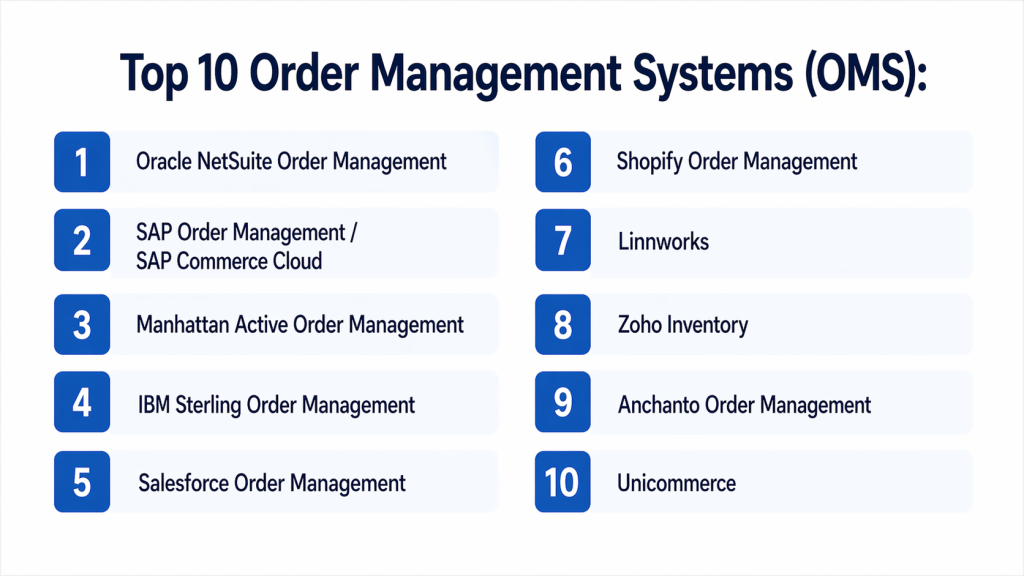
Top 10 Order Management Systems (OMS)
#1 — Oracle NetSuite Order Management
Short description:
Oracle NetSuite OMS is a cloud-based solution integrated within the NetSuite ERP ecosystem. It provides real-time visibility into orders, inventory, and financials. The platform is ideal for mid-market and enterprise businesses. It supports complex order workflows and global operations. Known for scalability and strong financial integration.
Key Features
- Real-time order tracking
- Inventory and fulfillment management
- Financial integration
- Multi-channel order processing
- Automation workflows
Pros
- Strong ERP integration
- Scalable for enterprise use
Cons
- Implementation complexity
- Higher cost
Platforms / Deployment
Cloud
Security & Compliance
Not publicly stated
Integrations & Ecosystem
Integrates deeply with enterprise systems.
- NetSuite ERP
- APIs
Support & Community
Enterprise-level support and documentation.
#2 — SAP Commerce Cloud OMS
Short description:
SAP Commerce Cloud OMS is designed for large enterprises with complex omnichannel operations. It provides advanced order orchestration and fulfillment capabilities. The platform supports global operations and multi-region inventory management. Ideal for enterprises requiring scalability and compliance.
Key Features
- Omnichannel order orchestration
- Inventory visibility
- Fulfillment automation
- Multi-region support
- Integration with SAP ecosystem
Pros
- Enterprise-grade capabilities
- Strong scalability
Cons
- High implementation cost
- Complex setup
Platforms / Deployment
Cloud
Security & Compliance
Not publicly stated
Integrations & Ecosystem
Integrates with SAP systems.
- SAP ERP
- APIs
Support & Community
Enterprise support.
#3 — Shopify Order Management
Short description:
Shopify includes built-in order management capabilities for eCommerce businesses. It enables order tracking, inventory management, and fulfillment from a single platform. Ideal for direct-to-consumer brands. Easy to use and quick to deploy. Best for businesses already using Shopify.
Key Features
- Order tracking
- Inventory synchronization
- Fulfillment routing
- Multi-channel sales support
- Reporting
Pros
- Easy to use
- Integrated ecosystem
Cons
- Limited for enterprise needs
- Platform dependency
Platforms / Deployment
Cloud
Security & Compliance
Not publicly stated
Integrations & Ecosystem
Strong eCommerce integrations.
- Shopify apps
- APIs
Support & Community
Large community and support resources.
#4 — Linnworks
Short description:
Linnworks is a multi-channel order management platform focused on eCommerce sellers. It helps businesses manage inventory and orders across multiple marketplaces. Ideal for growing online retailers. Known for strong integration capabilities and automation.
Key Features
- Multi-channel order management
- Inventory synchronization
- Automation workflows
- Reporting and analytics
- Marketplace integrations
Pros
- Strong integrations
- Good for scaling businesses
Cons
- Learning curve
- Pricing varies
Platforms / Deployment
Cloud
Security & Compliance
Not publicly stated
Integrations & Ecosystem
Supports marketplace integrations.
- Amazon
- eBay
- APIs
Support & Community
Good support for eCommerce users.
#5 — Zoho Inventory
Short description:
Zoho Inventory is an affordable OMS designed for SMBs. It helps manage orders, inventory, and shipping processes. Ideal for small businesses expanding into multi-channel selling. Offers strong integration within Zoho ecosystem.
Key Features
- Order and inventory management
- Multi-channel integration
- Shipping automation
- Reporting
- CRM integration
Pros
- Cost-effective
- Easy to use
Cons
- Limited enterprise features
- Scalability constraints
Platforms / Deployment
Cloud
Security & Compliance
Not publicly stated
Integrations & Ecosystem
Integrates with Zoho apps.
- Zoho CRM
- APIs
Support & Community
Good SMB-focused support.
#6 — Extensiv Order Management (Skubana)
Short description:
Extensiv OMS is an all-in-one platform designed for eCommerce and retail businesses. It centralizes orders, inventory, and fulfillment processes. Ideal for scaling online brands. Known for automation and analytics capabilities.
Key Features
- Centralized order management
- Inventory synchronization
- Automation workflows
- Analytics
- Multi-channel support
Pros
- Strong automation
- Good scalability
Cons
- Complex setup
- Pricing varies
Platforms / Deployment
Cloud
Security & Compliance
Not publicly stated
Integrations & Ecosystem
Supports integrations across systems.
- CRM
- WMS
- APIs
Support & Community
Good documentation and support.
#7 — QuickBooks Commerce
Short description:
QuickBooks Commerce is designed for wholesale and SMB businesses. It combines order management with accounting capabilities. Ideal for businesses needing financial integration. Helps streamline operations across sales and finance.
Key Features
- Order management
- Inventory tracking
- Accounting integration
- Multi-channel support
- Reporting
Pros
- Strong accounting integration
- Easy to use
Cons
- Limited scalability
- Integration limitations
Platforms / Deployment
Cloud
Security & Compliance
Not publicly stated
Integrations & Ecosystem
Integrates with eCommerce platforms.
- Shopify
- APIs
Support & Community
Good SMB support.
#8 — Fishbowl Inventory
Short description:
Fishbowl Inventory is an OMS solution focused on inventory and manufacturing. It is ideal for distributors and manufacturers. Provides strong inventory tracking and automation features. Works well with accounting systems.
Key Features
- Inventory management
- Order tracking
- Manufacturing support
- Automation workflows
- Reporting
Pros
- Strong inventory features
- Manufacturing focus
Cons
- UI limitations
- Requires setup
Platforms / Deployment
Cloud / On-premise
Security & Compliance
Not publicly stated
Integrations & Ecosystem
Supports integrations.
- QuickBooks
- APIs
Support & Community
Moderate support.
#9 — ShipStation
Short description:
ShipStation is a shipping-focused OMS platform that simplifies fulfillment. It helps businesses manage orders and shipping across channels. Ideal for eCommerce sellers. Known for ease of use and shipping automation.
Key Features
- Shipping automation
- Order management
- Carrier integrations
- Tracking
- Reporting
Pros
- Easy to use
- Strong shipping features
Cons
- Limited advanced OMS features
- Not ideal for enterprises
Platforms / Deployment
Cloud
Security & Compliance
Not publicly stated
Integrations & Ecosystem
Supports integrations with shipping providers.
- USPS
- FedEx
- APIs
Support & Community
Good support.
#10 — Anchanto Order Management
Short description:
Anchanto OMS is designed for eCommerce and logistics businesses. It supports omnichannel retail and fulfillment operations. Ideal for businesses expanding globally. Offers strong automation and integration capabilities.
Key Features
- Omnichannel order management
- Inventory synchronization
- Fulfillment automation
- Reporting
- Integration support
Pros
- Strong omnichannel capabilities
- Scalable
Cons
- Complex setup
- Pricing varies
Platforms / Deployment
Cloud
Security & Compliance
Not publicly stated
Integrations & Ecosystem
Supports integrations with marketplaces and logistics systems.
- APIs
- ERP
Support & Community
Enterprise-level support.
Comparison Table (Top 10)
| Tool Name | Best For | Platform(s) Supported | Deployment | Standout Feature | Public Rating |
|---|---|---|---|---|---|
| NetSuite OMS | Enterprise | Web | Cloud | ERP integration | N/A |
| SAP Commerce Cloud | Enterprise | Web | Cloud | Omnichannel support | N/A |
| Shopify OMS | SMB | Web | Cloud | Ease of use | N/A |
| Linnworks | eCommerce | Web | Cloud | Multi-channel sync | N/A |
| Zoho Inventory | SMB | Web | Cloud | Affordability | N/A |
| Extensiv OMS | eCommerce | Web | Cloud | Automation | N/A |
| QuickBooks Commerce | SMB | Web | Cloud | Accounting integration | N/A |
| Fishbowl | Manufacturing | Web | Hybrid | Inventory focus | N/A |
| ShipStation | SMB | Web | Cloud | Shipping automation | N/A |
| Anchanto OMS | Enterprise | Web | Cloud | Omnichannel | N/A |
Evaluation & Scoring of Order Management Systems (OMS)
| Tool Name | Core (25%) | Ease (15%) | Integrations (15%) | Security (10%) | Performance (10%) | Support (10%) | Value (15%) | Weighted Total |
|---|---|---|---|---|---|---|---|---|
| NetSuite OMS | 9 | 7 | 9 | 8 | 9 | 8 | 7 | 8.3 |
| SAP Commerce Cloud | 9 | 6 | 9 | 8 | 9 | 8 | 6 | 8.1 |
| Shopify OMS | 7 | 9 | 7 | 6 | 7 | 7 | 9 | 7.7 |
| Linnworks | 8 | 7 | 8 | 6 | 8 | 7 | 7 | 7.6 |
| Zoho Inventory | 7 | 9 | 7 | 6 | 7 | 7 | 9 | 7.8 |
| Extensiv OMS | 8 | 7 | 8 | 7 | 8 | 7 | 7 | 7.7 |
| QuickBooks Commerce | 7 | 9 | 7 | 6 | 7 | 7 | 8 | 7.5 |
| Fishbowl | 8 | 6 | 7 | 6 | 8 | 7 | 7 | 7.2 |
| ShipStation | 7 | 9 | 6 | 6 | 7 | 7 | 8 | 7.4 |
| Anchanto OMS | 8 | 7 | 8 | 7 | 8 | 8 | 7 | 7.8 |
How to interpret scores:
These scores are comparative and highlight strengths across features, usability, and value. Enterprise tools perform better in scalability and integrations, while SMB tools excel in ease of use and affordability. Use these scores as guidance rather than absolute rankings.
Which Order Management System (OMS) Is Right for You?
Solo / Freelancer
Simple tools like Shopify or Zoho Inventory are sufficient for basic needs.
SMB
Zoho Inventory, ShipStation, or QuickBooks Commerce are ideal.
Mid-Market
Linnworks and Extensiv OMS offer strong balance.
Enterprise
NetSuite and SAP Commerce Cloud are best choices.
Budget vs Premium
Budget tools focus on simplicity; premium tools offer automation and scalability.
Feature Depth vs Ease of Use
Choose based on operational complexity.
Integrations & Scalability
Ensure compatibility with ERP and logistics systems.
Security & Compliance Needs
Enterprises should prioritize governance and access controls.
Frequently Asked Questions (FAQs)
1. What is an Order Management System (OMS)?
An OMS is software that manages the lifecycle of an order from placement to delivery. It tracks inventory, processes orders, and coordinates fulfillment. It provides real-time visibility to businesses and customers. OMS improves efficiency and reduces manual errors. It is essential for modern commerce operations.
2. Why is OMS important?
OMS ensures smooth order processing across channels. It reduces errors and improves efficiency. It enhances customer experience through real-time tracking. It helps businesses scale operations. It provides better visibility into inventory and fulfillment.
3. Who needs an OMS?
Businesses with multiple sales channels need OMS. eCommerce companies, retailers, and manufacturers benefit the most. It is useful for managing high order volumes. Helps streamline operations and improve accuracy.
4. How does OMS improve customer experience?
OMS provides real-time order tracking. Customers get updates on delivery status. It reduces delays and errors. Improves transparency and trust. Enhances overall satisfaction.
5. Can OMS integrate with ERP systems?
Yes, most OMS tools integrate with ERP systems. This ensures data consistency. It improves operational efficiency. Integration is critical for scaling.
6. What are common OMS features?
Key features include order tracking, inventory management, automation, and reporting. Multi-channel integration is essential. Fulfillment and returns management are also important. These features streamline operations.
7. Is OMS expensive?
Costs vary depending on features and scale. SMB tools are affordable. Enterprise solutions are more expensive. ROI depends on operational efficiency gains.
8. What are common challenges in OMS implementation?
Implementation can be complex. Integration requires planning. Data migration can be difficult. Training is necessary. Proper setup is critical.
9. Can OMS handle returns?
Yes, modern OMS tools support returns and refunds. They automate reverse logistics. Helps maintain accurate inventory. Improves customer experience.
10. What are alternatives to OMS?
Alternatives include spreadsheets or ERP modules. However, they lack automation and scalability. OMS provides better control. It is more efficient.
Conclusion
Order Management Systems are essential for businesses managing complex, multi-channel operations. They centralize order processing, improve inventory visibility, and automate fulfillment workflows, leading to better efficiency and customer satisfaction. While SMB tools focus on simplicity and affordability, enterprise solutions provide advanced capabilities such as automation, analytics, and scalability. The right OMS depends on your business size, order volume, and integration needs. Instead of choosing based solely on features, evaluate how well the system fits into your existing ecosystem. Shortlist a few tools, test them in real scenarios, and validate performance before making a long-term decision.