Introduction
Requirements Management Tools are software platforms that help organizations capture, document, analyze, track, and manage product or system requirements throughout the entire development lifecycle. These requirements can include business needs, technical specifications, compliance rules, user stories, or system constraints.
In modern software and product development, requirements management is critical because unclear or changing requirements are one of the biggest reasons for project delays and failures. These tools ensure that every requirement is traceable—from initial idea to final delivery—while maintaining alignment between business stakeholders, product teams, QA, and engineering.
Real-world use cases include:
- Capturing business and system requirements for software projects
- Managing compliance and regulatory requirements in industries like healthcare and finance
- Tracking changes in requirements during Agile development cycles
- Ensuring traceability between requirements, test cases, and defects
- Aligning stakeholders on product scope and deliverables
- Managing large-scale enterprise system documentation
When evaluating requirements management tools, teams should consider:
- Requirement traceability across development lifecycle
- Collaboration between business and technical teams
- Version control and change management
- Integration with Agile and DevOps tools
- Test case and defect linkage
- Workflow customization and approval processes
- Scalability for enterprise-level projects
- Reporting and compliance documentation
- Ease of use and onboarding
- Security and access control
Best for: Business analysts, system engineers, product managers, QA teams, and enterprise software development organizations.
Not ideal for: Very small projects or simple applications that do not require structured requirement tracking or compliance-heavy workflows.
Key Trends in Requirements Management Tools
- AI-assisted requirement generation and validation
- End-to-end traceability from requirement to deployment
- Integration with Agile, DevOps, and CI/CD pipelines
- Cloud-based collaborative requirement platforms
- Strong focus on compliance and regulatory frameworks
- Automation of requirement change management workflows
- Linkage between requirements, test cases, and defects
- Real-time collaboration between distributed teams
- Model-based systems engineering (MBSE) adoption
- Increased use of digital product twins and simulations
How We Selected These Tools (Methodology)
- Market adoption in enterprise and regulated industries
- Depth of requirement lifecycle management features
- Traceability and version control capabilities
- Integration with testing and DevOps tools
- Collaboration and stakeholder management features
- Compliance and audit-readiness support
- Scalability for large enterprise systems
- Usability for both technical and business users
- Workflow customization and automation support
- Balance between traditional ALM and modern SaaS platforms
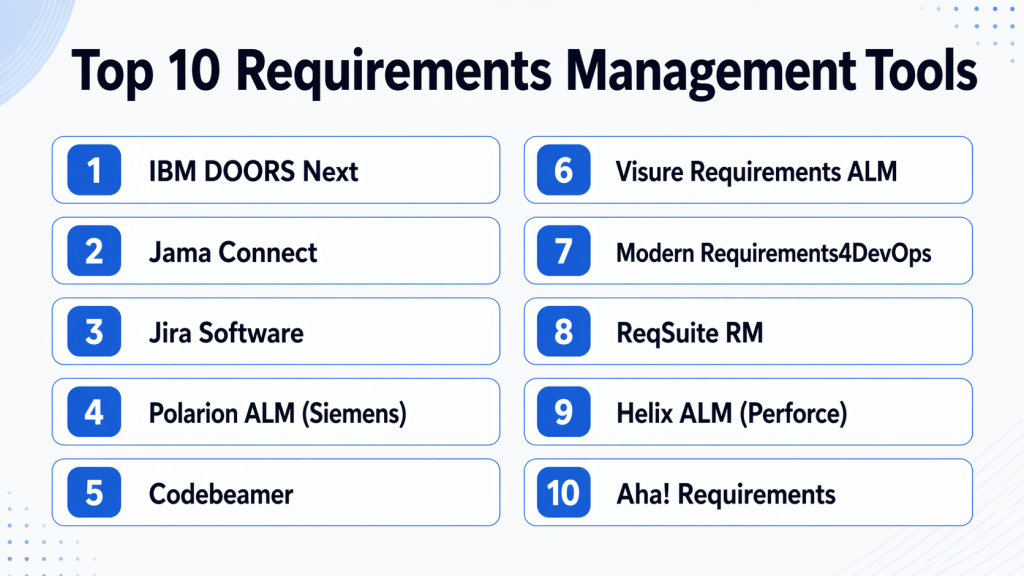
Top 10 Requirements Management Tools
#1 — IBM DOORS Next
Short description: IBM DOORS Next is a powerful enterprise requirements management platform designed for complex systems engineering and highly regulated industries such as aerospace, automotive, and healthcare. It provides end-to-end traceability and strict governance over requirements.
Key Features
- End-to-end requirements traceability
- Version control and baselining
- Collaboration across distributed teams
- Change and configuration management
- Advanced reporting and dashboards
- Compliance-ready documentation support
Pros
- Extremely powerful for large enterprises
- Strong compliance and traceability
Cons
- Complex to learn and implement
- High cost for smaller teams
Platforms / Deployment
- Web
- Cloud / On-premises
Security & Compliance
- Role-based access control
- Encryption and audit logs
- Strong enterprise compliance support
Integrations & Ecosystem
- IBM Engineering Lifecycle tools
- Test management tools
- DevOps pipelines
- APIs for enterprise integration
Support & Community
- Enterprise-grade support
- Strong documentation and training programs
#2 — Jama Connect
Short description: Jama Connect is a modern requirements management platform focused on live traceability and collaboration for product development teams.
Key Features
- Live traceability matrix
- Requirements hierarchy management
- Review and approval workflows
- Test case linking
- Risk management features
- Real-time collaboration
Pros
- Strong collaboration features
- Excellent traceability visualization
Cons
- Can be expensive for small teams
- Requires structured onboarding
Platforms / Deployment
- Web
- Cloud
Security & Compliance
- RBAC and encryption
- Not publicly stated certifications
Integrations & Ecosystem
- Jira
- Azure DevOps
- Test management tools
- APIs
Support & Community
- Strong enterprise support
- Training resources available
#3 — Jira Software
Short description: Jira Software is widely used for Agile project management and can be adapted for requirements management through issue tracking and workflow customization.
Key Features
- Requirement tracking via issues
- Agile boards (Scrum/Kanban)
- Custom workflows
- Backlog management
- Integration with development tools
- Reporting dashboards
Pros
- Highly flexible and widely adopted
- Strong integration ecosystem
Cons
- Not a dedicated requirements tool
- Requires customization for full RM use
Platforms / Deployment
- Web
- Cloud / Self-hosted
Security & Compliance
- RBAC, encryption, audit logs
- Enterprise compliance support
Integrations & Ecosystem
- Bitbucket, GitHub, GitLab
- CI/CD tools
- Confluence
- APIs
Support & Community
- Massive global user base
- Strong documentation
#4 — Polarion ALM
Short description: Polarion ALM by Siemens is a full application lifecycle management tool with strong requirements management and traceability features.
Key Features
- Requirements lifecycle management
- End-to-end traceability
- Test case management
- Workflow automation
- Version control
- Compliance reporting
Pros
- Strong ALM capabilities
- Ideal for regulated industries
Cons
- Complex interface
- Requires training
Platforms / Deployment
- Web
- Cloud / On-premises
Security & Compliance
- RBAC and encryption
- Enterprise compliance support
Integrations & Ecosystem
- Siemens tools
- DevOps systems
- APIs
Support & Community
- Enterprise-level support
#5 — Codebeamer
Short description: Codebeamer is a requirements and application lifecycle management platform designed for complex product development environments.
Key Features
- Requirements management
- Risk management
- Test management integration
- Workflow customization
- Traceability matrices
- Agile support
Pros
- Strong for complex engineering projects
- Excellent traceability
Cons
- Steep learning curve
- Enterprise-focused pricing
Platforms / Deployment
- Web
- Cloud / On-premises
Security & Compliance
- RBAC, encryption
- Not publicly stated certifications
Integrations & Ecosystem
- DevOps tools
- Testing platforms
- APIs
Support & Community
- Enterprise support available
#6 — Visure Requirements ALM
Short description: Visure Requirements ALM is a specialized requirements management tool focused on traceability, compliance, and risk management.
Key Features
- Requirements capture and modeling
- Traceability management
- Risk and compliance tracking
- Baseline management
- Collaboration tools
- Change management
Pros
- Strong compliance focus
- Excellent traceability features
Cons
- Less modern UI
- Requires training
Platforms / Deployment
- Web
- Cloud / On-premises
Security & Compliance
- RBAC and encryption
- Not publicly stated certifications
Integrations & Ecosystem
- Jira
- Test tools
- APIs
Support & Community
- Enterprise support
#7 — Modern Requirements4DevOps
Short description: Modern Requirements4DevOps integrates directly with Azure DevOps to extend its capabilities into full requirements management.
Key Features
- Requirements management inside Azure DevOps
- Traceability matrix
- Document generation
- Workflow automation
- Compliance tracking
- Review and approval system
Pros
- Seamless Azure DevOps integration
- Strong documentation capabilities
Cons
- Limited outside Microsoft ecosystem
- Requires Azure dependency
Platforms / Deployment
- Web
- Cloud
Security & Compliance
- RBAC and encryption
- Enterprise compliance support
Integrations & Ecosystem
- Azure DevOps
- Microsoft tools
- APIs
Support & Community
- Strong enterprise support
#8 — ReqSuite RM
Short description: ReqSuite RM is a flexible requirements management tool designed to simplify requirement structuring and collaboration.
Key Features
- Requirements structuring tools
- Change management
- Collaboration features
- Traceability support
- Reporting tools
- Workflow customization
Pros
- Easy to use
- Flexible configuration
Cons
- Smaller ecosystem
- Limited enterprise adoption
Platforms / Deployment
- Web
- Cloud
Security & Compliance
- RBAC and encryption
- Not publicly stated
Integrations & Ecosystem
- APIs
- Third-party tools
Support & Community
- Standard vendor support
#9 — Helix ALM (Perforce)
Short description: Helix ALM is a requirements, test, and issue management tool designed for regulated industries and complex software systems.
Key Features
- Requirements management
- Test case tracking
- Defect tracking
- Traceability reporting
- Workflow automation
- Version control integration
Pros
- Strong ALM suite
- Excellent traceability
Cons
- Complex for beginners
- Higher cost
Platforms / Deployment
- Web
- Cloud / On-premises
Security & Compliance
- RBAC, encryption
- Enterprise compliance support
Integrations & Ecosystem
- Perforce tools
- DevOps systems
- APIs
Support & Community
- Strong enterprise support
#10 — Aha! Requirements
Short description: Aha! Requirements is part of the Aha! suite and focuses on product planning, requirements definition, and roadmap alignment.
Key Features
- Requirements capture and planning
- Roadmap integration
- Idea management
- Collaboration tools
- Workflow customization
- Reporting dashboards
Pros
- Strong product management alignment
- Easy roadmap integration
Cons
- Limited deep engineering focus
- Premium pricing
Platforms / Deployment
- Web
- Cloud
Security & Compliance
- RBAC, encryption
- Not publicly stated certifications
Integrations & Ecosystem
- Jira
- Dev tools
- APIs
Support & Community
- Strong customer support
Comparison Table (Top 10)
| Tool Name | Best For | Platform(s) Supported | Deployment | Standout Feature | Public Rating |
|---|---|---|---|---|---|
| IBM DOORS Next | Enterprise systems | Web | Cloud/On-prem | Traceability | N/A |
| Jama Connect | Product teams | Web | Cloud | Live traceability | N/A |
| Jira | Agile teams | Web | Cloud/Self-hosted | Workflow flexibility | N/A |
| Polarion ALM | Engineering teams | Web | Cloud/On-prem | ALM suite | N/A |
| Codebeamer | Complex systems | Web | Cloud/On-prem | Risk management | N/A |
| Visure ALM | Compliance teams | Web | Cloud/On-prem | Compliance tracking | N/A |
| Modern Requirements4DevOps | Azure teams | Web | Cloud | DevOps integration | N/A |
| ReqSuite RM | SMBs | Web | Cloud | Simplicity | N/A |
| Helix ALM | Regulated industries | Web | Cloud/On-prem | Full ALM suite | N/A |
| Aha! Requirements | Product teams | Web | Cloud | Roadmap integration | N/A |
Evaluation & Scoring of Requirements Management Tools
| Tool Name | Core (25%) | Ease (15%) | Integrations (15%) | Security (10%) | Performance (10%) | Support (10%) | Value (15%) | Weighted Total |
|---|---|---|---|---|---|---|---|---|
| IBM DOORS Next | 10 | 6 | 9 | 10 | 9 | 9 | 7 | 8.60 |
| Jama Connect | 9 | 8 | 9 | 9 | 9 | 9 | 8 | 8.65 |
| Jira | 8 | 9 | 10 | 9 | 9 | 9 | 10 | 8.90 |
| Polarion ALM | 10 | 7 | 9 | 10 | 9 | 9 | 7 | 8.55 |
| Codebeamer | 9 | 7 | 9 | 9 | 9 | 9 | 7 | 8.35 |
| Visure ALM | 9 | 7 | 8 | 9 | 8 | 8 | 8 | 8.20 |
| Modern Requirements4DevOps | 8 | 8 | 10 | 9 | 8 | 8 | 9 | 8.45 |
| ReqSuite RM | 7 | 9 | 7 | 8 | 8 | 8 | 9 | 8.05 |
| Helix ALM | 9 | 7 | 9 | 9 | 9 | 9 | 7 | 8.40 |
| Aha! Requirements | 8 | 8 | 9 | 9 | 8 | 8 | 8 | 8.25 |
Which Requirements Management Tool Is Right for You?
Solo / Freelancer
ReqSuite RM or Jira for lightweight requirement tracking.
SMB
Aha! Requirements, Jira, and ReqSuite RM for structured product planning.
Mid-Market
Jama Connect, Helix ALM, and Codebeamer for scalable workflows.
Enterprise
IBM DOORS Next and Polarion ALM for complex, regulated environments.
Budget vs Premium
SMBs benefit from flexible tools; enterprises require compliance-heavy systems.
Feature Depth vs Ease of Use
Advanced ALM tools offer deep traceability but require training.
Integrations & Scalability
Choose tools that integrate with DevOps, testing, and CI/CD pipelines.
Security & Compliance Needs
Enterprise tools must support RBAC, encryption, audit logs, and regulatory compliance.
Frequently Asked Questions (FAQs)
1. What is a requirements management tool?
It helps teams document and track software or system requirements.
2. Why is requirements management important?
It prevents miscommunication and ensures project success.
3. Are these tools only for software development?
No, they are used in engineering, healthcare, finance, and manufacturing.
4. Do they support Agile workflows?
Yes, many modern tools support Agile and hybrid methodologies.
5. Can they integrate with Jira?
Yes, most tools integrate with Jira and DevOps systems.
6. Are they expensive?
Enterprise tools are expensive, while SMB tools are more affordable.
7. Do they support traceability?
Yes, traceability is a core feature of these tools.
8. Can they manage compliance requirements?
Yes, especially enterprise ALM platforms.
9. Are they cloud-based?
Most modern tools are cloud-based with hybrid options.
10. What is the biggest benefit?
They improve clarity, traceability, and product delivery success.
Conclusion
Requirements Management Tools are essential for ensuring clarity, alignment, and traceability across complex software and system development projects. SMBs often rely on tools like Jira, ReqSuite RM, and Aha! Requirements for flexibility, while enterprises depend on IBM DOORS Next, Jama Connect, and Polarion ALM for deep compliance and lifecycle management. The right choice depends on project complexity, regulatory needs, and integration requirements. Organizations should prioritize traceability, collaboration, and scalability when selecting a tool.