Introduction
Customer Experience (CX) Platforms are software solutions designed to help businesses manage, analyze, and improve every interaction a customer has with a brand. These platforms unify customer data, communication channels, feedback systems, and analytics into a single ecosystem to deliver consistent and personalized experiences across all touchpoints.
In today’s digital-first world, customer experience has become a key competitive differentiator. Businesses are no longer competing only on price or product but on how seamlessly and effectively they engage customers across their journey. CX platforms enable organizations to understand customer behavior, resolve issues faster, and improve satisfaction and loyalty.
Real-world use cases include:
- Managing customer support across chat, email, phone, and social channels
- Collecting and analyzing customer feedback and sentiment
- Personalizing marketing and engagement campaigns
- Tracking customer journeys across multiple touchpoints
- Improving customer retention and reducing churn
When evaluating CX platforms, buyers should consider:
- Omnichannel communication support
- Customer data integration and unification
- AI-driven insights and automation
- Feedback collection and sentiment analysis
- Personalization and segmentation capabilities
- Workflow automation for customer support
- Reporting and analytics dashboards
- Integration with CRM, marketing, and sales tools
- Scalability for enterprise environments
- Security and data privacy compliance
Best for: Enterprises, mid-market companies, customer support teams, marketing teams, and product teams focused on improving customer satisfaction and retention.
Not ideal for: Very small businesses with minimal customer interaction needs or simple support workflows that can be managed manually.
Key Trends in Customer Experience (CX) Platforms
- AI-powered customer sentiment analysis and prediction
- Unified customer data platforms for 360-degree customer views
- Omnichannel engagement across chat, email, voice, and social media
- Real-time personalization of customer interactions
- Automation of customer support workflows using AI chatbots
- Integration of CX with CRM, ERP, and marketing platforms
- Voice of Customer (VoC) analytics and feedback loops
- Increased focus on customer journey mapping
- Cloud-native CX platforms replacing legacy systems
- Privacy-first customer data management and compliance
How We Selected These Tools (Methodology)
- Evaluated market adoption and enterprise usage
- Assessed omnichannel communication capabilities
- Reviewed AI, automation, and personalization features
- Analyzed customer feedback and sentiment analysis tools
- Considered integration with CRM, marketing, and support systems
- Evaluated scalability for SMB, mid-market, and enterprise use
- Factored in ease of use and onboarding experience
- Assessed analytics, reporting, and dashboard capabilities
- Reviewed security, compliance, and data privacy standards
- Balanced feature depth with usability and flexibility
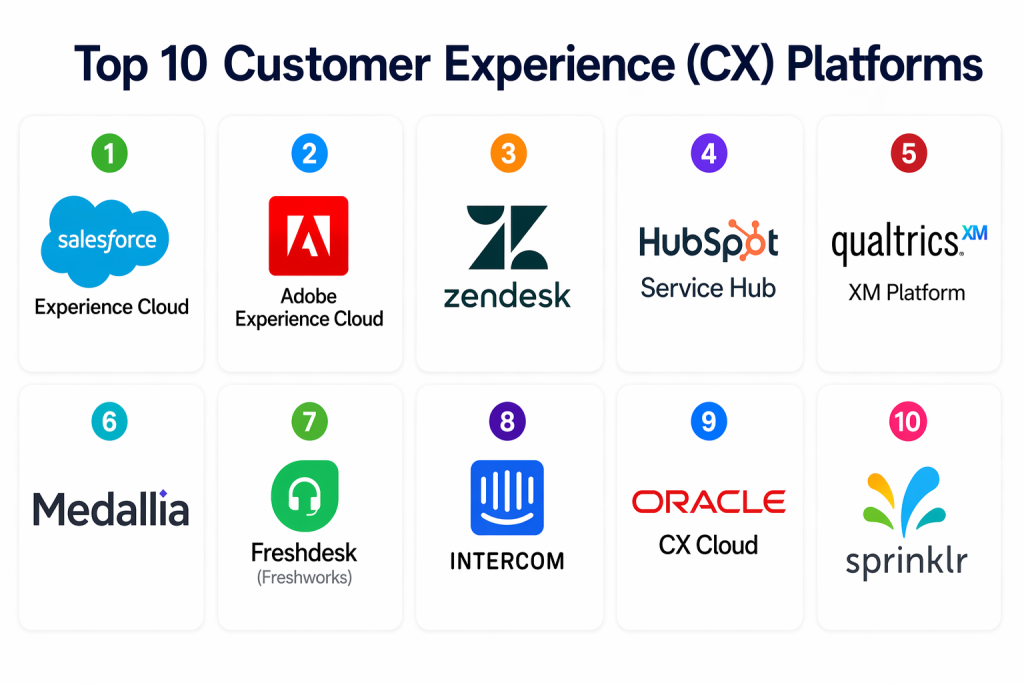
Top 10 Customer Experience (CX) Platforms
#1 — Salesforce Experience Cloud
Short description: Salesforce Experience Cloud is a powerful CX platform that enables businesses to build digital experiences, manage customer interactions, and integrate data across CRM, support, and marketing systems. It is ideal for large enterprises seeking a unified customer ecosystem.
Key Features
- Customer journey management
- Omnichannel engagement
- AI-driven insights via Einstein AI
- CRM integration with Salesforce ecosystem
- Personalized customer portals
- Workflow automation
Pros
- Strong enterprise scalability
- Deep CRM integration
Cons
- Complex setup and configuration
- High cost for smaller teams
Platforms / Deployment
- Web
- Cloud
Security & Compliance
- RBAC, encryption, audit logs
- SOC 2, GDPR
Integrations & Ecosystem
- Salesforce CRM
- Marketing Cloud
- Service Cloud
- APIs for third-party apps
Support & Community
Enterprise-level support and extensive documentation
#2 — Adobe Experience Cloud
Short description: Adobe Experience Cloud provides a comprehensive suite for managing customer experiences across marketing, analytics, and personalization. It is widely used by enterprise marketing and CX teams.
Key Features
- Customer journey analytics
- Personalization engine
- Content management
- AI-driven insights
- Omnichannel marketing automation
- Real-time data tracking
Pros
- Industry-leading personalization
- Strong analytics capabilities
Cons
- Complex implementation
- High cost structure
Platforms / Deployment
- Web
- Cloud
Security & Compliance
- RBAC, encryption, audit logs
- Not publicly stated
Integrations & Ecosystem
- Adobe Marketing tools
- CRM platforms
- Data management platforms
- APIs
Support & Community
Enterprise support with global documentation
#3 — Zendesk
Short description: Zendesk is a leading customer service and CX platform focused on support ticketing, omnichannel communication, and customer engagement. It is widely used by SMBs and enterprises.
Key Features
- Omnichannel support (email, chat, phone, social)
- Ticket management system
- AI-powered chatbots
- Customer analytics dashboards
- Workflow automation
- Self-service knowledge base
Pros
- Easy to use and implement
- Strong support ecosystem
Cons
- Limited advanced personalization
- Can become expensive at scale
Platforms / Deployment
- Web
- Cloud
Security & Compliance
- RBAC, encryption, audit logs
- GDPR compliant
Integrations & Ecosystem
- CRM systems
- Marketing tools
- E-commerce platforms
- APIs
Support & Community
Strong documentation and community support
#4 — HubSpot Service Hub
Short description: HubSpot Service Hub is a customer experience platform designed to improve customer support, engagement, and retention with integrated CRM capabilities.
Key Features
- Ticketing system
- Customer feedback tools
- Live chat and chatbots
- Knowledge base management
- CRM integration
- Reporting dashboards
Pros
- Easy onboarding
- Strong CRM integration
Cons
- Limited enterprise-level features
- Advanced features require premium plans
Platforms / Deployment
- Web
- Cloud
Security & Compliance
- RBAC, encryption
- Not publicly stated
Integrations & Ecosystem
- HubSpot CRM
- Marketing Hub
- Sales Hub
- APIs
Support & Community
Strong onboarding resources and documentation
#5 — Qualtrics XM Platform
Short description: Qualtrics XM Platform specializes in experience management by collecting and analyzing customer, employee, and product feedback to improve CX outcomes.
Key Features
- Voice of Customer (VoC) analytics
- Customer journey mapping
- Feedback collection tools
- Predictive analytics
- Experience dashboards
- Survey management
Pros
- Deep customer insight capabilities
- Strong analytics engine
Cons
- Complex setup
- Requires training
Platforms / Deployment
- Web
- Cloud
Security & Compliance
- RBAC, encryption
- Not publicly stated
Integrations & Ecosystem
- CRM platforms
- BI tools
- APIs
Support & Community
Enterprise support and training
#6 — Medallia
Short description: Medallia is a leading experience management platform that captures real-time feedback and transforms it into actionable insights for improving customer experience.
Key Features
- Real-time feedback capture
- AI-driven sentiment analysis
- Customer journey analytics
- Experience dashboards
- Survey tools
- Predictive insights
Pros
- Strong real-time analytics
- Deep customer insight capabilities
Cons
- Expensive for SMBs
- Complex interface
Platforms / Deployment
- Web
- Cloud
Security & Compliance
- RBAC, encryption, audit logs
- Not publicly stated
Integrations & Ecosystem
- CRM systems
- Contact centers
- APIs
Support & Community
Enterprise support and documentation
#7 — Freshdesk (Freshworks)
Short description: Freshdesk is a customer support and CX platform offering ticketing, automation, and omnichannel communication for businesses of all sizes.
Key Features
- Ticket management system
- Omnichannel support
- AI chatbot automation
- SLA management
- Knowledge base tools
- Reporting dashboards
Pros
- Affordable and scalable
- Easy to use
Cons
- Limited advanced analytics
- Enterprise features require upgrades
Platforms / Deployment
- Web
- Cloud
Security & Compliance
- RBAC, encryption
- GDPR compliant
Integrations & Ecosystem
- CRM tools
- E-commerce platforms
- APIs
Support & Community
Strong support and documentation
#8 — Intercom
Short description: Intercom is a conversational CX platform that enables businesses to engage customers through chat, messaging, and automation.
Key Features
- Live chat and messaging
- AI chatbot automation
- Customer segmentation
- Help desk tools
- Product tours
- Engagement analytics
Pros
- Strong conversational UI
- Excellent automation features
Cons
- Can be expensive
- Limited deep analytics
Platforms / Deployment
- Web
- Cloud
Security & Compliance
- Encryption, RBAC
- Not publicly stated
Integrations & Ecosystem
- CRM systems
- Marketing tools
- APIs
Support & Community
Documentation and premium support
#9 — Oracle CX Cloud
Short description: Oracle CX Cloud provides enterprise-level customer experience management across sales, marketing, and service functions.
Key Features
- Customer data management
- Marketing automation
- Service and support tools
- AI-driven insights
- Personalization engine
- Journey orchestration
Pros
- Strong enterprise capabilities
- Deep integration with Oracle ecosystem
Cons
- Complex implementation
- High cost
Platforms / Deployment
- Web
- Cloud
Security & Compliance
- RBAC, encryption, audit logs
- Not publicly stated
Integrations & Ecosystem
- Oracle ERP
- Oracle CRM
- APIs
Support & Community
Enterprise-level support
#10 — Sprinklr
Short description: Sprinklr is a unified CX platform focused on social media management, customer engagement, and omnichannel support.
Key Features
- Social media management
- Customer engagement tools
- AI-driven insights
- Omnichannel support
- Analytics dashboards
- Workflow automation
Pros
- Strong social CX capabilities
- Unified platform
Cons
- Complex for small teams
- Requires onboarding
Platforms / Deployment
- Web
- Cloud
Security & Compliance
- RBAC, encryption
- Not publicly stated
Integrations & Ecosystem
- CRM platforms
- Social media channels
- APIs
Support & Community
Enterprise support and training
Comparison Table (Top 10)
| Tool Name | Best For | Platform(s) Supported | Deployment | Standout Feature | Public Rating |
|---|---|---|---|---|---|
| Salesforce Experience Cloud | Enterprises | Web | Cloud | CRM integration | N/A |
| Adobe Experience Cloud | Marketing teams | Web | Cloud | Personalization engine | N/A |
| Zendesk | SMB & enterprise support | Web | Cloud | Ticketing system | N/A |
| HubSpot Service Hub | SMBs | Web | Cloud | CRM integration | N/A |
| Qualtrics XM | Experience analytics | Web | Cloud | VoC analytics | N/A |
| Medallia | Enterprise CX | Web | Cloud | Real-time feedback | N/A |
| Freshdesk | SMB support teams | Web | Cloud | Affordable CX | N/A |
| Intercom | Conversational CX | Web | Cloud | Chat automation | N/A |
| Oracle CX Cloud | Enterprises | Web | Cloud | ERP integration | N/A |
| Sprinklr | Social CX | Web | Cloud | Social engagement | N/A |
Evaluation & Scoring of CX Platforms
| Tool Name | Core (25%) | Ease (15%) | Integrations (15%) | Security (10%) | Performance (10%) | Support (10%) | Value (15%) | Weighted Total |
|---|---|---|---|---|---|---|---|---|
| Salesforce Experience Cloud | 10 | 7 | 10 | 9 | 9 | 9 | 7 | 8.80 |
| Adobe Experience Cloud | 10 | 7 | 9 | 9 | 9 | 9 | 6 | 8.25 |
| Zendesk | 9 | 9 | 8 | 8 | 8 | 8 | 8 | 8.45 |
| HubSpot Service Hub | 8 | 9 | 8 | 8 | 8 | 8 | 9 | 8.35 |
| Qualtrics XM | 9 | 7 | 8 | 9 | 9 | 8 | 7 | 8.20 |
| Medallia | 9 | 6 | 8 | 9 | 9 | 8 | 6 | 7.95 |
| Freshdesk | 8 | 9 | 8 | 8 | 8 | 8 | 9 | 8.20 |
| Intercom | 8 | 8 | 8 | 8 | 8 | 8 | 7 | 8.00 |
| Oracle CX Cloud | 9 | 6 | 9 | 9 | 9 | 8 | 6 | 7.95 |
| Sprinklr | 8 | 7 | 8 | 8 | 8 | 8 | 7 | 7.85 |
Which CX Platform Is Right for You?
Solo / Freelancer
HubSpot Service Hub or Freshdesk for lightweight customer support needs.
SMB
Zendesk, Freshdesk, and Intercom for scalable customer engagement.
Mid-Market
Qualtrics XM, Medallia, and Sprinklr for deeper insights and omnichannel CX.
Enterprise
Salesforce Experience Cloud, Adobe Experience Cloud, and Oracle CX Cloud for full-scale CX transformation.
Budget vs Premium
SMBs should prioritize affordability and ease of use; enterprises need advanced analytics and integration depth.
Feature Depth vs Ease of Use
Enterprise tools are powerful but complex; SMB tools focus on usability and speed.
Integrations & Scalability
Choose platforms that integrate with CRM, marketing, and data systems for unified CX.
Security & Compliance Needs
Enterprise CX platforms require RBAC, encryption, audit logs, and compliance readiness.
Frequently Asked Questions (FAQs)
1. What are CX platforms used for?
They manage and improve customer interactions across all channels.
2. Do CX tools include AI?
Yes, many platforms use AI for personalization, chatbots, and analytics.
3. Are CX platforms only for large companies?
No, SMB-friendly options like Zendesk and Freshdesk exist.
4. Can CX tools integrate with CRM systems?
Yes, integration with CRM platforms is standard.
5. Do CX platforms support omnichannel communication?
Yes, most support email, chat, voice, and social channels.
6. Are CX platforms secure?
Enterprise solutions include encryption, RBAC, and compliance features.
7. Can CX tools improve customer retention?
Yes, by improving engagement and satisfaction.
8. Do they support automation?
Yes, workflows and AI automation are core features.
9. Are CX platforms expensive?
Pricing ranges from affordable SMB tools to premium enterprise suites.
10. What is the main benefit of CX platforms?
They improve customer satisfaction, loyalty, and business growth.
Conclusion
Customer Experience (CX) Platforms are essential for organizations aiming to deliver consistent, personalized, and efficient customer interactions across multiple channels. SMBs benefit from Zendesk, Freshdesk, and HubSpot Service Hub for ease of use and affordability, while enterprises rely on Salesforce, Adobe, and Oracle CX Cloud for advanced analytics and scalability. The right platform depends on business size, customer complexity, and integration needs. Companies should shortlist tools, test capabilities, and evaluate automation, analytics, and scalability before final selection.