Introduction
Robotics Simulation Tools are software platforms that allow developers, engineers, and researchers to design, test, and validate robotic systems in a virtual environment before deploying them in the real world. These tools simulate physics, sensors, environments, and robot behaviors, enabling safe and cost-effective experimentation.
As robotics becomes central to industries like manufacturing, logistics, healthcare, and autonomous systems, simulation has become a critical step in development. Modern robotics simulation tools now integrate AI, machine learning, and digital twin capabilities, allowing teams to train robots, test edge cases, and accelerate deployment without physical risks.
Common use cases include:
- Autonomous robot training and testing
- Industrial robotics simulation and optimization
- AI-driven robotics development
- Sensor and perception testing
- Digital twin creation for real-world systems
Key evaluation criteria:
- Physics engine accuracy
- Sensor and environment simulation capabilities
- Integration with robotics frameworks (ROS, AI/ML tools)
- Real-time simulation performance
- Support for multi-robot systems
- Ease of use and learning curve
- Visualization and debugging tools
- Scalability and cloud support
Best for: Robotics engineers, AI researchers, autonomous system developers, and enterprises building robotic solutions across industries.
Not ideal for: Simple automation tasks or projects that do not require realistic simulation environments.
Key Trends in Robotics Simulation Tools for 2026 and Beyond
- AI-driven robotics training with reinforcement learning
- Digital twin integration for real-world system replication
- Cloud-based simulation environments
- Multi-robot and swarm simulation capabilities
- High-fidelity physics and sensor modeling
- Integration with computer vision and perception models
- Synthetic data generation for AI training
- Real-time simulation with hardware-in-the-loop
- Open-source ecosystems with ROS integration
- GPU-accelerated simulation platforms
How We Selected These Tools (Methodology)
- Evaluated adoption in robotics and AI communities
- Assessed simulation accuracy and physics capabilities
- Compared support for sensors and real-world environments
- Reviewed integration with robotics frameworks and AI tools
- Analyzed scalability and performance
- Considered ease of use and developer experience
- Included both open-source and enterprise platforms
- Focused on real-world deployment readiness
- Balanced innovation with maturity
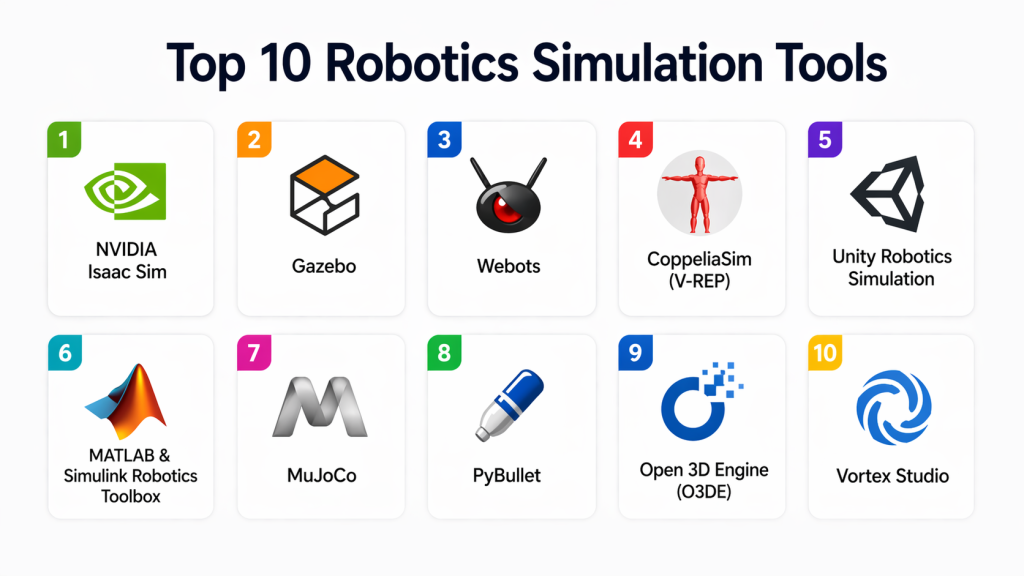
Top 10 Robotics Simulation Tools
#1 — NVIDIA Isaac Sim
Short description:
NVIDIA Isaac Sim is a high-fidelity robotics simulation platform designed for AI-driven robotics development using GPU acceleration and synthetic data generation.
Key Features
- Photorealistic simulation
- GPU acceleration
- Synthetic data generation
- AI and ML integration
- Digital twin capabilities
Pros
- High performance and realism
- Strong AI integration
Cons
- Requires powerful hardware
- Complex setup
Platforms / Deployment
Cloud / Self-hosted
Security & Compliance
Varies / N/A
Integrations & Ecosystem
Deep integration with NVIDIA AI ecosystem and robotics frameworks for advanced simulation workflows.
- ROS
- CUDA
- AI frameworks
Support & Community
Strong enterprise backing with growing community.
#2 — Gazebo
Short description:
Gazebo is a widely used open-source robotics simulator known for its strong integration with ROS and realistic physics simulation.
Key Features
- Physics simulation
- Sensor modeling
- ROS integration
- Multi-robot support
- Environment customization
Pros
- Open-source
- Strong ROS support
Cons
- Steep learning curve
- UI limitations
Platforms / Deployment
Self-hosted
Security & Compliance
Varies / N/A
Integrations & Ecosystem
Integrates seamlessly with ROS ecosystem and robotics tools for simulation and testing.
- ROS
- APIs
Support & Community
Large global robotics community.
#3 — Webots
Short description:
Webots is a user-friendly robotics simulation platform suitable for both education and professional development.
Key Features
- 3D simulation
- Robot modeling
- Multi-platform support
- Programming APIs
- Visualization tools
Pros
- Easy to use
- Cross-platform
Cons
- Limited advanced features
- Performance limitations
Platforms / Deployment
Windows / macOS / Linux
Security & Compliance
Varies / N/A
Integrations & Ecosystem
Supports integration with programming languages and robotics frameworks for flexible development.
- Python
- C++
- ROS
Support & Community
Active community and documentation.
#4 — CoppeliaSim (V-REP)
Short description:
CoppeliaSim is a versatile robotics simulation platform offering flexible scripting and advanced simulation capabilities.
Key Features
- Multi-robot simulation
- Script-based control
- Physics engines
- Real-time simulation
- Custom plugins
Pros
- Highly flexible
- Supports complex simulations
Cons
- Complex interface
- Learning curve
Platforms / Deployment
Windows / macOS / Linux
Security & Compliance
Varies / N/A
Integrations & Ecosystem
Integrates with robotics frameworks and custom scripts for advanced control.
- APIs
- ROS
Support & Community
Active developer community.
#5 — Unity Robotics Simulation
Short description:
Unity Robotics Simulation leverages the Unity game engine to create realistic robotic environments and simulations.
Key Features
- Realistic rendering
- Simulation environments
- ML integration
- Custom scripting
- Visualization tools
Pros
- High-quality visuals
- Flexible environment creation
Cons
- Requires Unity knowledge
- Not specialized for robotics
Platforms / Deployment
Cloud / Self-hosted
Security & Compliance
Varies / N/A
Integrations & Ecosystem
Integrates with Unity ecosystem and AI tools for simulation and training.
- Unity ML
- APIs
Support & Community
Large developer community.
#6 — MATLAB & Simulink Robotics Toolbox
Short description:
MATLAB & Simulink provide advanced tools for robotics simulation, control system design, and algorithm development.
Key Features
- Robotics algorithms
- Control system design
- Simulation models
- Visualization tools
- Integration with hardware
Pros
- Powerful analytics
- Industry-standard
Cons
- Expensive licensing
- Requires expertise
Platforms / Deployment
Windows / Linux / Cloud
Security & Compliance
Varies / N/A
Integrations & Ecosystem
Integrates with engineering tools and hardware systems for comprehensive robotics development.
- MATLAB
- Simulink
Support & Community
Strong academic and enterprise support.
#7 — MuJoCo
Short description:
MuJoCo is a physics-based simulation engine widely used for robotics and reinforcement learning research.
Key Features
- Accurate physics simulation
- Reinforcement learning support
- Fast computation
- Custom environments
- Model-based control
Pros
- High performance
- Accurate physics
Cons
- Limited visualization
- Requires coding
Platforms / Deployment
Windows / Linux / macOS
Security & Compliance
Varies / N/A
Integrations & Ecosystem
Integrates with ML frameworks for AI-driven robotics research.
- Python
- ML tools
Support & Community
Active research community.
#8 — PyBullet
Short description:
PyBullet is a lightweight simulation environment for robotics, physics, and AI applications.
Key Features
- Physics simulation
- Python API
- Reinforcement learning support
- Real-time simulation
- Easy setup
Pros
- Beginner-friendly
- Lightweight
Cons
- Limited realism
- Basic UI
Platforms / Deployment
Windows / macOS / Linux
Security & Compliance
Varies / N/A
Integrations & Ecosystem
Works with AI frameworks and robotics tools for experimentation.
- Python
- ML libraries
Support & Community
Active open-source community.
#9 — Open 3D Engine (O3DE)
Short description:
O3DE is an open-source 3D engine that supports robotics simulation with advanced rendering and physics capabilities.
Key Features
- High-quality rendering
- Physics engine
- Modular architecture
- Real-time simulation
- Open-source
Pros
- Flexible
- Scalable
Cons
- Complex setup
- Limited robotics-specific tools
Platforms / Deployment
Windows / Linux
Security & Compliance
Varies / N/A
Integrations & Ecosystem
Integrates with game engines and simulation tools for custom robotics environments.
- APIs
- Plugins
Support & Community
Growing open-source community.
#10 — Vortex Studio
Short description:
Vortex Studio is a high-fidelity simulation platform focused on heavy equipment and robotics systems.
Key Features
- Physics simulation
- Real-time interaction
- Digital twin support
- Training simulation
- Visualization tools
Pros
- High realism
- Industrial applications
Cons
- Expensive
- Niche use cases
Platforms / Deployment
Windows
Security & Compliance
Varies / N/A
Integrations & Ecosystem
Supports integration with industrial systems and simulation workflows.
- APIs
- Simulation tools
Support & Community
Enterprise support.
Comparison Table (Top 10)
| Tool Name | Best For | Platform(s) Supported | Deployment | Standout Feature | Public Rating |
|---|---|---|---|---|---|
| NVIDIA Isaac Sim | AI robotics | Linux/Cloud | Cloud/Self | Photorealism | N/A |
| Gazebo | ROS users | Linux | Self-hosted | ROS integration | N/A |
| Webots | Education | Multi-platform | Local | Ease of use | N/A |
| CoppeliaSim | Flexibility | Multi-platform | Local | Scripting | N/A |
| Unity Robotics | Visualization | Multi-platform | Cloud/Self | Graphics | N/A |
| MATLAB | Engineering | Multi-platform | Cloud/Self | Analytics | N/A |
| MuJoCo | RL research | Multi-platform | Local | Physics | N/A |
| PyBullet | Beginners | Multi-platform | Local | Simplicity | N/A |
| O3DE | Custom sims | Multi-platform | Local | Rendering | N/A |
| Vortex Studio | Industrial | Windows | Local | Realism | N/A |
Evaluation & Scoring of Robotics Simulation Tools
| Tool Name | Core (25%) | Ease (15%) | Integrations (15%) | Security (10%) | Performance (10%) | Support (10%) | Value (15%) | Weighted Total (0–10) |
|---|---|---|---|---|---|---|---|---|
| Isaac Sim | 9 | 7 | 9 | 7 | 10 | 9 | 7 | 8.5 |
| Gazebo | 8 | 6 | 9 | 6 | 8 | 8 | 9 | 8.0 |
| Webots | 7 | 9 | 7 | 6 | 7 | 7 | 9 | 7.6 |
| CoppeliaSim | 8 | 7 | 8 | 6 | 8 | 7 | 8 | 7.8 |
| Unity | 8 | 8 | 8 | 7 | 8 | 8 | 7 | 8.0 |
| MATLAB | 9 | 7 | 8 | 8 | 9 | 9 | 6 | 8.2 |
| MuJoCo | 9 | 6 | 8 | 6 | 9 | 7 | 8 | 8.0 |
| PyBullet | 7 | 9 | 7 | 6 | 7 | 7 | 9 | 7.7 |
| O3DE | 8 | 6 | 7 | 6 | 8 | 7 | 8 | 7.5 |
| Vortex | 9 | 6 | 7 | 8 | 9 | 8 | 6 | 7.9 |
How to interpret scores:
These scores reflect a comparative evaluation across simulation accuracy, usability, and ecosystem support. Higher scores indicate tools that are more balanced and production-ready, while others may excel in specific areas like research, visualization, or industrial simulation.
Which Robotics Simulation Tool Is Right for You?
Solo / Freelancer
PyBullet and Webots are ideal for learning and experimentation due to their simplicity and low setup requirements.
SMB
Gazebo and Unity Robotics Simulation provide flexibility and scalability for growing teams.
Mid-Market
CoppeliaSim and MuJoCo offer advanced simulation capabilities with manageable complexity.
Enterprise
NVIDIA Isaac Sim, MATLAB, and Vortex Studio are best for large-scale and high-fidelity simulation needs.
Budget vs Premium
- Budget: PyBullet, Gazebo
- Premium: Isaac Sim, MATLAB
Feature Depth vs Ease of Use
- Deep features: Isaac Sim, MATLAB
- Easy to use: Webots, PyBullet
Integrations & Scalability
Choose tools with strong integration support for robotics frameworks and AI pipelines.
Security & Compliance Needs
Enterprises should prioritize tools with strong access controls and industrial-grade support.
Frequently Asked Questions (FAQs)
What are robotics simulation tools?
They are software platforms used to simulate robot behavior, environments, and interactions in a virtual space before real-world deployment.
Why are simulation tools important?
They reduce costs, improve safety, and allow testing of edge cases without physical risks.
Do these tools support AI training?
Yes, many tools support reinforcement learning and AI model training.
Can I use these tools without coding?
Some tools offer visual interfaces, but coding knowledge is often required.
What is a digital twin?
A digital twin is a virtual replica of a real-world system used for simulation and analysis.
Are these tools suitable for real-time applications?
Yes, many platforms support real-time simulation and hardware integration.
Which tool is best for beginners?
PyBullet and Webots are good starting points.
Are these tools scalable?
Yes, especially cloud-based and enterprise tools.
What industries use robotics simulation?
Manufacturing, logistics, healthcare, and autonomous systems.
Can I switch tools later?
Yes, but migration may require adapting models and workflows.
Conclusion
Robotics Simulation Tools have become a foundational component in modern robotics development, enabling teams to design, test, and validate systems in safe and controlled virtual environments. As robotics continues to expand across industries, the ability to simulate complex scenarios before deployment is critical for reducing risks and accelerating innovation. These tools provide powerful capabilities ranging from basic physics simulation to advanced AI-driven environments and digital twins. The ecosystem includes lightweight solutions for beginners as well as high-performance platforms designed for enterprise and industrial applications. Choosing the right tool depends on your specific use case, technical expertise, and scalability requirements. Teams should focus on tools that integrate well with their robotics frameworks and support long-term development goals. Testing different platforms through pilot simulations can help identify the best fit. As AI and robotics converge, simulation tools will continue to evolve, offering more realistic and intelligent environments. Investing in the right simulation platform today can significantly improve efficiency, reduce costs, and enhance system reliability. Start by shortlisting a few tools, experimenting with real-world scenarios, and scaling based on performance and integration needs.