Introduction
Manufacturing Resource Planning (MRP) Tools are software systems designed to help manufacturers plan, schedule, and manage production resources efficiently. These tools ensure that materials, inventory, labor, and production timelines are aligned to meet demand without delays or excess waste. MRP is often a core component of broader ERP systems, but modern tools provide specialized capabilities for manufacturing-focused operations.
With increasing pressure on supply chains and the shift toward smart manufacturing, MRP tools are evolving rapidly. Today’s platforms integrate real-time data, AI-driven forecasting, and cloud-based collaboration to improve production efficiency and reduce costs. They enable organizations to maintain optimal inventory levels, streamline procurement, and ensure timely production.
Common use cases include:
- Production planning and scheduling
- Inventory and material management
- Demand forecasting and supply planning
- Procurement and vendor coordination
- Manufacturing cost control
Key evaluation criteria:
- Demand forecasting accuracy
- Inventory and materials management
- Integration with ERP and MES systems
- Scalability across production lines
- Automation of procurement workflows
- Reporting and analytics capabilities
- Ease of implementation and usability
- Security and access controls
Best for: Manufacturing companies, supply chain managers, production planners, and organizations looking to optimize inventory and production workflows.
Not ideal for: Businesses without manufacturing processes or companies with very simple inventory needs.
Key Trends in Manufacturing Resource Planning (MRP) Tools for 2026 and Beyond
- AI-driven demand forecasting and planning
- Cloud-native and SaaS MRP solutions
- Real-time inventory tracking and analytics
- Integration with IoT and smart factory systems
- Automated procurement and supplier management
- Digital twin integration for production planning
- Multi-location and global supply chain optimization
- Mobile-first MRP platforms
- Integration with MES and advanced planning systems
- Enhanced data visualization and reporting
How We Selected These Tools (Methodology)
- Evaluated adoption across manufacturing industries
- Assessed production planning and inventory capabilities
- Compared integration with ERP and MES systems
- Reviewed scalability and multi-site support
- Analyzed analytics and reporting features
- Considered ease of use and customization
- Included both enterprise and SMB-friendly tools
- Focused on real-world manufacturing use cases
- Balanced innovation with reliability
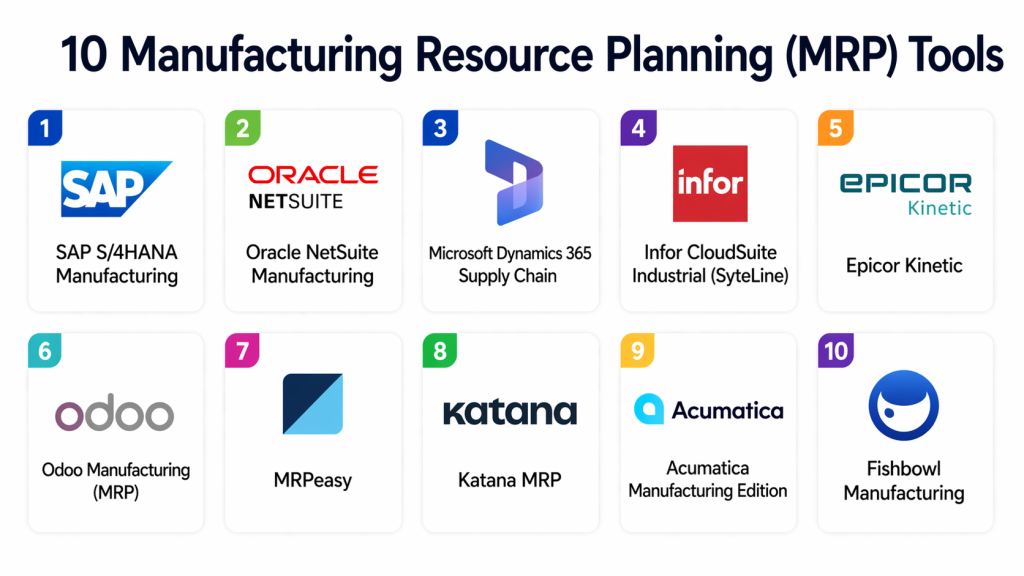
Top 10 Manufacturing Resource Planning (MRP) Tools
#1 — SAP S/4HANA Manufacturing
Short description:
SAP S/4HANA Manufacturing is an enterprise-grade MRP solution offering advanced planning, real-time analytics, and deep integration with SAP’s ERP ecosystem.
Key Features
- Advanced production planning
- Real-time analytics
- Integrated supply chain management
- Inventory optimization
- Demand forecasting
Pros
- Highly scalable
- Strong enterprise capabilities
Cons
- Expensive
- Complex implementation
Platforms / Deployment
Cloud / On-premise
Security & Compliance
RBAC, encryption
Integrations & Ecosystem
Deep integration with SAP ecosystem for end-to-end manufacturing and supply chain management.
- ERP
- MES
- Analytics
Support & Community
Global enterprise support.
#2 — Oracle NetSuite Manufacturing
Short description:
NetSuite Manufacturing provides cloud-based MRP capabilities with strong inventory, production, and financial management integration.
Key Features
- Demand planning
- Inventory tracking
- Production scheduling
- Financial integration
- Real-time reporting
Pros
- Cloud-native
- Easy scalability
Cons
- Subscription cost
- Limited deep customization
Platforms / Deployment
Cloud
Security & Compliance
RBAC, encryption
Integrations & Ecosystem
Integrates with NetSuite ERP and business applications for unified operations.
- ERP
- CRM
Support & Community
Enterprise support.
#3 — Microsoft Dynamics 365 Supply Chain Management
Short description:
Microsoft Dynamics 365 offers MRP capabilities integrated with supply chain and business operations for large-scale manufacturing.
Key Features
- Demand forecasting
- Inventory management
- Production planning
- AI-driven insights
- Integration with Microsoft ecosystem
Pros
- Strong analytics
- Scalable
Cons
- Complex setup
- Licensing cost
Platforms / Deployment
Cloud
Security & Compliance
RBAC, encryption
Integrations & Ecosystem
Deep integration with Microsoft ecosystem and enterprise tools.
- Azure
- Power BI
Support & Community
Strong enterprise support.
#4 — Infor CloudSuite Industrial (SyteLine)
Short description:
Infor CloudSuite Industrial is a manufacturing-focused MRP solution designed for mid-sized and enterprise manufacturers.
Key Features
- Production scheduling
- Inventory management
- Demand planning
- Analytics tools
- Workflow automation
Pros
- Industry-specific features
- Flexible deployment
Cons
- Learning curve
- Customization complexity
Platforms / Deployment
Cloud / On-premise
Security & Compliance
RBAC
Integrations & Ecosystem
Integrates with Infor ecosystem and industrial systems.
- ERP
- Data tools
Support & Community
Enterprise support.
#5 — Epicor Kinetic
Short description:
Epicor Kinetic is a modern MRP solution offering real-time visibility and production control for manufacturers.
Key Features
- Production management
- Inventory control
- Demand planning
- Analytics dashboards
- Workflow automation
Pros
- User-friendly
- Good for mid-market
Cons
- Limited enterprise depth
- Customization needed
Platforms / Deployment
Cloud / On-premise
Security & Compliance
RBAC
Integrations & Ecosystem
Integrates with Epicor ERP and manufacturing systems.
- ERP
- APIs
Support & Community
Strong mid-market support.
#6 — Odoo Manufacturing (MRP)
Short description:
Odoo MRP is an open-source manufacturing planning tool offering flexibility and customization for small to mid-sized businesses.
Key Features
- Production planning
- Inventory management
- Bill of materials
- Work order tracking
- Reporting tools
Pros
- Open-source flexibility
- Affordable
Cons
- Requires customization
- Limited advanced features
Platforms / Deployment
Cloud / Self-hosted
Security & Compliance
Varies / N/A
Integrations & Ecosystem
Integrates with Odoo modules and business applications.
- CRM
- Accounting
Support & Community
Large open-source community.
#7 — MRPeasy
Short description:
MRPeasy is a cloud-based MRP solution designed for small manufacturers with easy-to-use production planning tools.
Key Features
- Production scheduling
- Inventory management
- Procurement planning
- Reporting tools
- Cloud-based access
Pros
- Easy to use
- Affordable
Cons
- Limited scalability
- Basic features
Platforms / Deployment
Cloud
Security & Compliance
Varies / N/A
Integrations & Ecosystem
Integrates with accounting and business tools for small-scale operations.
- APIs
- Business apps
Support & Community
Good SMB support.
#8 — Katana MRP
Short description:
Katana is a modern cloud-based MRP tool focused on inventory and production planning for small businesses.
Key Features
- Inventory tracking
- Production planning
- Order management
- Real-time updates
- Integration tools
Pros
- Simple interface
- Fast deployment
Cons
- Limited enterprise features
- Scaling limitations
Platforms / Deployment
Cloud
Security & Compliance
Varies / N/A
Integrations & Ecosystem
Integrates with e-commerce and accounting tools.
- APIs
- Business apps
Support & Community
Strong SMB support.
#9 — Acumatica Manufacturing Edition
Short description:
Acumatica provides a flexible cloud-based MRP solution with strong financial and operational integration.
Key Features
- Production management
- Inventory control
- Demand planning
- Financial integration
- Analytics
Pros
- Flexible
- Scalable
Cons
- Learning curve
- Customization needed
Platforms / Deployment
Cloud
Security & Compliance
RBAC
Integrations & Ecosystem
Integrates with Acumatica ecosystem and enterprise tools.
- ERP
- APIs
Support & Community
Enterprise support.
#10 — Fishbowl Manufacturing
Short description:
Fishbowl is an inventory and MRP solution designed for small manufacturers and warehouses.
Key Features
- Inventory management
- Production tracking
- Order management
- Reporting tools
- Integration capabilities
Pros
- Easy to implement
- Cost-effective
Cons
- Limited scalability
- Basic features
Platforms / Deployment
On-premise / Cloud
Security & Compliance
Varies / N/A
Integrations & Ecosystem
Integrates with accounting and inventory systems.
- QuickBooks
- APIs
Support & Community
Good SMB support.
Comparison Table (Top 10)
| Tool Name | Best For | Platform(s) Supported | Deployment | Standout Feature | Public Rating |
|---|---|---|---|---|---|
| SAP S/4HANA | Enterprise | Web | Cloud/On-prem | Advanced planning | N/A |
| NetSuite | Cloud MRP | Web | Cloud | Real-time reporting | N/A |
| Dynamics 365 | Enterprise | Web | Cloud | AI insights | N/A |
| Infor CloudSuite | Mid-market | Web | Cloud/On-prem | Industry focus | N/A |
| Epicor Kinetic | Mid-market | Web | Cloud/On-prem | Usability | N/A |
| Odoo MRP | SMB | Web | Cloud/Self | Open-source | N/A |
| MRPeasy | Small biz | Web | Cloud | Simplicity | N/A |
| Katana | SMB | Web | Cloud | Real-time updates | N/A |
| Acumatica | Flexible | Web | Cloud | Integration | N/A |
| Fishbowl | Inventory | Web | Cloud/On-prem | Cost-effective | N/A |
Evaluation & Scoring of Manufacturing Resource Planning (MRP) Tools
| Tool Name | Core (25%) | Ease (15%) | Integrations (15%) | Security (10%) | Performance (10%) | Support (10%) | Value (15%) | Weighted Total (0–10) |
|---|---|---|---|---|---|---|---|---|
| SAP S/4HANA | 9 | 7 | 9 | 9 | 9 | 9 | 7 | 8.6 |
| NetSuite | 8 | 8 | 9 | 9 | 8 | 8 | 8 | 8.3 |
| Dynamics 365 | 9 | 7 | 9 | 9 | 9 | 9 | 7 | 8.5 |
| Infor | 8 | 7 | 8 | 8 | 8 | 8 | 7 | 7.9 |
| Epicor | 8 | 8 | 8 | 7 | 8 | 8 | 8 | 8.0 |
| Odoo | 7 | 9 | 7 | 6 | 7 | 7 | 9 | 7.6 |
| MRPeasy | 7 | 9 | 6 | 6 | 7 | 7 | 9 | 7.5 |
| Katana | 7 | 10 | 6 | 6 | 7 | 7 | 9 | 7.6 |
| Acumatica | 8 | 8 | 8 | 7 | 8 | 8 | 8 | 8.0 |
| Fishbowl | 7 | 9 | 6 | 6 | 7 | 7 | 9 | 7.5 |
How to interpret scores:
These scores provide a comparative overview of MRP tools based on functionality, usability, and scalability. Higher scores indicate enterprise-ready platforms, while lower scores may still be suitable for smaller or specialized use cases.
Which Manufacturing Resource Planning (MRP) Tool Is Right for You?
Solo / Freelancer
Katana or MRPeasy are ideal for small-scale production and simple inventory needs.
SMB
Odoo MRP and Epicor Kinetic provide flexibility and ease of use.
Mid-Market
Infor CloudSuite and Acumatica offer scalable solutions with strong features.
Enterprise
SAP S/4HANA, Oracle NetSuite, and Microsoft Dynamics 365 are best for large-scale operations.
Budget vs Premium
- Budget: Odoo, MRPeasy
- Premium: SAP, Microsoft
Feature Depth vs Ease of Use
- Deep features: SAP, Dynamics
- Easy to use: Katana, MRPeasy
Integrations & Scalability
Choose tools with strong ERP and supply chain integrations.
Security & Compliance Needs
Enterprises should prioritize tools with strong compliance and access controls.
Frequently Asked Questions (FAQs)
What is MRP?
MRP is a system used to plan and manage materials, production, and inventory in manufacturing.
How does MRP differ from ERP?
MRP focuses on production planning, while ERP covers broader business processes.
Are MRP tools cloud-based?
Many modern MRP tools are cloud-native.
What industries use MRP?
Manufacturing, automotive, electronics, and supply chain industries.
Do I need technical expertise?
Yes, especially for integration and customization.
Is MRP scalable?
Enterprise MRP systems are highly scalable.
Can MRP integrate with MES?
Yes, integration with MES and ERP is common.
What are the benefits of MRP?
Improved efficiency, reduced waste, and better inventory control.
How long does implementation take?
It varies from weeks to months.
Can I switch MRP tools later?
Yes, but migration can be complex.
Conclusion
Manufacturing Resource Planning (MRP) Tools are essential for optimizing production workflows, managing inventory, and ensuring efficient use of resources in modern manufacturing environments. As supply chains become more complex and demand variability increases, MRP systems play a crucial role in aligning production with business goals. The tools covered in this guide range from enterprise-grade platforms like SAP S/4HANA and Microsoft Dynamics 365 to flexible solutions like Odoo and Katana, each catering to different operational needs. Selecting the right MRP tool depends on your production scale, integration requirements, and long-term growth strategy. Organizations should prioritize systems that offer real-time visibility, scalability, and seamless integration with ERP and MES platforms. A practical approach is to start with pilot implementations, validate performance, and scale gradually based on results. As manufacturing continues to evolve, MRP tools will remain a cornerstone of efficient and data-driven operations. Investing in the right platform today can significantly improve productivity, reduce costs, and enhance supply chain resilience. Begin by shortlisting a few tools, testing them in real scenarios, and scaling based on measurable outcomes.