Introduction
eProcurement Platforms are digital solutions that automate and manage the procurement process—from sourcing suppliers to placing orders, approving purchases, and processing invoices. These platforms replace manual workflows with automated, data-driven systems that improve efficiency, transparency, and cost control.
In modern business environments, procurement has become more strategic than ever. Organizations need real-time visibility into spending, better supplier collaboration, and faster decision-making. eProcurement platforms enable this by integrating e-sourcing, e-tendering, catalog management, and invoice automation into a unified system
Real-world use cases include:
- Digital supplier onboarding and vendor management
- Automated purchase requisitions and approvals
- E-tendering and reverse auctions
- Contract lifecycle management
- Invoice matching and payment automation
What buyers should evaluate:
- End-to-end procurement coverage (S2P / P2P)
- Supplier collaboration and network access
- Workflow automation and approvals
- Integration with ERP and finance systems
- AI-driven spend analytics
- Scalability and global support
- Security and compliance capabilities
- Ease of use and onboarding
Best for: Enterprises, procurement teams, finance leaders, and organizations managing large supplier ecosystems.
Not ideal for: Small businesses with very simple purchasing needs or those using basic accounting tools.
Key Trends in eProcurement Platforms
- AI-driven spend analysis and recommendations
- Cloud-native procurement ecosystems
- Automation of sourcing-to-payment workflows
- Supplier risk and compliance monitoring
- Real-time spend visibility dashboards
- Integration with ERP, finance, and supply chain systems
- Mobile-first approval workflows
- Sustainability and ESG tracking in procurement
- API-first platforms for scalability
How We Selected These Tools (Methodology)
- Strong market adoption and enterprise usage
- Comprehensive feature coverage (S2P/P2P)
- Proven scalability and reliability
- Availability of automation and analytics capabilities
- Integration ecosystem strength
- Ease of implementation and usability
- Fit across SMB, mid-market, and enterprise
- Vendor reputation and maturity
- Support quality and ecosystem
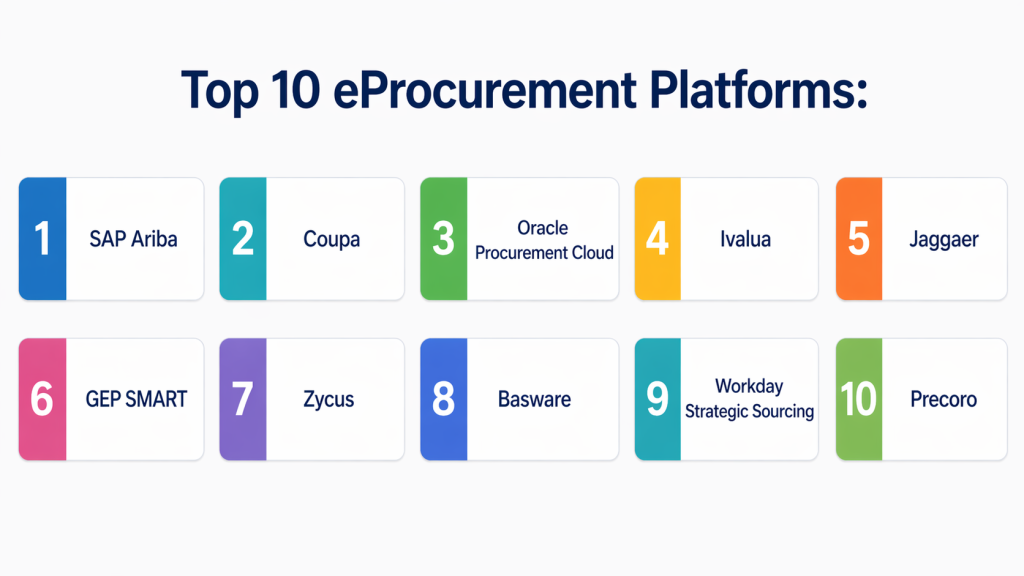
Top 10 eProcurement Platforms
#1 — SAP Ariba
Short description: SAP Ariba is a leading cloud-based eProcurement platform that connects businesses with a global supplier network. It supports sourcing, procurement, and supplier collaboration at scale.
Key Features
- Supplier network and collaboration
- Strategic sourcing and procurement
- Spend analytics
- Contract management
- Invoice automation
Pros
- Massive global supplier network
- Strong enterprise capabilities
Cons
- Complex implementation
- High cost
Platforms / Deployment
Web / Mobile
Cloud
Security & Compliance
Role-based access, compliance workflows
Integrations & Ecosystem
Deep integration with SAP ERP and supply chain systems.
Support & Community
Strong enterprise ecosystem and support.
#2 — Coupa
Short description: Coupa is a cloud-based spend management and eProcurement platform focused on usability and real-time spend visibility. It helps organizations manage procurement, invoicing, and expenses efficiently.
Key Features
- Procurement and invoicing
- Spend analytics
- Supplier management
- Contract management
- AI-driven insights
Pros
- User-friendly interface
- Strong analytics
Cons
- Premium pricing
- Limited customization
Platforms / Deployment
Web / Mobile
Cloud
Security & Compliance
Encryption, access controls
Integrations & Ecosystem
Supports integrations with multiple ERP systems.
Support & Community
Strong documentation and enterprise support.
#3 — Oracle Procurement Cloud
Short description: Oracle Procurement Cloud provides a complete eProcurement suite with supplier management, contract automation, and spend visibility.
Key Features
- Supplier onboarding
- Contract lifecycle management
- Procurement workflows
- Spend analytics
- Risk management
Pros
- Strong enterprise capabilities
- Seamless Oracle integration
Cons
- Complex setup
- Higher cost
Platforms / Deployment
Web / Mobile
Cloud
Security & Compliance
Not publicly stated
Integrations & Ecosystem
Deep integration with Oracle ERP ecosystem.
Support & Community
Enterprise-level support.
#4 — Jaggaer
Short description: Jaggaer is a flexible eProcurement platform designed for enterprises with complex sourcing and supplier management needs.
Key Features
- Source-to-pay suite
- Supplier management
- Spend analytics
- Contract management
- Workflow automation
Pros
- Highly customizable
- Strong sourcing capabilities
Cons
- Requires training
- Complex implementation
Platforms / Deployment
Web / Mobile
Cloud
Security & Compliance
Not publicly stated
Integrations & Ecosystem
Supports enterprise integrations.
Support & Community
Enterprise support.
#5 — GEP SMART
Short description: GEP SMART is an AI-powered eProcurement platform combining sourcing, procurement, and supplier management in one solution.
Key Features
- AI-based analytics
- Supplier lifecycle management
- Contract management
- Spend visibility
- Workflow automation
Pros
- Modern interface
- Scalable
Cons
- Setup time required
- Limited offline capabilities
Platforms / Deployment
Web / Mobile
Cloud
Security & Compliance
Not publicly stated
Integrations & Ecosystem
Supports enterprise integrations.
Support & Community
Moderate support.
#6 — Ivalua
Short description: Ivalua is a flexible source-to-pay platform designed for enterprises that need customization and full control over procurement processes.
Key Features
- Source-to-pay capabilities
- Supplier management
- Contract lifecycle
- Spend analysis
- Workflow automation
Pros
- Highly customizable
- Strong enterprise features
Cons
- Complex deployment
- Requires training
Platforms / Deployment
Web / Mobile
Cloud
Security & Compliance
Not publicly stated
Integrations & Ecosystem
Enterprise integrations supported.
Support & Community
Enterprise-grade support.
#7 — Zycus
Short description: Zycus offers AI-driven procurement automation with strong analytics and supplier management capabilities.
Key Features
- Spend analytics
- Supplier management
- Contract management
- AI automation
- Procurement workflows
Pros
- Strong AI features
- Good analytics
Cons
- Learning curve
- Pricing complexity
Platforms / Deployment
Web / Mobile
Cloud
Security & Compliance
Not publicly stated
Integrations & Ecosystem
ERP integrations supported.
Support & Community
Good support.
#8 — Proactis
Short description: Proactis is a procurement and spend management platform focused on automation and compliance, suitable for mid-sized and enterprise organizations.
Key Features
- Spend management
- Supplier onboarding
- Contract management
- Invoice processing
- Workflow automation
Pros
- Strong compliance features
- Flexible deployment
Cons
- UI may feel outdated
- Limited customization
Platforms / Deployment
Web
Cloud
Security & Compliance
Not publicly stated
Integrations & Ecosystem
Supports integrations with finance systems.
Support & Community
Moderate support.
#9 — Basware
Short description: Basware is a cloud-based eProcurement platform focused on invoice automation and financial process optimization.
Key Features
- Invoice automation
- Spend analytics
- Supplier network
- Procurement workflows
- Compliance tracking
Pros
- Strong invoice processing
- Global reach
Cons
- Limited sourcing features
- Complex pricing
Platforms / Deployment
Web
Cloud
Security & Compliance
Not publicly stated
Integrations & Ecosystem
Supports integrations with finance systems.
Support & Community
Enterprise support.
#10 — Precoro
Short description: Precoro is a user-friendly eProcurement platform designed for SMBs to automate purchasing workflows and control spending.
Key Features
- Purchase order automation
- Budget tracking
- Supplier management
- Reporting
- Workflow approvals
Pros
- Easy to use
- Affordable
Cons
- Limited scalability
- Fewer integrations
Platforms / Deployment
Web
Cloud
Security & Compliance
Not publicly stated
Integrations & Ecosystem
Supports integrations with accounting tools.
Support & Community
Good SMB support.
Comparison Table
| Tool Name | Best For | Platforms | Deployment | Standout Feature | Public Rating |
|---|---|---|---|---|---|
| SAP Ariba | Enterprise | Web, Mobile | Cloud | Supplier network | N/A |
| Coupa | Spend management | Web, Mobile | Cloud | Real-time analytics | N/A |
| Oracle Procurement | Enterprise | Web, Mobile | Cloud | ERP integration | N/A |
| Jaggaer | Large enterprises | Web, Mobile | Cloud | Customization | N/A |
| GEP SMART | AI procurement | Web, Mobile | Cloud | AI insights | N/A |
| Ivalua | Flexible S2P | Web, Mobile | Cloud | Custom workflows | N/A |
| Zycus | AI automation | Web, Mobile | Cloud | AI analytics | N/A |
| Proactis | Compliance | Web | Cloud | Spend control | N/A |
| Basware | Invoice automation | Web | Cloud | Invoice processing | N/A |
| Precoro | SMB | Web | Cloud | Ease of use | N/A |
Evaluation & Scoring of eProcurement Platforms
| Tool Name | Core | Ease | Integrations | Security | Performance | Support | Value | Weighted Total |
|---|---|---|---|---|---|---|---|---|
| SAP Ariba | 10 | 6 | 9 | 8 | 9 | 9 | 6 | 8.5 |
| Coupa | 9 | 8 | 9 | 8 | 9 | 9 | 7 | 8.6 |
| Oracle | 9 | 7 | 9 | 7 | 9 | 9 | 6 | 8.3 |
| Jaggaer | 9 | 6 | 8 | 7 | 9 | 8 | 6 | 8.0 |
| GEP SMART | 9 | 8 | 8 | 7 | 8 | 8 | 7 | 8.2 |
| Ivalua | 9 | 6 | 8 | 7 | 8 | 8 | 6 | 7.9 |
| Zycus | 8 | 7 | 8 | 7 | 8 | 8 | 7 | 7.9 |
| Proactis | 8 | 7 | 7 | 7 | 8 | 7 | 7 | 7.6 |
| Basware | 8 | 7 | 7 | 7 | 8 | 7 | 7 | 7.6 |
| Precoro | 7 | 9 | 6 | 6 | 7 | 7 | 9 | 7.6 |
How to interpret scores: These scores compare tools across features, usability, integrations, and value. Enterprise tools rank higher in capabilities, while SMB tools perform better in ease of use and affordability.
Which eProcurement Platform Is Right for You?
Solo / Freelancer
Basic accounting tools are usually sufficient.
SMB
Choose Precoro or Proactis for affordability and ease of use.
Mid-Market
GEP SMART or Zycus offer balanced capabilities.
Enterprise
SAP Ariba, Coupa, Oracle, Jaggaer, Ivalua are best for complex needs.
Budget vs Premium
- Budget: Precoro
- Premium: SAP Ariba, Coupa
Feature Depth vs Ease of Use
- Advanced: SAP Ariba, Oracle
- Easy: Precoro
Integrations & Scalability
- Strong: SAP Ariba, Coupa
- Basic: Precoro
Security & Compliance Needs
Enterprise platforms provide stronger governance and compliance.
Frequently Asked Questions (FAQs)
1. What is an eProcurement platform?
An eProcurement platform is a digital system that automates procurement processes such as sourcing, purchasing, and invoicing, improving efficiency and transparency.
2. How is eProcurement different from procurement software?
eProcurement focuses specifically on digital and online procurement processes, while procurement software may include both manual and digital workflows.
3. How much do these platforms cost?
Costs vary widely depending on features and company size. Enterprise platforms are more expensive than SMB-focused tools.
4. Are eProcurement platforms suitable for small businesses?
Yes, many tools offer simplified versions for SMBs with easy setup and lower costs.
5. Do these platforms support supplier collaboration?
Yes, most platforms include supplier portals and collaboration features.
6. Can they integrate with ERP systems?
Yes, most modern platforms integrate with ERP and finance systems.
7. How long does implementation take?
Implementation can range from a few days to several months depending on complexity.
8. Are eProcurement platforms secure?
Security varies by vendor, but most offer encryption and access controls.
9. Can these platforms reduce procurement costs?
Yes, they improve spend visibility and help optimize purchasing decisions.
10. Is it easy to switch platforms?
Switching requires planning for data migration and integrations but is manageable.
Conclusion
eProcurement platforms have transformed how organizations manage purchasing by bringing automation, visibility, and control into every stage of the procurement lifecycle. From sourcing suppliers and managing contracts to processing invoices and analyzing spend, these platforms enable businesses to operate more efficiently and make smarter, data-driven decisions. By reducing manual work and improving transparency, they help organizations minimize costs, mitigate risks, and strengthen supplier relationships. However, the right platform depends on your organization’s size, complexity, and operational goals. Enterprise solutions like SAP Ariba and Coupa offer deep functionality and scalability, while SMB-focused tools like Precoro provide simplicity and faster adoption. The key is to align your choice with your procurement maturity and integration needs. A practical approach is to shortlist a few tools, run pilot implementations, and evaluate how well they fit into your workflows before making a long-term investment.