Introduction
Revenue Recognition Software helps businesses automate how revenue is recorded, recognized, and reported based on accounting standards like ASC 606 and IFRS 15. Instead of manually tracking contracts, invoices, and revenue schedules in spreadsheets, these tools provide automated recognition, compliance, and real-time financial insights.
As businesses move toward subscription, SaaS, and complex pricing models, revenue recognition becomes more complicated. Companies must accurately recognize revenue over time, manage deferred revenue, and ensure compliance with strict accounting rules. Revenue recognition software simplifies this by automating calculations, reducing errors, and improving audit readiness.
Real-world use cases include:
- Managing subscription revenue and deferred income
- Automating revenue schedules across contracts
- Ensuring compliance with accounting standards
- Generating audit-ready financial reports
- Integrating revenue data with ERP and billing systems
What buyers should evaluate:
- Compliance with ASC 606 / IFRS 15
- Automation of revenue schedules
- Contract and subscription handling
- Integration with ERP, billing, and CRM systems
- Reporting and analytics capabilities
- Scalability for complex revenue models
- Ease of implementation and use
- Audit and compliance features
Best for: SaaS companies, finance teams, enterprises, and businesses with complex or recurring revenue models.
Not ideal for: Small businesses with simple one-time revenue transactions.
Key Trends in Revenue Recognition Software
- Automation of complex revenue schedules
- Real-time revenue reporting dashboards
- Integration with billing and subscription platforms
- AI-driven financial forecasting
- Cloud-based revenue recognition solutions
- Compliance-first financial systems
- Multi-entity and multi-currency support
- Audit-ready reporting and documentation
- End-to-end financial automation
How We Selected These Tools (Methodology)
- Strong market adoption and credibility
- Compliance with ASC 606 / IFRS 15 standards
- Proven performance and scalability
- Integration ecosystem with ERP and billing systems
- Availability of automation features
- Ease of use and onboarding
- Fit for SMB to enterprise use cases
- Vendor maturity and reliability
- Support and community strength
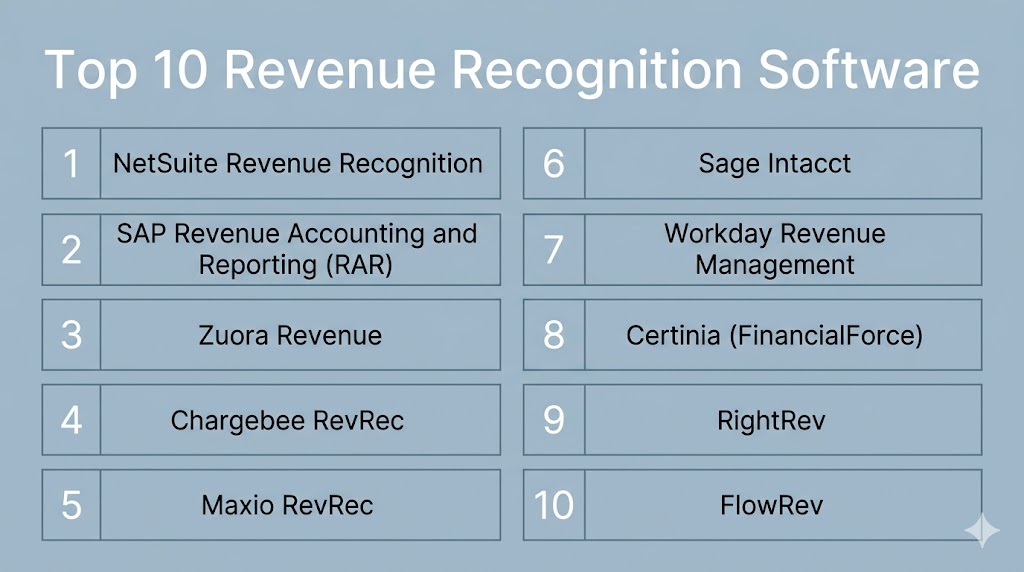
Top 10 Revenue Recognition Software
#1 — NetSuite Revenue Recognition
Short description: NetSuite provides a comprehensive revenue recognition solution integrated with its ERP platform, ideal for enterprises managing complex revenue streams.
Key Features
- Automated revenue recognition
- Compliance with accounting standards
- Contract management
- Financial reporting
- ERP integration
Pros
- Strong enterprise capabilities
- Seamless ERP integration
Cons
- High cost
- Complex setup
Platforms / Deployment
Web
Cloud
Security & Compliance
Role-based access, audit controls
Integrations & Ecosystem
Deep integration with NetSuite ERP
Support & Community
Enterprise-level support
#2 — SAP Revenue Accounting and Reporting (RAR)
Short description: SAP RAR is an enterprise-grade revenue recognition solution designed for organizations requiring strict compliance and scalability.
Key Features
- Revenue accounting automation
- Compliance management
- Contract handling
- Financial reporting
- Workflow automation
Pros
- Highly scalable
- Strong compliance features
Cons
- Complex implementation
- Requires SAP ecosystem
Platforms / Deployment
Web
Cloud / Hybrid
Security & Compliance
Enterprise-grade controls
Integrations & Ecosystem
SAP ecosystem integration
Support & Community
Strong enterprise support
#3 — Zuora Revenue
Short description: Zuora Revenue automates revenue recognition for subscription businesses, integrating billing and financial operations.
Key Features
- Subscription revenue recognition
- Compliance automation
- Revenue forecasting
- Reporting
- Workflow automation
Pros
- Strong for SaaS businesses
- Good automation
Cons
- Expensive
- Complex setup
Platforms / Deployment
Web
Cloud
Security & Compliance
Not publicly stated
Integrations & Ecosystem
Billing and ERP integrations
Support & Community
Good support
#4 — Chargebee RevRec
Short description: Chargebee RevRec provides automated revenue recognition for subscription businesses with strong billing integration.
Key Features
- Automated revenue schedules
- Compliance management
- Subscription handling
- Reporting
- Analytics
Pros
- Easy to use
- Strong billing integration
Cons
- Limited enterprise features
- Pricing varies
Platforms / Deployment
Web
Cloud
Security & Compliance
Not publicly stated
Integrations & Ecosystem
Billing and CRM integrations
Support & Community
Good support
#5 — Maxio RevRec
Short description: Maxio RevRec combines billing and revenue recognition for SaaS companies, offering strong analytics and automation.
Key Features
- Revenue recognition
- Subscription management
- Reporting
- Analytics
- Automation
Pros
- SaaS-focused
- Good analytics
Cons
- Limited non-SaaS use cases
- Pricing complexity
Platforms / Deployment
Web
Cloud
Security & Compliance
Not publicly stated
Integrations & Ecosystem
SaaS integrations
Support & Community
Good support
#6 — Sage Intacct
Short description: Sage Intacct offers revenue recognition as part of its cloud financial management suite, suitable for growing businesses.
Key Features
- Revenue automation
- Financial reporting
- Contract management
- Compliance
- Analytics
Pros
- Strong financial suite
- Scalable
Cons
- Subscription cost
- Learning curve
Platforms / Deployment
Web
Cloud
Security & Compliance
Not publicly stated
Integrations & Ecosystem
Accounting and ERP integrations
Support & Community
Strong support
#7 — Workday Revenue Management
Short description: Workday provides revenue recognition capabilities within its financial management platform for enterprises.
Key Features
- Revenue recognition automation
- Financial reporting
- Compliance management
- Workflow automation
- Analytics
Pros
- Enterprise-ready
- Strong integration
Cons
- Complex deployment
- High cost
Platforms / Deployment
Web
Cloud
Security & Compliance
Enterprise controls
Integrations & Ecosystem
Workday ecosystem
Support & Community
Enterprise support
#8 — Certinia (FinancialForce)
Short description: Certinia offers revenue recognition solutions integrated with Salesforce, ideal for service-based businesses.
Key Features
- Revenue automation
- Contract management
- Reporting
- Compliance
- Analytics
Pros
- Salesforce integration
- Flexible
Cons
- Limited outside Salesforce ecosystem
- Pricing complexity
Platforms / Deployment
Web
Cloud
Security & Compliance
Not publicly stated
Integrations & Ecosystem
Salesforce integrations
Support & Community
Good support
#9 — RightRev
Short description: RightRev is a modern revenue recognition platform designed for high-growth companies needing automation and compliance.
Key Features
- Revenue automation
- Compliance
- Reporting
- Contract management
- Analytics
Pros
- Modern platform
- Scalable
Cons
- Limited brand recognition
- Smaller ecosystem
Platforms / Deployment
Web
Cloud
Security & Compliance
Not publicly stated
Integrations & Ecosystem
ERP integrations
Support & Community
Moderate support
#10 — FlowRev
Short description: FlowRev provides automated revenue recognition for SaaS businesses with strong billing and subscription integration.
Key Features
- Revenue recognition
- Subscription management
- Reporting
- Automation
- Analytics
Pros
- Easy to use
- SaaS-focused
Cons
- Limited enterprise features
- Smaller ecosystem
Platforms / Deployment
Web
Cloud
Security & Compliance
Not publicly stated
Integrations & Ecosystem
Billing integrations
Support & Community
Moderate support
Comparison Table
| Tool Name | Best For | Platforms | Deployment | Standout Feature | Public Rating |
|---|---|---|---|---|---|
| NetSuite | Enterprise | Web | Cloud | ERP integration | N/A |
| SAP RAR | Enterprise | Web | Cloud/Hybrid | Compliance | N/A |
| Zuora Revenue | SaaS | Web | Cloud | Subscription revenue | N/A |
| Chargebee RevRec | SMB SaaS | Web | Cloud | Ease of use | N/A |
| Maxio | SaaS | Web | Cloud | Analytics | N/A |
| Sage Intacct | Mid-market | Web | Cloud | Financial suite | N/A |
| Workday | Enterprise | Web | Cloud | Integration | N/A |
| Certinia | Services | Web | Cloud | Salesforce integration | N/A |
| RightRev | Growth companies | Web | Cloud | Automation | N/A |
| FlowRev | SaaS | Web | Cloud | Simplicity | N/A |
Evaluation & Scoring of Revenue Recognition Software
| Tool Name | Core | Ease | Integrations | Security | Performance | Support | Value | Weighted Total |
|---|---|---|---|---|---|---|---|---|
| NetSuite | 9 | 7 | 9 | 8 | 9 | 9 | 7 | 8.4 |
| SAP RAR | 9 | 6 | 9 | 9 | 9 | 9 | 6 | 8.3 |
| Zuora | 8 | 7 | 8 | 7 | 8 | 8 | 7 | 7.8 |
| Chargebee | 8 | 9 | 8 | 7 | 8 | 8 | 8 | 8.1 |
| Maxio | 8 | 8 | 7 | 7 | 8 | 8 | 7 | 7.8 |
| Sage Intacct | 8 | 8 | 8 | 7 | 8 | 8 | 7 | 7.9 |
| Workday | 9 | 7 | 9 | 8 | 9 | 9 | 6 | 8.2 |
| Certinia | 8 | 7 | 8 | 7 | 8 | 8 | 7 | 7.8 |
| RightRev | 7 | 8 | 7 | 7 | 8 | 7 | 8 | 7.6 |
| FlowRev | 7 | 9 | 6 | 6 | 7 | 7 | 8 | 7.4 |
How to interpret scores: Enterprise tools score higher in scalability and compliance, while SMB tools perform better in usability and cost efficiency.
Which Revenue Recognition Software Is Right for You?
Solo / Freelancer
Basic accounting tools are sufficient.
SMB
Choose Chargebee RevRec or FlowRev.
Mid-Market
Sage Intacct or Maxio offer strong balance.
Enterprise
NetSuite, SAP RAR, Workday are best for complex needs.
Budget vs Premium
- Budget: FlowRev
- Premium: NetSuite, SAP
Feature Depth vs Ease of Use
- Advanced: SAP, NetSuite
- Easy: Chargebee
Integrations & Scalability
- Strong: Enterprise tools
- Moderate: SMB tools
Security & Compliance Needs
Enterprise tools provide stronger compliance features.
Frequently Asked Questions (FAQs)
1. What is revenue recognition software?
Revenue recognition software automates how businesses record revenue according to accounting rules. It ensures revenue is recognized accurately over time rather than immediately. This helps companies stay compliant and maintain accurate financial reporting.
2. Why is revenue recognition important?
It ensures businesses report revenue correctly and comply with accounting standards. Without it, companies risk financial inaccuracies and compliance issues. It also helps in better financial planning and forecasting.
3. Who needs revenue recognition software?
SaaS companies, subscription businesses, and enterprises with complex contracts benefit the most. Any business dealing with deferred or recurring revenue can use it. It becomes essential as financial operations scale.
4. How does the software work?
It automatically tracks contracts, billing schedules, and revenue timelines. Based on rules, it recognizes revenue over time and generates reports. This eliminates manual calculations and reduces errors.
5. Does it support compliance standards?
Yes, most tools support standards like ASC 606 and IFRS 15. These ensure revenue is recognized correctly based on contractual obligations. Compliance is one of the main reasons businesses adopt these tools.
6. Can it integrate with ERP systems?
Yes, integration with ERP, billing, and CRM systems is a key feature. It ensures data flows seamlessly across financial systems. This reduces manual work and improves accuracy.
7. How long does implementation take?
Implementation depends on complexity and business size. SMB tools can be set up quickly, while enterprise systems take longer. Proper planning ensures smoother deployment.
8. Is it suitable for small businesses?
Yes, but only if they have complex revenue models. For simple businesses, basic accounting tools may be enough. SMB-focused solutions are available for growing companies.
9. Can it reduce errors?
Yes, automation significantly reduces manual errors in revenue calculations. It ensures accurate reporting and compliance. This improves audit readiness.
10. Is it easy to switch tools?
Switching requires data migration and planning. Businesses should test compatibility before switching. A pilot approach can help reduce risks.
Conclusion
Revenue recognition software has become a critical component for businesses dealing with complex revenue streams, especially in subscription and SaaS models. By automating revenue calculations, ensuring compliance with accounting standards, and providing real-time financial insights, these tools help organizations maintain accuracy and transparency in their financial reporting. They reduce manual effort, minimize errors, and improve audit readiness, making them essential for modern finance teams.
The right solution depends on your organization’s size, revenue complexity, and integration requirements. Enterprise platforms like NetSuite, SAP RAR, and Workday offer deep functionality and scalability, while tools like Chargebee RevRec and FlowRev provide simplicity and faster implementation for smaller teams. A practical approach is to shortlist a few tools, test them with real business scenarios, and evaluate how well they integrate with your existing systems before making a final decision. Choosing the right revenue recognition software can significantly improve financial efficiency and support long-term growth.