Introduction
AI Agent Platforms are systems that enable developers and businesses to build, deploy, and manage autonomous AI agents capable of reasoning, planning, and executing tasks across applications. Unlike traditional AI tools that respond to prompts, AI agents can take actions, interact with systems, and complete multi-step workflows independently.
These platforms combine large language models, workflow orchestration, APIs, and integrations to create intelligent agents that automate business processes, customer interactions, and operational tasks. They are becoming a foundational layer for automation across industries.
Real-world use cases include:
- Autonomous customer support agents
- Workflow automation across apps and APIs
- AI-powered research and data analysis
- Task execution (emails, scheduling, reporting)
- Multi-agent collaboration systems
Key evaluation criteria for buyers:
- Agent orchestration and workflow capabilities
- Integration with APIs, tools, and data sources
- Multi-agent collaboration support
- Security, governance, and compliance
- Scalability and performance
- Customization and developer flexibility
- Monitoring and observability tools
- Ease of use (no-code vs developer-first)
- Deployment flexibility (cloud/on-prem/hybrid)
- Cost and operational overhead
Best for:
AI agent platforms are ideal for developers, enterprises, automation teams, and AI engineers building intelligent automation systems.
Not ideal for:
Simple automation use cases that can be handled by basic scripting or rule-based tools.
Key Trends in AI Agent Platforms
- Agentic AI replacing traditional automation tools
- Multi-agent systems collaborating on complex tasks
- Deep integration with enterprise apps (Slack, CRM, APIs)
- Low-code and no-code agent builders emerging
- Built-in governance, security, and compliance layers
- Autonomous task execution with minimal human input
- Integration with LLMs and retrieval systems (RAG)
- Real-time monitoring and observability of agents
- Hybrid deployment models (cloud + on-prem)
- Rise of developer-first agent frameworks
How We Selected These Tools (Methodology)
- Evaluated agent orchestration and autonomy capabilities
- Assessed integration with APIs and enterprise systems
- Reviewed multi-agent collaboration features
- Checked scalability and enterprise readiness
- Considered security, governance, and compliance
- Examined developer experience and flexibility
- Evaluated ease of use (no-code vs code-first)
- Reviewed community adoption and ecosystem
- Considered open-source vs managed platforms
- Ensured applicability across SMB to enterprise environments
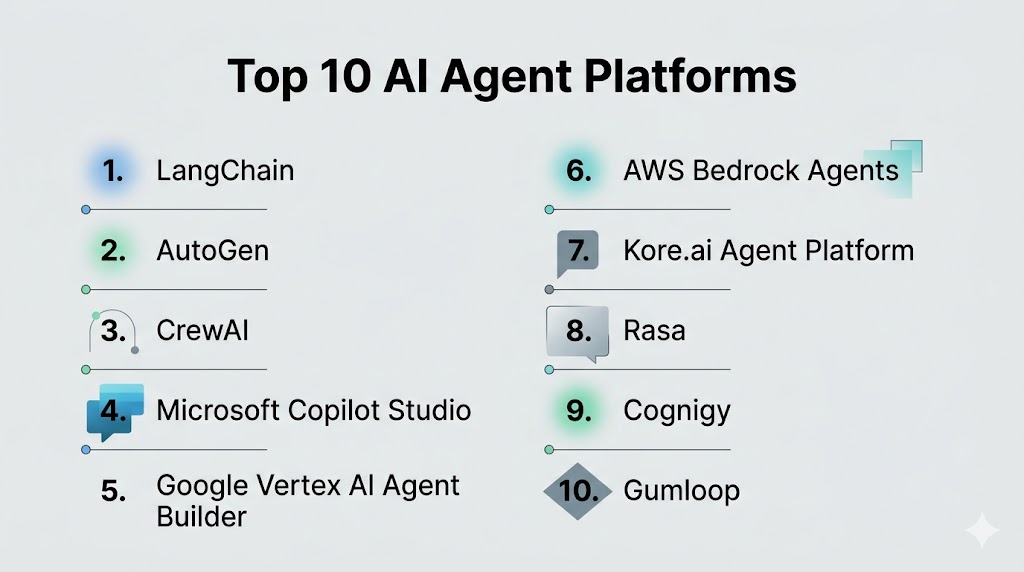
Top 10 AI Agent Platforms
#1 — LangChain
Short description (3-4 lines): LangChain is a developer-first framework for building AI agents that connect language models with external tools, APIs, and data sources.
Key Features
- Agent orchestration
- Tool and API integration
- Memory and context management
- Multi-step workflows
- RAG support
- Open-source ecosystem
Pros
- Highly flexible
- Large ecosystem
Cons
- Requires coding
- Complex setup
Platforms / Deployment
- Cloud / On-prem
Security & Compliance
- Depends on deployment
Integrations & Ecosystem
- APIs, databases, ML tools
Support & Community
- Large developer community
#2 — AutoGen
Short description: AutoGen is a framework for building multi-agent systems that collaborate to complete complex tasks.
Key Features
- Multi-agent collaboration
- Task automation
- LLM integration
- Workflow orchestration
- Custom agent roles
Pros
- Strong multi-agent support
- Flexible
Cons
- Developer-focused
- Learning curve
Platforms / Deployment
- Cloud / Local
Security & Compliance
- Depends on deployment
Integrations & Ecosystem
- LLMs, APIs
Support & Community
- Growing community
#3 — CrewAI
Short description: CrewAI enables developers to create teams of AI agents working together on shared tasks.
Key Features
- Multi-agent coordination
- Task delegation
- Workflow automation
- Python-based framework
- Role-based agents
Pros
- Easy agent collaboration
- Lightweight
Cons
- Limited enterprise features
- Smaller ecosystem
Platforms / Deployment
- Local / Cloud
Security & Compliance
- Depends on deployment
Integrations & Ecosystem
- APIs
Support & Community
- Active community
#4 — Microsoft Copilot Studio
Short description: Copilot Studio allows enterprises to build AI agents integrated with Microsoft ecosystems.
Key Features
- No-code agent builder
- Workflow automation
- Integration with Microsoft 365
- AI-powered assistants
- Enterprise deployment
Pros
- Easy to use
- Strong enterprise integration
Cons
- Microsoft dependency
- Limited flexibility
Platforms / Deployment
- Cloud
Security & Compliance
- Enterprise-grade security
Integrations & Ecosystem
- Microsoft ecosystem
Support & Community
- Enterprise support
#5 — Google Vertex AI Agent Builder
Short description: Vertex AI Agent Builder provides tools for creating AI agents with deep integration into Google Cloud.
Key Features
- Agent creation tools
- RAG integration
- Workflow orchestration
- API integration
- Scalable infrastructure
Pros
- Scalable
- Cloud-native
Cons
- Google dependency
- Learning curve
Platforms / Deployment
- Cloud
Security & Compliance
- IAM, encryption
Integrations & Ecosystem
- Google Cloud
Support & Community
- Google support
#6 — AWS Bedrock AgentCore
Short description: AWS Bedrock AgentCore enables building and deploying AI agents with secure orchestration on AWS.
Key Features
- Agent orchestration
- LLM integration
- Secure workflows
- API connectivity
- Scalable deployment
Pros
- Enterprise-ready
- Secure
Cons
- AWS dependency
- Cost complexity
Platforms / Deployment
- Cloud
Security & Compliance
- IAM, encryption
Integrations & Ecosystem
- AWS ecosystem
Support & Community
- AWS support
#7 — Kore.ai
Short description: Kore.ai is an enterprise conversational AI and agent platform for automation and customer engagement.
Key Features
- Conversational AI agents
- Workflow automation
- Multi-channel support
- Analytics and monitoring
- Enterprise features
Pros
- Enterprise-ready
- Rich features
Cons
- Complex
- Expensive
Platforms / Deployment
- Cloud / Hybrid
Security & Compliance
- Enterprise compliance
Integrations & Ecosystem
- CRM, enterprise tools
Support & Community
- Enterprise support
#8 — Rasa
Short description: Rasa is an open-source platform for building conversational AI agents with full control.
Key Features
- Open-source framework
- Conversational AI
- Custom workflows
- On-prem deployment
- Full customization
Pros
- Full control
- Privacy-focused
Cons
- Requires expertise
- Setup complexity
Platforms / Deployment
- On-prem / Cloud
Security & Compliance
- Strong control
Integrations & Ecosystem
- APIs
Support & Community
- Active community
#9 — Cognigy
Short description: Cognigy provides AI agent automation for customer service and enterprise workflows.
Key Features
- Voice and chat agents
- Workflow automation
- Multi-channel support
- Analytics tools
- Enterprise deployment
Pros
- Scalable
- Strong automation
Cons
- Enterprise pricing
- Complex
Platforms / Deployment
- Cloud / Hybrid
Security & Compliance
- Enterprise security
Integrations & Ecosystem
- CRM, contact center tools
Support & Community
- Enterprise support
#10 — Gumloop
Short description: Gumloop is a no-code AI agent platform designed for building automation workflows easily.
Key Features
- No-code agent builder
- Workflow automation
- Integration with tools
- LLM support
- Easy deployment
Pros
- Beginner-friendly
- Fast setup
Cons
- Limited advanced features
- New platform
Platforms / Deployment
- Cloud
Security & Compliance
- Standard controls
Integrations & Ecosystem
- APIs
Support & Community
- Growing community
Comparison Table
| Tool | Best For | Platform | Deployment | Standout Feature | Rating |
|---|---|---|---|---|---|
| LangChain | Developers | Multi | Hybrid | Flexibility | N/A |
| AutoGen | Multi-agent | Multi | Hybrid | Collaboration | N/A |
| CrewAI | Lightweight agents | Multi | Hybrid | Simplicity | N/A |
| Copilot Studio | Enterprise | Cloud | Cloud | No-code builder | N/A |
| Vertex AI | Cloud AI | Cloud | Cloud | Scalability | N/A |
| AWS Bedrock | Enterprise AI | Cloud | Cloud | Secure orchestration | N/A |
| Kore.ai | Conversational AI | Multi | Hybrid | Enterprise features | N/A |
| Rasa | Open-source | Multi | On-prem | Full control | N/A |
| Cognigy | Automation | Multi | Hybrid | Voice agents | N/A |
| Gumloop | No-code | Cloud | Cloud | Ease of use | N/A |
Evaluation & Scoring
| Tool | Core | Ease | Integration | Security | Performance | Support | Value | Total |
|---|---|---|---|---|---|---|---|---|
| LangChain | 10 | 7 | 9 | 7 | 9 | 9 | 9 | 8.9 |
| AutoGen | 9 | 7 | 8 | 7 | 9 | 8 | 8 | 8.4 |
| CrewAI | 8 | 8 | 7 | 7 | 8 | 7 | 8 | 7.8 |
| Copilot Studio | 8 | 9 | 9 | 9 | 8 | 8 | 7 | 8.3 |
| Vertex AI | 9 | 7 | 9 | 9 | 9 | 8 | 7 | 8.6 |
| AWS Bedrock | 9 | 7 | 9 | 9 | 9 | 8 | 7 | 8.6 |
| Kore.ai | 9 | 7 | 8 | 9 | 9 | 8 | 7 | 8.4 |
| Rasa | 9 | 6 | 8 | 9 | 8 | 8 | 9 | 8.3 |
| Cognigy | 8 | 7 | 8 | 9 | 8 | 8 | 7 | 8.0 |
| Gumloop | 7 | 9 | 7 | 7 | 7 | 7 | 8 | 7.6 |
Which AI Agent Platform Is Right for You?
Solo / Freelancer
Gumloop or CrewAI is best for quick setup and simplicity.
SMB
LangChain or AutoGen offers flexibility and scalability.
Mid-Market
Vertex AI or Copilot Studio provides integration and growth.
Enterprise
AWS Bedrock, Kore.ai, or Rasa delivers security and full control.
Frequently Asked Questions (FAQs)
What is an AI agent platform?
An AI agent platform allows users to build autonomous systems that can perform tasks, make decisions, and interact with external tools. These platforms go beyond chatbots by enabling multi-step reasoning and execution workflows.
How are AI agents different from chatbots?
Chatbots typically respond to user queries, while AI agents can take actions and complete tasks autonomously. Agents can plan, execute workflows, and interact with APIs or systems without constant user input.
Can AI agents work across multiple systems?
Yes, modern platforms integrate with APIs, databases, and business tools. This allows agents to operate across systems like CRM, email, and analytics platforms to complete tasks end-to-end.
Are AI agent platforms secure?
Enterprise platforms include security features such as access controls, encryption, and governance policies. However, proper configuration and monitoring are essential to prevent misuse or unintended actions.
Do AI agents require coding knowledge?
Some platforms are developer-focused and require coding, while others offer no-code or low-code interfaces. This allows both technical and non-technical users to build AI agents.
Can AI agents replace human workers?
AI agents automate repetitive tasks but do not fully replace humans. They augment productivity and allow humans to focus on higher-value work.
What industries use AI agent platforms?
Industries such as finance, healthcare, retail, and IT use AI agents for automation, customer support, and data processing.
Are AI agent platforms scalable?
Yes, most platforms are designed to scale across large workloads and enterprise environments. Cloud-based solutions provide high scalability and reliability.
What are the limitations of AI agents?
Limitations include dependency on data quality, potential errors in execution, and lack of full contextual understanding. Human oversight is still required.
How to choose the right AI agent platform?
Choose based on your use case, integration needs, scalability requirements, and budget. Testing platforms with real workflows helps determine the best fit.
Conclusion
AI agent platforms are rapidly redefining automation by enabling systems that can think, act, and execute tasks autonomously across complex workflows. Developer-first tools like LangChain and AutoGen provide flexibility for building advanced agent systems, while platforms like CrewAI and Gumloop simplify agent creation for smaller teams. Mid-market organizations benefit from integrated solutions like Microsoft Copilot Studio and Google Vertex AI, which combine usability with scalability. Enterprises can leverage powerful platforms like AWS Bedrock, Kore.ai, and Rasa to achieve secure, large-scale automation with governance and control. The right platform depends on your technical capabilities, integration needs, and automation goals. A practical approach is to experiment with a few platforms, evaluate their real-world performance, and choose the one that aligns best with your business and operational strategy.