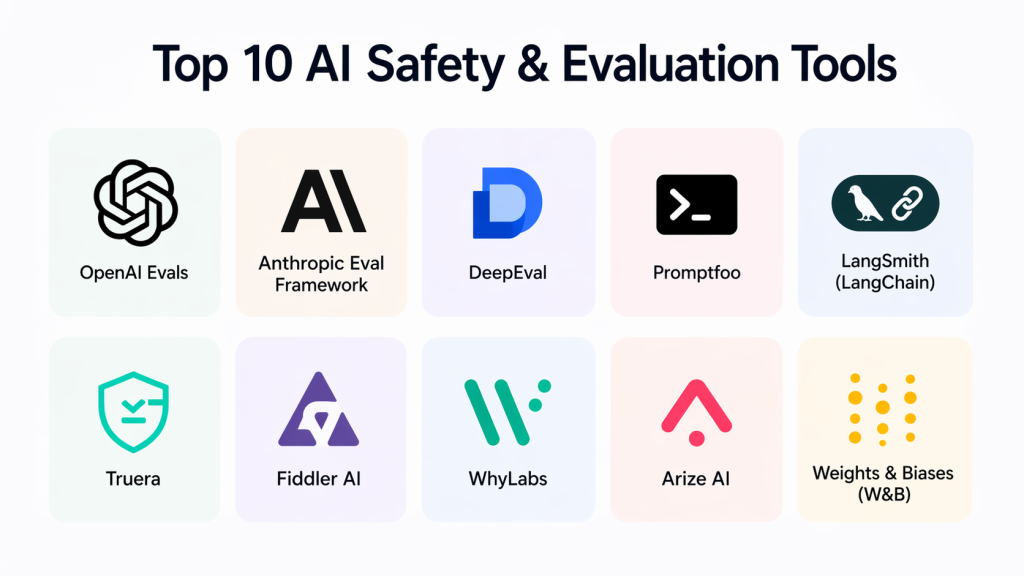
Introduction
AI Safety & Evaluation Tools are platforms designed to test, monitor, and improve the reliability, fairness, and safety of AI systems—especially large language models and generative AI applications. These tools help organizations validate outputs, detect risks, and ensure AI systems behave as expected in real-world scenarios.
As AI adoption expands across industries, risks like hallucinations, bias, data leakage, and unsafe outputs are becoming critical concerns. Organizations are now prioritizing structured evaluation frameworks to maintain trust, compliance, and performance in AI-driven systems.
Common use cases include:
- Evaluating LLM outputs for accuracy and consistency
- Detecting bias, toxicity, and harmful responses
- Monitoring model drift and performance degradation
- Testing prompts and AI workflows
- Enforcing AI governance and compliance policies
Key evaluation criteria:
- Flexibility of evaluation frameworks
- Support for LLM testing and benchmarking
- Automation and CI/CD integration
- Observability and monitoring capabilities
- Security and privacy controls
- Integration with AI/ML pipelines
- Scalability for production environments
- Ease of use for developers and analysts
Best for: AI engineers, ML teams, enterprises deploying generative AI, and organizations focused on AI governance and risk management.
Not ideal for: Small teams experimenting with basic AI tools or organizations without production-level AI deployments.
Key Trends in AI Safety & Evaluation Tools for 2026 and Beyond
- LLM-specific evaluation frameworks for generative AI
- Automated red-teaming and adversarial testing
- Real-time monitoring of AI outputs in production
- AI-driven bias and fairness detection
- Tight integration with MLOps and CI/CD pipelines
- Synthetic data testing for edge cases
- Policy-based governance and guardrails
- Human-in-the-loop evaluation systems
- Explainability and transparency improvements
- Multi-model and multi-provider evaluation capabilities
How We Selected These Tools (Methodology)
- Evaluated industry adoption and developer usage trends
- Assessed flexibility and completeness of evaluation features
- Compared real-time monitoring and observability capabilities
- Reviewed security and governance readiness
- Analyzed integration with AI ecosystems and pipelines
- Considered usability and developer experience
- Included both enterprise and developer-first solutions
- Balanced commercial and open-source tools
- Focused on real-world applicability and scalability
Top 10 AI Safety & Evaluation Tools Tools
#1 — OpenAI Evals
Short description:
OpenAI Evals is an open-source evaluation framework designed to benchmark and test large language models using structured datasets and scenarios. It enables developers to systematically measure model performance and improve output reliability.
Key Features
- Custom evaluation pipelines
- Dataset-based benchmarking
- LLM performance tracking
- Extensible framework
- Open-source flexibility
Pros
- Highly customizable
- Strong developer adoption
Cons
- Requires coding knowledge
- Limited visual interface
Platforms / Deployment
Self-hosted
Security & Compliance
Varies / N/A
Integrations & Ecosystem
Works with custom AI pipelines and LLM frameworks, allowing developers to integrate evaluation workflows into their existing systems.
- Python-based workflows
- APIs
- Model providers
Support & Community
Active open-source community with strong documentation support.
#2 — Anthropic Eval Framework
Short description:
Anthropic’s evaluation framework focuses on AI alignment, safety testing, and responsible AI behavior. It is designed to assess how well models follow intended instructions and ethical guidelines.
Key Features
- Alignment-focused testing
- Scenario-based evaluations
- Safety benchmarking
- Prompt evaluation tools
Pros
- Strong focus on AI safety
- Suitable for advanced use cases
Cons
- Limited general-purpose tooling
- Smaller ecosystem
Platforms / Deployment
Cloud / Self-hosted
Security & Compliance
Not publicly stated
Integrations & Ecosystem
Designed to integrate with AI pipelines and evaluation workflows, especially in safety-critical applications.
- APIs
- LLM platforms
Support & Community
Research-driven support with a growing developer community.
#3 — DeepEval
Short description:
DeepEval is a lightweight evaluation framework built for testing LLM applications with automated metrics and benchmarking tools. It is designed for developers who want quick and flexible evaluation setups.
Key Features
- Automated evaluation metrics
- Prompt testing
- CI/CD integration
- Benchmarking tools
Pros
- Easy to integrate
- Developer-friendly design
Cons
- Limited enterprise features
- Requires setup effort
Platforms / Deployment
Self-hosted
Security & Compliance
Varies / N/A
Integrations & Ecosystem
Works well with modern AI stacks and development pipelines, enabling continuous evaluation.
- Python
- CI/CD tools
Support & Community
Growing community with evolving documentation.
#4 — Promptfoo
Short description:
Promptfoo is a testing framework focused on prompt engineering and LLM evaluation across multiple models. It allows teams to compare outputs and optimize prompts effectively.
Key Features
- Prompt testing workflows
- Multi-model comparison
- Scenario-based evaluation
- CLI-based automation
Pros
- Simple and effective
- Great for prompt optimization
Cons
- Limited enterprise capabilities
- CLI-centric interface
Platforms / Deployment
Self-hosted
Security & Compliance
Varies / N/A
Integrations & Ecosystem
Supports integration with multiple AI providers and development environments.
- OpenAI
- Anthropic
- Hugging Face
Support & Community
Active developer community with regular updates.
#5 — LangSmith (LangChain)
Short description:
LangSmith provides observability and evaluation tools for LLM applications, especially those built using LangChain. It helps developers debug, monitor, and optimize AI workflows.
Key Features
- LLM observability
- Workflow tracing
- Debugging tools
- Evaluation tracking
Pros
- Strong debugging capabilities
- Seamless integration with LangChain
Cons
- Dependency on LangChain ecosystem
- Learning curve for new users
Platforms / Deployment
Cloud
Security & Compliance
Not publicly stated
Integrations & Ecosystem
Deep integration with LangChain and modern AI tools, making it suitable for advanced workflows.
- APIs
- LLM providers
Support & Community
Large developer community and extensive documentation.
#6 — Truera
Short description:
Truera is an enterprise-grade AI quality and explainability platform that focuses on model evaluation, bias detection, and governance. It is designed for organizations deploying AI at scale.
Key Features
- Model explainability
- Bias detection
- Performance monitoring
- Governance tools
Pros
- Enterprise-ready features
- Strong explainability tools
Cons
- Complex implementation
- Higher cost
Platforms / Deployment
Cloud / Hybrid
Security & Compliance
RBAC, audit logs
Integrations & Ecosystem
Integrates with enterprise ML workflows and cloud platforms, enabling end-to-end AI monitoring.
- AWS
- Azure
- ML frameworks
Support & Community
Enterprise-level support with onboarding assistance.
#7 — Fiddler AI
Short description:
Fiddler AI provides monitoring and explainability tools for production AI systems, helping organizations ensure transparency and fairness.
Key Features
- Model monitoring
- Explainability dashboards
- Bias detection
- Performance analytics
Pros
- Strong monitoring capabilities
- Suitable for enterprise use
Cons
- Integration complexity
- Pricing not transparent
Platforms / Deployment
Cloud / Hybrid
Security & Compliance
RBAC, audit logs
Integrations & Ecosystem
Supports integration with modern ML infrastructure and deployment pipelines.
- Kubernetes
- AWS
- ML tools
Support & Community
Enterprise-grade support and documentation.
#8 — WhyLabs
Short description:
WhyLabs offers data and model observability tools to track AI performance in production and detect anomalies.
Key Features
- Data monitoring
- Drift detection
- Observability dashboards
- Alerting system
Pros
- Strong observability features
- Easy to integrate
Cons
- Limited governance depth
- Requires configuration
Platforms / Deployment
Cloud
Security & Compliance
Not publicly stated
Integrations & Ecosystem
Integrates with data pipelines and monitoring tools for continuous evaluation.
- Python
- Data platforms
Support & Community
Growing ecosystem with improving support.
#9 — Arize AI
Short description:
Arize AI focuses on model observability and evaluation, helping teams monitor performance and identify issues in real time.
Key Features
- Performance monitoring
- Drift detection
- Evaluation metrics
- Visualization tools
Pros
- Scalable platform
- Strong analytics capabilities
Cons
- Setup complexity
- Enterprise-focused
Platforms / Deployment
Cloud
Security & Compliance
Not publicly stated
Integrations & Ecosystem
Works with cloud and ML ecosystems to support production AI monitoring.
- AWS
- GCP
- ML frameworks
Support & Community
Enterprise support with detailed documentation.
#10 — Weights & Biases (W&B)
Short description:
Weights & Biases is a widely used platform for experiment tracking, evaluation, and monitoring of machine learning models.
Key Features
- Experiment tracking
- Model evaluation
- Visualization dashboards
- Collaboration tools
Pros
- Highly popular and widely adopted
- Strong ecosystem support
Cons
- Pricing for advanced features
- Learning curve
Platforms / Deployment
Cloud / Self-hosted
Security & Compliance
SSO, RBAC
Integrations & Ecosystem
Extensive integrations with machine learning frameworks and tools, making it versatile for various workflows.
- PyTorch
- TensorFlow
- Hugging Face
Support & Community
Large global community with strong documentation.
Comparison Table (Top 10)
| Tool Name | Best For | Platform(s) Supported | Deployment | Standout Feature | Public Rating |
|---|---|---|---|---|---|
| OpenAI Evals | LLM benchmarking | CLI/Web | Self-hosted | Custom eval pipelines | N/A |
| Anthropic Eval | AI safety | Web | Cloud/Self | Alignment testing | N/A |
| DeepEval | Developers | CLI | Self-hosted | Lightweight testing | N/A |
| Promptfoo | Prompt testing | CLI | Self-hosted | Multi-model comparison | N/A |
| LangSmith | Debugging | Web | Cloud | Observability | N/A |
| Truera | Enterprise AI | Web | Cloud/Hybrid | Explainability | N/A |
| Fiddler AI | Monitoring | Web | Cloud/Hybrid | Bias detection | N/A |
| WhyLabs | Observability | Web | Cloud | Drift detection | N/A |
| Arize AI | Monitoring | Web | Cloud | Performance analytics | N/A |
| W&B | ML tracking | Web | Cloud/Self | Experiment tracking | N/A |
Evaluation & Scoring of AI Safety & Evaluation Tools
| Tool Name | Core (25%) | Ease (15%) | Integrations (15%) | Security (10%) | Performance (10%) | Support (10%) | Value (15%) | Weighted Total (0–10) |
|---|---|---|---|---|---|---|---|---|
| OpenAI Evals | 9 | 6 | 8 | 6 | 8 | 7 | 9 | 7.9 |
| Anthropic Eval | 8 | 6 | 7 | 7 | 8 | 6 | 8 | 7.4 |
| DeepEval | 8 | 7 | 7 | 6 | 7 | 6 | 9 | 7.5 |
| Promptfoo | 7 | 8 | 7 | 6 | 7 | 6 | 9 | 7.4 |
| LangSmith | 9 | 7 | 8 | 7 | 8 | 8 | 8 | 8.0 |
| Truera | 9 | 6 | 8 | 8 | 8 | 8 | 7 | 8.0 |
| Fiddler AI | 8 | 7 | 8 | 8 | 8 | 7 | 7 | 7.9 |
| WhyLabs | 7 | 8 | 7 | 7 | 8 | 7 | 8 | 7.6 |
| Arize AI | 8 | 7 | 8 | 7 | 8 | 7 | 7 | 7.7 |
| W&B | 9 | 8 | 9 | 7 | 9 | 9 | 8 | 8.6 |
How to interpret scores:
These scores provide a relative comparison across core capabilities, usability, and ecosystem strength. Higher scores indicate more balanced and production-ready platforms, while slightly lower scores may still represent excellent niche or developer-focused tools. Use this table as a directional guide rather than an absolute ranking.
Which AI Safety & Evaluation Tools Tool Is Right for You?
Solo / Freelancer
If you are experimenting with AI models or building small-scale projects, lightweight tools like Promptfoo or DeepEval are ideal. They offer flexibility without requiring heavy infrastructure.
SMB
Small and growing teams should prioritize usability and integration ease. LangSmith and Weights & Biases provide a good balance of functionality and scalability.
Mid-Market
Organizations at this stage need both monitoring and evaluation capabilities. WhyLabs and Fiddler AI offer strong observability and production readiness.
Enterprise
Large organizations should focus on governance, explainability, and compliance. Truera, Arize AI, and Fiddler AI are well-suited for enterprise AI deployments.
Budget vs Premium
- Budget-friendly: OpenAI Evals, DeepEval
- Premium solutions: Truera, Arize AI
Feature Depth vs Ease of Use
- Deep features: Truera, Fiddler AI
- Ease of use: Promptfoo, Weights & Biases
Integrations & Scalability
Choose tools that integrate seamlessly with your ML pipelines and support scaling across multiple environments.
Security & Compliance Needs
For regulated industries, prioritize platforms with strong access controls, audit logs, and governance features.
Frequently Asked Questions (FAQs)
What are AI Safety & Evaluation Tools?
These tools help test, monitor, and improve AI systems by evaluating outputs, detecting risks, and ensuring models behave safely and reliably in production environments.
Why are these tools important?
They reduce risks such as hallucinations, bias, and unsafe outputs, helping organizations maintain trust and compliance in AI systems.
Are these tools only for enterprises?
No, many tools are designed for developers and smaller teams, while others are built for enterprise-scale deployments.
How do these tools integrate with AI pipelines?
Most platforms provide APIs, SDKs, and integrations with ML frameworks, enabling seamless connection with CI/CD and MLOps workflows.
Do these tools support real-time monitoring?
Yes, many tools offer real-time monitoring, alerts, and dashboards to track AI performance continuously.
What is model drift?
Model drift occurs when an AI model’s performance declines over time due to changes in data or usage patterns.
Can I use open-source tools?
Yes, open-source tools like OpenAI Evals provide flexibility and customization for developers.
How long does implementation take?
Implementation can range from a few days for simple setups to several weeks for enterprise deployments.
Are these tools secure?
Security features vary by platform, but enterprise tools typically include RBAC, encryption, and audit logs.
Can I switch tools later?
Yes, but switching may require reconfiguring pipelines and migrating evaluation data, which can be complex.
Conclusion
AI Safety & Evaluation Tools have become a critical component of modern AI systems, especially as organizations move from experimentation to production deployment. These tools help ensure that AI models are reliable, safe, and aligned with business and ethical expectations.The platforms covered in this guide offer a wide spectrum of capabilities, ranging from lightweight evaluation frameworks to enterprise-grade monitoring and governance solutions. Each tool serves a unique purpose, whether it is prompt testing, model observability, or bias detection. Choosing the right tool depends heavily on your organization’s AI maturity, scale, and specific use cases. Smaller teams may benefit from simple and flexible tools, while enterprises require robust platforms with advanced governance and compliance feature.It is important to consider factors such as integration capabilities, scalability, and long-term maintainability when selecting a solution. AI systems evolve rapidly, and your evaluation tools must be able to adapt accordingly. A practical approach is to shortlist a few tools, test them in controlled environments, and evaluate how well they fit into your workflows. This ensures that your final choice aligns with both technical and business requirements.