Introduction
Configure-Price-Quote (CPQ) software helps sales teams automate complex product configurations, pricing logic, and quote generation. Instead of relying on spreadsheets or manual approvals, CPQ platforms ensure that every quote is accurate, consistent, and aligned with business rules.
In modern B2B sales environments, speed and precision are critical. Customers expect fast responses, personalized pricing, and error-free proposals. CPQ tools streamline this entire process by integrating with CRM, ERP, and billing systems, reducing sales cycles and improving conversion rates.
Common use cases include:
- Generating accurate quotes for configurable products
- Automating pricing rules and discount approvals
- Managing subscription and recurring pricing models
- Supporting global sales teams with standardized pricing
- Reducing manual errors in complex deals
What buyers should evaluate:
- Product configuration flexibility
- Pricing and discounting capabilities
- CRM and ERP integrations
- Workflow automation and approvals
- Subscription and billing support
- Ease of use for sales teams
- Scalability across regions and teams
- Reporting and analytics
- Security and compliance
- Total cost of ownership
Best for: B2B sales teams, SaaS companies, manufacturers, telecom providers, and enterprises with complex pricing structures.
Not ideal for: Small businesses with simple pricing models or teams that do not require structured quote automation.
Key Trends in Configure-Price-Quote (CPQ) Software
- AI-driven pricing recommendations and deal optimization
- Automation of approval workflows and discount governance
- Growth of subscription and usage-based pricing support
- Real-time quote generation and dynamic pricing
- Integration with revenue lifecycle management platforms
- API-first architectures for composable sales stacks
- Embedded analytics for deal performance insights
- Self-service quoting for customers and partners
- Enhanced mobile sales capabilities
- Expansion into end-to-end revenue platforms
How We Selected These Tools (Methodology)
- Strong market adoption and enterprise usage
- Feature completeness in configuration and pricing
- Integration capabilities with CRM, ERP, and billing systems
- Scalability across SMB and enterprise segments
- Security and governance readiness
- Ease of use and onboarding experience
- Workflow automation capabilities
- Vendor ecosystem and support quality
- Performance in handling complex product catalogs
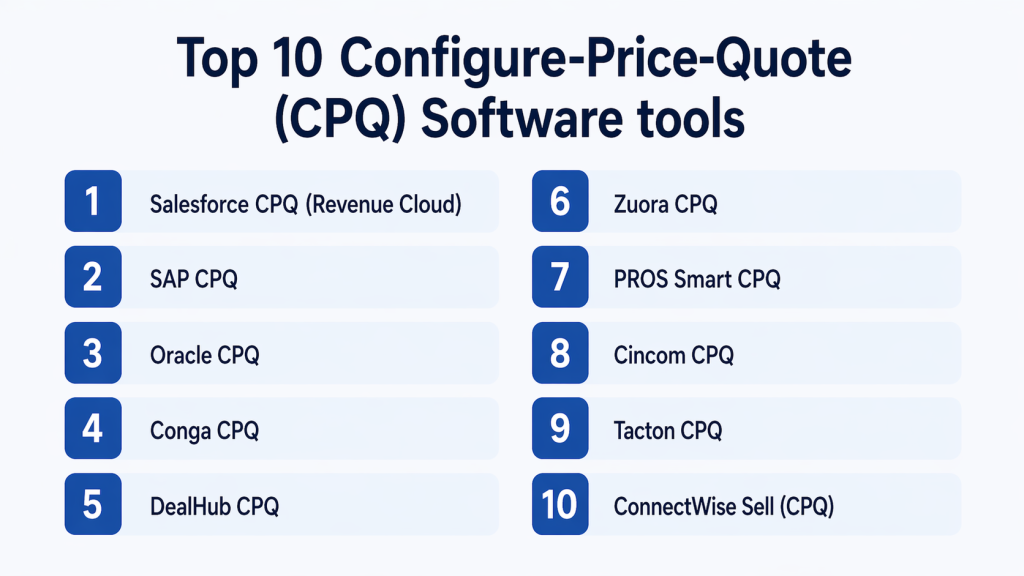
Top 10 Configure-Price-Quote (CPQ) Software
#1 — Salesforce CPQ (Revenue Cloud)
Short description:
Salesforce CPQ is a leading CPQ solution deeply integrated with the Salesforce ecosystem. It enables sales teams to configure complex products, apply pricing rules, and generate accurate quotes quickly. The platform supports subscription and usage-based pricing models, making it ideal for SaaS and enterprise sales teams. It enhances productivity by automating approvals and workflows. Strong scalability and ecosystem support make it a preferred choice for large organizations.
Key Features
- Advanced product configuration
- Automated pricing and discounting
- Quote generation and approvals
- Subscription billing support
- CRM-native integration
- Revenue lifecycle management
Pros
- Deep Salesforce integration
- Highly scalable
Cons
- Expensive
- Requires customization
Platforms / Deployment
Cloud
Security & Compliance
SSO, RBAC, audit logs (other certifications: Not publicly stated)
Integrations & Ecosystem
Strong ecosystem with enterprise tools and CRM platforms.
- Salesforce CRM
- ERP systems
- APIs
Support & Community
Extensive documentation and large global community.
#2 — SAP CPQ
Short description:
SAP CPQ is an enterprise-grade solution designed for complex product configurations and pricing scenarios. It integrates seamlessly with SAP ERP systems, making it ideal for large organizations and manufacturers. The platform supports advanced automation and workflow management. It helps sales teams manage complex deals efficiently. Built for scalability, it suits global enterprises with intricate pricing needs.
Key Features
- Advanced configuration engine
- Pricing automation
- Workflow approvals
- Integration with SAP systems
- Quote lifecycle management
Pros
- Strong enterprise capabilities
- Deep ERP integration
Cons
- Complex implementation
- High cost
Platforms / Deployment
Cloud
Security & Compliance
Not publicly stated
Integrations & Ecosystem
Enterprise-grade integrations across systems.
- SAP ERP
- APIs
Support & Community
Enterprise-level support and onboarding.
#3 — Oracle CPQ
Short description:
Oracle CPQ provides powerful tools for managing complex configurations and pricing models. It includes guided selling features that help sales teams choose the right product combinations. The platform is suitable for enterprises with large catalogs and advanced pricing needs. It offers strong automation and analytics capabilities. Known for reliability and flexibility in enterprise environments.
Key Features
- Guided selling workflows
- Pricing automation
- Quote generation
- Workflow management
- Analytics and reporting
Pros
- Highly configurable
- Enterprise-ready
Cons
- Steep learning curve
- Expensive
Platforms / Deployment
Cloud
Security & Compliance
Not publicly stated
Integrations & Ecosystem
Integrates with enterprise systems.
- Oracle ERP
- APIs
Support & Community
Strong enterprise support.
#4 — Conga CPQ
Short description:
Conga CPQ focuses on automating quote creation and document generation. It integrates with CRM platforms and simplifies complex sales workflows. The platform is suitable for mid-market and enterprise businesses. It enhances efficiency by reducing manual work. Known for strong document automation capabilities.
Key Features
- Quote automation
- Pricing rules engine
- Document generation
- Workflow approvals
- CRM integration
Pros
- Strong document automation
- Flexible deployment
Cons
- Setup complexity
- Pricing varies
Platforms / Deployment
Cloud
Security & Compliance
Not publicly stated
Integrations & Ecosystem
Supports CRM and enterprise integrations.
- Salesforce
- APIs
Support & Community
Good documentation and support.
#5 — DealHub CPQ
Short description:
DealHub CPQ is designed for modern sales teams looking for simplicity and speed. It provides guided selling and real-time pricing capabilities. The platform is easy to implement and user-friendly. Ideal for SMBs and growing businesses. Helps teams close deals faster with minimal complexity.
Key Features
- Guided selling
- Real-time pricing
- Quote automation
- Workflow approvals
- Analytics
Pros
- Easy to use
- Fast implementation
Cons
- Limited enterprise features
- Customization constraints
Platforms / Deployment
Cloud
Security & Compliance
Not publicly stated
Integrations & Ecosystem
Integrates with popular CRM tools.
- HubSpot
- Salesforce
- APIs
Support & Community
Responsive and helpful support.
#6 — Zuora CPQ
Short description:
Zuora CPQ is built for subscription-based businesses that require recurring billing and pricing models. It integrates with billing platforms to manage the entire subscription lifecycle. Ideal for SaaS companies and service-based businesses. Provides strong automation for pricing and invoicing workflows. Designed for scalability in subscription environments.
Key Features
- Subscription pricing
- Billing integration
- Quote generation
- Workflow automation
- Revenue management
Pros
- Strong subscription support
- Scalable architecture
Cons
- Complex setup
- Limited outside subscription use
Platforms / Deployment
Cloud
Security & Compliance
Not publicly stated
Integrations & Ecosystem
Integrates with billing and CRM systems.
- Salesforce
- APIs
Support & Community
Enterprise support available.
#7 — PROS Smart CPQ
Short description:
PROS Smart CPQ focuses on AI-driven pricing and revenue optimization. It helps businesses improve pricing strategies using advanced analytics. The platform supports complex configurations and automation. Ideal for enterprises that prioritize pricing intelligence. Offers strong insights into deal performance.
Key Features
- AI pricing optimization
- Configuration engine
- Quote automation
- Advanced analytics
- Workflow management
Pros
- Advanced pricing intelligence
- Strong analytics capabilities
Cons
- Complex implementation
- Higher cost
Platforms / Deployment
Cloud
Security & Compliance
Not publicly stated
Integrations & Ecosystem
Supports enterprise integrations.
- CRM systems
- APIs
Support & Community
Enterprise-grade support.
#8 — Cincom CPQ
Short description:
Cincom CPQ is designed for manufacturing industries with complex product configurations. It supports detailed engineering rules and workflows. The platform is suitable for industrial businesses. It enables accurate configuration and pricing. Known for handling highly customizable products.
Key Features
- Complex configuration engine
- Pricing automation
- Workflow management
- Integration capabilities
- Quote generation
Pros
- Strong manufacturing focus
- Detailed configuration support
Cons
- Outdated interface
- Complex setup
Platforms / Deployment
Cloud / On-premise
Security & Compliance
Not publicly stated
Integrations & Ecosystem
Supports integrations with enterprise systems.
- ERP
- APIs
Support & Community
Moderate support.
#9 — Tacton CPQ
Short description:
Tacton CPQ is a powerful solution for engineering-heavy industries. It enables advanced product configuration and visualization. The platform supports guided selling and automation. Ideal for manufacturing and complex product environments. Known for its strong configuration engine.
Key Features
- Advanced configuration
- Visualization tools
- Guided selling
- Pricing automation
- Workflow management
Pros
- Strong configuration capabilities
- Industry-focused
Cons
- Expensive
- Requires expertise
Platforms / Deployment
Cloud
Security & Compliance
Not publicly stated
Integrations & Ecosystem
Supports enterprise integrations.
- CAD systems
- ERP
- APIs
Support & Community
Enterprise-level support.
#10 — ConnectWise Sell (CPQ)
Short description:
ConnectWise Sell is a CPQ solution designed for IT service providers and SMBs. It simplifies quoting and proposal generation. The platform is easy to use and quick to implement. It integrates with CRM and PSA tools. Ideal for smaller teams needing efficient quoting.
Key Features
- Quote automation
- Proposal generation
- CRM integration
- Workflow management
- Reporting
Pros
- Easy to use
- Suitable for SMBs
Cons
- Limited enterprise features
- Customization limitations
Platforms / Deployment
Cloud
Security & Compliance
Not publicly stated
Integrations & Ecosystem
Supports integrations with IT tools.
- CRM systems
- APIs
Support & Community
Good SMB-focused support.
Comparison Table (Top 10)
| Tool Name | Best For | Platform(s) Supported | Deployment | Standout Feature | Public Rating |
|---|---|---|---|---|---|
| Salesforce CPQ | Enterprise | Web | Cloud | CRM-native integration | N/A |
| SAP CPQ | Enterprise | Web | Cloud | ERP integration | N/A |
| Oracle CPQ | Enterprise | Web | Cloud | Guided selling | N/A |
| Conga CPQ | Mid-market | Web | Cloud | Document automation | N/A |
| DealHub CPQ | SMB | Web | Cloud | Ease of use | N/A |
| Zuora CPQ | SaaS | Web | Cloud | Subscription pricing | N/A |
| PROS CPQ | Enterprise | Web | Cloud | AI pricing | N/A |
| Cincom CPQ | Manufacturing | Web | Hybrid | Product configuration | N/A |
| Tacton CPQ | Manufacturing | Web | Cloud | Visualization | N/A |
| ConnectWise Sell | SMB | Web | Cloud | Simplicity | N/A |
Evaluation & Scoring of Configure-Price-Quote (CPQ) Software
| Tool Name | Core (25%) | Ease (15%) | Integrations (15%) | Security (10%) | Performance (10%) | Support (10%) | Value (15%) | Weighted Total |
|---|---|---|---|---|---|---|---|---|
| Salesforce CPQ | 9 | 7 | 9 | 8 | 9 | 9 | 7 | 8.4 |
| SAP CPQ | 9 | 6 | 9 | 8 | 9 | 8 | 6 | 8.1 |
| Oracle CPQ | 9 | 6 | 8 | 8 | 9 | 8 | 6 | 8.0 |
| Conga CPQ | 8 | 7 | 8 | 7 | 8 | 7 | 7 | 7.6 |
| DealHub CPQ | 7 | 9 | 7 | 6 | 7 | 7 | 8 | 7.5 |
| Zuora CPQ | 8 | 7 | 8 | 7 | 8 | 8 | 7 | 7.8 |
| PROS CPQ | 9 | 6 | 8 | 7 | 9 | 8 | 6 | 8.0 |
| Cincom CPQ | 8 | 6 | 7 | 7 | 8 | 7 | 6 | 7.3 |
| Tacton CPQ | 9 | 6 | 8 | 7 | 9 | 8 | 6 | 8.0 |
| ConnectWise Sell | 7 | 9 | 7 | 6 | 7 | 7 | 8 | 7.5 |
How to interpret scores:
These scores are comparative and help highlight strengths across features, usability, and value. Enterprise tools typically score higher in scalability and integrations, while SMB-focused tools perform better in ease of use and pricing. Use these scores as guidance rather than absolute rankings.
Which Configure-Price-Quote (CPQ) Software Is Right for You?
Solo / Freelancer
CPQ tools are generally not required unless dealing with complex pricing.
SMB
DealHub CPQ and ConnectWise Sell are ideal for simplicity and cost efficiency.
Mid-Market
Conga CPQ offers a good balance between features and usability.
Enterprise
Salesforce CPQ, SAP CPQ, and Oracle CPQ are best suited.
Budget vs Premium
Budget tools prioritize ease, while premium tools offer automation and scalability.
Feature Depth vs Ease of Use
Choose based on complexity of sales processes and team expertise.
Integrations & Scalability
Ensure compatibility with CRM and ERP systems.
Security & Compliance Needs
Enterprises should prioritize governance and access control.
Frequently Asked Questions (FAQs)
1. What is CPQ software?
CPQ software automates product configuration, pricing, and quote generation. It helps sales teams create accurate proposals quickly. It reduces manual errors and improves consistency. CPQ integrates with CRM systems for better workflow management. It is widely used in B2B sales environments with complex pricing models.
2. Who should use CPQ software?
CPQ software is ideal for businesses with complex products, pricing rules, or customization requirements. SaaS companies, manufacturers, telecom providers, and enterprise sales teams benefit the most. It is especially useful when manual quoting becomes inefficient. Organizations with large sales teams gain significant productivity improvements.
3. How does CPQ improve sales efficiency?
CPQ reduces the time needed to generate quotes by automating pricing and approvals. It ensures accuracy, which minimizes rework and delays. Sales reps can focus more on closing deals instead of manual tasks. Faster response times improve customer experience. Overall, it accelerates the sales cycle.
4. Can CPQ integrate with CRM systems?
Yes, most CPQ tools are designed to integrate seamlessly with CRM platforms. This ensures that customer data, product information, and pricing rules are aligned. Integration improves workflow efficiency and data consistency. It also enables automation across the sales process. CRM integration is a key requirement for CPQ adoption.
5. Is CPQ software expensive?
Pricing varies depending on the vendor and features offered. Enterprise-grade solutions are typically more expensive due to advanced capabilities. SMB-focused tools offer more affordable options. It is important to evaluate ROI rather than just upfront cost. Efficiency gains often justify the investment.
6. What are common challenges in CPQ implementation?
Implementation can be complex due to configuration and integration requirements. Data migration from legacy systems can take time. Training sales teams is also necessary. Poor planning can lead to delays. Choosing the right tool and strategy is critical for success.
7. Can CPQ handle subscription pricing?
Yes, many CPQ tools support subscription and recurring pricing models. This is especially important for SaaS businesses. It helps manage billing cycles, renewals, and upgrades. Advanced tools also support usage-based pricing. This flexibility makes CPQ valuable for modern pricing strategies.
8. How secure is CPQ software?
Security depends on the vendor and deployment model. Most enterprise tools provide access control, encryption, and audit logs. It is important to evaluate compliance requirements. Sensitive pricing and customer data must be protected. Always review security features before adoption.
9. Can CPQ be customized?
Yes, most CPQ platforms offer customization options for pricing rules, workflows, and configurations. Enterprise tools provide deeper customization capabilities. However, customization can increase implementation complexity. It is important to balance flexibility with usability.
10. What are alternatives to CPQ software?
Alternatives include spreadsheets and manual quoting processes. However, these methods are prone to errors and inefficiency. CPQ provides automation and scalability. For growing businesses, CPQ is a more reliable solution. It ensures accuracy and consistency in sales operations.
Conclusion
Configure-Price-Quote software has become a critical component of modern sales operations, especially for businesses dealing with complex products and pricing models. It enables organizations to automate configuration, pricing, and quoting processes, reducing errors and accelerating deal cycles. While simpler tools work well for small teams, enterprise platforms offer advanced features such as AI-driven pricing, deep integrations, and scalable workflows. The right choice depends on your business size, sales complexity, and integration requirements. Instead of focusing only on features, evaluate how well the tool fits into your existing systems and processes. Shortlist a few options, test them in real scenarios, and validate their impact on sales efficiency before making a long-term decision.