Introduction
SCADA (Supervisory Control and Data Acquisition) Systems are critical software platforms used in industrial automation to monitor, control, and analyze real-time processes across factories, utilities, and infrastructure. These systems collect data from sensors, PLCs, and machines, then present it through dashboards, alarms, and control interfaces for operators.
In modern industrial environments, SCADA systems are evolving rapidly with cloud integration, IIoT (Industrial Internet of Things), and AI-driven analytics. They are no longer just monitoring tools—they are now central to predictive maintenance, digital twins, and intelligent automation strategies.
Common use cases include:
- Manufacturing process monitoring
- Power grid and energy management
- Oil & gas pipeline control
- Water treatment and utilities management
- Smart factory and Industry 4.0 systems
Key evaluation criteria:
- Real-time data acquisition and visualization
- Protocol support (OPC, Modbus, etc.)
- Scalability and distributed architecture
- Integration with PLCs and industrial devices
- Security and access control
- Alarm management and reporting
- Cloud and IIoT readiness
- Ease of configuration and deployment
Best for: Industrial enterprises, manufacturing plants, utilities, energy companies, and automation engineers managing large-scale operations.
Not ideal for: Small automation setups or projects without real-time monitoring and control requirements.
Key Trends in Industrial Automation SCADA Systems for 2026 and Beyond
- Integration with IIoT platforms and edge computing
- Cloud-native SCADA architectures
- AI-driven predictive maintenance and analytics
- Digital twin integration for industrial systems
- Enhanced cybersecurity for critical infrastructure
- Web-based HMI and remote monitoring
- Hybrid architectures combining edge + cloud
- Open protocols and interoperability standards
- Real-time data streaming and analytics pipelines
- Convergence with MES and ERP systems
How We Selected These Tools (Methodology)
- Evaluated adoption across industrial automation sectors
- Assessed real-time monitoring and control capabilities
- Compared protocol support and interoperability
- Reviewed scalability and enterprise readiness
- Analyzed integration with IIoT and cloud systems
- Considered usability and engineering flexibility
- Included both legacy leaders and modern platforms
- Focused on real-world industrial deployments
- Balanced performance, innovation, and reliability
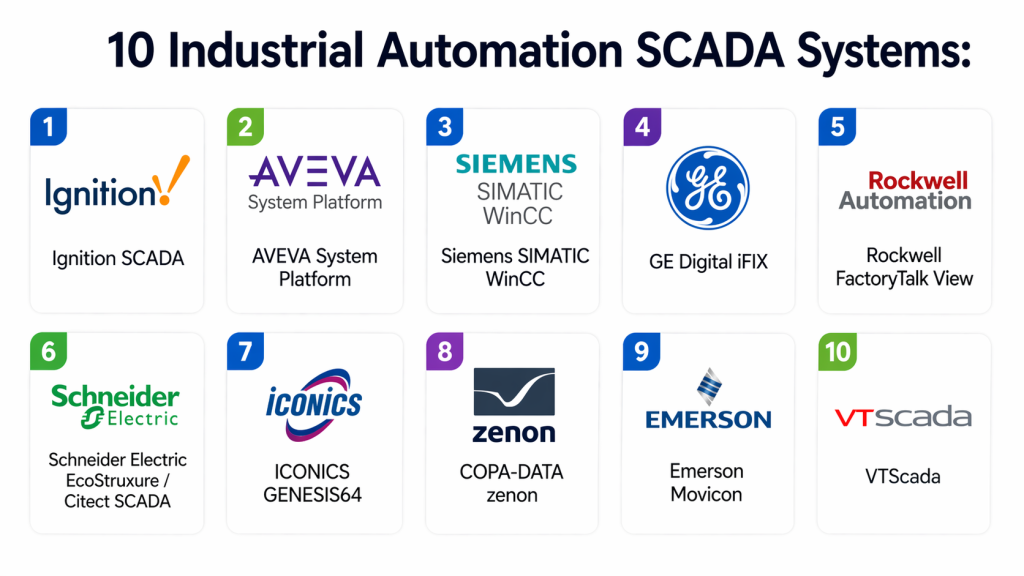
Top 10 Industrial Automation SCADA Systems
#1 — Ignition SCADA (Inductive Automation)
Short description:
Ignition is a modern SCADA platform designed for industrial automation, offering unlimited licensing and strong integration with IIoT systems and databases.
Key Features
- Real-time monitoring and visualization
- Unlimited tags and clients
- Web-based deployment
- Integrated historian
- IIoT and MES capabilities
Pros
- Highly scalable
- Flexible licensing model
Cons
- Requires configuration expertise
- Learning curve
Platforms / Deployment
Cloud / On-premise
Security & Compliance
RBAC, encryption, audit logs
Integrations & Ecosystem
Ignition integrates with a wide range of industrial systems and databases, enabling centralized control and analytics.
- OPC UA
- SQL databases
- PLCs
Support & Community
Large community and strong vendor support.
#2 — AVEVA System Platform (Wonderware)
Short description:
AVEVA System Platform is a leading enterprise SCADA solution known for its scalability and object-oriented architecture.
Key Features
- Enterprise-wide SCADA architecture
- Object-based modeling
- Advanced visualization
- Historian integration
- Redundancy support
Pros
- Enterprise-grade
- Highly scalable
Cons
- Expensive
- Complex deployment
Platforms / Deployment
Cloud / On-premise
Security & Compliance
RBAC, encryption
Integrations & Ecosystem
Integrates deeply with AVEVA ecosystem and industrial systems for large-scale automation.
- MES
- Historian
- ERP systems
Support & Community
Strong enterprise support and global presence.
#3 — Siemens SIMATIC WinCC
Short description:
WinCC is a widely used SCADA system for industrial automation, offering robust real-time monitoring and diagnostics.
Key Features
- Real-time control
- Advanced HMI
- Data logging
- Diagnostics tools
- Integration with Siemens PLCs
Pros
- Reliable and mature
- Strong industrial adoption
Cons
- Vendor lock-in
- Complex configuration
Platforms / Deployment
Windows / Cloud
Security & Compliance
RBAC, encryption
Integrations & Ecosystem
Deep integration with Siemens automation ecosystem.
- PLCs
- TIA Portal
Support & Community
Strong global support.
#4 — GE Digital iFIX
Short description:
iFIX is a proven SCADA platform used in industries requiring high reliability and regulatory compliance.
Key Features
- Real-time monitoring
- Alarm management
- Data visualization
- Integration with GE Historian
- Compliance tools
Pros
- Stable and reliable
- Strong compliance support
Cons
- Legacy architecture
- Limited modern UI
Platforms / Deployment
Windows
Security & Compliance
RBAC, audit logs
Integrations & Ecosystem
Integrates with industrial systems and data platforms for process monitoring.
- Historian
- PLCs
Support & Community
Established enterprise support.
#5 — FactoryTalk View (Rockwell Automation)
Short description:
FactoryTalk View is a SCADA platform designed for industrial automation with strong integration into Rockwell systems.
Key Features
- HMI and SCADA integration
- Real-time monitoring
- Alarm management
- Data logging
- Visualization tools
Pros
- Strong Rockwell integration
- Reliable performance
Cons
- Vendor-specific
- Licensing costs
Platforms / Deployment
Windows / Cloud
Security & Compliance
RBAC
Integrations & Ecosystem
Works with Rockwell automation ecosystem and industrial systems.
- PLCs
- Automation tools
Support & Community
Enterprise support.
#6 — Schneider Electric EcoStruxure (Citect SCADA)
Short description:
EcoStruxure is a SCADA solution focused on industrial automation and energy management.
Key Features
- Real-time monitoring
- Alarm management
- Distributed architecture
- Visualization tools
- Energy management
Pros
- Strong industrial focus
- Scalable
Cons
- Complex setup
- Vendor dependency
Platforms / Deployment
Cloud / On-premise
Security & Compliance
RBAC, encryption
Integrations & Ecosystem
Integrates with Schneider Electric systems and industrial infrastructure.
- PLCs
- Energy systems
Support & Community
Global enterprise support.
#7 — ICONICS GENESIS64
Short description:
GENESIS64 is a modern SCADA platform with advanced visualization and IoT integration capabilities.
Key Features
- 3D visualization
- IoT integration
- Real-time analytics
- Cloud support
- Scalability
Pros
- Modern UI
- Strong visualization
Cons
- Complex configuration
- Learning curve
Platforms / Deployment
Cloud / Windows
Security & Compliance
RBAC
Integrations & Ecosystem
Integrates with IoT platforms and industrial systems.
- Azure
- APIs
Support & Community
Enterprise support.
#8 — COPA-DATA zenon
Short description:
Zenon is a flexible SCADA platform used in energy, manufacturing, and infrastructure industries.
Key Features
- Cross-platform support
- Energy management
- Automation integration
- Visualization tools
- Security features
Pros
- Flexible architecture
- Strong security
Cons
- Complex configuration
- Limited ecosystem
Platforms / Deployment
Windows / Cloud
Security & Compliance
RBAC, encryption
Integrations & Ecosystem
Supports integration with industrial systems and energy platforms.
- APIs
- Automation tools
Support & Community
Strong enterprise support.
#9 — Emerson Movicon
Short description:
Movicon is a lightweight SCADA platform designed for embedded and edge automation applications.
Key Features
- Edge computing support
- HTML5 visualization
- Lightweight runtime
- Real-time monitoring
- Embedded deployment
Pros
- Lightweight
- Flexible
Cons
- Limited scalability
- Smaller ecosystem
Platforms / Deployment
Cloud / Edge / On-premise
Security & Compliance
RBAC
Integrations & Ecosystem
Integrates with industrial devices and edge systems.
- APIs
- PLCs
Support & Community
Moderate community.
#10 — VTScada
Short description:
VTScada is a robust SCADA platform focused on monitoring, data logging, and visualization for industrial systems.
Key Features
- Data visualization
- Alarm management
- Historical data tracking
- Dashboard design
- HMI integration
Pros
- Easy configuration
- Reliable monitoring
Cons
- Limited advanced features
- Smaller ecosystem
Platforms / Deployment
On-premise
Security & Compliance
RBAC
Integrations & Ecosystem
Supports integration with industrial systems and monitoring tools.
- PLCs
- Data systems
Support & Community
Moderate support and documentation.
Comparison Table (Top 10)
| Tool Name | Best For | Platform(s) Supported | Deployment | Standout Feature | Public Rating |
|---|---|---|---|---|---|
| Ignition | IIoT SCADA | Web | Cloud/On-prem | Unlimited licensing | N/A |
| AVEVA | Enterprise | Windows/Web | Cloud/On-prem | Enterprise scale | N/A |
| WinCC | Manufacturing | Windows | Cloud/On-prem | Siemens integration | N/A |
| iFIX | Compliance | Windows | On-prem | Reliability | N/A |
| FactoryTalk | Rockwell users | Windows | Cloud/On-prem | HMI integration | N/A |
| EcoStruxure | Energy systems | Web | Cloud/On-prem | Energy mgmt | N/A |
| GENESIS64 | Modern UI | Windows | Cloud | 3D visualization | N/A |
| zenon | Energy | Windows | Cloud | Security | N/A |
| Movicon | Edge systems | Multi | Edge/Cloud | Lightweight | N/A |
| VTScada | Monitoring | Windows | On-prem | Simplicity | N/A |
Evaluation & Scoring of Industrial Automation SCADA Systems
| Tool Name | Core (25%) | Ease (15%) | Integrations (15%) | Security (10%) | Performance (10%) | Support (10%) | Value (15%) | Weighted Total (0–10) |
|---|---|---|---|---|---|---|---|---|
| Ignition | 9 | 8 | 9 | 8 | 9 | 9 | 9 | 8.8 |
| AVEVA | 9 | 7 | 9 | 9 | 9 | 9 | 7 | 8.6 |
| WinCC | 9 | 7 | 8 | 9 | 9 | 9 | 7 | 8.5 |
| iFIX | 8 | 6 | 8 | 9 | 8 | 8 | 7 | 7.9 |
| FactoryTalk | 8 | 7 | 8 | 8 | 8 | 8 | 7 | 7.9 |
| EcoStruxure | 8 | 7 | 8 | 9 | 8 | 8 | 7 | 8.0 |
| GENESIS64 | 8 | 7 | 8 | 8 | 8 | 8 | 8 | 8.0 |
| zenon | 8 | 7 | 7 | 9 | 8 | 8 | 7 | 7.9 |
| Movicon | 7 | 8 | 7 | 7 | 7 | 7 | 8 | 7.4 |
| VTScada | 7 | 8 | 7 | 7 | 7 | 7 | 8 | 7.4 |
How to interpret scores:
These scores reflect a comparative analysis across performance, usability, and enterprise readiness. Higher scores indicate robust, scalable systems suitable for large deployments, while lower scores may still be effective for smaller or specialized applications.
Which Industrial Automation SCADA System Is Right for You?
Solo / Freelancer
Open-source SCADA tools or lightweight systems are better suited than enterprise platforms.
SMB
VTScada or Movicon provide cost-effective and manageable solutions.
Mid-Market
Ignition and GENESIS64 offer scalability with flexibility.
Enterprise
AVEVA, Siemens WinCC, and EcoStruxure are ideal for large-scale industrial deployments.
Budget vs Premium
- Budget: Open-source SCADA tools
- Premium: AVEVA, Siemens
Feature Depth vs Ease of Use
- Deep features: AVEVA, WinCC
- Easy to use: VTScada, Ignition
Integrations & Scalability
Choose platforms with strong support for industrial protocols and cloud integration.
Security & Compliance Needs
Enterprises should prioritize SCADA systems with strong cybersecurity and compliance features.
Frequently Asked Questions (FAQs)
What is SCADA in industrial automation?
SCADA is a system used to monitor and control industrial processes in real time.
Where is SCADA used?
SCADA is used in industries like manufacturing, energy, water systems, and oil & gas
What are the main components of SCADA?
Key components include sensors, PLCs, communication systems, and HMI dashboards.
Is SCADA secure?
Modern SCADA systems include encryption and access control, but security depends on implementation.
Can SCADA integrate with IoT?
Yes, modern SCADA systems support IIoT integration.
How scalable are SCADA systems?
Enterprise SCADA systems can scale across multiple facilities and global operations.
What is the difference between SCADA and PLC?
PLC controls machines locally, while SCADA monitors and controls systems at a higher level.
Are cloud SCADA systems reliable?
Yes, many modern SCADA platforms are cloud-enabled with high availability.
How long does implementation take?
It depends on complexity, ranging from weeks to months.
Can I switch SCADA platforms?
Yes, but migration can be complex due to system dependencies.
Conclusion
Industrial Automation SCADA Systems remain the backbone of modern industrial operations, enabling real-time monitoring, control, and optimization across complex environments. As industries evolve toward digital transformation, SCADA platforms are becoming more intelligent, scalable, and integrated with IIoT and AI technologies. These systems not only improve operational efficiency but also enhance safety, reliability, and decision-making across critical infrastructure. The tools covered in this guide range from flexible platforms like Ignition to enterprise-grade solutions like AVEVA and Siemens WinCC, each designed for different scales and requirements. Choosing the right SCADA system depends on your industry, infrastructure, and long-term automation goals. Organizations should prioritize integration capabilities, scalability, and cybersecurity when evaluating solutions. Starting with pilot deployments can help validate performance and compatibility with existing systems. As automation continues to advance, SCADA systems will play an even more central role in enabling smart factories and intelligent operations. Investing in the right platform today can significantly improve efficiency and future-proof your automation strategy. Begin by shortlisting a few tools, testing them in real-world environments, and scaling based on measurable results.