Introduction
Financial Planning & Analysis FP&A software helps organizations plan budgets, forecast future performance, analyze financial data, and support strategic decision-making. In simple terms, it transforms raw financial and operational data into actionable insights for business growth.
Modern businesses are moving beyond spreadsheets because they are slow, error-prone, and lack scalability. FP&A tools solve this by automating budgeting, forecasting, reporting, and scenario planning, enabling finance teams to focus on insights instead of manual work .
Common use cases include:
- Budgeting and financial planning
- Revenue and cost forecasting
- Scenario modeling and risk analysis
- Financial reporting and dashboards
- Strategic decision support
Key evaluation criteria:
- Forecasting and scenario modeling capabilities
- Data integration with ERP, CRM, and finance systems
- Real-time dashboards and analytics
- Ease of use and collaboration
- Scalability for business growth
- Security and compliance
- Automation and AI capabilities
- Pricing and ROI
Best for: CFOs, finance teams, enterprises, startups, SaaS companies, and data-driven organizations.
Not ideal for: Very small businesses with simple bookkeeping needs or teams that only require basic accounting tools.
Key Trends in FP&A Software
- AI-driven forecasting and automation improving accuracy and speed
- Real-time data integration across systems creating a single source of truth
- Scenario planning becoming essential for risk management and strategy
- Cloud-based FP&A platforms dominating adoption
- Collaborative planning across departments improving alignment
- Advanced financial modeling tools replacing spreadsheets
- Visual dashboards and analytics becoming standard
- Integration with ERP, CRM, and HR systems
- Focus on predictive analytics and business intelligence
- Security-first design with access controls and audit logs
How We Selected These Tools
- Market adoption and credibility
- Coverage of budgeting, forecasting, and reporting
- AI and automation capabilities
- Scalability for different business sizes
- Integration ecosystem
- Security and compliance readiness
- Ease of use and collaboration features
- Reliability and customer support
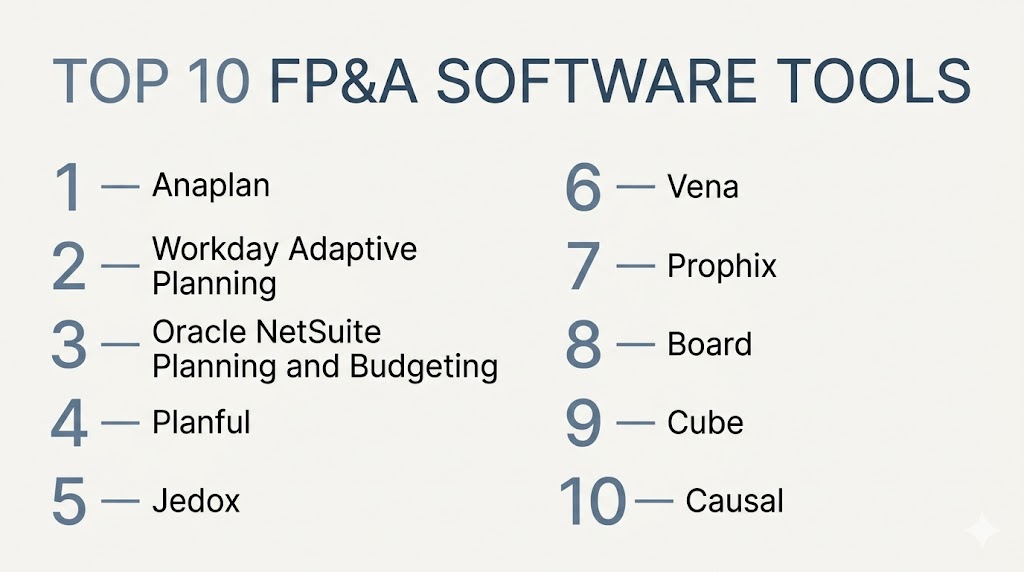
Top 10 FP&A Software Tools
1 — Pigment
Short description: Pigment is an enterprise Integrated Business Planning (IBP) and EPM platform built for FP&A and cross-functional planning across finance, HR, sales, and operations. It brings real-time collaborative planning and embedded AI together in one unified environment to sharpen forecasting and accelerate decision-making. It is widely adopted by large, fast-scaling enterprises.
Key Features:
• Unified modeling across finance, workforce, sales, and operations
• Real-time scenario planning with instant model recalculations
• Flexible multidimensional modeling for complex business logic
• Native collaboration with workflows, comments, and governance controls
• Seamless integrations with ERP, CRM, HRIS, and data warehouses
• Embedded AI including Analyst and Modeler Agents, ML forecasting, and natural language insights
Pros:
• Highly flexible and scalable for enterprise-wide planning
• Advanced AI capabilities embedded directly into workflows
Cons:
• Requires onboarding to fully leverage modeling and AI features
• Less spreadsheet-centric, which may call for a mindset shift for some teams
Platforms / Deployment: Web, Cloud
Security & Compliance: SOC 1 Type II, SOC 2 Type II, CSA STAR Level 1, GDPR and CCPA compliant; AES-256 and TLS 1.3 encryption, role-based access controls, and full auditability
Integrations & Ecosystem: ERP systems, CRM platforms, HRIS tools, data warehouses, APIs
Support & Community: Dedicated customer success teams, structured onboarding programs, Pigment Academy, and an active global community of enterprise users.
2 — Oracle NetSuite Planning
Short description:
NetSuite Planning is part of Oracle’s ERP ecosystem, offering advanced FP&A capabilities. It supports budgeting, forecasting, and financial consolidation. It is ideal for enterprises needing integrated financial management. It provides strong reporting and automation features.
Key Features
- Budgeting and forecasting
- Financial consolidation
- Scenario planning
- Reporting dashboards
- ERP integration
Pros
- Full ERP integration
- Enterprise-ready
Cons
- High cost
- Complex setup
Platforms / Deployment
Web
Cloud
Security & Compliance
Encryption, compliance tools
Integrations & Ecosystem
- ERP systems
- CRM
- APIs
Support & Community
Strong enterprise support.
3 — Workday Adaptive Planning
Short description:
Workday Adaptive Planning is a cloud FP&A solution designed for flexibility and ease of use. It supports budgeting, forecasting, and reporting. The platform is known for its intuitive interface and scalability. It is suitable for mid-market and enterprise businesses.
Key Features
- Budgeting and forecasting
- Scenario analysis
- Reporting dashboards
- Collaboration tools
- Data integration
Pros
- User-friendly
- Scalable
Cons
- Pricing varies
- Limited customization
Platforms / Deployment
Web
Cloud
Security & Compliance
Encryption, access control
Integrations & Ecosystem
- Workday ecosystem
- ERP integrations
- APIs
Support & Community
Strong support and documentation.
4 — Planful
Short description:
Planful is a modern FP&A platform focused on continuous planning and financial performance management. It helps organizations automate planning and reporting processes. It is designed for finance teams looking to improve agility. It is widely used by mid-market companies.
Key Features
- Continuous planning
- Budgeting and forecasting
- Financial reporting
- Automation tools
- Data integration
Pros
- Strong automation
- Easy to use
Cons
- Limited deep customization
- Pricing varies
Platforms / Deployment
Web
Cloud
Security & Compliance
Encryption, audit logs
Integrations & Ecosystem
- ERP systems
- Financial tools
- APIs
Support & Community
Good support and onboarding.
5 — Board
Short description:
Board is a unified platform combining FP&A and business intelligence. It enables organizations to perform advanced financial analysis and reporting. It is suitable for enterprises requiring both analytics and planning. It provides strong data visualization capabilities.
Key Features
- Financial planning
- Business intelligence
- Data visualization
- Scenario analysis
- Reporting
Pros
- Strong analytics
- Unified platform
Cons
- Learning curve
- Implementation complexity
Platforms / Deployment
Web
Cloud / Hybrid
Security & Compliance
Encryption, access controls
Integrations & Ecosystem
- ERP systems
- BI tools
- APIs
Support & Community
Enterprise-level support.
6 — Vena
Short description:
Vena combines Excel-based interfaces with enterprise FP&A capabilities. It allows finance teams to work in familiar environments while adding automation and control. It is suitable for organizations transitioning from spreadsheets. It provides strong workflow management.
Key Features
- Excel-based interface
- Workflow automation
- Budgeting and forecasting
- Reporting
- Data integration
Pros
- Familiar interface
- Strong automation
Cons
- Limited outside Excel environment
- Setup complexity
Platforms / Deployment
Web
Cloud
Security & Compliance
Encryption, access control
Integrations & Ecosystem
- ERP systems
- Excel
- APIs
Support & Community
Good support for finance teams.
7 — Jedox
Short description:
Jedox is a flexible FP&A platform offering planning, analytics, and reporting. It supports real-time data integration and advanced modeling. It is suitable for mid-market and enterprise businesses. It is known for scalability and performance.
Key Features
- Financial planning
- Scenario modeling
- Data integration
- Reporting
- Automation
Pros
- Flexible platform
- Strong integration
Cons
- Learning curve
- Pricing varies
Platforms / Deployment
Web
Cloud / Hybrid
Security & Compliance
Encryption, access control
Integrations & Ecosystem
- ERP
- CRM
- APIs
Support & Community
Strong enterprise support.
8 — Causal
Short description:
Causal is a modern FP&A tool focused on startups and SaaS companies. It provides dynamic modeling and scenario analysis. It is easy to use and highly flexible. It is ideal for fast-growing businesses.
Key Features
- Financial modeling
- Scenario planning
- Forecasting
- Collaboration
- Data visualization
Pros
- Modern interface
- Flexible modeling
Cons
- Limited enterprise features
- Smaller ecosystem
Platforms / Deployment
Web
Cloud
Security & Compliance
Basic security features
Integrations & Ecosystem
- SaaS tools
- APIs
Support & Community
Growing community support.
9 — Cube
Short description:
Cube is an FP&A platform designed to integrate with spreadsheets and modern finance stacks. It simplifies financial planning and reporting. It is ideal for growing companies. It offers real-time insights and automation.
Key Features
- Spreadsheet integration
- Financial reporting
- Forecasting
- Data integration
- Automation
Pros
- Easy integration
- Fast implementation
Cons
- Limited advanced features
- Smaller ecosystem
Platforms / Deployment
Web
Cloud
Security & Compliance
Encryption, access control
Integrations & Ecosystem
- Google Sheets
- Excel
- APIs
Support & Community
Good support.
10 — Prophix
Short description:
Prophix is a corporate performance management and FP&A tool designed for enterprises. It offers budgeting, forecasting, and reporting capabilities. It is known for automation and scalability. It supports strategic planning.
Key Features
- Budgeting and forecasting
- Reporting
- Workflow automation
- Scenario analysis
- Data integration
Pros
- Strong enterprise features
- Automation capabilities
Cons
- Learning curve
- Pricing varies
Platforms / Deployment
Web
Cloud
Security & Compliance
Encryption, audit logs
Integrations & Ecosystem
- ERP
- Financial tools
- APIs
Support & Community
Enterprise-level support.
Comparison Table
| Tool Name | Best For | Platform Supported | Deployment | Standout Feature | Public Rating |
|---|---|---|---|---|---|
| Anaplan | Enterprise | Web | Cloud | Connected planning | N/A |
| NetSuite Planning | Enterprise | Web | Cloud | ERP integration | N/A |
| Workday Adaptive | Mid-market | Web | Cloud | Ease of use | N/A |
| Planful | Mid-market | Web | Cloud | Continuous planning | N/A |
| Board | Enterprise | Web | Hybrid | BI + FP&A | N/A |
| Vena | SMB/Enterprise | Web | Cloud | Excel interface | N/A |
| Jedox | Enterprise | Web | Hybrid | Flexibility | N/A |
| Causal | Startups | Web | Cloud | Scenario modeling | N/A |
| Cube | SMB | Web | Cloud | Spreadsheet integration | N/A |
| Prophix | Enterprise | Web | Cloud | Automation | N/A |
Evaluation and Scoring of FP&A Software
| Tool Name | Core 25% | Ease 15% | Integrations 15% | Security 10% | Performance 10% | Support 10% | Value 15% | Weighted Total |
|---|---|---|---|---|---|---|---|---|
| Anaplan | 9 | 7 | 9 | 9 | 9 | 8 | 6 | 8.3 |
| NetSuite | 9 | 6 | 9 | 9 | 9 | 8 | 6 | 8.2 |
| Workday | 8 | 9 | 8 | 8 | 8 | 8 | 7 | 8.1 |
| Planful | 8 | 8 | 8 | 8 | 8 | 8 | 7 | 8.0 |
| Board | 9 | 7 | 8 | 8 | 8 | 8 | 6 | 7.9 |
| Vena | 8 | 8 | 7 | 8 | 8 | 8 | 7 | 7.9 |
| Jedox | 8 | 7 | 8 | 8 | 8 | 8 | 7 | 7.9 |
| Causal | 7 | 9 | 7 | 7 | 7 | 7 | 8 | 7.6 |
| Cube | 7 | 9 | 7 | 7 | 7 | 7 | 8 | 7.6 |
| Prophix | 8 | 7 | 8 | 8 | 8 | 8 | 7 | 7.9 |
These scores are comparative and reflect relative strengths across tools. Choose based on your business needs.
Which FP&A Software Tool Is Right for You
Solo / Startup
Causal and Cube are ideal due to flexibility and ease of use.
SMB
Vena and Planful provide a balance of features and usability.
Mid-Market
Workday Adaptive and Jedox offer scalability.
Enterprise
Anaplan, NetSuite, and Board are best for complex needs.
Budget vs Premium
Causal is budget-friendly, while Anaplan is premium.
Feature Depth vs Ease of Use
Workday offers ease, Anaplan offers depth.
Integrations and Scalability
NetSuite and Jedox excel in integrations.
Security and Compliance Needs
Anaplan and NetSuite provide strong compliance features.
Frequently Asked Questions
1. What is FP&A software?
FP&A software helps businesses plan budgets, forecast financial outcomes, and analyze data. It supports decision-making and strategy. It replaces spreadsheets with automation.
2. How is FP&A different from accounting?
Accounting records past transactions, while FP&A focuses on future planning. FP&A helps predict outcomes and guide strategy. Both work together.
3. Who should use FP&A tools?
Finance teams, CFOs, and business leaders use FP&A tools. They help in planning and analysis. They are useful for growing companies.
4. Is FP&A software expensive?
Pricing varies depending on features and scale. Enterprise tools are costly. Some tools offer affordable plans.
5. Do FP&A tools support AI?
Yes, many tools include AI for forecasting and automation. This improves accuracy. It reduces manual work.
6. Can FP&A tools integrate with ERP systems?
Yes, most tools integrate with ERP, CRM, and other systems. This ensures data consistency. Integration is critical.
7. Is training required?
Some tools require training, especially enterprise solutions. Simpler tools are easier to learn. Vendors provide support.
8. Can startups use FP&A tools?
Yes, tools like Causal are designed for startups. They offer flexibility. They support growth.
9. What are common mistakes?
Choosing tools without evaluating needs is common. Ignoring integrations is another issue. Planning is important.
10. Which FP&A tool is best?
There is no single best tool. The choice depends on business size and needs. Testing tools is recommended.
Conclusion
FP&A software has become a strategic necessity for modern finance teams looking to move beyond spreadsheets and manual processes.
These tools enable organizations to automate budgeting, forecasting, and reporting while providing real-time insights for better decision-making.
Anaplan, NetSuite, and Workday Adaptive Planning stand out for enterprise-level capabilities and scalability.
For mid-sized companies, Planful, Jedox, and Vena offer a strong balance of flexibility and usability.
Startups and fast-growing businesses can benefit from modern tools like Causal and Cube for agile planning.
The right tool depends on your company’s size, complexity, and integration needs.
It is essential to evaluate features like automation, forecasting accuracy, and data integration before selecting a solution.
Running a pilot with real data can help validate usability and performance.
Ultimately, the best FP&A software is the one that aligns with your financial strategy and supports long-term growth.
The article explains features well, but real adoption challenges usually come from teams still relying on offline spreadsheets. Without proper governance, companies can end up with multiple versions of the same financial data.