Introduction
LLM gateways and model routing platforms are infrastructure layers that help organizations manage, secure, optimize, and route requests across multiple large language models and AI providers. Instead of directly connecting applications to a single AI model, these platforms act as centralized control planes that handle traffic management, fallback routing, observability, governance, cost optimization, authentication, and multi-model orchestration.
As enterprises increasingly adopt generative AI applications, managing multiple AI providers and balancing performance, cost, latency, and compliance has become a major operational challenge. Modern organizations now require intelligent routing systems that can dynamically select the best model for each request while maintaining reliability and governance standards. LLM gateways are rapidly becoming a foundational layer in enterprise AI infrastructure.
Real-world use cases include:
- Multi-model AI application routing
- AI cost optimization and failover management
- Enterprise AI governance and compliance
- Prompt security and observability
- AI API traffic management
- AI performance monitoring and analytics
- Unified access to multiple LLM providers
Key buyer evaluation criteria include:
- Multi-model routing intelligence
- API compatibility and flexibility
- Security and governance controls
- Observability and monitoring
- Cost optimization features
- Latency and reliability management
- Scalability and autoscaling
- Integration ecosystem maturity
- Deployment flexibility
- Enterprise administration capabilities
Best for: Enterprise AI teams, SaaS companies, AI infrastructure teams, platform engineering organizations, fintech companies, healthcare AI providers, customer support automation teams, and businesses deploying production generative AI applications.
Not ideal for: Small teams using only a single AI provider, lightweight experimental projects, or organizations without advanced governance and multi-model requirements.
Key Trends in LLM Gateways & Model Routing Platforms
- Multi-model orchestration is becoming standard for enterprise AI deployments.
- AI cost optimization through intelligent routing is rapidly gaining importance.
- Prompt observability and AI telemetry are evolving into core platform capabilities.
- Enterprises are increasingly deploying AI gateways for governance and compliance control.
- Fallback routing and redundancy management are becoming critical for uptime reliability.
- OpenAI-compatible APIs are emerging as common interoperability standards.
- Security-focused AI gateways are expanding for regulated industries.
- Real-time latency optimization is becoming a competitive differentiator.
- Hybrid AI deployments across self-hosted and cloud models are increasing.
- AI traffic shaping and rate-limiting are becoming essential operational capabilities.
How We Selected These Tools Methodology
The platforms in this list were selected using practical enterprise and developer-focused evaluation criteria:
- Market adoption and ecosystem momentum
- Multi-model routing capabilities
- Security and governance readiness
- API compatibility and developer experience
- Reliability and failover management
- Observability and analytics depth
- Deployment flexibility across cloud and hybrid environments
- Integration ecosystem maturity
- Scalability for enterprise workloads
- Balance across enterprise, developer-first, and open-source solutions
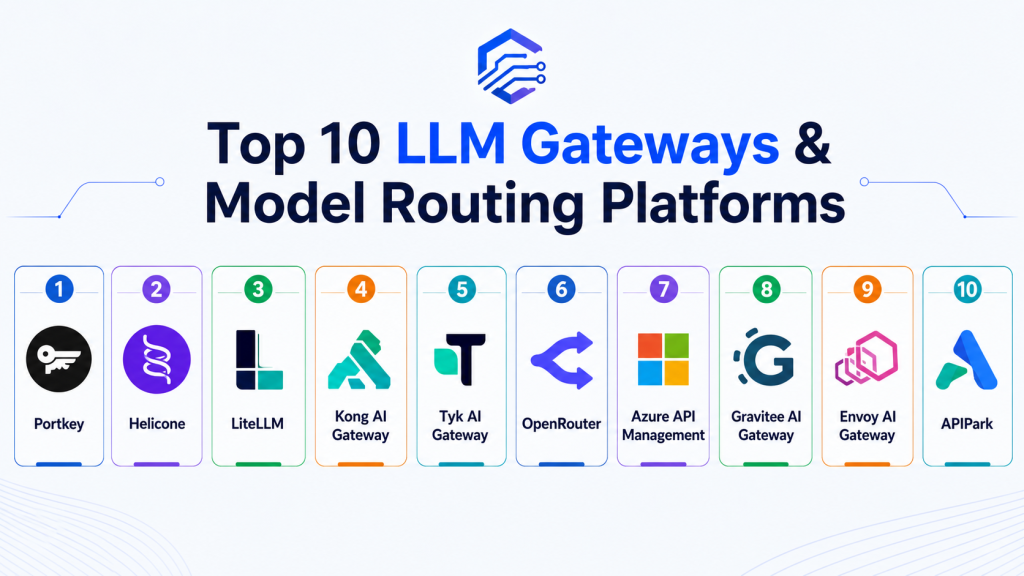
Top 10 LLM Gateways & Model Routing Platforms
1- Portkey
Short description: Portkey is a popular AI gateway and observability platform designed to manage, monitor, and optimize large language model traffic across multiple providers. It helps organizations centralize AI operations with routing, governance, caching, and reliability controls for production generative AI systems.
Key Features
- Multi-provider AI routing
- AI observability dashboards
- Caching and retry logic
- Rate limiting and failover management
- Prompt logging and analytics
- OpenAI-compatible APIs
- Guardrails and governance controls
Pros
- Strong observability capabilities
- Easy integration workflows
- Good enterprise governance features
- Flexible multi-provider routing
Cons
- Advanced enterprise scaling may require tuning
- Some features depend on provider compatibility
- Pricing can increase with heavy traffic
- Smaller ecosystem than hyperscale cloud vendors
Platforms / Deployment
Cloud / Self-hosted / Hybrid
Security & Compliance
Authentication controls, RBAC support, encryption compatibility, audit logging. Additional certifications not publicly stated.
Integrations & Ecosystem
Portkey integrates with modern AI development ecosystems and generative AI deployment pipelines.
- OpenAI
- Anthropic
- Azure OpenAI
- LangChain
- LlamaIndex
- Kubernetes
- Observability platforms
Support & Community
Strong developer-focused documentation with growing enterprise adoption and active community momentum.
2- Helicone
Short description: Helicone is an open-source LLM observability and gateway platform built for monitoring, analytics, and request management across generative AI applications. It is widely used by AI teams seeking visibility into model performance, latency, and costs.
Key Features
- AI request monitoring
- Cost tracking analytics
- Request caching
- Prompt observability
- OpenAI-compatible proxy
- User analytics
- Latency monitoring
Pros
- Strong observability focus
- Developer-friendly setup
- Open-source flexibility
- Good analytics experience
Cons
- More observability-focused than full orchestration
- Enterprise governance features still evolving
- Smaller enterprise support ecosystem
- Limited advanced routing intelligence
Platforms / Deployment
Cloud / Self-hosted / Hybrid
Security & Compliance
Authentication support, API security compatibility, audit logging support. Additional certifications not publicly stated.
Integrations & Ecosystem
Helicone integrates naturally into modern LLM application stacks and observability workflows.
- OpenAI
- Anthropic
- LangChain
- Vercel AI SDK
- Node.js frameworks
- Python SDKs
- Analytics platforms
Support & Community
Growing open-source ecosystem with active AI developer adoption and strong documentation quality.
3- LiteLLM
Short description: LiteLLM is a lightweight gateway and routing layer that provides a unified interface for multiple large language model providers. It simplifies provider switching and enables developers to build portable AI applications with standardized APIs.
Key Features
- Unified LLM API interface
- Multi-provider routing
- OpenAI-compatible APIs
- Load balancing
- Fallback support
- Cost tracking
- Proxy deployment support
Pros
- Very developer-friendly
- Broad provider compatibility
- Lightweight deployment model
- Strong portability benefits
Cons
- Limited enterprise governance features
- Advanced observability still evolving
- Smaller operational tooling ecosystem
- Requires additional infrastructure for large-scale governance
Platforms / Deployment
Cloud / Self-hosted / Hybrid
Security & Compliance
Authentication support, API key management, encryption compatibility. Additional certifications not publicly stated.
Integrations & Ecosystem
LiteLLM integrates with modern AI development frameworks and LLM providers.
- OpenAI
- Anthropic
- Gemini
- Hugging Face
- LangChain
- CrewAI
- LlamaIndex
Support & Community
Very active developer community with rapid ecosystem growth and strong documentation support.
4- Kong AI Gateway
Short description: Kong AI Gateway extends the Kong API gateway ecosystem into AI traffic management and LLM governance. It enables organizations to apply enterprise-grade API management practices to generative AI deployments.
Key Features
- AI API gateway management
- Authentication and authorization
- Rate limiting
- Traffic shaping
- Multi-provider AI routing
- Security policy enforcement
- Analytics and monitoring
Pros
- Mature enterprise gateway foundation
- Strong security controls
- Excellent API management capabilities
- Good scalability for enterprise workloads
Cons
- Can be complex to configure
- Enterprise licensing may be expensive
- Requires API gateway expertise
- Some AI features are newer compared to AI-native platforms
Platforms / Deployment
Cloud / Self-hosted / Hybrid
Security & Compliance
SSO/SAML, RBAC, MFA compatibility, audit logging, encryption support. Additional compliance varies by deployment.
Integrations & Ecosystem
Kong AI Gateway integrates with enterprise API ecosystems and cloud-native infrastructure.
- Kubernetes
- OpenAI
- Anthropic
- AWS
- Azure
- Service meshes
- Monitoring platforms
Support & Community
Large enterprise ecosystem with mature documentation and strong commercial support options.
5- Tyk AI Gateway
Short description: Tyk AI Gateway is an API management and AI traffic governance platform designed for organizations deploying generative AI services at scale. It focuses on security, policy management, and AI API governance.
Key Features
- AI API governance
- Authentication and authorization
- Request rate limiting
- AI traffic management
- Monitoring dashboards
- OpenAI-compatible APIs
- Policy enforcement
Pros
- Strong API governance capabilities
- Flexible deployment models
- Good enterprise security controls
- Hybrid deployment support
Cons
- Requires API gateway expertise
- Smaller AI-native ecosystem
- Advanced AI routing still evolving
- Learning curve for new teams
Platforms / Deployment
Cloud / Self-hosted / Hybrid
Security & Compliance
RBAC, SSO compatibility, audit logging, encryption support. Additional certifications vary by deployment.
Integrations & Ecosystem
Tyk AI Gateway integrates with enterprise API and cloud-native infrastructure ecosystems.
- Kubernetes
- OpenAI
- AWS
- Azure
- Grafana
- Prometheus
- Service mesh environments
Support & Community
Good enterprise support structure with active API management community adoption.
6- OpenRouter
Short description: OpenRouter is a multi-model AI routing platform that enables developers to access and switch between multiple large language models through a unified API interface. It focuses on flexibility, routing simplicity, and provider interoperability.
Key Features
- Unified AI model access
- Multi-provider routing
- OpenAI-compatible APIs
- Cost optimization support
- Failover handling
- Model comparison workflows
- Usage analytics
Pros
- Simple multi-model access
- Strong developer experience
- Broad provider ecosystem
- Easy provider switching
Cons
- Limited enterprise governance
- Less operational tooling than enterprise gateways
- Smaller compliance ecosystem
- Advanced enterprise routing limited
Platforms / Deployment
Cloud
Security & Compliance
API authentication support and encryption compatibility. Additional certifications not publicly stated.
Integrations & Ecosystem
OpenRouter integrates with developer AI workflows and generative AI application stacks.
- OpenAI
- Anthropic
- DeepSeek
- Gemini
- Claude APIs
- LangChain
- Developer SDKs
Support & Community
Growing AI developer adoption with straightforward onboarding and active ecosystem momentum.
7- Azure API Management for AI
Short description: Azure API Management for AI extends Microsoft’s API management platform into generative AI governance and model routing. It provides enterprise-grade controls for organizations building AI-powered applications within Azure ecosystems.
Key Features
- AI API governance
- Enterprise authentication
- Traffic management
- AI policy enforcement
- Observability integration
- Rate limiting
- Security management
Pros
- Strong enterprise governance
- Deep Azure integration
- Mature API management capabilities
- Enterprise scalability
Cons
- Best suited for Azure-centric organizations
- Configuration complexity
- Potential vendor lock-in
- Requires enterprise API management knowledge
Platforms / Deployment
Cloud / Hybrid
Security & Compliance
RBAC, Azure Active Directory integration, audit logging, encryption support, enterprise cloud security controls.
Integrations & Ecosystem
Azure API Management integrates deeply with Microsoft cloud and enterprise AI services.
- Azure OpenAI
- Microsoft Entra ID
- Kubernetes
- Power Platform
- Azure Monitor
- Logic Apps
- Enterprise Microsoft ecosystem
Support & Community
Strong enterprise documentation and commercial support ecosystem.
8- Gravitee AI Gateway
Short description: Gravitee AI Gateway is an API management and AI governance platform focused on securing and controlling generative AI traffic. It helps organizations enforce policies and monitor AI interactions across distributed environments.
Key Features
- AI traffic governance
- API security management
- Multi-model routing
- AI request monitoring
- Policy enforcement
- Analytics dashboards
- Hybrid deployment support
Pros
- Strong governance capabilities
- Flexible hybrid deployment
- Good observability tooling
- Enterprise-focused architecture
Cons
- Smaller AI ecosystem compared to larger vendors
- Some advanced AI capabilities still maturing
- Requires API management familiarity
- Enterprise complexity for smaller teams
Platforms / Deployment
Cloud / Self-hosted / Hybrid
Security & Compliance
Authentication support, RBAC, audit logging, encryption compatibility. Additional certifications not publicly stated.
Integrations & Ecosystem
Gravitee integrates with enterprise API ecosystems and AI governance environments.
- Kubernetes
- OpenAI
- Azure
- Monitoring platforms
- API management stacks
- Identity providers
- Cloud infrastructure tools
Support & Community
Growing enterprise ecosystem with strong API governance expertise.
9- Envoy AI Gateway
Short description: Envoy AI Gateway builds on the Envoy proxy ecosystem to provide AI traffic routing, observability, and governance for large-scale AI applications. It is particularly attractive for cloud-native infrastructure teams.
Key Features
- AI traffic routing
- Service mesh compatibility
- OpenAI-compatible APIs
- Rate limiting
- Load balancing
- Observability support
- Cloud-native architecture
Pros
- Strong cloud-native scalability
- Good service mesh integration
- Flexible deployment architecture
- Strong open-source foundation
Cons
- Requires infrastructure expertise
- Operational complexity
- Enterprise tooling still evolving
- Smaller AI-native feature depth
Platforms / Deployment
Cloud / Self-hosted / Hybrid
Security & Compliance
Authentication compatibility, encryption support, RBAC integration. Additional certifications vary by deployment.
Integrations & Ecosystem
Envoy AI Gateway integrates with cloud-native and Kubernetes-centric infrastructure environments.
- Kubernetes
- Istio
- Service meshes
- OpenAI
- Observability stacks
- Prometheus
- Grafana
Support & Community
Strong open-source ecosystem with growing AI infrastructure adoption.
10- APIPark
Short description: APIPark is an AI gateway and API management platform designed to unify access to multiple LLM providers and AI services. It focuses on AI traffic governance, routing, and centralized AI API management.
Key Features
- Multi-provider AI access
- Unified API gateway
- Traffic management
- Request logging
- Authentication support
- OpenAI-compatible APIs
- Monitoring dashboards
Pros
- Simplified AI API management
- Multi-provider flexibility
- Centralized governance
- Good routing capabilities
Cons
- Smaller ecosystem maturity
- Limited enterprise adoption compared to larger vendors
- Advanced observability still evolving
- Fewer enterprise integrations
Platforms / Deployment
Cloud / Self-hosted / Hybrid
Security & Compliance
Authentication controls, API key management, encryption compatibility. Additional certifications not publicly stated.
Integrations & Ecosystem
APIPark integrates with modern AI provider ecosystems and API management workflows.
- OpenAI
- Anthropic
- Kubernetes
- Monitoring platforms
- Developer SDKs
- API gateways
- Cloud infrastructure tools
Support & Community
Emerging ecosystem with growing developer interest and improving documentation quality.
Comparison Table Top 10
| Tool Name | Best For | Platforms Supported | Deployment | Standout Feature | Public Rating |
|---|---|---|---|---|---|
| Portkey | Enterprise AI routing | Cloud / Linux | Hybrid | AI observability | N/A |
| Helicone | AI analytics and monitoring | Cloud / Linux | Hybrid | Prompt analytics | N/A |
| LiteLLM | Unified LLM APIs | Cloud / Linux / macOS | Hybrid | Multi-provider portability | N/A |
| Kong AI Gateway | Enterprise AI governance | Cloud / Linux | Hybrid | API gateway maturity | N/A |
| Tyk AI Gateway | AI API governance | Cloud / Linux | Hybrid | Security controls | N/A |
| OpenRouter | Multi-model access | Cloud | Cloud | Unified AI access | N/A |
| Azure API Management for AI | Microsoft ecosystem AI | Cloud | Hybrid | Azure integration | N/A |
| Gravitee AI Gateway | AI governance | Cloud / Linux | Hybrid | Policy enforcement | N/A |
| Envoy AI Gateway | Cloud-native AI routing | Linux / Cloud | Hybrid | Service mesh integration | N/A |
| APIPark | Unified AI API management | Cloud / Linux | Hybrid | Multi-provider routing | N/A |
Evaluation & Scoring of LLM Gateways & Model Routing Platforms
| Tool Name | Core 25% | Ease 15% | Integrations 15% | Security 10% | Performance 10% | Support 10% | Value 15% | Weighted Total |
|---|---|---|---|---|---|---|---|---|
| Portkey | 9.2 | 8.7 | 9.0 | 8.8 | 9.0 | 8.5 | 8.4 | 8.8 |
| Helicone | 8.3 | 8.8 | 8.2 | 7.8 | 8.5 | 8.0 | 9.0 | 8.4 |
| LiteLLM | 8.7 | 9.1 | 8.8 | 7.5 | 8.6 | 8.3 | 9.2 | 8.7 |
| Kong AI Gateway | 9.3 | 7.4 | 9.5 | 9.5 | 9.0 | 9.1 | 7.8 | 8.9 |
| Tyk AI Gateway | 8.8 | 7.8 | 8.9 | 9.0 | 8.7 | 8.5 | 8.2 | 8.5 |
| OpenRouter | 8.2 | 9.0 | 8.3 | 7.0 | 8.4 | 7.9 | 9.1 | 8.3 |
| Azure API Management for AI | 9.1 | 7.6 | 9.4 | 9.6 | 9.1 | 9.2 | 7.7 | 8.9 |
| Gravitee AI Gateway | 8.5 | 7.7 | 8.6 | 8.9 | 8.6 | 8.1 | 8.2 | 8.4 |
| Envoy AI Gateway | 8.6 | 7.2 | 8.8 | 8.5 | 9.2 | 8.0 | 8.6 | 8.5 |
| APIPark | 8.0 | 8.2 | 7.9 | 7.5 | 8.1 | 7.6 | 8.8 | 8.1 |
These scores are comparative and intended to help organizations evaluate strengths across governance, routing intelligence, integration depth, and operational scalability. Higher scores do not necessarily mean a universal winner because different platforms focus on different priorities. Enterprise API governance platforms typically score higher in security and compliance, while developer-first tools often provide better simplicity and flexibility. Buyers should evaluate operational complexity, deployment strategy, and AI traffic requirements before selecting a platform.
Which LLM Gateways & Model Routing Platforms Tool Is Right for You?
Solo / Freelancer
Individual developers and small AI builders often benefit from lightweight and flexible routing platforms. LiteLLM and OpenRouter are strong options because they simplify access to multiple LLM providers without requiring heavy infrastructure management.
SMB
Small and medium-sized businesses usually prioritize deployment simplicity, cost optimization, and operational visibility. Portkey and Helicone provide strong observability and routing capabilities while remaining relatively developer-friendly.
Mid-Market
Mid-market organizations often require stronger governance, analytics, and routing intelligence. Tyk AI Gateway, Gravitee AI Gateway, and Envoy AI Gateway provide balanced operational flexibility and enterprise scalability.
Enterprise
Large enterprises generally prioritize governance, security, reliability, and integration maturity. Kong AI Gateway and Azure API Management for AI are strong choices for organizations needing enterprise-grade API and AI governance capabilities.
Budget vs Premium
Developer-first open-source tools can significantly reduce operational costs but may require more engineering effort. Enterprise API management platforms provide stronger governance and support but often come with higher licensing and operational expenses.
Feature Depth vs Ease of Use
Simpler routing tools focus on developer productivity and portability, while enterprise gateways provide deeper governance, policy management, and observability capabilities at the cost of increased complexity.
Integrations & Scalability
Cloud-native organizations should evaluate integration compatibility with Kubernetes, service meshes, cloud providers, and observability stacks. Enterprises heavily invested in Microsoft or API management ecosystems may prefer Azure or Kong solutions.
Security & Compliance Needs
Regulated industries should prioritize platforms with strong RBAC controls, audit logging, encryption support, authentication integration, and enterprise governance features.
Frequently Asked Questions FAQs
1. What is an LLM gateway platform?
An LLM gateway platform acts as a centralized layer between applications and AI models. It manages routing, security, monitoring, caching, governance, and provider interoperability for generative AI systems.
2. Why are model routing platforms important?
Model routing platforms help organizations optimize cost, reliability, and performance by intelligently directing requests to the most suitable AI model or provider.
3. Can these platforms support multiple AI providers?
Yes, most modern LLM gateways support multiple providers such as OpenAI, Anthropic, Gemini, and open-source model ecosystems through unified APIs.
4. What is fallback routing in AI gateways?
Fallback routing automatically redirects requests to alternative models or providers if the primary service fails or experiences latency issues.
5. Are AI gateways only for enterprises?
No, developer-first platforms like LiteLLM and OpenRouter are also useful for startups, individual developers, and SMBs building generative AI applications.
6. How do AI gateways improve security?
AI gateways provide centralized authentication, logging, traffic management, governance policies, and monitoring that help organizations secure AI traffic and enforce compliance standards.
7. What integrations matter most in LLM routing platforms?
Important integrations include Kubernetes, observability tools, API gateways, AI providers, authentication systems, and AI development frameworks.
8. Can AI gateways reduce AI infrastructure costs?
Yes, intelligent routing, caching, and provider optimization can significantly reduce inference and API costs for high-volume AI applications.
9. What are common deployment models for AI gateways?
Most platforms support cloud, self-hosted, or hybrid deployment models depending on governance, scalability, and compliance requirements.
10. How difficult is migration between AI routing platforms?
Migration complexity depends on API architecture, observability tooling, and infrastructure integrations. Platforms using OpenAI-compatible APIs usually simplify migration workflows.
Conclusion
LLM gateways and model routing platforms are rapidly becoming a core layer in enterprise AI infrastructure as organizations scale generative AI applications across multiple providers and deployment environments. These platforms help teams manage routing intelligence, governance, observability, security, and operational reliability while improving cost efficiency and reducing vendor lock-in risks. The right solution depends on deployment complexity, governance requirements, infrastructure maturity, and integration priorities. Developer-focused tools are often better for rapid experimentation and portability, while enterprise-grade API management platforms provide deeper policy enforcement and compliance capabilities. There is no universal best platform for every organization or AI workload. The most effective strategy is to shortlist a few platforms that align with your AI architecture goals, run controlled pilot deployments, validate integration and security requirements, and measure real-world operational efficiency before scaling into production environments.