Introduction
AR education apps use augmented reality technology to create interactive learning experiences by overlaying digital content onto the real world through smartphones, tablets, or AR-enabled devices. These applications help students visualize concepts, interact with 3D models, and engage with educational material in a more immersive and hands-on way than traditional learning methods.
As digital learning continues evolving, augmented reality is becoming increasingly valuable for improving engagement, retention, and experiential learning. Schools, universities, training institutes, and online education platforms are adopting AR tools to make complex subjects easier to understand. From science labs and anatomy simulations to language learning and astronomy exploration, AR education apps are transforming how students interact with educational content.
Real-world use cases include:
- Interactive science and biology learning
- AR-based language education
- Virtual anatomy and medical training
- Astronomy and space exploration lessons
- STEM and engineering visualization
- Classroom collaboration activities
- Remote and hybrid learning experiences
Key buyer evaluation criteria include:
- Content quality and curriculum relevance
- Device compatibility
- Ease of classroom deployment
- Student engagement features
- AR visualization quality
- Offline accessibility
- Teacher management tools
- Collaboration and sharing features
- Pricing and licensing flexibility
- Security and privacy controls
Best for: Schools, colleges, online learning platforms, STEM education providers, training organizations, homeschooling parents, language institutes, and interactive classroom environments.
Not ideal for: Institutions with limited device availability, environments without stable internet access for cloud features, or organizations that only require text-based learning systems.
Key Trends in AR Education Apps
- AI-powered adaptive learning is becoming integrated into AR educational experiences.
- Mobile-first AR learning is growing faster than headset-based education deployments.
- Interactive 3D visualization is becoming common in STEM and medical education.
- Gamified AR learning experiences are improving student engagement and retention.
- Cloud-based collaborative AR classrooms are expanding rapidly.
- AR language learning applications are becoming more conversational and immersive.
- Hybrid learning environments are increasingly using AR for remote participation.
- Educational institutions are adopting AR labs instead of expensive physical simulations.
- Multimodal learning with voice, gesture, and AR interaction is evolving quickly.
- Cross-platform AR compatibility is becoming a major buying requirement.
How We Selected These Tools Methodology
The apps in this list were selected using practical education and technology-focused evaluation criteria:
- Market popularity and educational adoption
- AR visualization quality
- Student engagement capabilities
- Curriculum and content depth
- Device compatibility
- Ease of use for students and teachers
- Classroom deployment flexibility
- Integration ecosystem maturity
- Pricing accessibility
- Community and educational support quality
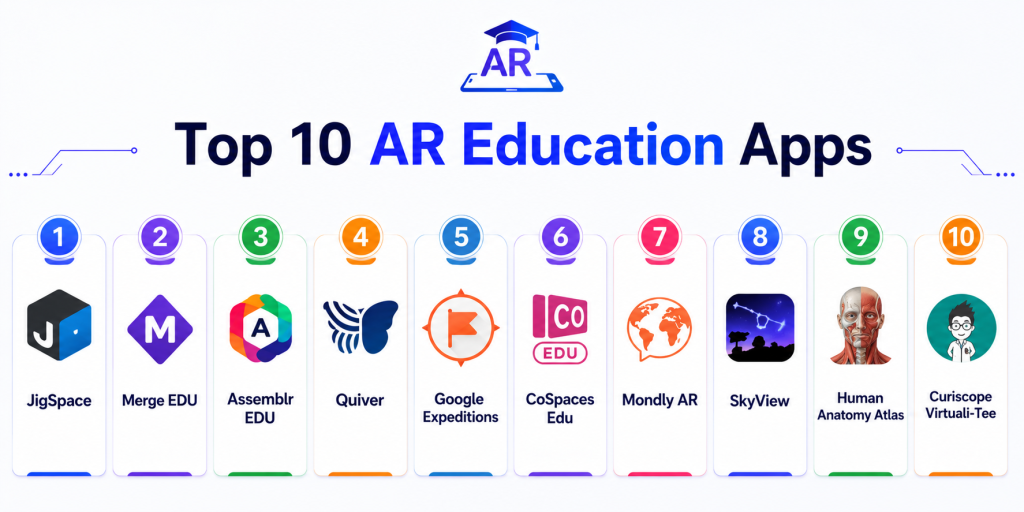
Top 10 AR Education Apps
1- JigSpace
Short description: JigSpace is an augmented reality learning app that helps students and educators visualize complex concepts through interactive 3D presentations. It is widely used in STEM education, engineering demonstrations, and visual learning environments.
Key Features
- Interactive 3D learning models
- AR visual storytelling
- STEM education support
- Collaborative presentations
- Mobile and tablet compatibility
- Educational content library
- Real-world object visualization
Pros
- Excellent 3D visualization quality
- Highly engaging learning experience
- Good for STEM education
- Easy classroom demonstrations
Cons
- Advanced content creation can take time
- Some features require subscriptions
- Less suitable for text-heavy learning
- Requires compatible mobile devices
Platforms / Deployment
iOS / Android / Cloud
Security & Compliance
Authentication support and cloud security compatibility. Additional certifications not publicly stated.
Integrations & Ecosystem
JigSpace integrates with collaborative and classroom presentation workflows.
- iPad
- Smartphones
- Classroom displays
- STEM learning systems
- Collaborative learning tools
- Educational presentations
- AR-enabled devices
Support & Community
Strong educational adoption with active content sharing and good onboarding resources.
2- Merge EDU
Short description: Merge EDU is an AR and VR education platform designed for immersive classroom learning experiences. It allows students to interact with digital objects and simulations across science, history, and STEM subjects.
Key Features
- AR and VR educational content
- Hands-on STEM simulations
- Interactive science lessons
- Classroom management support
- 3D object interaction
- Device compatibility
- Educational activity library
Pros
- Strong STEM learning focus
- Engaging classroom experiences
- Good educational content quality
- Flexible deployment options
Cons
- Hardware accessories may increase costs
- Some advanced features require subscriptions
- Internet connectivity needed for some content
- Setup complexity for larger classrooms
Platforms / Deployment
iOS / Android / Cloud
Security & Compliance
Student privacy compatibility and authentication support. Additional certifications not publicly stated.
Integrations & Ecosystem
Merge EDU integrates with classroom learning environments and STEM education workflows.
- Google Classroom
- Tablets
- VR learning tools
- STEM lesson systems
- Science education platforms
- Classroom projectors
- Mobile devices
Support & Community
Strong teacher-focused support ecosystem with growing educational community adoption.
3- Assemblr EDU
Short description: Assemblr EDU is an AR learning and content creation platform designed for schools and educational institutions. It enables students and teachers to create interactive AR experiences for classroom learning.
Key Features
- AR content creation
- Interactive 3D models
- Classroom collaboration
- Educational templates
- Visual storytelling
- Cross-device support
- STEM learning tools
Pros
- Easy AR content creation
- Good classroom collaboration tools
- Creative learning workflows
- Suitable for younger students
Cons
- Advanced projects may require training
- Limited enterprise education tooling
- Some premium content restricted
- Performance depends on device quality
Platforms / Deployment
Web / iOS / Android
Security & Compliance
Authentication compatibility and educational cloud security support. Additional certifications not publicly stated.
Integrations & Ecosystem
Assemblr EDU supports collaborative classroom and creative education environments.
- Google Classroom
- Mobile devices
- Tablets
- STEM education platforms
- Creative design tools
- Online classrooms
- Presentation systems
Support & Community
Growing education-focused ecosystem with active teacher adoption.
4- Quiver
Short description: Quiver is an AR coloring and educational app that transforms printed coloring pages into interactive 3D experiences. It is especially popular for younger students and elementary learning environments.
Key Features
- Interactive AR coloring
- 3D animated learning
- Printable worksheets
- Child-friendly interface
- Educational themes
- Classroom compatibility
- Visual learning support
Pros
- Very engaging for children
- Easy to use
- Encourages creativity
- Affordable learning option
Cons
- Limited advanced educational depth
- More suitable for younger learners
- Requires printable materials
- Limited enterprise classroom controls
Platforms / Deployment
iOS / Android
Security & Compliance
Basic authentication and mobile security compatibility. Additional certifications not publicly stated.
Integrations & Ecosystem
Quiver integrates with creative learning and elementary classroom environments.
- Tablets
- Smartphones
- Printable learning materials
- Elementary classrooms
- Creative education activities
- Visual learning workflows
- AR mobile environments
Support & Community
Strong adoption in elementary education and homeschooling communities.
5- Google Expeditions
Short description: Google Expeditions is an immersive AR and VR educational platform that allows students to explore historical landmarks, science simulations, and virtual field trips through interactive learning experiences.
Key Features
- Virtual field trips
- AR classroom experiences
- Historical simulations
- Interactive learning environments
- Group classroom support
- STEM learning integration
- Cross-device accessibility
Pros
- Excellent immersive experiences
- Strong educational content library
- Good collaborative learning support
- Engaging visual learning workflows
Cons
- Some services have limited ongoing support
- Internet dependency for certain experiences
- Device performance requirements
- Limited advanced customization
Platforms / Deployment
iOS / Android / Cloud
Security & Compliance
Google ecosystem security compatibility and authentication support.
Integrations & Ecosystem
Google Expeditions integrates naturally into Google-based classroom environments.
- Google Classroom
- Android devices
- Tablets
- VR learning environments
- Science education tools
- Online learning systems
- Classroom displays
Support & Community
Large educational ecosystem with strong classroom adoption history.
6- CoSpaces Edu
Short description: CoSpaces Edu is a creative AR and VR platform that enables students to design, code, and interact with immersive educational environments. It is widely used for coding, storytelling, and STEM learning projects.
Key Features
- AR and VR content creation
- Coding education support
- Interactive storytelling
- 3D object design
- Collaborative learning
- STEM education workflows
- Cross-platform compatibility
Pros
- Strong creativity tools
- Good coding education support
- Collaborative learning capabilities
- Flexible educational use cases
Cons
- Learning curve for advanced projects
- Premium plans required for some features
- Device compatibility limitations
- Requires creative planning from teachers
Platforms / Deployment
Web / iOS / Android
Security & Compliance
Authentication compatibility and educational cloud security support. Additional certifications not publicly stated.
Integrations & Ecosystem
CoSpaces Edu integrates with coding and creative classroom ecosystems.
- Google Classroom
- Coding education tools
- VR learning systems
- STEM classrooms
- Tablets
- Online collaboration tools
- Mobile learning devices
Support & Community
Strong educator community with extensive creative learning resources.
7- Mondly AR
Short description: Mondly AR is a language learning application that uses augmented reality and conversational AI to create immersive language practice experiences. It helps learners interact with virtual tutors and real-world scenarios.
Key Features
- AR language lessons
- Conversational AI interaction
- Speech recognition
- Interactive vocabulary training
- Gamified learning
- Real-world conversation simulations
- Multi-language support
Pros
- Engaging language practice
- Good speech interaction
- Interactive conversational learning
- Strong mobile experience
Cons
- Limited advanced grammar depth
- Subscription-based premium features
- Requires stable device performance
- Less suitable for enterprise education systems
Platforms / Deployment
iOS / Android
Security & Compliance
Authentication support and mobile app security compatibility. Additional certifications not publicly stated.
Integrations & Ecosystem
Mondly AR integrates with mobile learning and language education ecosystems.
- Mobile devices
- Language learning systems
- Speech recognition tools
- AI conversational workflows
- Educational mobile platforms
- Gamified learning systems
- Classroom supplements
Support & Community
Large language learning community with broad global adoption.
8- SkyView
Short description: SkyView is an AR astronomy app that helps students and astronomy enthusiasts explore stars, planets, constellations, and space objects using interactive augmented reality experiences.
Key Features
- AR astronomy visualization
- Real-time sky mapping
- Constellation identification
- Space education content
- Interactive star tracking
- Mobile learning experience
- Educational astronomy tools
Pros
- Excellent astronomy visualization
- Easy to use
- Strong educational engagement
- Good mobile accessibility
Cons
- Specialized subject focus
- Limited classroom administration tools
- Some advanced features paid
- Less useful outside astronomy education
Platforms / Deployment
iOS / Android
Security & Compliance
Mobile security compatibility and authentication support. Additional certifications not publicly stated.
Integrations & Ecosystem
SkyView integrates with science learning and astronomy education workflows.
- Mobile devices
- Science classrooms
- Astronomy education systems
- STEM learning activities
- Planetarium education
- Educational presentations
- AR mobile environments
Support & Community
Strong astronomy enthusiast and STEM education community adoption.
9- Human Anatomy Atlas
Short description: Human Anatomy Atlas is an interactive AR anatomy learning platform used by students, educators, and healthcare professionals for immersive anatomy education and medical visualization.
Key Features
- 3D human anatomy models
- Interactive AR visualization
- Medical education support
- Detailed anatomical simulations
- Learning quizzes
- Cross-device compatibility
- Healthcare training workflows
Pros
- Excellent anatomy detail
- Strong medical learning value
- High-quality 3D visualization
- Useful for healthcare education
Cons
- More specialized for medical learning
- Premium pricing for full content
- Device performance requirements
- Can overwhelm younger learners
Platforms / Deployment
iOS / Android / Windows
Security & Compliance
Authentication compatibility and healthcare learning security support. Additional certifications not publicly stated.
Integrations & Ecosystem
Human Anatomy Atlas integrates with healthcare and medical education ecosystems.
- Medical learning systems
- Tablets
- Classroom displays
- Healthcare training programs
- Mobile learning devices
- Science education platforms
- Anatomy simulations
Support & Community
Strong adoption among medical students and healthcare educators.
10- Curiscope Virtuali-Tee
Short description: Curiscope Virtuali-Tee is an AR science education app that allows students to explore the human body using interactive augmented reality experiences and wearable educational products.
Key Features
- AR human body exploration
- Interactive science learning
- Wearable educational integration
- Visual anatomy experiences
- STEM learning support
- Classroom engagement tools
- Child-friendly educational design
Pros
- Highly engaging for students
- Excellent visual science learning
- Unique wearable integration
- Strong STEM classroom appeal
Cons
- Specialized educational focus
- Hardware accessory requirements
- Limited advanced medical depth
- Smaller enterprise classroom ecosystem
Platforms / Deployment
iOS / Android
Security & Compliance
Mobile app security compatibility and authentication support. Additional certifications not publicly stated.
Integrations & Ecosystem
Curiscope Virtuali-Tee integrates with science learning and interactive classroom workflows.
- STEM classrooms
- Mobile devices
- Science education systems
- Interactive learning activities
- Wearable education tools
- Visual learning workflows
- Classroom demonstrations
Support & Community
Growing STEM education community with strong classroom engagement focus.
Comparison Table Top 10
| Tool Name | Best For | Platforms Supported | Deployment | Standout Feature | Public Rating |
|---|---|---|---|---|---|
| JigSpace | STEM visualization | iOS / Android | Cloud | Interactive 3D models | N/A |
| Merge EDU | Immersive classroom learning | iOS / Android | Cloud | AR and VR simulations | N/A |
| Assemblr EDU | AR content creation | Web / iOS / Android | Cloud | Classroom creativity | N/A |
| Quiver | Elementary AR learning | iOS / Android | Mobile | Interactive coloring | N/A |
| Google Expeditions | Virtual field trips | iOS / Android | Cloud | Immersive exploration | N/A |
| CoSpaces Edu | Coding and creativity | Web / iOS / Android | Cloud | AR coding projects | N/A |
| Mondly AR | Language learning | iOS / Android | Mobile | Conversational AR | N/A |
| SkyView | Astronomy education | iOS / Android | Mobile | Real-time sky mapping | N/A |
| Human Anatomy Atlas | Medical learning | iOS / Android / Windows | Hybrid | Detailed anatomy models | N/A |
| Curiscope Virtuali-Tee | Interactive science learning | iOS / Android | Mobile | Wearable AR science | N/A |
Evaluation & Scoring of AR Education Apps
| Tool Name | Core 25% | Ease 15% | Integrations 15% | Security 10% | Performance 10% | Support 10% | Value 15% | Weighted Total |
|---|---|---|---|---|---|---|---|---|
| JigSpace | 9.2 | 8.8 | 8.4 | 7.8 | 9.0 | 8.5 | 8.7 | 8.7 |
| Merge EDU | 9.0 | 8.5 | 8.6 | 8.0 | 8.8 | 8.7 | 8.5 | 8.6 |
| Assemblr EDU | 8.6 | 8.9 | 8.4 | 7.5 | 8.5 | 8.2 | 8.9 | 8.5 |
| Quiver | 8.0 | 9.3 | 7.2 | 7.2 | 8.3 | 8.0 | 9.1 | 8.2 |
| Google Expeditions | 9.1 | 8.8 | 8.8 | 8.2 | 8.9 | 8.7 | 8.6 | 8.8 |
| CoSpaces Edu | 8.9 | 8.4 | 8.9 | 7.8 | 8.7 | 8.5 | 8.5 | 8.6 |
| Mondly AR | 8.5 | 9.0 | 7.9 | 7.6 | 8.5 | 8.2 | 8.7 | 8.4 |
| SkyView | 8.3 | 9.1 | 7.4 | 7.1 | 8.4 | 8.0 | 9.0 | 8.2 |
| Human Anatomy Atlas | 9.4 | 8.2 | 8.0 | 8.0 | 9.2 | 8.8 | 8.1 | 8.7 |
| Curiscope Virtuali-Tee | 8.4 | 8.8 | 7.5 | 7.2 | 8.5 | 8.0 | 8.8 | 8.3 |
These scores are comparative and intended to help schools, educators, and institutions evaluate AR education apps based on engagement, usability, scalability, and educational value. Higher scores do not necessarily mean one app is universally better because different apps specialize in different learning experiences. Some tools focus heavily on STEM education, while others specialize in language learning or medical visualization. Buyers should evaluate curriculum fit, classroom deployment needs, device availability, and student age groups before selecting a platform.
Which AR Education Apps Tool Is Right for You?
Solo / Freelancer
Independent educators and tutors often benefit from flexible and easy-to-use applications. Quiver, SkyView, and Mondly AR are good choices for engaging individual learners without requiring large infrastructure investments.
SMB
Small schools and training centers usually prioritize affordability, classroom engagement, and deployment simplicity. Assemblr EDU and Merge EDU provide strong collaborative learning capabilities with manageable operational complexity.
Mid-Market
Mid-sized educational organizations often require broader curriculum support and scalable classroom management. CoSpaces Edu and JigSpace are suitable for interactive STEM and collaborative learning environments.
Enterprise
Large educational institutions and universities typically prioritize scalability, advanced content depth, and governance. Human Anatomy Atlas and Google Expeditions provide strong immersive learning experiences for large-scale deployments.
Budget vs Premium
Affordable AR apps are often suitable for younger students and lightweight classroom use, while premium enterprise-focused platforms provide deeper content libraries, management controls, and advanced simulations.
Feature Depth vs Ease of Use
Simple AR apps provide quick onboarding and high engagement for younger students, while advanced educational platforms offer deeper simulations and collaborative learning capabilities for higher education.
Integrations & Scalability
Schools using Google Classroom or cloud-based learning systems should prioritize platforms with strong classroom integration and multi-device compatibility.
Security & Compliance Needs
Educational institutions should evaluate student privacy protections, authentication controls, cloud deployment security, and classroom administration features before deployment.
Frequently Asked Questions FAQs
1. What are AR education apps?
AR education apps are learning applications that use augmented reality to overlay digital objects and interactive experiences onto the real world through mobile devices or AR-enabled hardware.
2. Why are AR learning apps becoming popular?
AR apps improve engagement, visualization, and interactive learning experiences, making complex concepts easier to understand and remember.
3. Which subjects benefit most from AR education?
STEM subjects, anatomy, astronomy, language learning, engineering, and geography often benefit the most from immersive AR visualization.
4. Do AR education apps require special hardware?
Most modern AR education apps work on smartphones and tablets, though some advanced experiences may require AR headsets or accessories.
5. Are AR education apps suitable for younger students?
Yes, many AR apps are designed specifically for elementary and middle-school students with interactive and gamified learning experiences.
6. Can AR apps support remote learning?
Yes, many platforms support cloud-based learning, collaborative classrooms, and remote educational experiences through mobile and web deployments.
7. What are common challenges with AR learning platforms?
Common challenges include device compatibility, classroom setup complexity, internet requirements, and teacher training needs.
8. Are AR education apps expensive?
Pricing varies widely. Some apps offer free educational content, while enterprise or advanced classroom solutions may require subscriptions or hardware purchases.
9. What integrations matter most in AR education platforms?
Important integrations include classroom management systems, cloud learning platforms, mobile devices, collaboration tools, and STEM learning ecosystems.
10. Which AR education app is best for STEM learning?
JigSpace, Merge EDU, and CoSpaces Edu are commonly strong choices for interactive STEM and engineering-focused learning experiences.
Conclusion
AR education apps are transforming digital learning by making educational experiences more interactive, visual, and immersive across classrooms, training programs, and remote learning environments. These platforms help students better understand complex concepts through hands-on 3D interaction, collaborative learning, and experiential visualization. The right AR education app depends on curriculum requirements, classroom scale, device availability, and learning objectives. Some applications focus heavily on STEM and medical visualization, while others specialize in creativity, language learning, or interactive science education. Lightweight mobile-first solutions are often ideal for smaller classrooms, while enterprise-scale educational platforms provide deeper collaboration and management capabilities. The most effective approach is to shortlist a few apps that align with your educational goals, test them with real classroom scenarios, validate device compatibility and teacher workflows, and evaluate long-term engagement before scaling adoption across larger learning environments.