Introduction
The transition of machine learning from a research experiment to a core business utility has created a new necessity. It is no longer enough to simply build a model; the model must be maintained, monitored, and scaled. This guide is crafted to explore the professional journey toward mastering these specific skills.
A high-level view is provided for engineers who wish to move beyond simple automation. The focus is placed on the convergence of data science and system reliability.
What is Certified MLOps Engineer
The Certified MLOps Engineer is a professional who ensures that machine learning systems are predictable and repeatable. In this role, the “black box” of AI is treated with the same rigor as traditional software.
Advanced workflows are established to handle the unique challenges of data. Unlike standard code, data changes constantly. This certification validates the ability to manage those changes without breaking the production environment.
Why it matters today?
Business value is often lost when models stay stuck on a developer’s laptop. Today, companies require speed to remain competitive. Decisions are driven by real-time data, and any delay in model deployment results in lost opportunities.
Reliability is the foundation of modern AI. When a model fails, it can impact thousands of users instantly. Expertise in MLOps is the only way to prevent these technical disasters and ensure that AI remains an asset rather than a liability.
Why Certified MLOps Engineer certifications are important
A standard language for AI operations is provided by this certification. It ensures that every member of a technical team follows the same high-quality protocols.
Marketability is greatly enhanced for the individual. As organizations move away from “manual” AI, they seek professionals who can prove their ability to automate complex systems. A formal credential serves as a signal of readiness for these high-stakes roles.
Why choose AIOps School?
AIOps School specialized environment for learning is created here. The focus is not scattered across general IT; instead, it is deeply rooted in the future of AI-driven operations.
Practical wisdom is shared by those who have built large-scale systems. The curriculum is built to solve actual industry bottlenecks. Every lesson is designed to move a professional closer to real-world mastery.
Certification Deep-Dive
What is this certification?
This is a comprehensive validation of an engineer’s ability to build “living” software systems. It covers the entire cycle from initial data ingestion to the final monitoring of a model’s performance in the wild.
Who should take this certification?
This is designed for those who already understand the basics of the cloud but want to specialize in AI. It is highly beneficial for Platform Engineers and Data Architects who need to support machine learning teams.
Certification Overview Table
| Track | Level | Who it’s for | Prerequisites | Skills Covered | Recommended Order |
| MLOps | Professional | Software Engineers | Basic Python & DevOps | CI/CD for ML, Monitoring | 1 |
| AIOps | Advanced | SREs | MLOps Foundation | AI-driven Ops | 2 |
| DataOps | Specialized | Data Engineers | SQL & Cloud | Data Pipelines | 1 |
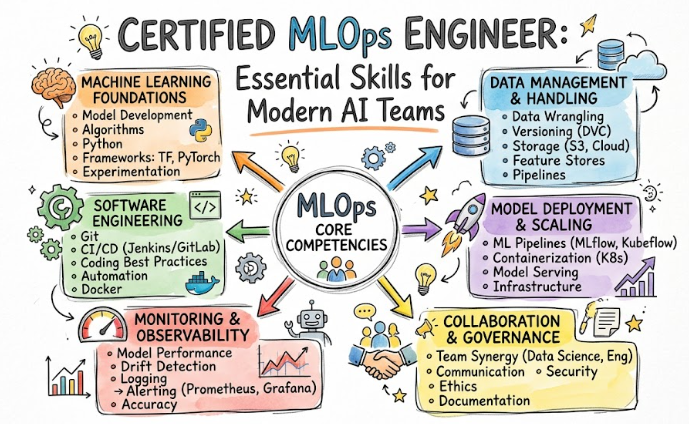
Skills you will gain
- The architecture of automated ML pipelines is understood.
- Version control for massive datasets is implemented.
- Scalable infrastructure is deployed using modern container tools.
- Techniques for detecting “model decay” are mastered.
- Security protocols for sensitive AI data are established.
Real-world projects you should be able to do after this certification
- A self-healing deployment system for neural networks is designed.
- A multi-stage pipeline that tests both code and data quality is built.
- A centralized feature store for an entire organization is created.
- Automated alerts for drops in model accuracy are configured.
Preparation plan
7–14 days plan:
The core vocabulary of MLOps is studied. The relationship between different tools in the stack is mapped out. Initial labs are used to visualize the flow of a basic pipeline.
30 days plan:
Deep dives into specific automation tools are conducted. Every step of the pipeline—from data cleaning to serving—is practiced manually to understand the underlying mechanics.
60 days plan:
Complex, multi-cloud scenarios are simulated. Troubleshooting and optimization become the main focus. A final capstone project is completed to prove total readiness for the exam.
Common mistakes to avoid
- Treating a machine learning model exactly like a static piece of software.
- Ignoring the cost of cloud resources when scaling AI.
- Failing to document the data lineage for compliance purposes.
- Over-complicating the initial architecture.
Best next certification after this
- Same track: Senior AI Architect.
- Cross-track: Security for Artificial Intelligence.
- Leadership / management: Director of Engineering (AI Focus).
Choose Your Learning Path
1. DevOps Perspective
The focus is placed on the “Ops” side. Best practices for uptime and deployment are translated into the world of data science.
2. DevSecOps Perspective
The integrity of the model is protected. Security checks are inserted into every stage of the learning process to prevent data poisoning.
3. Site Reliability Engineering (SRE) Perspective
The “Golden Signals” of monitoring are applied to machine learning. Systems are built to be resilient against traffic spikes and data shifts.
4. AIOps / MLOps Perspective
This is the most direct path. The focus remains on the specific tools and methodologies that make AI production-ready.
5. DataOps Perspective
The health of the data is the main priority. Pipelines are built to ensure that “garbage in” never happens, so “garbage out” is avoided.
6. FinOps Perspective
The financial impact of heavy AI workloads is managed. Strategies are implemented to keep the cost of training models under control.
Role → Recommended Certifications Mapping
| Role | Target Certification | Core Outcome |
| DevOps Engineer | Certified MLOps Engineer | Automation of AI |
| Site Reliability Engineer | SRE Specialist | AI System Uptime |
| Platform Engineer | Infrastructure Lead | Scalable AI Labs |
| Cloud Engineer | Cloud AI Architect | Global AI Delivery |
| Security Engineer | AI Security Expert | Model Protection |
| Data Engineer | DataOps Professional | Data Reliability |
| FinOps Practitioner | AI Cost Optimizer | ROI on AI Projects |
| Engineering Manager | AI Strategy Leader | Team Governance |
Next Certifications to Take
Same-track Recommendation:
An advanced course in Automated Governance is suggested. It ensures that all AI activities meet legal and ethical standards.
Cross-track Recommendation:
A certification in Distributed Systems is advised. It provides the deep technical knowledge needed to handle massive global data flows.
Leadership-focused Recommendation:
A program in Technical Product Management is recommended. This helps an engineer understand how to turn AI features into successful business products.
Training & Certification Support Institutions
DevOpsSchool
A solid foundation for all operations roles is provided here. The focus is on bridging the gap between development and delivery. Real-world expertise is shared through structured modules.
Cotocus
Technical depth is emphasized in every training session. Complex topics are broken down into manageable pieces. Support is offered for those aiming for high-level certifications.
ScmGalaxy
The importance of configuration and versioning is taught. A large library of resources is available for self-paced learning. Community knowledge is used to solve modern engineering hurdles.
BestDevOps
Simplified paths to career success are created. The most important skills for the current job market are highlighted. Practical exercises are used to reinforce every concept.
devsecopsschool.com
A culture of security is promoted. Techniques for protecting modern software pipelines are shared. The curriculum is designed to make security a standard part of development.
sreschool.com
The art of building reliable systems is explored. Students are taught how to handle failures gracefully. Scaling strategies for large enterprises are a key focus.
aiopsschool.com
The future of intelligent operations is led by this institution. Specialized training for MLOps and AIOps is provided. The focus is placed entirely on the automation of the next generation of software.
dataopsschool.com
Data is treated as a first-class citizen in the engineering world. Methods for creating high-speed, high-quality data pipelines are taught. Data integrity is the core mission.
finopsschool.com
The intersection of finance and cloud engineering is mastered here. Professionals learn how to prove the value of their technical work through cost efficiency. Cloud waste is targeted and removed.
FAQs Section
1. Is the exam for Certified MLOps Engineer difficult?
A significant amount of study is required. It is designed to test actual capability rather than just memory.
2. How long does it take to get certified?
Most candidates spend one to two months preparing. This varies based on their hands-on experience.
3. What are the prerequisites?
A basic understanding of how software is deployed in the cloud is necessary. Python knowledge is very helpful.
4. What is the best sequence for these certifications?
Starting with general DevOps and then moving into MLOps is the most common path.
5. How much can a Certified MLOps Engineer earn?
Salaries in this field are among the highest in the tech industry due to the specialized nature of the work.
6. What are the common job titles for graduates?
Titles include Machine Learning Engineer, MLOps Specialist, and AI Operations Lead.
7. Is the certification recognized in India?
Yes, it is highly valued by major tech hubs and multinational corporations across the country.
8. Do I need to be a data scientist?
No, this is an engineering role focused on the systems that support data science.
9. Can I take the exam from home?
Yes, secure online proctoring is available for all candidates globally.
10. How are the labs conducted?
Hands-on environments are provided to simulate real-world infrastructure challenges.
11. Is there a community for support?
A large network of alumni and experts is available for guidance.
12. Why is MLOps better than traditional DevOps for AI?
It addresses the specific needs of data drift and model retraining which DevOps does not cover.
Additional FAQs for Certified MLOps Engineer
1. What is the focus of Certified MLOps Engineer?
The main focus is the automation and reliability of AI systems.
2. Is Kubernetes used in Certified MLOps Engineer?
Yes, container orchestration is a core part of the training.
3. Will this certification help with career growth?
It provides a clear advantage when applying for senior-level engineering positions.
4. Are there any coding assignments?
Yes, building scripts to automate pipelines is part of the learning process.
5. Is a certificate provided immediately?
Digital credentials are issued shortly after passing the final assessment.
6. What is the validity of the certificate?
Standard industry renewal periods apply to ensure skills stay current.
7. Are there discounts for group registrations?
Institutional inquiries are welcomed for team training programs.
8. Is technical support available during the course?
Yes, mentors are available to help with any technical difficulties.
Testimonials
Isabella G.
A new level of technical maturity was reached. The complexity of AI systems is no longer intimidating. My ability to design stable pipelines has improved 100%.
Liam N.
Total clarity regarding my career path was gained. The distinction between a developer and an MLOps engineer is now clear. I feel ready for the most demanding roles.
Arjun S.
The practical labs were the highlight of the journey. Real-world errors were simulated and solved. My value to the team has increased significantly.
Priya M.
Confidence in handling large-scale deployments was built. Security is now integrated into my workflow from day one. This was a great investment in my future.
Robert K.
Guidance for the whole department is now provided with ease. The strategic side of AI operations is fully understood. Every engineer should take this path.
Conclusion
The importance of the Certified MLOps Engineer role cannot be overstated. It is the backbone of the modern AI revolution. Long-term career benefits are secured by those who master the lifecycle of machine learning.
A strategic approach to learning is the best way to move forward. By choosing a recognized path, a professional ensures they are following the best practices of the industry. The future belongs to those who can operationalize intelligence.