Introduction
Lead Enrichment Tools help businesses improve incomplete lead records by adding useful company, contact, role, industry, location, firmographic, technographic, and intent-related details. Instead of working with only a name and email address, sales and marketing teams can understand who the lead is, where they work, what company size they belong to, what tools they may use, and whether they fit the ideal customer profile.
These tools are important because lead quality directly affects sales productivity, marketing segmentation, account scoring, personalization, and conversion rates. Without enrichment, teams often waste time chasing poor-fit leads, manually researching prospects, or working with outdated CRM records. A good enrichment platform helps clean, complete, and prioritize lead data so teams can focus on the best opportunities.
Real-world use cases include:
- Enriching form submissions with company and role data
- Updating incomplete CRM records
- Segmenting leads by company size, industry, location, or job title
- Improving lead scoring and routing accuracy
- Supporting outbound prospecting and account-based marketing
- Reducing manual research for sales teams
Buyer evaluation criteria should include:
- Contact and company data accuracy
- Firmographic and technographic coverage
- CRM and marketing automation integrations
- Real-time enrichment capabilities
- Data freshness and update frequency
- Lead scoring and qualification support
- Compliance and consent controls
- API and workflow flexibility
- Ease of use for sales and marketing teams
- Pricing, credits, and scalability
Best for: B2B sales teams, demand generation teams, revenue operations teams, marketing operations teams, SDR teams, account-based marketing teams, SaaS companies, agencies, and enterprises that need cleaner lead data and better prospect qualification.
Not ideal for: Very small teams with low lead volume, businesses that do not use CRM or marketing automation, consumer-focused brands with limited B2B data needs, or companies that cannot act on enriched data through segmentation, routing, or follow-up workflows.
Key Trends in Lead Enrichment Tools
- Real-time enrichment is becoming standard: Teams want form submissions, demo requests, and inbound leads enriched immediately before routing them to sales.
- Firmographic data is still core: Company size, industry, location, revenue range, and employee count remain essential for lead qualification.
- Technographic enrichment is gaining value: Knowing what tools a company uses helps sales and marketing teams personalize messaging and identify fit.
- Intent data is becoming more connected: Some enrichment workflows now include signals that show whether an account may be researching relevant topics.
- CRM hygiene is a major priority: Revenue teams increasingly use enrichment tools to clean duplicate, incomplete, outdated, or poorly segmented records.
- API-first enrichment is growing: Teams want enrichment embedded into forms, product signup flows, lead routing systems, and data pipelines.
- Privacy and compliance are more important: Buyers must understand how vendors source, process, store, and update contact and company data.
- Account-based marketing relies heavily on enrichment: ABM campaigns need accurate account data, buying committee details, segmentation, and account matching.
- AI-assisted scoring is improving prioritization: Enriched data can help AI models identify which leads are most likely to fit target customer profiles.
- Sales personalization depends on better data: Enrichment helps reps write more relevant messages based on industry, role, company size, and technology usage.
How We Selected These Tools
The tools in this list were selected using practical buyer-focused evaluation logic:
- Strong recognition in lead enrichment, sales intelligence, data enrichment, prospecting, or revenue operations
- Ability to enrich contact, company, account, and CRM records with useful B2B data
- Fit across SMB, mid-market, and enterprise sales and marketing teams
- Integration strength with CRM, marketing automation, sales engagement, and workflow tools
- Practical support for inbound lead enrichment, outbound prospecting, and CRM data improvement
- Data quality signals such as breadth, freshness, match accuracy, and business relevance
- Workflow flexibility through APIs, bulk enrichment, real-time enrichment, and automation
- Ease of use for sales, marketing, and revenue operations users
- Security, compliance, permissions, and data governance considerations
- Overall buyer value based on data quality, usability, scalability, and operational impact
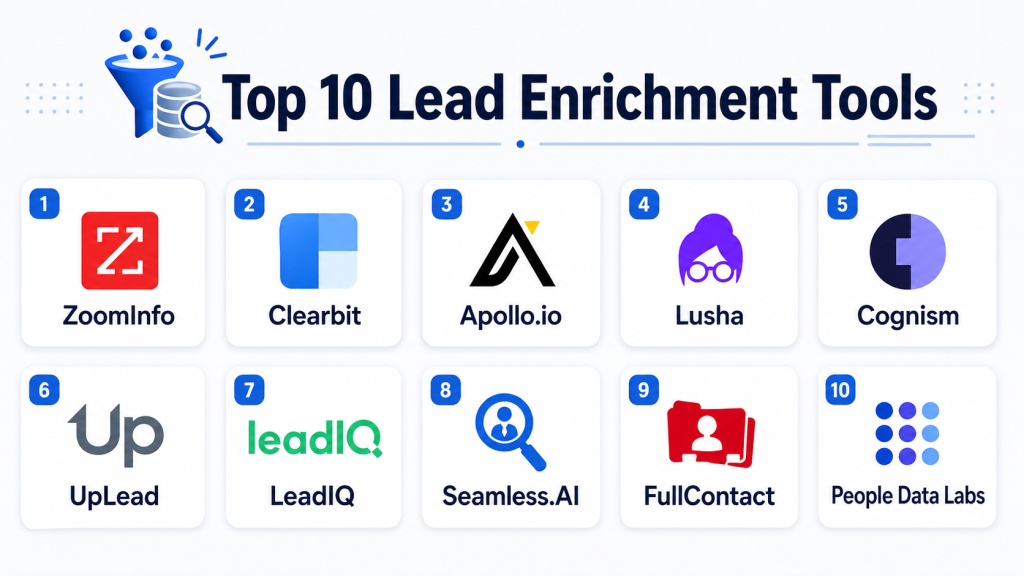
Top 10 Lead Enrichment Tools
#1 — ZoomInfo
Short description: ZoomInfo is a B2B data and sales intelligence platform that helps teams enrich leads, accounts, contacts, and CRM records with company and buyer information. It is widely used by sales, marketing, and revenue operations teams that need reliable prospect data at scale. It is especially useful for outbound prospecting, account targeting, data enrichment, and sales intelligence workflows.
Key Features
- B2B contact and company database
- Firmographic and demographic enrichment
- Technographic and intent-related data support
- CRM enrichment and data cleanup workflows
- Account and contact search filters
- Sales intelligence and prospecting tools
- Workflow integrations with sales and marketing systems
Pros
- Strong fit for enterprise and mid-market B2B teams
- Useful for both enrichment and outbound prospecting
- Broad company and contact data coverage
Cons
- Pricing may be high for smaller teams
- Data accuracy can vary by region, industry, and contact type
- Requires clear governance to avoid poor outreach practices
Platforms / Deployment
Cloud
Web-based platform
CRM and sales workflow integrations
Security & Compliance
ZoomInfo provides business and enterprise administration features. Buyers should validate access controls, data handling practices, retention settings, user permissions, and compliance requirements directly.
Integrations & Ecosystem
ZoomInfo integrates with CRM, sales engagement, marketing automation, and revenue operations workflows. It works best when enriched data flows directly into routing, segmentation, scoring, and outreach processes.
- Salesforce
- HubSpot
- Sales engagement tools
- Marketing automation platforms
- Workflow automation systems
- Data enrichment workflows
Support & Community
ZoomInfo provides onboarding resources, documentation, training, customer support, and account management options. Support depth may vary by package and contract.
#2 — Clearbit
Short description: Clearbit is a lead enrichment and B2B data platform focused on helping teams enrich leads, companies, and website visitors with firmographic and company data. It is often used for real-time form enrichment, lead scoring, routing, segmentation, and account-based marketing workflows. It is especially useful for teams that want enrichment directly embedded into marketing and revenue operations processes.
Key Features
- Real-time lead and company enrichment
- Firmographic and company data attributes
- Website visitor identification support
- Lead scoring and routing workflows
- API-based enrichment
- CRM and marketing automation integrations
- Segmentation and personalization support
Pros
- Strong real-time enrichment capabilities
- Useful for inbound lead qualification and routing
- API-friendly for growth and operations teams
Cons
- Data coverage can vary by market and company type
- Advanced workflows may require technical setup
- Some teams may need additional prospecting tools alongside it
Platforms / Deployment
Cloud
Web-based platform
API-based deployment options
Security & Compliance
Security and compliance details should be verified directly. Buyers should validate SSO, user permissions, encryption, data handling, retention, and compliance requirements based on their use case.
Integrations & Ecosystem
Clearbit connects enrichment data with CRM, forms, marketing automation, website personalization, lead routing, and analytics workflows. It is useful for teams that want data to flow automatically into revenue systems.
- Salesforce
- HubSpot
- Marketing automation tools
- Website forms
- Data warehouses
- API workflows
Support & Community
Clearbit provides documentation, API resources, onboarding materials, and customer support options. Support depth may vary by plan and customer type.
#3 — Apollo.io
Short description: Apollo.io combines B2B prospecting, contact data, lead enrichment, email outreach, and sales engagement workflows. It is popular with startups, SMBs, and sales teams that want data enrichment and outbound prospecting in one platform. Apollo.io is practical for building lists, enriching records, running email sequences, and improving sales pipeline generation.
Key Features
- Contact and company data enrichment
- Prospect search and list building
- Email sequencing and outbound automation
- Lead scoring and filtering
- CRM integration support
- Data enrichment and update workflows
- Engagement analytics
Pros
- Strong value for SMB and startup sales teams
- Combines enrichment, prospecting, and outreach
- Easy to use for outbound lead generation
Cons
- Data accuracy may vary by geography and segment
- Enterprise governance depth should be validated
- Outreach quality still depends on team strategy and messaging
Platforms / Deployment
Cloud
Web-based platform
Email, CRM, and sales workflow integrations
Security & Compliance
Security and compliance features should be verified directly. Buyers should validate data handling, permissions, email compliance, retention, access controls, and administrative settings.
Integrations & Ecosystem
Apollo.io connects data enrichment with prospecting, sales engagement, and CRM workflows. It is useful for teams that want fewer tools for list building, enrichment, and outbound campaigns.
- CRM systems
- Email providers
- Sales engagement workflows
- Workflow automation tools
- Data enrichment processes
- Reporting tools
Support & Community
Apollo.io provides documentation, onboarding resources, support options, and product education materials. Support level may vary by plan and team size.
#4 — Lusha
Short description: Lusha is a B2B contact and company data platform used for prospecting, enrichment, and sales intelligence. It helps teams find contact details, enrich lead records, and identify decision-makers within target accounts. Lusha is especially useful for sales teams that need quick access to prospect information and simple enrichment workflows.
Key Features
- Contact and company data enrichment
- Prospect search and filtering
- Browser extension for prospect research
- CRM enrichment support
- Bulk enrichment options
- Sales intelligence workflows
- Team usage and credit management
Pros
- Easy to use for sales prospecting
- Useful for quick contact discovery and enrichment
- Good fit for SMB and mid-market teams
Cons
- Data coverage may vary by region and role
- Credit-based usage needs monitoring
- Larger teams should validate governance and admin controls
Platforms / Deployment
Cloud
Web-based platform
Browser extension availability
CRM integrations
Security & Compliance
Security and compliance details should be reviewed directly. Buyers should validate data sourcing, consent practices, access controls, user permissions, and compliance requirements.
Integrations & Ecosystem
Lusha fits into sales prospecting and CRM enrichment workflows. It is often used by SDRs, account executives, recruiters, and sales teams that need fast contact discovery.
- CRM systems
- Browser-based research workflows
- Sales engagement tools
- Prospecting workflows
- Data export processes
- Team management tools
Support & Community
Lusha provides support resources, documentation, help materials, and customer assistance. Support depth may vary by package.
#5 — Cognism
Short description: Cognism is a B2B sales intelligence and lead enrichment platform focused on contact data, company data, intent signals, and compliant prospecting workflows. It is often used by sales and marketing teams that need accurate contact data and strong account targeting. It is particularly relevant for teams that care about responsible B2B data usage and outreach governance.
Key Features
- B2B contact and company enrichment
- Sales intelligence and prospecting
- Firmographic and account data
- Intent-related data support
- CRM enrichment workflows
- Data quality and verification features
- Sales and marketing integrations
Pros
- Strong fit for B2B prospecting and enrichment
- Useful for sales teams targeting specific accounts and personas
- Good option for teams that prioritize data governance
Cons
- Pricing may be higher than simple enrichment tools
- Best value depends on region and target market coverage
- Buyers should validate specific data availability before purchase
Platforms / Deployment
Cloud
Web-based platform
CRM and sales workflow integrations
Security & Compliance
Cognism emphasizes responsible data workflows, but buyers should validate specific security controls, privacy requirements, data handling practices, permissions, and compliance needs directly.
Integrations & Ecosystem
Cognism integrates with CRM and sales workflows to help teams enrich records, identify prospects, and improve account targeting. It fits well into sales development and revenue operations processes.
- CRM platforms
- Sales engagement tools
- Prospecting workflows
- Account targeting systems
- Data enrichment processes
- Reporting workflows
Support & Community
Cognism provides onboarding, documentation, support resources, and customer success assistance. Support level may vary by package and region.
#6 — UpLead
Short description: UpLead is a B2B lead generation and data enrichment platform that helps teams find verified contacts, enrich company records, and build prospect lists. It is useful for sales and marketing teams that want a practical database with filtering, verification, and export workflows. UpLead can be a good fit for SMBs and mid-market teams looking for simpler enrichment and prospecting.
Key Features
- B2B contact and company database
- Email verification support
- Lead enrichment workflows
- Firmographic filtering
- Technographic filtering support
- CRM export and integration options
- Prospect list building
Pros
- Practical for SMB and mid-market prospecting
- Useful verification-focused workflows
- Easier to adopt than some enterprise platforms
Cons
- Coverage may vary by target segment
- Not as broad as larger sales intelligence suites
- Advanced workflow automation may require additional tools
Platforms / Deployment
Cloud
Web-based platform
CRM and export workflows
Security & Compliance
Security and compliance details should be verified directly. Buyers should validate data sourcing, user permissions, privacy controls, and compliance requirements.
Integrations & Ecosystem
UpLead supports prospecting, list building, enrichment, and CRM workflows. It is useful for teams that need simple access to verified B2B lead data.
- CRM systems
- Email workflows
- Sales prospecting tools
- Export workflows
- Data enrichment processes
- Marketing lists
Support & Community
UpLead provides support resources, documentation, and onboarding guidance. Support depth may vary by plan.
#7 — LeadIQ
Short description: LeadIQ is a sales prospecting and lead enrichment tool designed to help reps capture leads, enrich contact data, and sync prospect information into sales workflows. It is useful for outbound sales teams that need fast prospect capture from web research and sales platforms. LeadIQ works well when reps need to reduce manual data entry and improve outreach preparation.
Key Features
- Contact capture and enrichment
- Prospecting workflow support
- CRM and sales engagement sync
- Browser-based lead research
- Email and contact data support
- Team workflow collaboration
- Sales productivity features
Pros
- Good for SDR and outbound sales workflows
- Reduces manual prospect research and data entry
- Useful for CRM and sales engagement handoff
Cons
- Best suited for sales prospecting rather than full marketing enrichment
- Data accuracy should be validated by region and persona
- Advanced enrichment needs may require additional tools
Platforms / Deployment
Cloud
Web-based platform
Browser extension availability
CRM and sales engagement integrations
Security & Compliance
Buyers should verify data handling, access controls, user permissions, retention, and compliance requirements directly.
Integrations & Ecosystem
LeadIQ connects prospect research with CRM and sales engagement workflows. It is most useful for outbound teams that need clean prospect records quickly.
- Salesforce
- HubSpot
- Sales engagement platforms
- Browser-based research workflows
- Prospecting tools
- Outreach workflows
Support & Community
LeadIQ provides documentation, onboarding resources, product support, and sales workflow guidance. Support depth may vary by plan.
#8 — Seamless.AI
Short description: Seamless.AI is a sales intelligence and lead enrichment platform that helps teams find contact details, build prospect lists, and enrich sales records. It is designed for sales teams that need prospect discovery and contact data for outbound campaigns. It is especially useful for organizations that want a prospecting-focused tool with search and enrichment capabilities.
Key Features
- Contact and company search
- Lead enrichment workflows
- Prospect list building
- Sales intelligence data
- CRM integration support
- Browser-based prospecting tools
- Data export and workflow support
Pros
- Useful for outbound sales prospecting
- Helps reps find and enrich contact records
- Practical for list building and sales research
Cons
- Data accuracy should be validated before scaling
- Buyers should review data governance requirements carefully
- Advanced marketing operations workflows may need other tools
Platforms / Deployment
Cloud
Web-based platform
Browser and CRM workflow support
Security & Compliance
Security and compliance details should be validated directly. Buyers should review data sourcing, permissions, privacy practices, and compliance requirements.
Integrations & Ecosystem
Seamless.AI fits into prospecting, sales outreach, and CRM enrichment workflows. It is most useful for sales teams building outbound lists and improving contact records.
- CRM systems
- Sales engagement tools
- Browser-based prospecting
- Export workflows
- Lead enrichment processes
- Sales research workflows
Support & Community
Seamless.AI provides support resources, documentation, onboarding options, and customer assistance. Support level may vary by plan.
#9 — FullContact
Short description: FullContact is a data enrichment platform focused on identity resolution, contact enrichment, audience insights, and customer data improvement. It helps businesses enrich customer and lead records with additional identity, demographic, and profile attributes. It is useful for teams that need data enrichment beyond basic B2B prospecting, especially in customer data and identity-focused workflows.
Key Features
- Contact and identity enrichment
- Customer profile enhancement
- Audience insights
- Data matching and resolution
- API-based enrichment
- CRM and database enrichment support
- Customer data workflow support
Pros
- Strong for identity and profile enrichment workflows
- Useful for customer data improvement
- API-friendly for technical and data teams
Cons
- May not be the best standalone B2B prospecting tool
- Use cases may require technical setup
- Data attributes and coverage should be validated directly
Platforms / Deployment
Cloud
API-based deployment
Web-based access may vary by package
Security & Compliance
Security and compliance details should be verified directly. Buyers should validate data handling, permissions, encryption, retention, privacy requirements, and compliance coverage.
Integrations & Ecosystem
FullContact fits into customer data, enrichment, identity resolution, and analytics workflows. It is useful when enrichment needs to connect with CRM, CDP, databases, and internal applications.
- CRM systems
- Customer data platforms
- Data warehouses
- API workflows
- Analytics systems
- Identity resolution processes
Support & Community
FullContact provides API documentation, support resources, onboarding guidance, and customer assistance. Support depth may vary by package and technical requirements.
#10 — People Data Labs
Short description: People Data Labs is a data platform that provides person and company data through APIs, datasets, and enrichment workflows. It is often used by technical, data, and revenue operations teams that need scalable data enrichment for applications, databases, and analytics. It is best suited for teams that want flexible enrichment infrastructure rather than only a sales-facing prospecting interface.
Key Features
- Person and company data enrichment
- API-based enrichment workflows
- Bulk enrichment support
- Dataset access options
- Identity matching and data normalization
- Firmographic and profile attributes
- Data infrastructure support for internal systems
Pros
- Strong API and data infrastructure flexibility
- Useful for technical teams and large-scale enrichment
- Supports bulk data workflows and internal applications
Cons
- Less beginner-friendly than sales-facing tools
- Requires technical or data operations resources
- Buyers must validate data coverage and compliance fit carefully
Platforms / Deployment
Cloud
API-based deployment
Data workflow and bulk enrichment options
Security & Compliance
Security and compliance details should be validated directly. Buyers should review data sourcing, processing, retention, permissions, encryption, and compliance obligations before implementation.
Integrations & Ecosystem
People Data Labs is designed for API-driven enrichment, internal systems, analytics, and data operations. It is especially useful for teams building enrichment directly into products, data pipelines, or CRM hygiene workflows.
- API workflows
- Data warehouses
- CRM enrichment pipelines
- Internal applications
- Analytics systems
- Customer data infrastructure
Support & Community
People Data Labs provides API documentation, technical resources, support options, and implementation guidance. Support depth may vary by package and technical scope.
Comparison Table
| Tool Name | Best For | Platform(s) Supported | Deployment | Standout Feature | Public Rating |
|---|---|---|---|---|---|
| ZoomInfo | Enterprise B2B sales intelligence | Web-based | Cloud | Broad contact and company data enrichment | N/A |
| Clearbit | Real-time inbound enrichment | Web-based, API | Cloud | Form and company enrichment workflows | N/A |
| Apollo.io | SMB outbound prospecting and enrichment | Web-based | Cloud | Data plus outreach automation | N/A |
| Lusha | Quick contact discovery and enrichment | Web-based, browser extension | Cloud | Simple prospect data enrichment | N/A |
| Cognism | B2B prospecting with data governance focus | Web-based | Cloud | Contact enrichment and sales intelligence | N/A |
| UpLead | Verified B2B leads for SMBs | Web-based | Cloud | Prospect list building and verification | N/A |
| LeadIQ | SDR prospect capture and enrichment | Web-based, browser extension | Cloud | Fast prospect capture into sales workflows | N/A |
| Seamless.AI | Outbound sales list building | Web-based, browser support | Cloud | Sales-focused contact discovery | N/A |
| FullContact | Identity and profile enrichment | API, web-based access varies | Cloud | Identity resolution and customer enrichment | N/A |
| People Data Labs | API-driven enrichment at scale | API, data workflows | Cloud | Flexible person and company data APIs | N/A |
Evaluation & Scoring of Lead Enrichment Tools
| Tool Name | Core (25%) | Ease (15%) | Integrations (15%) | Security (10%) | Performance (10%) | Support (10%) | Value (15%) | Weighted Total (0–10) |
|---|---|---|---|---|---|---|---|---|
| ZoomInfo | 10 | 8 | 9 | 8 | 9 | 8 | 7 | 8.50 |
| Clearbit | 9 | 8 | 9 | 8 | 8 | 8 | 8 | 8.35 |
| Apollo.io | 8 | 9 | 8 | 7 | 8 | 8 | 9 | 8.25 |
| Lusha | 8 | 9 | 8 | 7 | 8 | 8 | 8 | 8.05 |
| Cognism | 9 | 8 | 8 | 8 | 8 | 8 | 7 | 8.10 |
| UpLead | 8 | 9 | 7 | 7 | 8 | 8 | 8 | 7.90 |
| LeadIQ | 8 | 9 | 8 | 7 | 8 | 8 | 8 | 8.05 |
| Seamless.AI | 8 | 8 | 7 | 7 | 8 | 7 | 8 | 7.65 |
| FullContact | 8 | 7 | 8 | 8 | 8 | 7 | 7 | 7.65 |
| People Data Labs | 9 | 6 | 8 | 8 | 8 | 7 | 8 | 7.85 |
These scores are comparative and should be used as a shortlist guide. Sales-facing tools often score higher in ease of use, while API-first platforms score higher in flexibility and scale. Enterprise data platforms may be stronger for coverage and governance, while SMB-friendly tools may offer better speed and value. The best tool depends on your data needs, CRM stack, target market, lead volume, compliance requirements, and enrichment workflow.
Which Lead Enrichment Tool Is Right for You?
Solo / Freelancer
Solo professionals usually need a simple and affordable tool for prospect research, contact lookup, and basic enrichment. Apollo.io, Lusha, UpLead, or LinkedIn-based workflows may be enough depending on the use case. If you only handle a small number of leads, avoid complex API or enterprise data platforms. Focus on tools that reduce manual research and help you personalize outreach quickly.
SMB
SMBs should prioritize ease of use, affordable pricing, CRM integration, and practical data accuracy. Apollo.io, Lusha, UpLead, LeadIQ, and Seamless.AI are useful for outbound prospecting and list building. Clearbit can be valuable when inbound forms and website leads need real-time enrichment. SMBs should test data quality with their actual target customer profile before committing to a larger plan.
Mid-Market
Mid-market teams usually need stronger CRM enrichment, lead routing, segmentation, and sales-marketing alignment. ZoomInfo, Clearbit, Apollo.io, Cognism, LeadIQ, and Lusha are strong candidates depending on the region and workflow. Teams should prioritize enrichment accuracy, duplicate prevention, CRM field mapping, and automated lead routing. Data governance becomes more important as more teams depend on enriched records.
Enterprise
Enterprises should prioritize data coverage, governance, integrations, APIs, permissions, scalability, and compliance review. ZoomInfo, Clearbit, Cognism, FullContact, and People Data Labs are strong options for enterprise evaluation depending on whether the need is sales intelligence, real-time enrichment, customer identity enrichment, or API-based data infrastructure. Large teams should involve sales operations, marketing operations, legal, security, and IT early in the selection process.
Budget vs Premium
Budget-focused teams should start with tools that solve a clear enrichment problem without unnecessary complexity. Apollo.io, Lusha, UpLead, LeadIQ, and Seamless.AI can be practical for smaller teams. Premium buyers should evaluate ZoomInfo, Clearbit, Cognism, FullContact, or People Data Labs when they need broader data, stronger workflows, API access, or enterprise-grade governance.
Feature Depth vs Ease of Use
If ease of use matters most, Apollo.io, Lusha, UpLead, LeadIQ, and Seamless.AI are practical choices. If feature depth matters more, ZoomInfo, Clearbit, Cognism, FullContact, and People Data Labs offer broader or more flexible enrichment capabilities. Sales teams may prefer simple search and CRM sync, while operations teams may prefer APIs, bulk enrichment, identity matching, and automated data workflows.
Integrations & Scalability
Lead Enrichment Tools should integrate with CRM, marketing automation, sales engagement, forms, data warehouses, analytics tools, and workflow automation systems. Poor integration can create duplicate records, inconsistent fields, and unreliable reporting. Scalable enrichment requires clear field mapping, deduplication rules, routing logic, permissions, and periodic data refreshes.
Security & Compliance Needs
Lead enrichment involves personal and company data, so buyers should carefully review data sourcing, consent practices, retention, permissions, access controls, encryption, and regional privacy requirements. Teams should confirm whether enriched data can be used for sales outreach, marketing segmentation, analytics, or customer profiling. Legal and compliance review is especially important for regulated industries and global markets.
Frequently Asked Questions
1. What are Lead Enrichment Tools?
Lead Enrichment Tools add missing details to lead, contact, company, and account records.
They can provide information such as job title, company size, industry, location, technology usage, and business profile data.
These tools help sales and marketing teams qualify, segment, route, and personalize leads more effectively.
2. Why is lead enrichment important?
Lead enrichment improves data quality and reduces manual research for sales and marketing teams.
It helps teams understand whether a lead matches the ideal customer profile.
Better enriched data can improve lead scoring, routing, personalization, and conversion rates.
3. What types of data can be enriched?
Common enrichment fields include name, job title, company, industry, employee count, location, revenue range, website, and social profile data.
Some tools also provide technographic, firmographic, intent, and account-level insights.
The available data depends on the vendor, region, and target market.
4. Are Lead Enrichment Tools useful for small businesses?
Yes, small businesses can use lead enrichment tools to save time and improve prospect qualification.
Simple tools can help SMBs find contact details, complete CRM records, and personalize outreach.
Small teams should choose tools that are affordable, easy to use, and aligned with their target customer profile.
5. How much do Lead Enrichment Tools cost?
Pricing often depends on users, credits, data volume, enrichment requests, integrations, and enterprise features.
Some tools use credit-based pricing, while others offer subscription or API-based pricing.
Buyers should compare total cost based on actual enrichment volume and workflow needs.
6. Do Lead Enrichment Tools integrate with CRM systems?
Yes, many enrichment tools integrate with CRM systems to update leads, contacts, companies, and accounts automatically.
CRM integration helps sales teams work with cleaner and more complete records.
Buyers should confirm field mapping, duplicate handling, sync rules, and admin controls before rollout.
7. What mistakes should buyers avoid?
A common mistake is choosing a tool without testing data accuracy against real target accounts.
Another mistake is enriching data without clear routing, scoring, or follow-up workflows.
Teams should also avoid pushing unverified data into CRM without deduplication and governance rules.
8. Are Lead Enrichment Tools secure and compliant?
Many vendors provide security controls, but compliance depends on data sources, usage, region, and configuration.
Buyers should review data handling, consent practices, access controls, retention, and privacy obligations.
Legal and security teams should be involved when enrichment affects large-scale outreach or customer profiling.
9. Can lead enrichment improve personalization?
Yes, enrichment can improve personalization by giving reps and marketers more context about the lead and company.
Teams can tailor messages by industry, role, company size, technology stack, or business segment.
However, personalization should be relevant and respectful, not overly intrusive.
10. What are alternatives to dedicated Lead Enrichment Tools?
Alternatives include manual research, CRM-only data entry, public company websites, professional networks, spreadsheets, and internal data cleanup.
These methods may work for very small teams or low lead volume.
Dedicated enrichment tools are better when teams need speed, scale, automation, accuracy, and CRM-ready data workflows.
Conclusion
Lead Enrichment Tools help businesses turn incomplete lead records into useful sales and marketing intelligence. They support better qualification, routing, segmentation, personalization, CRM hygiene, and account-based workflows. ZoomInfo and Cognism are strong options for teams that need broader B2B sales intelligence and enrichment depth. Clearbit is useful for real-time inbound enrichment, form enrichment, routing, and API-based workflows. Apollo.io, Lusha, UpLead, LeadIQ, and Seamless.AI are practical choices for sales teams focused on outbound prospecting and contact discovery. FullContact and People Data Labs are better suited for identity enrichment, API-driven data workflows, and technical enrichment use cases. The best platform depends on your target market, data accuracy needs, CRM setup, compliance requirements, budget, and team maturity. Before choosing, shortlist two or three tools, test them with real leads, validate data accuracy, and review integration behavior.
This blog gives practical insights into selecting tools based on integrations, automation, and data accuracy features.
The article covers features nicely, but long-term maintenance is another challenge. Over time, enrichment workflows become harder to manage if data mapping isn’t standardized properly.