Introduction
Review Management Platforms help businesses collect, monitor, respond to, analyze, and improve customer reviews across review sites, search platforms, social channels, local directories, and industry-specific platforms. These tools give teams one place to manage feedback instead of checking each review source manually.
A strong review management platform helps businesses request reviews from real customers, respond faster, track ratings, identify recurring service issues, compare locations, and report reputation performance. For local businesses, service brands, healthcare groups, agencies, franchises, and ecommerce companies, reviews directly influence trust, visibility, and conversion.
Real-world use cases include:
- Monitoring reviews from multiple platforms in one dashboard
- Sending automated review requests after customer interactions
- Responding to positive and negative reviews quickly
- Tracking rating trends by location, team, or product
- Identifying recurring customer complaints and service gaps
- Creating review reports for managers, clients, and executives
Buyer evaluation criteria should include:
- Review source coverage
- Review request automation
- Review response workflows
- Sentiment and keyword analysis
- Multi-location reporting
- Review display widgets
- CRM, POS, booking, and support integrations
- Team permissions and approval workflows
- Security and compliance controls
- Pricing, scalability, and support quality
Best for: Local businesses, agencies, healthcare practices, restaurants, hotels, retailers, franchises, SaaS companies, ecommerce brands, customer experience teams, and enterprises that need structured review collection, response, and reporting.
Not ideal for: Businesses with very low customer volume, teams that only need occasional manual review checks, or companies that are not prepared to respond to feedback and improve service based on review insights.
Key Trends in Review Management Platforms
- Automated review requests are becoming standard: Businesses use SMS, email, QR codes, receipts, booking flows, and post-purchase workflows to ask customers for reviews.
- AI-assisted response drafting is growing: Platforms increasingly help teams create faster, more consistent responses while keeping human review in the process.
- Multi-location dashboards are essential: Franchises, clinics, retailers, and service brands need rating visibility across every branch or region.
- Sentiment analysis is more actionable: Teams use review themes to identify service problems, product issues, staff training gaps, and customer satisfaction trends.
- Review generation and customer experience are merging: Reviews are no longer only a marketing metric; they also guide operations and service improvement.
- Local SEO and reviews are closely connected: Strong review volume, freshness, and response activity can support local visibility and customer trust.
- Agencies need white-label reporting: Marketing and reputation agencies want client-ready dashboards, recurring reports, and scalable review workflows.
- Compliance controls matter in regulated industries: Healthcare, finance, legal, and other sensitive sectors need permissions, response approvals, and careful handling of customer information.
- Review display widgets are gaining value: Businesses want to showcase positive feedback on websites, landing pages, and product pages.
- Response speed is becoming a performance metric: Teams increasingly track how quickly locations or managers respond to reviews.
How We Selected These Tools
The tools in this list were selected using practical buyer-focused evaluation logic:
- Strong recognition in review management, reputation management, local SEO, customer feedback, or customer experience workflows
- Ability to monitor, collect, respond to, and analyze reviews across multiple sources
- Fit across SMBs, agencies, multi-location brands, franchises, healthcare groups, ecommerce businesses, and enterprise teams
- Practical support for review requests, templates, response management, alerts, and reporting
- Multi-location capabilities such as location dashboards, benchmarking, permissions, and regional views
- Integration strength with CRM, POS, booking, practice management, support, ecommerce, and messaging systems
- Ease of use for business owners, marketers, location managers, support teams, and agencies
- Reporting quality for ratings, review volume, sentiment, response time, and customer feedback themes
- Security and administration controls such as user roles, access permissions, and approval workflows
- Overall value based on usability, automation, source coverage, analytics, scalability, and support
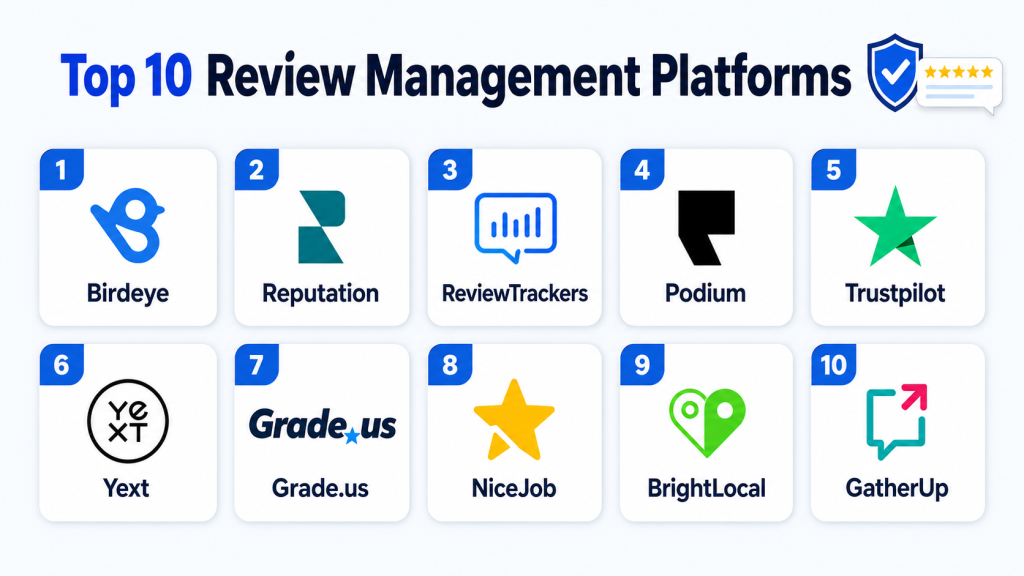
Top 10 Review Management Platforms
#1 — Birdeye
Short description: Birdeye is a review management and customer experience platform that helps businesses request reviews, monitor feedback, respond to customers, manage listings, and communicate through messaging channels. It is widely used by local businesses, healthcare practices, agencies, and multi-location brands. Birdeye is especially strong for teams that want review generation and customer messaging in one platform.
Key Features
- Automated review request workflows
- Review monitoring across multiple sources
- Review response management
- Customer messaging and web chat
- Business listings management
- Surveys and feedback collection
- Multi-location reporting dashboards
Pros
- Strong for review generation and local reputation management
- Useful combination of reviews, messaging, and feedback workflows
- Good fit for SMBs and multi-location businesses
Cons
- Some advanced features may depend on selected package
- Teams need clear response ownership to get full value
- Buyers should validate industry-specific integrations before purchase
Platforms / Deployment
Cloud
Web-based platform
Mobile app availability may vary by package
Security & Compliance
Security and compliance features should be verified directly. Buyers should validate permissions, authentication, encryption, audit logs, data retention, and industry-specific requirements.
Integrations & Ecosystem
Birdeye connects review management with messaging, listings, surveys, and customer engagement workflows. It is useful for businesses that want one system to request, monitor, respond to, and report on customer feedback.
- CRM systems
- Practice management systems
- POS workflows
- Messaging tools
- Listings platforms
- Website chat workflows
Support & Community
Birdeye provides onboarding, documentation, support resources, implementation assistance, and reputation management guidance. Support depth may vary by plan and business size.
#2 — Reputation
Short description: Reputation is a review management and customer experience platform built for larger brands, franchises, and multi-location organizations. It helps teams manage reviews, listings, surveys, social feedback, and customer experience insights across locations. Reputation is especially useful when leadership needs location-level visibility and operational accountability.
Key Features
- Review monitoring and response management
- Review request automation
- Location-level dashboards
- Local listings management
- Customer surveys and feedback workflows
- Sentiment and trend analysis
- Competitive and location benchmarking
Pros
- Strong fit for enterprise and multi-location brands
- Combines reviews, listings, surveys, and reputation insights
- Useful for operational improvement across locations
Cons
- May be more advanced than small businesses need
- Setup requires clear internal workflows and ownership
- Pricing and modules should be reviewed carefully
Platforms / Deployment
Cloud
Web-based platform
Mobile access may vary by package
Security & Compliance
Enterprise security and administration controls may be available. Buyers should validate SSO, role-based access, audit logs, encryption, retention, data handling, and compliance requirements directly.
Integrations & Ecosystem
Reputation fits customer experience, local marketing, review management, listings, and multi-location operations workflows. It is useful when customer feedback must connect with performance management and leadership reporting.
- CRM workflows
- Local listings systems
- Survey workflows
- Customer experience tools
- Social media workflows
- Reporting dashboards
Support & Community
Reputation provides onboarding, customer success resources, documentation, implementation guidance, and enterprise support options. Support level may vary by package.
#3 — ReviewTrackers
Short description: ReviewTrackers is a review monitoring and analytics platform that helps businesses track reviews, analyze customer sentiment, respond to feedback, and report performance across locations. It is well suited for teams that want customer review insights without unnecessary complexity. ReviewTrackers is especially useful for identifying recurring customer experience issues from review data.
Key Features
- Review monitoring from multiple sources
- Review response management
- Sentiment and keyword analysis
- Alerts and notifications
- Multi-location reporting
- Customer feedback analytics
- Competitor benchmarking support
Pros
- Strong focus on review monitoring and analytics
- Useful for customer experience and operations teams
- Good fit for multi-location review reporting
Cons
- May require additional tools for listings or social workflows
- Advanced review generation needs should be validated
- Best value depends on review volume and response process
Platforms / Deployment
Cloud
Web-based platform
Security & Compliance
Security and compliance details should be verified directly. Buyers should validate user permissions, access controls, encryption, audit logs, retention, and privacy requirements.
Integrations & Ecosystem
ReviewTrackers fits review management, customer feedback analysis, operations reporting, and location performance workflows. It helps teams turn customer reviews into measurable improvement opportunities.
- Review platforms
- CRM systems
- Customer experience workflows
- Reporting dashboards
- Location management workflows
- Operations teams
Support & Community
ReviewTrackers provides onboarding resources, documentation, support, and review management guidance. Support depth may vary by package.
#4 — Podium
Short description: Podium is a customer communication and review management platform that helps businesses request reviews, message customers, manage web chat, and improve local engagement. It is especially useful for service-based businesses that rely on fast customer communication. Podium works well when review management and customer messaging need to operate together.
Key Features
- Review request automation
- Customer messaging inbox
- Web chat and lead capture
- Review monitoring and response workflows
- Team collaboration tools
- Customer interaction history
- Local business communication workflows
Pros
- Strong for review requests and customer messaging
- Practical for local service businesses
- Helps teams respond to customers quickly
Cons
- May not be as analytics-heavy as enterprise CX tools
- Best value depends on messaging adoption
- Pricing and feature bundles should be reviewed carefully
Platforms / Deployment
Cloud
Web-based platform
Mobile app availability may vary
Security & Compliance
Security and compliance details should be verified directly. Buyers should validate permissions, messaging data handling, authentication, retention, encryption, and compliance needs.
Integrations & Ecosystem
Podium fits workflows where customer communication, reviews, website chat, and follow-up messaging are connected. It is useful for teams that want to turn customer conversations into review growth and better engagement.
- CRM workflows
- Website chat
- Customer messaging
- Local business tools
- Review platforms
- Payment workflows may vary
Support & Community
Podium provides onboarding, documentation, customer support, business communication resources, and training materials. Support level may vary by plan.
#5 — Trustpilot
Short description: Trustpilot is a customer review platform that helps businesses collect, manage, showcase, and analyze public customer reviews. It is useful for ecommerce brands, SaaS companies, service businesses, and companies that want a public trust profile. Trustpilot is especially strong when public review credibility and social proof are central to the customer journey.
Key Features
- Customer review collection
- Review invitation workflows
- Public business review profile
- Review response management
- Review analytics and insights
- Trust badges and display widgets
- Review sharing and brand credibility workflows
Pros
- Strong public review and trust-building platform
- Useful for ecommerce, SaaS, and service businesses
- Helps showcase customer feedback on websites and buyer journeys
Cons
- Focused mainly on reviews rather than full reputation operations
- Active response management is still required
- Advanced features and integrations may depend on package
Platforms / Deployment
Cloud
Web-based platform
Security & Compliance
Security and compliance details should be verified directly. Buyers should validate account permissions, review moderation policies, data handling, privacy controls, authentication, and compliance requirements.
Integrations & Ecosystem
Trustpilot fits review collection, public reputation, website conversion, and customer trust workflows. It works best when reviews are used as visible proof during the buyer decision process.
- Ecommerce platforms
- Website widgets
- Review invitation workflows
- CRM systems
- Customer experience workflows
- Analytics tools
Support & Community
Trustpilot provides documentation, business support, review management guidance, onboarding resources, and customer education materials. Support level may vary by plan.
#6 — Yext
Short description: Yext is a digital presence platform that supports review management, listings management, local search visibility, and business information control. It is especially useful for multi-location brands that need accurate location data and consistent online information. Yext helps businesses manage how they appear across search, maps, directories, and review platforms.
Key Features
- Review monitoring and response workflows
- Listings management and synchronization
- Local search visibility support
- Location data management
- Knowledge graph and business information management
- Analytics and reporting
- Multi-location governance
Pros
- Strong for listings and local digital presence
- Useful for multi-location businesses and franchises
- Helps reduce inaccurate business information online
Cons
- Review management is part of a broader platform
- Pricing and modules should be reviewed carefully
- Best fit depends on local search and listings priorities
Platforms / Deployment
Cloud
Web-based platform
Security & Compliance
Enterprise administration and security controls may be available. Buyers should validate SSO, permissions, audit logs, encryption, data governance, and compliance requirements directly.
Integrations & Ecosystem
Yext fits local search, listings, review management, and digital presence workflows. It is strongest when review strategy depends on accurate business information across many platforms.
- Listings networks
- Local search workflows
- Review platforms
- Website and location pages
- Analytics dashboards
- Enterprise location management
Support & Community
Yext provides documentation, onboarding, support, training resources, and enterprise implementation assistance. Support depth may vary by package.
#7 — Grade.us
Short description: Grade.us is a review management platform designed for agencies, marketers, and businesses that need review generation, monitoring, white-label reporting, and reputation workflows. It is especially useful for agencies managing review programs for multiple clients. Grade.us helps teams create review funnels, monitor feedback, and deliver client-ready reports.
Key Features
- Review generation campaigns
- Review monitoring and alerts
- White-label reporting
- Agency dashboard workflows
- Review funnel creation
- Multi-location support
- Reputation reporting
Pros
- Strong fit for agencies and consultants
- Useful white-label review management workflows
- Practical for multi-client reputation programs
Cons
- May not be as broad as enterprise CX platforms
- Social listening and listings depth should be validated
- Best value depends on agency or multi-client use cases
Platforms / Deployment
Cloud
Web-based platform
Security & Compliance
Security and compliance details should be verified directly. Buyers should validate permissions, client access controls, data handling, retention, and privacy requirements.
Integrations & Ecosystem
Grade.us fits agency-led review management, client reporting, local reputation, and review request workflows. It is practical for repeatable review services across many clients or locations.
- Agency reporting workflows
- Review platforms
- Client dashboards
- Local business reputation programs
- Review request campaigns
- White-label reporting
Support & Community
Grade.us provides documentation, support resources, onboarding assistance, and agency-focused guidance. Support depth may vary by package.
#8 — NiceJob
Short description: NiceJob is a review management and reputation marketing platform that helps businesses collect reviews, improve online trust, and showcase positive feedback. It is especially useful for local service businesses that want simple review generation and customer referral workflows. NiceJob works well for teams that want an easy way to request, collect, and display reviews.
Key Features
- Automated review requests
- Review monitoring
- Review display and sharing tools
- Customer referral workflows
- Website conversion support
- Campaign analytics
- Simple local business setup
Pros
- Strong for small and local service businesses
- Easy review generation workflows
- Helps turn happy customers into social proof
Cons
- Less advanced for enterprise governance
- Limited compared with broader CX platforms
- Best fit depends on steady customer transaction volume
Platforms / Deployment
Cloud
Web-based platform
Security & Compliance
Security and compliance details should be verified directly. Buyers should validate permissions, customer data handling, review request practices, consent controls, and privacy requirements.
Integrations & Ecosystem
NiceJob fits local service, review generation, reputation marketing, and website proof workflows. It is useful for businesses that want to increase review volume and showcase customer satisfaction.
- CRM workflows
- Local business tools
- Review platforms
- Website widgets
- Customer follow-up systems
- Referral workflows
Support & Community
NiceJob provides onboarding resources, support, help documentation, and reputation marketing guidance. Support depth may vary by plan.
#9 — BrightLocal
Short description: BrightLocal is a local SEO and review management platform that helps businesses track reviews, manage local visibility, audit listings, and report local search performance. It is popular with agencies, local businesses, and marketers focused on local SEO and review tracking. BrightLocal is especially practical for businesses that want review management connected with local search performance.
Key Features
- Review monitoring and reporting
- Review request tools
- Local SEO audits
- Citation and listing tracking
- Local rank tracking
- Reputation reports
- Agency-friendly workflows
Pros
- Strong for local SEO and review tracking
- Practical for agencies and small businesses
- Good value for local reputation workflows
Cons
- Not as broad as enterprise CX platforms
- Social listening and survey workflows may be limited
- Best for local reputation rather than full brand intelligence
Platforms / Deployment
Cloud
Web-based platform
Security & Compliance
Security and compliance details should be verified directly. Buyers should validate account controls, permissions, data handling, retention, and privacy requirements.
Integrations & Ecosystem
BrightLocal fits review monitoring, local SEO, citation management, and agency reporting workflows. It is useful when local visibility and customer reviews need to be tracked together.
- Local SEO workflows
- Review platforms
- Citation management
- Agency reporting
- Local rank tracking
- Business listing audits
Support & Community
BrightLocal provides documentation, learning resources, support options, local SEO education, and agency-focused guidance. Support depth may vary by plan.
#10 — GatherUp
Short description: GatherUp is a review management and customer feedback platform that helps businesses request reviews, collect first-party feedback, monitor third-party reviews, and analyze customer sentiment. It is useful for local businesses, agencies, multi-location brands, and customer experience teams. GatherUp is especially strong when businesses want both private feedback and public review generation workflows.
Key Features
- Review request automation
- First-party feedback collection
- Third-party review monitoring
- Review response workflows
- Sentiment and feedback analysis
- Review widgets and display tools
- Multi-location reporting support
Pros
- Strong combination of feedback collection and review management
- Useful for local businesses and agencies
- Helps teams understand customer issues before they become public complaints
Cons
- Buyers should validate source coverage for their industry
- May need additional tools for broader listings or social monitoring
- Best value depends on consistent customer feedback workflows
Platforms / Deployment
Cloud
Web-based platform
Security & Compliance
Security and compliance details should be verified directly. Buyers should validate permissions, data handling, feedback storage, review request practices, retention, and privacy requirements.
Integrations & Ecosystem
GatherUp fits customer feedback, review generation, reputation reporting, and local business workflows. It is valuable when teams want both private feedback and public review growth.
- Review platforms
- Customer feedback workflows
- Website widgets
- Agency reporting
- Local business systems
- Multi-location reporting
Support & Community
GatherUp provides documentation, onboarding resources, support options, and review management guidance. Support level may vary by package.
Comparison Table
| Tool Name | Best For | Platform(s) Supported | Deployment | Standout Feature | Public Rating |
|---|---|---|---|---|---|
| Birdeye | Local businesses and multi-location customer experience | Web-based, mobile access varies | Cloud | Review generation plus customer messaging | N/A |
| Reputation | Enterprise and multi-location brands | Web-based, mobile access varies | Cloud | Reviews, listings, surveys, and location insights | N/A |
| ReviewTrackers | Review monitoring and analytics | Web-based | Cloud | Multi-source review tracking and sentiment insights | N/A |
| Podium | Local businesses needing reviews and messaging | Web-based, mobile access varies | Cloud | Customer messaging connected with reviews | N/A |
| Trustpilot | Public customer review collection | Web-based | Cloud | Public review profile and trust signals | N/A |
| Yext | Listings and local digital presence | Web-based | Cloud | Listings accuracy plus review workflows | N/A |
| Grade.us | Agencies and white-label review management | Web-based | Cloud | White-label review campaigns and reports | N/A |
| NiceJob | Local service business review growth | Web-based | Cloud | Automated review generation | N/A |
| BrightLocal | Local SEO and review management | Web-based | Cloud | Local SEO audits plus review tracking | N/A |
| GatherUp | Feedback collection and review generation | Web-based | Cloud | First-party feedback plus review workflows | N/A |
Evaluation & Scoring of Review Management Platforms
| Tool Name | Core (25%) | Ease (15%) | Integrations (15%) | Security (10%) | Performance (10%) | Support (10%) | Value (15%) | Weighted Total (0–10) |
|---|---|---|---|---|---|---|---|---|
| Birdeye | 9 | 8 | 9 | 8 | 8 | 8 | 8 | 8.35 |
| Reputation | 10 | 7 | 9 | 9 | 9 | 8 | 7 | 8.55 |
| ReviewTrackers | 8 | 8 | 8 | 8 | 8 | 8 | 8 | 8.00 |
| Podium | 8 | 9 | 8 | 8 | 8 | 8 | 8 | 8.20 |
| Trustpilot | 8 | 8 | 8 | 8 | 8 | 8 | 7 | 7.85 |
| Yext | 9 | 8 | 9 | 9 | 9 | 8 | 7 | 8.45 |
| Grade.us | 8 | 8 | 7 | 7 | 8 | 8 | 8 | 7.75 |
| NiceJob | 7 | 9 | 7 | 7 | 8 | 8 | 9 | 7.85 |
| BrightLocal | 8 | 9 | 7 | 7 | 8 | 8 | 9 | 8.05 |
| GatherUp | 8 | 8 | 7 | 7 | 8 | 8 | 8 | 7.75 |
These scores are comparative and should be used as a shortlist guide. Enterprise and multi-location tools usually score higher for governance, integrations, reporting, and scalability. SMB and agency-friendly tools often score higher for ease of use and value. Review-first tools are strongest for collecting and responding to customer reviews, while local presence tools are stronger when listings and local search visibility are equally important. The best option depends on your review volume, location count, customer communication process, and reporting needs.
Which Review Management Platform Is Right for You?
Solo / Freelancer
Solo professionals and very small businesses should choose a simple platform that helps request and monitor reviews without adding operational complexity. NiceJob, BrightLocal, Trustpilot, or GatherUp can be practical depending on the workflow. If you only receive a few reviews per month, a lightweight tool may be enough. The priority should be timely responses, ethical review requests, and clear customer follow-up.
SMB
SMBs should prioritize easy review requests, simple dashboards, response tools, and affordable pricing. Birdeye, Podium, NiceJob, Trustpilot, BrightLocal, and GatherUp are strong candidates. A local service business may prefer NiceJob or Podium, while a growing brand that wants public credibility may prefer Trustpilot. The best choice is the one your team will use consistently after every customer interaction.
Mid-Market
Mid-market teams usually need review monitoring, response workflows, customer feedback analytics, location reporting, and integrations with CRM, POS, or support systems. Birdeye, ReviewTrackers, Reputation, Podium, Yext, and GatherUp are strong options. Teams should evaluate review source coverage, response templates, sentiment accuracy, and integration behavior before finalizing a platform.
Enterprise
Enterprises should prioritize location-level dashboards, governance, permissions, response approvals, listings accuracy, security, and executive reporting. Reputation, Yext, Birdeye, ReviewTrackers, and Podium are strong enterprise candidates depending on the use case. Large teams should involve marketing, operations, customer experience, IT, legal, and location managers before rollout.
Budget vs Premium
Budget-focused buyers should consider BrightLocal, NiceJob, Grade.us, GatherUp, or Trustpilot depending on review needs. These tools can support review collection and reporting without excessive complexity. Premium buyers should evaluate Reputation, Birdeye, Yext, Podium, and ReviewTrackers when they need multi-location support, integrations, advanced reporting, messaging, or governance.
Feature Depth vs Ease of Use
If ease of use matters most, NiceJob, Podium, BrightLocal, Trustpilot, and GatherUp are practical choices. If feature depth matters more, Reputation, Birdeye, Yext, ReviewTrackers, and Grade.us offer broader workflows for reviews, listings, analytics, multi-location management, or agency reporting. Teams should choose based on whether they need review generation, review analytics, customer messaging, local SEO, or full reputation operations.
Integrations & Scalability
Review Management Platforms should connect with CRM systems, POS systems, booking tools, support platforms, practice management software, ecommerce platforms, messaging systems, and local listings networks. As review volume grows, teams should evaluate API access, user roles, response routing, templates, approval workflows, location groups, and reporting exports. Strong integrations help make review management part of the customer journey instead of a separate manual task.
Security & Compliance Needs
Review management can involve customer names, contact details, service history, internal notes, response templates, and sensitive feedback. Buyers should validate role-based access, authentication, retention, encryption, audit logs, review response approvals, and compliance requirements. Healthcare, finance, legal, and regulated industries should involve legal and compliance teams before launching automated review workflows.
Frequently Asked Questions
1. What are Review Management Platforms?
Review Management Platforms help businesses collect, monitor, respond to, and analyze customer reviews.
They centralize review activity from different platforms so teams can manage feedback more efficiently.
They are commonly used by local businesses, agencies, multi-location brands, and customer experience teams.
2. Why are Review Management Platforms important?
They help businesses respond faster to customer feedback and improve online trust.
They also reveal patterns in service quality, product issues, staff performance, and customer satisfaction.
A strong review management process can support reputation, local visibility, and conversion rates.
3. What features should buyers prioritize?
Buyers should prioritize review monitoring, review requests, response workflows, alerts, sentiment analysis, and reporting.
Multi-location businesses should also look for location dashboards, permissions, and benchmarking.
Agencies may need white-label reports and multi-client management features.
4. Are Review Management Platforms useful for small businesses?
Yes, small businesses can use these tools to request reviews, monitor feedback, and respond quickly.
Simple platforms can help improve online trust without requiring a large marketing team.
Small businesses should choose tools that are easy to use and aligned with their review volume.
5. How much do Review Management Platforms cost?
Pricing usually depends on locations, users, review sources, request volume, integrations, reporting, and support level.
Some platforms are affordable for small businesses, while enterprise tools are typically quote-based.
Buyers should compare total cost based on their number of locations and required workflows.
6. Can these platforms help generate more reviews?
Yes, many platforms automate review requests through email, SMS, QR codes, receipts, booking workflows, or post-service messages.
They help businesses ask real customers for feedback at the right time.
Review requests should always be ethical, accurate, and aligned with review platform policies.
7. Do Review Management Platforms help with local SEO?
Yes, review volume, rating quality, response activity, and business listing accuracy can support local trust and visibility.
Some platforms also include local SEO audits, listings management, and local rank tracking.
Businesses should combine review management with accurate business information and strong customer service.
8. What mistakes should buyers avoid?
A common mistake is collecting reviews without responding to them or learning from negative feedback.
Another mistake is choosing a platform without checking review source coverage and integrations.
Teams should also avoid review practices that feel manipulative or violate platform policies.
9. Are Review Management Platforms secure?
Many platforms provide permissions, authentication, access controls, and data handling settings.
However, security depth varies by vendor and package.
Buyers should validate user roles, encryption, data retention, response approvals, and compliance requirements before rollout.
10. What are alternatives to dedicated Review Management Platforms?
Alternatives include manually checking review sites, using spreadsheets, setting up basic alerts, or relying on platform-native review notifications.
These methods may work for very small teams with low review volume.
Dedicated platforms are better when businesses need automation, reporting, multi-location visibility, and structured response workflows.
Conclusion
Review Management Platforms help businesses manage customer feedback in a more organized, scalable, and measurable way. They support review collection, monitoring, response workflows, sentiment analysis, local visibility, and multi-location reporting. Birdeye, Reputation, ReviewTrackers, Podium, and Yext are strong choices for businesses that need more advanced workflows, integrations, and reporting. Trustpilot is useful when public customer reviews and trust signals are central to the buyer journey. Grade.us, NiceJob, BrightLocal, and GatherUp are practical options for agencies, local businesses, and teams that want focused review generation and reporting. The best platform depends on your review volume, number of locations, industry, customer communication process, compliance needs, and budget. Before choosing, shortlist two or three tools, test review source coverage, validate request workflows, and review reporting quality. A strong Review Management Platform should help your team respond faster, improve customer experience, and build trust through consistent review management.
For best results, combine the platform with excellent service, ethical review requests, and a clear internal feedback response process.
This article gives useful information about managing online reviews and building stronger customer relationships effectively.