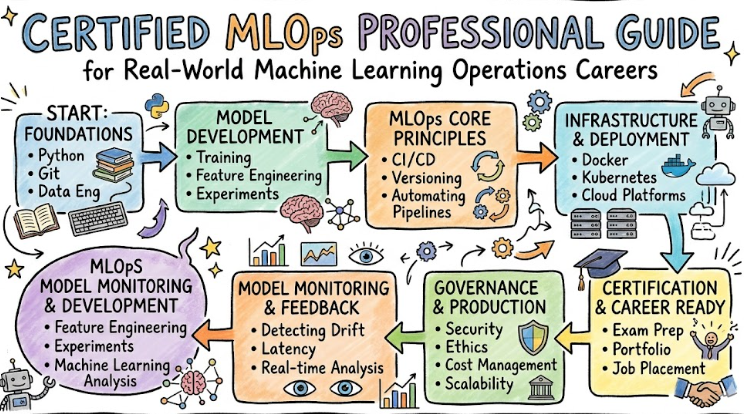
1. Introduction
The integration of Machine Learning into business processes is no longer optional. However, many models are never moved into production due to a lack of operational standards. This problem is solved by MLOps. By using the principles of automation and monitoring, the lifecycle of machine learning is streamlined.
In this guide, the Certified MLOps Professional certification is explored in detail. The importance of this credential is highlighted for engineers who want to stay relevant in an evolving market. Whether an individual is based in India or working globally, the standards of this program are recognized everywhere.
2. What is Certified MLOps Professional?
The Certified MLOps Professional is a high-level credential designed for those who manage machine learning lifecycles. It is not just about writing code; it is about building the infrastructure that allows models to thrive. Reliability, scalability, and security are prioritized in this curriculum.
Skills such as continuous integration, continuous delivery (CI/CD) for ML, and automated testing are validated by this certification. It is widely considered a benchmark for professionals who wish to lead ML infrastructure teams.
3. Why it matters today?
In the current tech landscape, data is being generated at an unprecedented rate. If machine learning models are not managed properly, they become a liability rather than an asset. MLOps matters today because:
- Model Decay is Prevented: Without monitoring, models lose accuracy over time. MLOps ensures that performance is tracked constantly.
- Speed is Increased: The time taken to move a model from a notebook to a live server is significantly reduced.
- Collaboration is Improved: Data scientists and DevOps engineers are brought together through a shared set of tools and practices.
- Costs are Managed: Resources are optimized, ensuring that cloud bills do not spiral out of control during model training.
4. Why Certified MLOps Professional certifications are important?
A certification acts as a proof of competence. In a competitive job market, it is often used by recruiters to filter candidates. For the Certified MLOps Professional, the importance lies in:
- Standardization: A common language for ML operations is established.
- Career Growth: Higher salary brackets are often unlocked by those holding specialized certifications.
- Skill Validation: Mastery over complex tools like Kubernetes, MLflow, and Kubeflow is demonstrated.
- Global Recognition: The certification is respected by major tech firms across the globe.
5. Why choose AIOps School?
Choosing the right platform for learning is critical. At AIOps School, the focus is kept entirely on modern operational disciplines.
- Industry-Aligned Curriculum: The courses are designed based on current industry demands and challenges.
- Expert Guidance: Knowledge is shared by mentors who have spent years managing complex IT systems.
- Practical Approach: Theoretical knowledge is supported by hands-on labs and real-world scenarios.
- Community Support: A vast network of professionals is accessible to students for networking and career advice.
6. Certification Deep-Dive: Certified MLOps Professional
What is this certification?
The Certified MLOps Professional is an advanced program that focuses on the operational side of Machine Learning. The automation of ML workflows and the management of model deployment pipelines are taught in depth.
Who should take this certification?
This program is ideal for Software Engineers, DevOps Engineers, and Data Engineers who want to specialize in AI infrastructure. It is also highly recommended for Engineering Managers who oversee ML projects.
Certification Overview Table
| Track | Level | Who it’s for | Prerequisites | Skills Covered | Recommended Order |
| AIOps/MLOps | Professional | Engineers & Managers | Basic DevOps & Python | CI/CD for ML, Monitoring, Orchestration | After Foundation |
Skills you will gain
- Pipeline Automation: Automated ML pipelines are built using modern tools.
- Model Versioning: Techniques for tracking different versions of data and models are mastered.
- Infrastructure as Code (IaC): ML environments are managed using tools like Terraform or Ansible.
- Monitoring and Alerting: Performance drifts in ML models are detected and resolved.
- Scalability: Machine learning workloads are scaled across cloud environments.
Real-world projects you should be able to do
- End-to-End CI/CD Pipeline: An automated pipeline for a sentiment analysis model is created.
- Automated Model Retraining: A system is developed where models are retrained automatically when data drift is detected.
- Kubernetes for ML: A machine learning model is deployed as a microservice on a Kubernetes cluster.
- Monitoring Dashboard: A real-time dashboard is built to track model accuracy and resource usage.
Preparation Plan
7–14 Days Plan (Intensive)
- Days 1-4: Core MLOps concepts and the lifecycle of ML models are reviewed.
- Days 5-8: Hands-on labs focusing on CI/CD and version control are completed.
- Days 9-12: Practice exams are taken to identify weak areas.
- Days 13-14: Final revision of monitoring and security protocols is performed.
30 Days Plan (Balanced)
- Week 1: Introduction to MLOps principles and toolsets.
- Week 2: Deep dive into containerization and orchestration for ML.
- Week 3: Focus on data engineering and model governance.
- Week 4: Real-world project implementation and practice tests.
60 Days Plan (Deep Study)
- Month 1: Comprehensive study of Python for ML, Linux basics, and cloud infrastructure.
- Month 2: Advanced topics including automated testing, drift detection, and final certification prep.
Common mistakes to avoid
- Ignoring Data Quality: It is often forgotten that bad data leads to bad models, regardless of how good the MLOps pipeline is.
- Over-Engineering: Complex tools are sometimes used when simpler solutions would suffice.
- Neglecting Monitoring: Many assume that a deployed model will work perfectly forever without intervention.
- Skipping Prerequisites: Attempting professional level content without understanding basic DevOps is a common error.
Best next certification after this
- Same track: Advanced AIOps Architect.
- Cross-track: Certified DevSecOps Professional.
- Leadership/management: Engineering Management in AI.
7. Choose Your Learning Path
Different professionals have different needs. The following learning paths are suggested:
- DevOps Path: This is best for traditional DevOps engineers. Transitioning from managing code to managing models is the primary focus.
- DevSecOps Path: This is best for security-focused engineers. Ensuring that ML pipelines are secure from data poisoning and model theft is taught.
- SRE Path: This is best for reliability engineers. Maintaining high availability for ML-based services is the core objective.
- AIOps / MLOps Path: This is the direct path for those who want to be pure AI operations specialists.
- DataOps Path: This is best for data engineers. The flow of data into ML models is optimized and managed.
- FinOps Path: This is best for those managing cloud costs. The expenses associated with large-scale ML training and deployment are monitored and controlled.
8. Role → Recommended Certifications Mapping
| Role | Recommended Certification | Importance |
| DevOps Engineer | Certified MLOps Professional | Bridging software and ML workflows. |
| SRE | Certified AIOps Professional | Enhancing system reliability with AI. |
| Platform Engineer | Certified MLOps Professional | Building robust ML platforms. |
| Cloud Engineer | Certified Cloud Architect | Managing ML workloads in the cloud. |
| Security Engineer | Certified DevSecOps Professional | Securing the ML lifecycle. |
| Data Engineer | Certified DataOps Professional | Optimizing data pipelines for ML. |
| FinOps Practitioner | Certified FinOps Professional | Controlling AI-related cloud costs. |
| Engineering Manager | Certified MLOps Manager | Leading high-performance ML teams. |
9. Next Certifications to Take
One same-track certification
The Certified AIOps Engineer program is highly recommended. It allows for a deeper understanding of how artificial intelligence is used to automate general IT operations beyond just machine learning.
One cross-track certification
The Certified DevSecOps Professional is a great choice. Security is often overlooked in ML, and this certification ensures that pipelines are protected against modern threats.
One leadership-focused certification
The IT Strategy and Digital Transformation certification is suggested for those moving into management. It helps in understanding how technology alignment drives business value at a high level.
10. Training & Certification Support Institutions
DevOpsSchool
This institution is known for its wide range of DevOps and SRE training programs. A massive library of technical resources and community-driven learning is provided to students globally.
Cotocus
Personalized training and certification support are offered here. Complex technical concepts are broken down into easy-to-digest modules, making it a preferred choice for working professionals.
ScmGalaxy
A focus on Software Configuration Management and DevOps is maintained by this platform. It is an excellent resource for finding tutorials, blogs, and community support for various IT certifications.
BestDevOps
Practical and lab-oriented training is prioritized at BestDevOps. Their curriculum is designed to ensure that students are ready for the challenges of a real-world production environment.
devsecopsschool.com
This platform is dedicated entirely to the fusion of security and DevOps. Specialized courses on securing CI/CD pipelines and cloud infrastructure are provided here.
sreschool.com
The principles of Site Reliability Engineering are taught here. Reliable and scalable system designs are emphasized through their various certification programs.
aiopsschool.com
This is the primary destination for MLOps and AIOps learning. Innovative courses that combine artificial intelligence with IT operations are hosted on this platform.
dataopsschool.com
The management of data lifecycles is the specialty of this institution. Modern data engineering and operational practices are explored in their comprehensive guides.
finopsschool.com
Cloud financial management is the focus here. Strategies for optimizing cloud spend and implementing financial accountability in tech teams are taught.
11. FAQs Section
1. What is the difficulty level of this certification?
The difficulty is considered intermediate to advanced. A solid understanding of Linux, Python, and basic DevOps tools is required to succeed.
2. How much time is required to prepare?
Generally, 30 to 60 days are sufficient if a consistent study schedule is followed. For those with prior experience, it can be completed faster.
3. What are the prerequisites?
Familiarity with containerization (Docker), orchestration (Kubernetes), and basic machine learning concepts is highly recommended.
4. What is the recommended certification sequence?
It is suggested that a Foundation level certification is completed first, followed by the Certified MLOps Professional, and finally an Architect level credential.
5. How much career value does this add?
High value is added as MLOps is one of the fastest-growing roles in tech. It often leads to roles with higher responsibility and better pay.
6. Which job roles can I apply for?
Roles such as MLOps Engineer, ML Infrastructure Engineer, and AI Operations Manager can be pursued after getting certified.
7. Is the certification recognized globally?
Yes, the standards followed by AIOps School are recognized by multinational corporations in India, the US, Europe, and beyond.
8. Are hands-on labs included?
Practical application is a core part of the training. Labs are provided to ensure that concepts are applied to real-world scenarios.
9. Can an Engineering Manager benefit from this?
Absolutely. It provides the technical oversight needed to lead data science and operations teams effectively.
10. Is Python knowledge mandatory?
A basic understanding of Python is necessary because most machine learning workflows are built using this language.
11. How does MLOps differ from DevOps?
While DevOps focuses on code and software reliability, MLOps focuses on the unique needs of data, models, and code combined.
12. What is the growth potential in this field?
The demand for MLOps professionals is expected to grow significantly as more companies move their AI projects into production.
Additional FAQs for Certified MLOps Professional
1. What specific tools are covered in this certification?
Tools like MLflow, Kubeflow, Docker, Kubernetes, and Git are typically covered in the curriculum.
2. Does this certification cover cloud platforms?
Yes, the implementation of MLOps on major cloud providers like AWS, Azure, and Google Cloud is discussed.
3. Is model monitoring included in the exam?
Monitoring for performance drift and data drift is a major component of the certification.
4. Are CI/CD pipelines for ML different from regular pipelines?
Yes, they include additional steps like model validation, data versioning, and automated retraining.
5. What is the format of the certification exam?
The exam usually consists of multiple-choice questions that test both theoretical knowledge and practical troubleshooting.
6. Can I take this certification if I am a pure Data Scientist?
Yes, it is highly beneficial for Data Scientists who want to understand how their models are deployed and managed in production.
7. How long is the certification valid?
Usually, the certification is valid for two to three years, after which a renewal or advanced certification is recommended.
8. Is there any community support available for students?
Yes, students are often given access to forums and groups where they can interact with other professionals and mentors.
12. Testimonials
Aarav
The path to understanding ML infrastructure was made very clear. The shift from a standard DevOps role to an MLOps specialist was achieved with much more confidence.
Sarah
A deep understanding of model monitoring was gained through this program. Real-world applications of drift detection are now being implemented in daily work.
Vikram
Career clarity was provided by the structured learning path. The confusion between data engineering and machine learning operations was finally resolved.
Elena
The ability to manage large-scale AI deployments was greatly improved. Skill improvement in Kubernetes for machine learning was a major highlight of the journey.
Rajesh
Confidence in leading a team of AI engineers was fostered. The practical approach helped in making better architectural decisions for the company’s ML platform.
13. Conclusion
The mastery of machine learning operations is achieved through the Certified MLOps Professional designation, which is recognized as a key credential for modern engineering roles. By this program, the challenges of deploying and monitoring AI models are addressed, and a high level of technical proficiency is demonstrated to global employers. When AIOps School is chosen as the learning provider, the journey is supported by expert guidance and a practical curriculum that is designed for real-world success. Long-term career benefits are secured through this strategic step, and the door to advanced leadership positions in the tech industry is opened for those who complete the training.
Really helpful content explaining how MLOps certifications support career growth and improve practical understanding of AI operations workflows.