Introduction
Text-to-Speech TTS Platforms convert written text into spoken audio using synthetic or AI-generated voices. These platforms help teams create voiceovers, product narration, accessibility audio, learning content, app voices, IVR prompts, podcasts, audiobooks, customer support audio, and multilingual speech experiences.
Modern TTS platforms are much more advanced than older robotic voice systems. Many now support realistic neural voices, multilingual speech, pronunciation control, voice cloning, emotional tone, SSML, API access, real-time streaming, and enterprise governance. For example, Amazon Polly converts text into audio streams using deep learning, Google Cloud Text-to-Speech provides API-based natural-sounding speech, and OpenAI’s speech endpoint supports models for turning text into spoken audio.
Real-world use cases include:
- Creating narration for videos, ads, and product demos
- Generating elearning and training audio
- Building voice assistants, chatbots, and AI agents
- Producing podcast intros, audiobooks, and accessibility audio
- Creating IVR, call center, and customer support voice prompts
- Localizing voice content for global audiences
Buyer evaluation criteria should include:
- Voice realism and naturalness
- Language and accent coverage
- Developer API quality
- SSML and pronunciation controls
- Voice cloning and consent controls
- Real-time or streaming speech support
- Audio export quality
- Enterprise security and access controls
- Pricing model and usage scalability
- Support, documentation, and ecosystem maturity
Best for: Creators, educators, developers, SaaS teams, AI product teams, call center teams, learning teams, accessibility teams, marketers, media teams, and enterprises that need scalable speech generation.
Not ideal for: Teams that need fully human emotional acting, celebrity-level performance, cinematic voice direction, or voice cloning without consent, review, and legal governance.
Key Trends in Text-to-Speech TTS Platforms
- Neural voices are now the standard: Major cloud platforms use neural models to produce more natural speech for apps, assistants, and business workflows.
- Developer-first APIs are growing: Product teams increasingly need speech APIs for AI agents, IVR systems, accessibility tools, learning apps, and customer experiences.
- Voice cloning requires governance: Tools like ElevenLabs and PlayHT support voice cloning workflows, but businesses should validate speaker consent and legal usage before deployment.
- SSML control matters for professional output: Amazon Polly, Microsoft Azure AI Speech, and Google Cloud Text-to-Speech support speech customization patterns such as pauses, pronunciation, speaking rate, pitch, emphasis, and voice style.
- Multilingual voice generation is expanding: Platforms such as LOVO and ElevenLabs support broad multilingual voice workflows for creators and global teams.
- Real-time TTS is becoming more important: AI agents, live assistants, conversational interfaces, and voice bots need low-latency speech generation.
- Brand voice consistency is a priority: Businesses want repeatable voice style for training, product demos, customer support, and marketing content.
- Accessibility use cases are increasing: TTS helps convert written content into audio for users who prefer or need spoken output.
- Enterprise security is a buying factor: Teams need permissions, SSO, API key controls, auditability, retention settings, and data handling clarity.
- Human review still matters: AI voices are powerful, but pronunciation, tone, emotion, sensitive wording, and brand accuracy still need review.
How We Selected These Tools
The tools in this list were selected using practical buyer-focused evaluation logic:
- Strong recognition in text-to-speech, AI voice generation, speech synthesis, developer APIs, or enterprise voice workflows
- Ability to convert written content into natural spoken audio
- Fit across creators, developers, SMBs, enterprises, educators, product teams, and call center teams
- Support for multilingual voices, pronunciation controls, SSML, or custom voice workflows
- API maturity, documentation quality, and integration flexibility
- Ease of use for non-technical creators and marketers
- Security and governance options for business and enterprise usage
- Voice realism, speed, stability, and output quality
- Commercial usage clarity and support for production workloads
- Overall value based on quality, scale, usability, pricing flexibility, and ecosystem fit
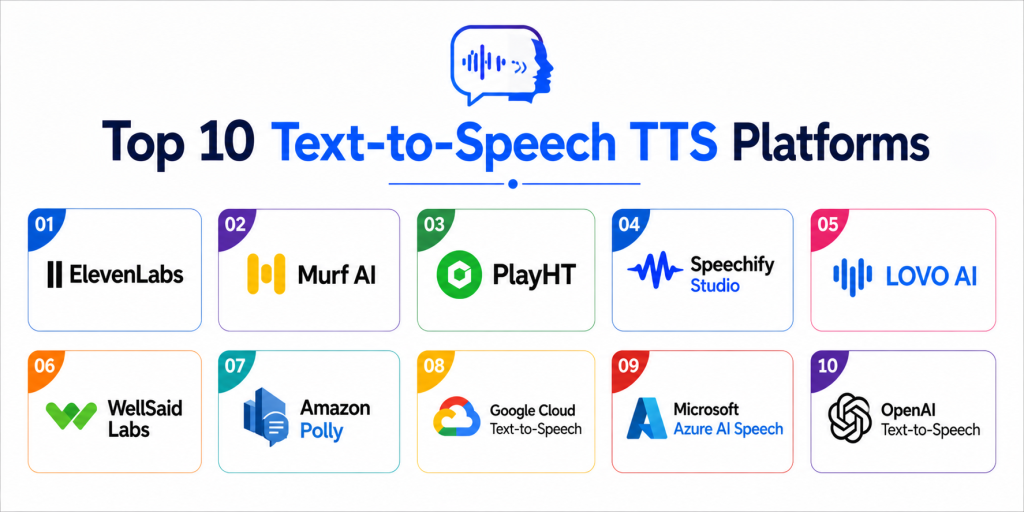
Top 10 Text-to-Speech TTS Platforms
#1 — ElevenLabs
Short description: ElevenLabs is an AI voice and text-to-speech platform known for realistic speech generation, multilingual voices, and voice cloning workflows. It is useful for creators, educators, publishers, marketers, game teams, and businesses that need expressive voice output. ElevenLabs states that its TTS supports lifelike speech, multilingual generation, and API integrations.
Key Features
- Realistic AI text-to-speech
- Multilingual voice generation
- Voice cloning options
- Audio generation for videos, audiobooks, podcasts, and apps
- API integration support
- Voice style and delivery customization
- Creator and business voice workflows
Pros
- Strong voice realism and expressive output
- Useful for creators and business narration
- Good fit for high-quality AI voice production
Cons
- Voice cloning requires clear consent and governance
- Pricing should be reviewed by usage volume
- Sensitive scripts need privacy and legal review
Platforms / Deployment
Cloud
Web-based platform
API workflows may vary
Security & Compliance
Buyers should validate workspace permissions, voice consent rules, data handling, retention, commercial usage rights, and enterprise security controls directly.
Integrations & Ecosystem
ElevenLabs fits voiceover production, content localization, podcast narration, audiobook workflows, learning content, and API-based voice applications.
- Video narration
- Podcast and audiobook workflows
- Elearning content
- Creator videos
- Game and character audio
- Developer voice applications
Support & Community
ElevenLabs provides documentation, developer materials, support resources, and creator-focused guidance. Support depth may vary by plan.
#2 — Murf AI
Short description: Murf AI is a text-to-speech and AI voiceover platform for creating narration for videos, podcasts, elearning, ads, presentations, and business content. It supports realistic voice generation, voiceover editing, and business-friendly workflows. Murf highlights voiceover generation for podcasts, audiobooks, video voiceovers, and website audio embedding.
Key Features
- AI voiceover generation
- Text-to-speech voice studio
- Voice editing and script workflow
- Business and elearning voiceover support
- Presentation and content integrations
- Voice changer and dubbing-related workflows may vary
- Audio export options
Pros
- Strong for business videos, training, and presentations
- Easy for non-technical users
- Good balance of voice quality and workflow simplicity
Cons
- Some advanced features may require higher plans
- AI output still needs proofreading and tone review
- Enterprise governance should be validated directly
Platforms / Deployment
Cloud
Web-based platform
Security & Compliance
Buyers should validate user permissions, content handling, retention, voice usage terms, commercial rights, and enterprise security needs directly.
Integrations & Ecosystem
Murf AI fits training, marketing, presentation, product demo, and explainer video workflows.
- Elearning content
- Marketing videos
- Product demos
- Presentations
- Website audio
- Podcast narration
Support & Community
Murf provides support resources, documentation, onboarding guidance, and business support options depending on plan.
#3 — PlayHT
Short description: PlayHT is an AI voice generation and text-to-speech platform that converts text into realistic voices. It supports customizable voices, voice cloning, and scalable audio generation. PlayHT also provides text-to-speech API documentation for developer workflows.
Key Features
- AI text-to-speech generation
- Voice cloning support
- Customizable voice workflows
- Fast audio generation
- Multilingual voice support
- API documentation and developer access
- Creator and business narration use cases
Pros
- Useful for both creators and developers
- Good fit for scalable voice generation
- Supports custom and cloned voice workflows
Cons
- Voice cloning must be governed carefully
- Output quality may vary by voice and language
- Enterprise controls should be reviewed directly
Platforms / Deployment
Cloud
Web-based platform
API workflows available
Security & Compliance
Buyers should validate voice consent, API security, storage, user permissions, data retention, and commercial usage terms directly.
Integrations & Ecosystem
PlayHT fits creator narration, voice apps, elearning, marketing content, podcasts, and developer-led speech workflows.
- API-based voice generation
- Course narration
- Product voice features
- Marketing audio
- Podcast content
- Multilingual voice projects
Support & Community
PlayHT provides API documentation, product resources, support options, and developer-focused materials.
#4 — Speechify Studio
Short description: Speechify Studio is a text-to-speech and AI voice platform for creators, educators, businesses, and teams that need voiceovers, narration, dubbing, and voice cloning workflows. It is useful for videos, scripts, courses, social content, and business audio. Speechify advertises a large voice library, multilingual support, voice cloning, and voice controls such as pronunciation, pitch, pace, and tone.
Key Features
- AI voice generation
- Large voice library
- Multilingual voiceover workflows
- Voice cloning support
- Pitch, pace, tone, and pronunciation controls
- Script-to-audio workflow
- Creator and business use cases
Pros
- Strong for creators and educators
- Useful language and voice variety
- Practical customization controls
Cons
- Voice cloning requires consent review
- Enterprise security should be validated directly
- High-volume usage may require plan review
Platforms / Deployment
Cloud
Web-based platform
Mobile ecosystem may vary
Security & Compliance
Buyers should validate consent policies, voice ownership, commercial rights, content handling, workspace access, and retention settings directly.
Integrations & Ecosystem
Speechify Studio fits video narration, course audio, social media voiceovers, podcast scripts, business content, and dubbing-style workflows.
- Creator videos
- Elearning narration
- Podcast scripts
- Business voiceovers
- Social media content
- Multilingual audio
Support & Community
Speechify provides help resources, product documentation, support options, and creator-focused guidance. Support level may vary by plan.
#5 — LOVO AI
Short description: LOVO AI is an AI voice generator and text-to-speech platform with a large voice library and online video editing workflow. It is useful for marketing videos, training content, YouTube narration, podcasts, audiobooks, and social content. LOVO states that it offers hundreds of voices across many languages and an online video editor.
Key Features
- AI text-to-speech generation
- Large multilingual voice library
- Online video editor
- Voiceover creation for videos and training
- Podcast and audiobook narration support
- Social media content workflows
- Script-to-voice workflow
Pros
- Good for creators and marketing teams
- Helpful multilingual voice coverage
- Combines voice generation with video editing support
Cons
- Enterprise controls should be validated
- Voice realism may vary by selected voice
- Human review is needed for polished public content
Platforms / Deployment
Cloud
Web-based platform
Security & Compliance
Buyers should validate user access, commercial usage rights, content retention, privacy settings, and enterprise security requirements directly.
Integrations & Ecosystem
LOVO AI fits creator videos, ads, training, audiobooks, podcasts, and social-first content workflows.
- YouTube narration
- Marketing videos
- Elearning content
- Audiobooks
- Podcast scripts
- Social media clips
Support & Community
LOVO provides help resources, product documentation, creator education, and support options depending on plan.
#6 — WellSaid Labs
Short description: WellSaid Labs is a professional AI voice platform for teams that need polished text-to-speech voiceovers. It is designed for training, marketing, product education, and enterprise narration workflows. WellSaid describes its platform as providing human-quality TTS voiceovers for modern teams and voices modeled on licensed recordings by real voice actors.
Key Features
- Professional text-to-speech voiceovers
- Business-focused voice library
- Team voice production workflows
- Script-to-speech generation
- Brand voice consistency support
- Voice avatar workflows may be available
- Enterprise narration use cases
Pros
- Strong for professional business narration
- Useful for learning and training teams
- Good fit when consistency and quality matter
Cons
- May be less casual creator-focused
- Voice library and plan limits should be reviewed
- Advanced customization should be validated directly
Platforms / Deployment
Cloud
Web-based platform
Security & Compliance
Buyers should validate team access, user permissions, content handling, voice rights, retention, and enterprise security requirements directly.
Integrations & Ecosystem
WellSaid Labs fits corporate training, product education, marketing videos, internal communication, and brand narration workflows.
- Training content
- Product education
- Marketing narration
- Internal communication
- Learning modules
- Professional voiceover production
Support & Community
WellSaid provides product resources, support options, business guidance, and enterprise assistance depending on plan.
#7 — Amazon Polly
Short description: Amazon Polly is a fully managed cloud text-to-speech service that converts text into audio streams. It is strong for developers, enterprises, and AWS-based teams that need scalable TTS for apps, IVR systems, accessibility features, and automated audio. Amazon describes Polly as generating speech on demand with lifelike voices across a broad set of languages.
Key Features
- Cloud text-to-speech API
- Neural and standard voice options
- Audio stream generation
- Broad language and voice support
- SSML customization support
- AWS ecosystem integration
- Scalable application workflows
Pros
- Strong for developers and cloud applications
- Scales well inside AWS
- Useful SSML control for structured speech
Cons
- Less creator-friendly than studio-style tools
- Requires technical setup
- Usage cost should be monitored carefully
Platforms / Deployment
Cloud
AWS-managed API service
Security & Compliance
Security depends on AWS configuration. Buyers should validate IAM permissions, encryption, API access, storage policies, logging, regional requirements, and compliance needs.
Integrations & Ecosystem
Amazon Polly fits apps, IVR systems, voice assistants, learning products, accessibility workflows, and AWS-based automation.
- AWS services
- IVR systems
- Apps and websites
- Elearning platforms
- Voice assistants
- Automated narration workflows
Support & Community
AWS provides documentation, SDKs, support plans, architecture guidance, and developer community resources. Support depth depends on AWS support tier.
#8 — Google Cloud Text-to-Speech
Short description: Google Cloud Text-to-Speech is a developer-focused API for converting text into natural-sounding speech. It is useful for apps, customer experiences, accessibility tools, learning systems, voice interfaces, and automated narration. Google describes the service as converting text into natural-sounding speech using Google AI technologies and supporting voice personalization by language and preference.
Key Features
- Cloud TTS API
- Natural-sounding AI voices
- Large voice and language selection
- SSML support
- Pitch, speed, pause, and formatting control
- Developer SDK and API workflows
- App and product voice integration
Pros
- Strong for scalable developer workflows
- Good language and voice variety
- Useful customization through SSML
Cons
- Not a simple creator voiceover studio
- Requires development knowledge
- Pricing and usage should be monitored
Platforms / Deployment
Cloud
Google Cloud API
Security & Compliance
Security depends on Google Cloud configuration. Buyers should validate IAM roles, encryption, logging, data handling, regional requirements, and compliance needs.
Integrations & Ecosystem
Google Cloud Text-to-Speech fits app development, accessibility tools, learning products, IVR systems, and AI-enabled user experiences.
- Google Cloud workflows
- Mobile and web apps
- IVR systems
- Accessibility tools
- Learning platforms
- Automated narration
Support & Community
Google Cloud provides documentation, SDKs, product guides, developer community resources, and business support options depending on support plan.
#9 — Microsoft Azure AI Speech
Short description: Microsoft Azure AI Speech includes neural text-to-speech capabilities for developers and enterprises building speech-enabled apps, assistants, accessibility workflows, and customer experiences. Microsoft documentation states that neural TTS uses deep neural networks for natural computer voices, and SSML can be used to tune pitch, pronunciation, speaking rate, volume, style, and role.
Key Features
- Neural text-to-speech
- Speech Synthesis Markup Language support
- Voice style and role controls
- Developer API workflows
- Azure ecosystem integration
- Enterprise identity and cloud governance options
- Real-time app and assistant use cases
Pros
- Strong for Microsoft and Azure-based enterprises
- Useful SSML and voice customization controls
- Good fit for apps, bots, IVR, and accessibility workflows
Cons
- Requires technical setup for production use
- Pricing and deployment design should be reviewed
- Not as simple as creator-focused voice studios
Platforms / Deployment
Cloud
Azure-managed API service
Security & Compliance
Security depends on Azure configuration. Buyers should validate identity controls, API keys, private networking options, logging, encryption, regional deployment, and compliance needs.
Integrations & Ecosystem
Azure AI Speech fits enterprise apps, bots, customer service systems, accessibility workflows, and Microsoft cloud environments.
- Azure services
- Bot frameworks
- IVR workflows
- Enterprise apps
- Accessibility tools
- Customer experience systems
Support & Community
Microsoft provides documentation, SDKs, learning paths, support plans, developer resources, and enterprise support options.
#10 — OpenAI Text-to-Speech
Short description: OpenAI Text-to-Speech is available through the Audio API for generating spoken audio from text. It is useful for developers building AI products, narration, assistants, learning experiences, and conversational applications. OpenAI documentation says the audio speech endpoint supports compatible models such as gpt-4o-mini-tts, tts-1, and tts-1-hd, while the TTS guide lists built-in voices and notes that gpt-4o-mini-tts can be guided to speak with a particular tone.
Key Features
- API-based text-to-speech
- Multiple compatible speech models
- Built-in voice options
- Tone and style guidance with supported models
- Developer-friendly audio endpoint
- AI product integration workflows
- Spoken output for assistants and apps
Pros
- Strong fit for AI-native products
- Useful for conversational and assistant workflows
- Simple API path for developers already using OpenAI
Cons
- Voice customization options should be validated for each use case
- Enterprise governance should be reviewed directly
- Not primarily a full creative voiceover studio
Platforms / Deployment
Cloud
OpenAI API
Security & Compliance
Buyers should validate API access controls, data handling settings, logging, retention, enterprise controls, and compliance requirements directly before production use.
Integrations & Ecosystem
OpenAI Text-to-Speech fits AI assistants, voice-enabled apps, educational tools, narration workflows, and product experiences.
- AI applications
- Conversational agents
- Learning products
- Accessibility features
- Narration workflows
- Developer audio pipelines
Support & Community
OpenAI provides official API documentation, developer resources, platform support options, and ecosystem examples.
Comparison Table
| Tool Name | Best For | Platform Supported | Deployment | Standout Feature | Public Rating |
|---|---|---|---|---|---|
| ElevenLabs | Realistic creator and business speech | Web-based, API varies | Cloud | Expressive AI voices and voice cloning | N/A |
| Murf AI | Business voiceovers and elearning | Web-based | Cloud | Voiceover studio for videos and training | N/A |
| PlayHT | Scalable AI voice generation | Web-based, API | Cloud | Voice cloning and developer TTS workflows | N/A |
| Speechify Studio | Creator and multilingual voiceovers | Web-based, mobile ecosystem varies | Cloud | Voice library with pronunciation and tone controls | N/A |
| LOVO AI | Marketing, creator, and training audio | Web-based | Cloud | Large voice library with video editing workflow | N/A |
| WellSaid Labs | Professional team narration | Web-based | Cloud | Licensed voice actor-based professional voices | N/A |
| Amazon Polly | AWS developers and applications | API | Cloud | Scalable managed TTS with SSML support | N/A |
| Google Cloud Text-to-Speech | Developer apps and multilingual TTS | API | Cloud | Natural-sounding speech via Google Cloud API | N/A |
| Microsoft Azure AI Speech | Enterprise apps and Azure workflows | API | Cloud | Neural TTS with advanced SSML controls | N/A |
| OpenAI Text-to-Speech | AI-native apps and assistants | API | Cloud | TTS models for spoken output in AI products | N/A |
Evaluation & Scoring of Text-to-Speech TTS Platforms
| Tool Name | Core 25% | Ease 15% | Integrations 15% | Security 10% | Performance 10% | Support 10% | Value 15% | Weighted Total |
|---|---|---|---|---|---|---|---|---|
| ElevenLabs | 10 | 9 | 8 | 8 | 9 | 8 | 8 | 8.75 |
| Murf AI | 9 | 9 | 8 | 8 | 8 | 8 | 8 | 8.40 |
| PlayHT | 8 | 8 | 9 | 7 | 8 | 8 | 8 | 8.05 |
| Speechify Studio | 8 | 9 | 7 | 7 | 8 | 8 | 8 | 7.90 |
| LOVO AI | 8 | 9 | 7 | 7 | 8 | 8 | 8 | 7.95 |
| WellSaid Labs | 9 | 8 | 8 | 8 | 8 | 8 | 7 | 8.10 |
| Amazon Polly | 9 | 6 | 10 | 9 | 9 | 9 | 9 | 8.75 |
| Google Cloud Text-to-Speech | 9 | 6 | 10 | 9 | 9 | 9 | 8 | 8.60 |
| Microsoft Azure AI Speech | 9 | 6 | 10 | 9 | 9 | 9 | 8 | 8.60 |
| OpenAI Text-to-Speech | 8 | 7 | 9 | 8 | 8 | 8 | 8 | 8.05 |
These scores are comparative and should be used as a shortlist guide. Creator-focused platforms score higher for ease of use and natural voice production. Developer-first cloud APIs score higher for scale, integration, automation, and enterprise deployment. Professional team platforms score higher when repeatable brand narration and collaboration matter. The best choice depends on your content type, technical resources, language needs, security requirements, and budget.
Which Text-to-Speech TTS Platform Is Right for You?
Solo / Freelancer
Solo creators should prioritize ease of use, voice quality, export options, and affordable plans. ElevenLabs, Murf AI, Speechify Studio, LOVO AI, and PlayHT are practical options. If you need emotional narration or creator-style audio, ElevenLabs and Murf AI are strong choices. If you need video voiceovers with simple editing, LOVO AI and Murf AI may fit better.
SMB
SMBs should choose tools that support repeatable voiceover workflows, commercial usage rights, team access, and simple editing. Murf AI, WellSaid Labs, ElevenLabs, PlayHT, LOVO AI, and Speechify Studio are strong candidates. A training team may prefer Murf or WellSaid Labs, while a marketing team may prefer ElevenLabs or LOVO AI for faster creative output.
Mid-Market
Mid-market teams usually need collaboration, brand consistency, multilingual voices, API access, and better governance. ElevenLabs, Murf AI, WellSaid Labs, PlayHT, Amazon Polly, Google Cloud Text-to-Speech, Azure AI Speech, and OpenAI Text-to-Speech are strong options depending on whether the workflow is creator-led or developer-led. Teams should test pronunciation, voice tone, latency, export quality, and billing predictability.
Enterprise
Enterprises should prioritize security, identity controls, API governance, regional deployment, auditability, voice consent, data handling, and support. Amazon Polly, Google Cloud Text-to-Speech, Microsoft Azure AI Speech, OpenAI Text-to-Speech, WellSaid Labs, and ElevenLabs business workflows are strong candidates. Large organizations should involve security, legal, procurement, product, learning, accessibility, and brand teams before rollout.
Budget vs Premium
Budget-focused users should consider creator platforms with simple subscriptions or pay-as-you-go cloud APIs depending on usage. Premium buyers should evaluate enterprise plans from Amazon Polly, Google Cloud, Microsoft Azure, ElevenLabs, WellSaid Labs, and OpenAI when scale, support, governance, and integration matter more than the lowest monthly price.
Feature Depth vs Ease of Use
If ease of use matters most, Murf AI, ElevenLabs, Speechify Studio, LOVO AI, and WellSaid Labs are practical choices. If feature depth matters more, Amazon Polly, Google Cloud Text-to-Speech, Microsoft Azure AI Speech, OpenAI Text-to-Speech, and PlayHT provide stronger API, automation, and product integration workflows. The right choice depends on whether you are creating media content or building speech into software.
Integrations & Scalability
TTS platforms should connect with apps, websites, video editors, LMS platforms, IVR systems, chatbots, AI agents, accessibility tools, marketing workflows, and cloud infrastructure. As teams scale, they should evaluate APIs, SDKs, SSML support, latency, quotas, voice libraries, team permissions, logs, data handling, usage monitoring, and cost controls.
Security & Compliance Needs
TTS workflows may involve customer text, internal scripts, training content, product messaging, voice clones, and business-sensitive data. Buyers should validate encryption, data retention, access controls, API key management, SSO, audit logs, regional processing, and AI training policies. Voice cloning should only be used with explicit permission and clear governance rules.
Frequently Asked Questions
1. What are Text-to-Speech TTS Platforms?
Text-to-Speech TTS Platforms convert written text into spoken audio.
They are used for voiceovers, apps, IVR systems, accessibility tools, training content, audiobooks, and AI assistants.
Modern TTS platforms often use neural or AI-based voices for more natural sound.
2. How are TTS platforms different from voiceover tools?
TTS platforms focus on generating speech from text, often through APIs or studio tools.
Voiceover tools may include recording, editing, video syncing, dubbing, and broader production workflows.
Many modern platforms overlap because they combine TTS, voiceover editing, and voice cloning.
3. What features should buyers prioritize?
Buyers should prioritize voice realism, language coverage, pronunciation control, SSML, API access, export quality, and commercial rights.
Business teams should also review team permissions, content privacy, voice consent, and support.
Developers should test latency, reliability, documentation, and pricing at scale.
4. Are AI TTS voices good enough for business content?
Yes, many AI TTS voices are strong enough for training, product demos, explainer videos, internal communication, and app experiences.
However, important brand campaigns should still be reviewed for pronunciation, tone, pacing, and emotional fit.
Human voice actors may still be better for premium storytelling and high-emotion performances.
5. Which TTS platforms are best for creators?
ElevenLabs, Murf AI, Speechify Studio, LOVO AI, and PlayHT are practical choices for creators.
They provide browser-based workflows and voice libraries that are easier than developer APIs.
Creators should test the same script across tools to compare realism and style.
6. Which TTS platforms are best for developers?
Amazon Polly, Google Cloud Text-to-Speech, Microsoft Azure AI Speech, OpenAI Text-to-Speech, and PlayHT are strong developer options.
They provide APIs for apps, agents, IVR systems, accessibility tools, and product workflows.
Developers should compare latency, SSML support, model behavior, pricing, and security controls.
7. Can TTS platforms clone voices?
Some TTS platforms support voice cloning or custom voice creation.
ElevenLabs and PlayHT both describe voice cloning-related workflows, while other vendors may offer custom voice or enterprise voice options.
Voice cloning should only be used with explicit permission and clear legal review.
8. What mistakes should buyers avoid?
A common mistake is choosing a platform based only on demo voices without testing real scripts.
Another mistake is ignoring pronunciation control, commercial usage rights, and data privacy.
Teams should also avoid voice cloning without consent or governance.
9. Are TTS platforms secure?
Security varies by vendor, plan, and deployment model.
Cloud APIs can be secure when identity, encryption, logging, and data retention are configured correctly.
Buyers should validate access controls, API keys, SSO, audit logs, regional processing, and AI data usage policies.
10. What are alternatives to dedicated TTS platforms?
Alternatives include human voice actors, recording studios, in-house narration, video editor voice tools, browser speech features, and basic operating system text-to-speech.
These options may work for small or specialized needs.
Dedicated TTS platforms are better when teams need scale, automation, voice variety, multilingual output, or app integration.
Conclusion
Text-to-Speech TTS Platforms help teams convert written content into clear, scalable, and reusable spoken audio.
ElevenLabs, Murf AI, PlayHT, Speechify Studio, LOVO AI, and WellSaid Labs are strong choices for creators, marketers, educators, and business teams that need fast voiceover production.
Amazon Polly, Google Cloud Text-to-Speech, Microsoft Azure AI Speech, and OpenAI Text-to-Speech are stronger fits for developers and enterprises building speech into apps, AI agents, customer support systems, and accessibility workflows.
The best platform depends on whether your priority is voice realism, API scalability, language coverage, brand consistency, security, or cost control.
Creator teams should test voice quality and editing workflows, while developer teams should test latency, SSML, API reliability, and billing behavior.
Enterprise teams should also validate privacy, data handling, access controls, and voice consent policies.
Before choosing, shortlist two or three platforms, test the same script, compare pronunciation quality, review commercial terms, and validate integration fit.