Introduction
WebAssembly runtimes and toolchains enable developers to compile code written in languages like C, C++, Rust, and Go into a portable binary format that runs efficiently across browsers, servers, and edge environments. These tools make it possible to execute high-performance applications securely outside traditional runtime constraints.
As modern architectures shift toward microservices, edge computing, and sandboxed execution, WebAssembly is becoming a powerful alternative to containers for lightweight, secure workloads. WASM runtimes execute these binaries, while toolchains handle compilation, optimization, and packaging.
Common use cases include edge computing, serverless functions, browser-based apps, secure plugin systems, and performance-critical workloads.
What buyers should evaluate:
- Runtime performance and startup speed
- Language support and compiler ecosystem
- Security sandboxing capabilities
- Integration with cloud and edge platforms
- Toolchain maturity and community support
- Debugging and observability features
- Ease of deployment and portability
- Compatibility with WASI standards
- Scalability for production workloads
- Ecosystem and extensibility
Best for: Platform engineers, backend developers, cloud-native teams, DevOps engineers, and organizations building portable and high-performance applications.
Not ideal for: Teams not working with performance-critical workloads or those relying solely on traditional runtime environments.
Key Trends in WebAssembly WASM Runtimes and Toolchains
- Rapid adoption in edge computing environments
- Integration with serverless and microservices architectures
- Growing support for WASI standardization
- Increased use in secure sandboxed execution
- Expansion beyond browsers into backend systems
- Lightweight alternative to containers
- Improved language support including Rust and Go
- Integration with Kubernetes and cloud platforms
- Performance optimization for near-native execution
- Rise of developer-friendly toolchains
How We Selected These Tools
- Industry adoption and ecosystem maturity
- Runtime performance and efficiency
- Support for WASI and standards
- Language and compiler compatibility
- Integration with cloud and DevOps workflows
- Security and sandboxing capabilities
- Ease of use and developer experience
- Active development and updates
- Community and documentation strength
- Suitability across multiple use cases
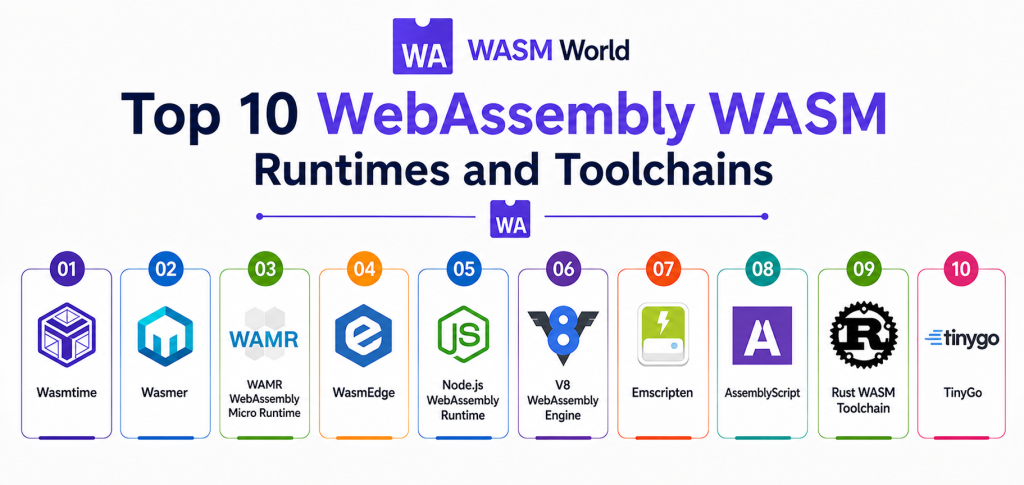
Top 10 WebAssembly WASM Runtimes and Toolchains
1. Wasmtime
Short description:
Wasmtime is a high-performance WebAssembly runtime designed for secure and fast execution. It is built with a focus on WASI compatibility and server-side applications. It is widely used in cloud-native environments. It is ideal for developers building scalable backend systems.
Key Features
- WASI support
- Fast startup time
- Secure sandboxing
- JIT compilation
- Cross-platform support
- CLI and API support
- Memory safety
Pros
- Strong performance
- Secure execution
- Active development
Cons
- Requires setup
- Limited GUI tools
- Learning curve
Platforms / Deployment
Linux / Windows / macOS
Deployment: Cloud / Self-hosted
Security & Compliance
Sandboxed execution supported
Integrations & Ecosystem
Wasmtime integrates with modern development and cloud ecosystems.
- WASI
- Cloud platforms
- DevOps pipelines
- APIs
- Microservices
- Containers
Support & Community
Strong open-source community and documentation
2. Wasmer
Short description:
Wasmer is a popular WebAssembly runtime that supports multiple execution engines. It allows developers to run WASM applications on any platform. It is designed for portability and performance. It is ideal for cross-platform development.
Key Features
- Multiple execution engines
- WASI support
- Cross-platform runtime
- Package manager
- CLI tools
- Plugin system
- Runtime APIs
Pros
- Highly portable
- Flexible execution
- Easy deployment
Cons
- Requires understanding of engines
- Smaller enterprise adoption
- Setup complexity
Platforms / Deployment
Linux / Windows / macOS
Deployment: Cloud / Self-hosted
Security & Compliance
Sandboxed runtime supported
Integrations & Ecosystem
Wasmer integrates with various development tools and workflows.
- WASI
- DevOps tools
- Cloud environments
- APIs
- Package systems
- Microservices
Support & Community
Active community and growing ecosystem
3. WAMR WebAssembly Micro Runtime
Short description:
WAMR is a lightweight runtime designed for embedded systems and IoT devices. It focuses on low memory usage and fast execution. It is widely used in constrained environments. It is ideal for edge and embedded use cases.
Key Features
- Lightweight runtime
- Low memory footprint
- Fast execution
- WASI support
- Embedded device support
- Modular design
- Secure sandboxing
Pros
- Very lightweight
- Ideal for IoT
- Fast performance
Cons
- Limited features
- Not for complex workloads
- Smaller ecosystem
Platforms / Deployment
Embedded / Linux
Deployment: Edge / Device
Security & Compliance
Sandboxed execution supported
Integrations & Ecosystem
WAMR integrates with embedded and edge systems.
- IoT platforms
- Edge devices
- Embedded systems
- APIs
- Firmware
- Lightweight environments
Support & Community
Growing community
4. WasmEdge
Short description:
WasmEdge is a high-performance WebAssembly runtime optimized for cloud and edge computing. It provides fast execution and supports AI workloads. It is widely used in edge computing scenarios. It is ideal for modern cloud-native applications.
Key Features
- High performance runtime
- Edge computing support
- AI and ML support
- WASI compatibility
- Fast startup
- Plugin support
- Cloud integration
Pros
- Optimized for edge
- Fast execution
- Supports modern workloads
Cons
- Requires setup
- Smaller ecosystem
- Learning curve
Platforms / Deployment
Linux / Windows / macOS
Deployment: Cloud / Edge
Security & Compliance
Sandboxed execution supported
Integrations & Ecosystem
WasmEdge integrates with cloud and edge systems.
- Kubernetes
- Cloud platforms
- DevOps tools
- APIs
- AI frameworks
- Microservices
Support & Community
Active development and community
5. Node.js WebAssembly Runtime
Short description:
Node.js provides built-in support for running WebAssembly modules. It allows developers to integrate WASM into JavaScript applications. It is widely used for backend development. It is ideal for developers already using Node.js.
Key Features
- Native WASM support
- JavaScript integration
- Cross-platform runtime
- CLI tools
- Module support
- High performance
- Developer ecosystem
Pros
- Easy integration
- Large ecosystem
- Widely adopted
Cons
- Limited advanced WASM features
- Not specialized runtime
- Performance overhead
Platforms / Deployment
Linux / Windows / macOS
Deployment: Cloud / Server
Security & Compliance
Standard runtime security features
Integrations & Ecosystem
Node.js integrates with web and backend tools.
- JavaScript ecosystem
- APIs
- Cloud platforms
- Dev tools
- Frameworks
- Microservices
Support & Community
Very large global community
6. V8 WebAssembly Engine
Short description:
V8 is the JavaScript engine used in Chrome and Node.js, with strong WebAssembly support. It enables high-performance execution in browsers and servers. It is widely used in web environments. It is ideal for browser-based applications.
Key Features
- High-performance engine
- WASM support
- Browser integration
- JIT compilation
- Memory management
- Cross-platform
- Developer tools
Pros
- Fast execution
- Widely adopted
- Strong ecosystem
Cons
- Limited standalone usage
- Requires browser or Node
- Not a full runtime
Platforms / Deployment
Browser / Server
Deployment: Embedded
Security & Compliance
Sandboxed execution supported
Integrations & Ecosystem
V8 integrates with web platforms and tools.
- Browsers
- Node.js
- Web apps
- APIs
- Dev tools
- JavaScript ecosystem
Support & Community
Extensive community
7. Emscripten
Short description:
Emscripten is a compiler toolchain that converts C and C++ code into WebAssembly. It enables developers to run native applications in browsers. It is widely used for porting applications. It is ideal for performance-critical web apps.
Key Features
- C and C++ compilation
- WASM output
- Optimization tools
- Debugging support
- Browser compatibility
- File system emulation
- Runtime libraries
Pros
- Powerful compiler
- Widely used
- Strong ecosystem
Cons
- Complex setup
- Large output size
- Learning curve
Platforms / Deployment
Cross-platform
Deployment: Toolchain
Security & Compliance
Not publicly stated
Integrations & Ecosystem
Emscripten integrates with development tools.
- Compilers
- Dev tools
- Browsers
- APIs
- Build systems
- CI pipelines
Support & Community
Large developer community
8. AssemblyScript
Short description:
AssemblyScript is a TypeScript-like language designed for WebAssembly. It allows developers to write code similar to JavaScript while targeting WASM. It is easy to learn for web developers. It is ideal for frontend-focused teams.
Key Features
- TypeScript-like syntax
- WASM compilation
- Developer-friendly
- Lightweight
- Toolchain support
- Easy onboarding
- Web integration
Pros
- Easy to learn
- Fast development
- Good for web apps
Cons
- Limited advanced features
- Smaller ecosystem
- Performance limitations
Platforms / Deployment
Cross-platform
Deployment: Toolchain
Security & Compliance
Not publicly stated
Integrations & Ecosystem
AssemblyScript integrates with web development tools.
- JavaScript ecosystem
- Build tools
- APIs
- Dev tools
- Web apps
- Frameworks
Support & Community
Growing community
9. Rust WASM Toolchain
Short description:
Rust provides strong support for compiling to WebAssembly with high performance and safety. It is widely used for system-level programming and WASM applications. It is ideal for developers needing performance and memory safety.
Key Features
- WASM compilation
- Memory safety
- High performance
- Strong tooling
- Cross-platform support
- Package management
- Debugging tools
Pros
- Excellent performance
- Safe memory model
- Strong ecosystem
Cons
- Steep learning curve
- Complex setup
- Requires Rust knowledge
Platforms / Deployment
Cross-platform
Deployment: Toolchain
Security & Compliance
Memory-safe execution model
Integrations & Ecosystem
Rust integrates with modern development workflows.
- Cargo
- DevOps tools
- APIs
- Build systems
- Cloud platforms
- Microservices
Support & Community
Very strong community
10. TinyGo
Short description:
TinyGo is a Go compiler for WebAssembly and embedded systems. It focuses on small binary sizes and efficiency. It is ideal for edge computing and IoT applications. It is widely used in lightweight environments.
Key Features
- Go language support
- Small binaries
- WASM compilation
- Embedded support
- Fast execution
- Cross-platform
- CLI tools
Pros
- Lightweight
- Efficient
- Good for IoT
Cons
- Limited Go support
- Smaller ecosystem
- Requires setup
Platforms / Deployment
Cross-platform
Deployment: Toolchain
Security & Compliance
Not publicly stated
Integrations & Ecosystem
TinyGo integrates with embedded and cloud workflows.
- IoT systems
- DevOps tools
- APIs
- Cloud platforms
- Microservices
- Build systems
Support & Community
Growing community
Comparison Table
| Tool Name | Best For | Platform(s) Supported | Deployment | Standout Feature | Public Rating |
|---|---|---|---|---|---|
| Wasmtime | Server-side WASM | Multi-platform | Self-hosted | WASI support | N/A |
| Wasmer | Cross-platform | Multi-platform | Hybrid | Multi-engine runtime | N/A |
| WAMR | Embedded systems | Embedded | Edge | Lightweight runtime | N/A |
| WasmEdge | Edge computing | Multi-platform | Cloud | High performance | N/A |
| Node.js | JS integration | Multi-platform | Cloud | JS ecosystem | N/A |
| V8 | Browser runtime | Browser | Embedded | High performance engine | N/A |
| Emscripten | C/C++ apps | Cross-platform | Toolchain | Compilation | N/A |
| AssemblyScript | Web devs | Cross-platform | Toolchain | TypeScript syntax | N/A |
| Rust WASM | Performance | Cross-platform | Toolchain | Memory safety | N/A |
| TinyGo | IoT | Cross-platform | Toolchain | Small binaries | N/A |
Evaluation & Scoring of WebAssembly WASM Tools
| Tool Name | Core | Ease | Integrations | Security | Performance | Support | Value | Weighted Total |
|---|---|---|---|---|---|---|---|---|
| Wasmtime | 9 | 7 | 9 | 9 | 9 | 9 | 9 | 8.9 |
| Wasmer | 9 | 8 | 9 | 9 | 9 | 8 | 9 | 8.8 |
| WAMR | 8 | 8 | 7 | 9 | 9 | 7 | 9 | 8.3 |
| WasmEdge | 9 | 7 | 9 | 9 | 9 | 8 | 8 | 8.7 |
| Node.js | 8 | 9 | 10 | 8 | 8 | 10 | 9 | 8.9 |
| V8 | 8 | 8 | 9 | 9 | 9 | 9 | 9 | 8.7 |
| Emscripten | 9 | 6 | 8 | 7 | 9 | 9 | 9 | 8.3 |
| AssemblyScript | 7 | 9 | 8 | 7 | 8 | 8 | 9 | 8.0 |
| Rust WASM | 9 | 6 | 9 | 10 | 9 | 9 | 9 | 8.8 |
| TinyGo | 8 | 7 | 8 | 8 | 8 | 7 | 9 | 8.0 |
Scores are relative and based on performance, usability, and ecosystem strength. The best choice depends on whether you need runtime execution or compilation toolchains.
Which WebAssembly Tool Is Right for You
Solo / Freelancer
Use AssemblyScript or Node.js for quick development and easy learning.
SMB
Wasmer and WasmEdge provide flexibility and performance.
Mid-Market
Combine Wasmtime with Rust for scalable backend systems.
Enterprise
Azure, Wasmtime, and WasmEdge provide strong scalability and security.
Budget vs Premium
Most tools are open-source and free, making WASM highly accessible.
Feature Depth vs Ease of Use
Rust offers deep control, while AssemblyScript is easier.
Integrations & Scalability
Wasmtime and Wasmer scale well across environments.
Security & Compliance Needs
WASM runtimes provide strong sandboxing and isolation.
Frequently Asked Questions
1. What is WebAssembly
WebAssembly is a binary instruction format that allows code to run efficiently across platforms. It is used for high-performance applications. It works in browsers and servers.
2. What are WASM runtimes
Runtimes execute WebAssembly code outside or inside browsers. They provide a secure environment. Examples include Wasmtime and Wasmer.
3. What are toolchains
Toolchains compile code into WebAssembly format. They include compilers and build tools. Examples include Emscripten and Rust.
4. Why use WebAssembly
It offers near-native performance and portability. It improves security through sandboxing. It is ideal for modern applications.
5. Is WebAssembly secure
Yes, it runs in a sandboxed environment. It limits access to system resources. Security depends on implementation.
6. Can I use WebAssembly on the server
Yes, many runtimes support server-side execution. It is widely used in cloud and edge environments. It improves efficiency.
7. Which language is best for WASM
Rust is popular for performance, while AssemblyScript is easier for web developers. The choice depends on use case.
8. Is WebAssembly replacing containers
Not completely, but it offers a lightweight alternative. It is useful for specific workloads. Both technologies can coexist.
9. Do I need special tools
Yes, you need runtimes and toolchains. These tools compile and run WASM code. They are essential for development.
10. How do I get started
Choose a language and toolchain, then use a runtime to execute code. Start with simple examples. Explore documentation and tutorials.
Conclusion
WebAssembly runtimes and toolchains are transforming how applications are built and deployed across platforms. They enable high-performance execution with strong security through sandboxing, making them ideal for modern cloud-native, edge, and serverless environments. From powerful runtimes like Wasmtime and Wasmer to flexible toolchains like Emscripten and Rust, the ecosystem offers solutions for a wide range of use cases. The right choice depends on your goals. If you need high-performance backend execution, runtimes like Wasmtime or WasmEdge are strong options. For development, Rust and AssemblyScript provide different trade-offs between performance and ease of use. Lightweight environments benefit from tools like TinyGo and WAMR. There is no single best tool for every scenario. Start by identifying your requirements, shortlist a few runtimes and toolchains, and test them in your workflow. This practical approach will help you select the most effective solution for your WebAssembly projects.
This article clearly explains WebAssembly runtimes and toolchains with useful insights into performance, portability, and modern application development benefits.