Introduction
Passkey and FIDO2 authentication platforms enable passwordless login using cryptographic credentials instead of traditional passwords. These systems rely on public-private key cryptography, where a private key is securely stored on a user’s device and authentication is completed using biometrics or a device PIN.
Unlike passwords, passkeys are phishing-resistant, cannot be reused, and do not expose secrets to servers, making them significantly more secure than legacy authentication methods.
As organizations move toward zero-trust security and better user experience, passkeys and FIDO2 platforms are becoming a core part of identity and access management strategies.
Common use cases include passwordless login, multi-factor authentication replacement, secure workforce access, customer identity authentication, and fraud prevention.
What buyers should evaluate:
- FIDO2 and WebAuthn support
- Passkey lifecycle management
- Device and hardware key compatibility
- Integration with SSO and IAM systems
- User experience and onboarding
- Security features like phishing resistance
- Cross-platform support
- Scalability for enterprise use
- Compliance and audit capabilities
- API and developer support
Best for: Enterprises, SaaS platforms, developers, security teams, and organizations moving to passwordless authentication.
Not ideal for: Small setups without identity infrastructure or systems not requiring strong authentication controls.
Key Trends in Passkey & FIDO2 Authentication Platforms
- Rapid shift toward passwordless authentication
- Strong industry backing from major tech companies
- Integration with biometrics and device security
- Adoption in enterprise identity platforms
- Replacement of SMS-based MFA
- Growth of hardware security keys
- Cross-device passkey synchronization
- Integration with zero-trust architectures
- Developer-first APIs for passkey implementation
- Increasing regulatory focus on phishing-resistant authentication
How We Selected These Tools
- Adoption across enterprise and developer ecosystems
- Compliance with FIDO2 and WebAuthn standards
- Strength of passwordless authentication features
- Integration with IAM and SSO platforms
- Scalability for enterprise environments
- Security posture and phishing resistance
- Ease of deployment and developer experience
- Ecosystem and community support
- Innovation in passkey adoption
- Real-world use cases across industries
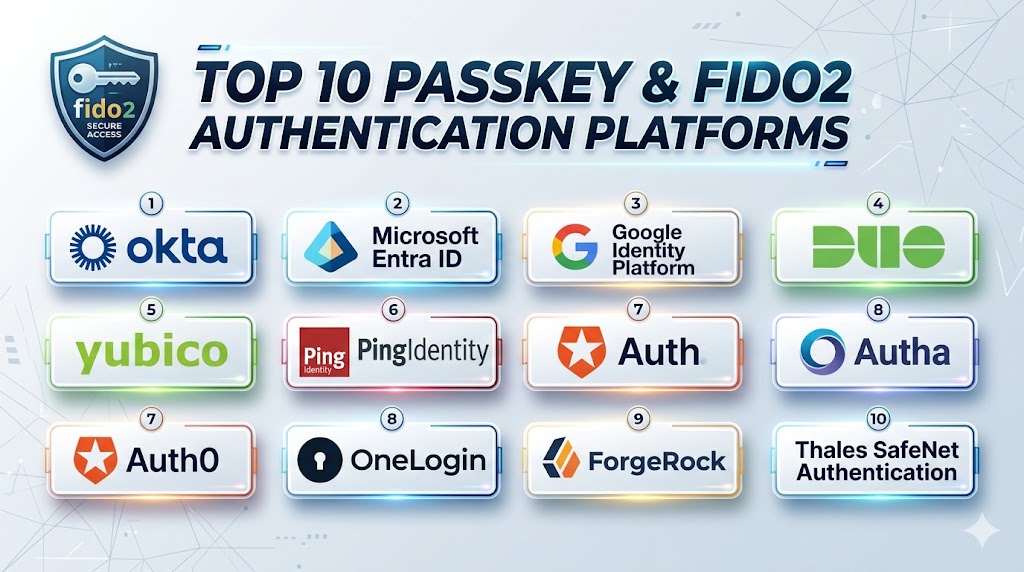
Top 10 Passkey & FIDO2 Authentication Platforms
1. Okta
Short description:
Okta is a leading identity platform supporting passkeys and FIDO2 authentication. It enables passwordless login across enterprise applications. It provides strong integration capabilities. It is ideal for large organizations.
Key Features
- Passkey authentication
- SSO and IAM integration
- Adaptive MFA
- Device trust
- API-based identity
- User lifecycle management
- Enterprise scalability
Pros
- Enterprise-grade platform
- Strong integrations
- Scalable
Cons
- Expensive
- Complex setup
- Requires IAM knowledge
Platforms / Deployment
Cloud
Deployment: SaaS
Security & Compliance
Supports FIDO2, MFA, RBAC, and enterprise compliance
Integrations & Ecosystem
- Cloud apps
- APIs
- Dev tools
- SaaS platforms
- Security systems
- Identity providers
Support & Community
Strong enterprise support
2. Microsoft Entra ID
Short description:
Microsoft Entra ID provides native passkey and FIDO2 authentication for enterprise environments. It integrates with Microsoft ecosystems. It is widely used globally. It is ideal for enterprise identity management.
Key Features
- Passkey authentication
- FIDO2 security keys
- SSO integration
- Conditional access
- Identity governance
- Cloud integration
- Device management
Pros
- Strong enterprise adoption
- Seamless Microsoft integration
- Secure
Cons
- Microsoft ecosystem dependency
- Complex configuration
Platforms / Deployment
Cloud
Deployment: SaaS
Security & Compliance
Supports phishing-resistant authentication
Integrations & Ecosystem
- Azure
- Microsoft apps
- APIs
- Dev tools
- Cloud services
- Security systems
Support & Community
Enterprise ecosystem
3. Google Identity Platform
Short description:
Google Identity Platform supports passkeys and passwordless authentication across web and mobile apps. It provides developer-friendly APIs. It is ideal for scalable applications.
Key Features
- Passkey authentication
- OAuth integration
- Developer APIs
- User management
- Cross-platform support
- Cloud integration
- Identity federation
Pros
- Developer-friendly
- Scalable
- Easy integration
Cons
- Limited enterprise features
- Google dependency
4. Duo Security
Short description:
Duo Security provides strong authentication including FIDO2 passkeys and MFA. It focuses on zero-trust security. It is widely used in enterprises. It is ideal for secure workforce access.
Key Features
- Passkey support
- MFA and SSO
- Device trust
- Risk-based authentication
- Policy enforcement
- Cloud integration
- Security analytics
Pros
- Strong security
- Easy deployment
- Reliable
Cons
- Paid solution
- Limited customization
5. Yubico
Short description:
Yubico provides hardware-based FIDO2 authentication using security keys. It enables strong passwordless security. It is widely used for high-security environments. It is ideal for enterprises and governments.
Key Features
- Hardware security keys
- FIDO2 and passkey support
- Multi-protocol authentication
- Offline authentication
- Strong encryption
- Cross-platform support
- Secure key storage
Pros
- Highly secure
- Phishing-resistant
- Reliable
Cons
- Requires hardware
- Cost per device
6. Ping Identity
Short description:
Ping Identity offers enterprise identity solutions with passkey and FIDO2 support. It provides flexible authentication workflows. It is ideal for large organizations.
Key Features
- Passkey authentication
- Identity orchestration
- MFA and SSO
- API security
- Risk-based authentication
- Cloud and hybrid support
- Developer tools
Pros
- Flexible
- Enterprise-ready
- Strong integrations
Cons
- Complex setup
- Expensive
7. Auth0
Short description:
Auth0 provides developer-focused identity solutions with passkey support. It enables easy implementation of passwordless authentication. It is ideal for SaaS and developers.
Key Features
- Passkey authentication
- API-first design
- User management
- Social login integration
- MFA support
- Extensibility
- Cloud-based
Pros
- Developer-friendly
- Easy integration
- Flexible
Cons
- Pricing complexity
- Requires setup
8. OneLogin
Short description:
OneLogin is an identity management platform supporting passwordless authentication. It provides secure access to applications. It is ideal for SMB and enterprise users.
Key Features
- Passkey support
- SSO integration
- MFA
- User management
- Cloud-based
- Security policies
- Automation
Pros
- Easy to use
- Scalable
- Good integrations
Cons
- Limited advanced features
- Paid plans
9. ForgeRock
Short description:
ForgeRock provides advanced identity platforms with FIDO2 support. It offers customizable authentication flows. It is ideal for large enterprises.
Key Features
- Passkey authentication
- Identity orchestration
- API security
- MFA
- Risk-based access
- Cloud and hybrid deployment
- Developer tools
Pros
- Highly customizable
- Enterprise-grade
- Strong security
Cons
- Complex implementation
- High cost
10. Thales SafeNet Authentication
Short description:
Thales SafeNet provides strong authentication solutions including FIDO2 and passkeys. It focuses on enterprise security and compliance. It is ideal for regulated industries.
Key Features
- Passkey support
- MFA
- Hardware tokens
- Identity management
- Compliance features
- Encryption
- Centralized management
Pros
- Strong security
- Compliance-ready
- Enterprise-focused
Cons
- Expensive
- Complex deployment
Comparison Table
| Tool Name | Best For | Platform(s) Supported | Deployment | Standout Feature | Public Rating |
|---|---|---|---|---|---|
| Okta | Enterprise IAM | Cloud | SaaS | Identity platform | N/A |
| Microsoft Entra ID | Enterprise | Cloud | SaaS | Microsoft integration | N/A |
| Google Identity | Developers | Cloud | SaaS | API-first design | N/A |
| Duo Security | Workforce security | Cloud | SaaS | Zero trust MFA | N/A |
| Yubico | Hardware auth | Cross-platform | Device | Security keys | N/A |
| Ping Identity | Enterprise | Hybrid | SaaS | Identity orchestration | N/A |
| Auth0 | Developers | Cloud | SaaS | Developer APIs | N/A |
| OneLogin | SMB | Cloud | SaaS | Simplicity | N/A |
| ForgeRock | Large enterprise | Hybrid | SaaS | Custom flows | N/A |
| Thales SafeNet | Regulated sectors | Hybrid | SaaS | Compliance focus | N/A |
Evaluation & Scoring of Passkey Authentication Platforms
| Tool Name | Core | Ease | Integrations | Security | Performance | Support | Value | Weighted Total |
|---|---|---|---|---|---|---|---|---|
| Okta | 10 | 8 | 10 | 10 | 9 | 9 | 8 | 9.3 |
| Microsoft Entra | 10 | 8 | 10 | 10 | 9 | 9 | 8 | 9.3 |
| Google Identity | 9 | 9 | 9 | 9 | 9 | 8 | 9 | 9.0 |
| Duo Security | 9 | 9 | 9 | 10 | 9 | 9 | 8 | 9.1 |
| Yubico | 9 | 8 | 8 | 10 | 9 | 8 | 8 | 8.9 |
| Ping Identity | 9 | 7 | 10 | 10 | 9 | 9 | 7 | 9.0 |
| Auth0 | 9 | 9 | 9 | 9 | 9 | 8 | 8 | 8.9 |
| OneLogin | 8 | 9 | 8 | 9 | 8 | 8 | 9 | 8.6 |
| ForgeRock | 9 | 7 | 10 | 10 | 9 | 9 | 7 | 9.0 |
| Thales SafeNet | 9 | 7 | 9 | 10 | 9 | 9 | 7 | 8.9 |
Scores are comparative and reflect capabilities across security, usability, and enterprise readiness.
Which Passkey & FIDO2 Platform Is Right for You
Solo / Freelancer
Use Google Identity or Auth0 for simple and developer-friendly authentication.
SMB
OneLogin and Duo Security offer ease of use with strong security.
Mid-Market
Ping Identity and Auth0 provide flexibility and scalability.
Enterprise
Okta, Microsoft Entra, and ForgeRock offer full IAM capabilities.
Budget vs Premium
Open developer tools are flexible, enterprise platforms are premium.
Feature Depth vs Ease of Use
Auth0 is easier, Okta offers deeper control.
Integrations & Scalability
Microsoft and Okta lead in enterprise integrations.
Security & Compliance Needs
Yubico and Thales provide strongest security for regulated industries.
Frequently Asked Questions
1. What is a passkey
A passkey is a passwordless credential that uses cryptographic keys for login. It replaces passwords. It is more secure and user-friendly.
2. What is FIDO2
FIDO2 is a standard for passwordless authentication. It uses biometrics or PINs. It improves security and usability.
3. Are passkeys secure
Yes, they are phishing-resistant and do not expose secrets. They are more secure than passwords.
4. Do passkeys replace passwords
Yes, they are designed to replace passwords completely. Adoption is increasing globally.
5. Can passkeys be used on multiple devices
Yes, synced passkeys work across devices. Device-bound keys provide higher security.
6. Are passkeys better than MFA
They provide similar or stronger protection. They reduce friction. They are easier to use.
7. Do enterprises use passkeys
Yes, many enterprises are adopting them. They improve security and reduce risk.
8. Can developers implement passkeys
Yes, APIs and SDKs are available. Platforms like Auth0 and Google support them.
9. Are hardware keys required
Not always. Software-based passkeys are common. Hardware keys add extra security.
10. How do I choose a platform
Evaluate security, integrations, and scalability. Test solutions. Choose based on needs.
Conclusion
Passkey and FIDO2 authentication platforms represent a major shift toward a passwordless future, offering stronger security and improved user experience compared to traditional authentication methods. By leveraging cryptographic keys and device-based authentication, these platforms eliminate the risks associated with passwords, such as phishing, credential reuse, and data breaches. The ecosystem includes a mix of enterprise identity platforms like Okta and Microsoft Entra, developer-focused solutions like Auth0 and Google Identity, and hardware-based security providers like Yubico. Each platform serves different use cases, from simple application authentication to complex enterprise identity management. There is no single best platform for every organization. The right choice depends on your scale, security requirements, and integration needs. Start by identifying your authentication goals, shortlist a few platforms, and run pilot implementations. This approach ensures a smooth transition to a secure, passwordless authentication strategy.
Easy to understand guide explaining features, pros, and limitations of popular FIDO2 authentication platforms clearly.
The tools look strong, but fallback mechanisms are equally important. If passkey authentication fails, recovery flows need to be secure yet user-friendly.