Introduction
Data Enrichment APIs help businesses improve raw, incomplete, or outdated records by adding useful information from external data sources. These APIs can enrich leads, contacts, accounts, customer profiles, companies, emails, phone numbers, locations, social profiles, firmographics, technographics, and identity attributes. Instead of manually researching missing details, teams can send data through an API and receive structured information that improves sales, marketing, analytics, fraud checks, personalization, and customer operations.
Modern teams use Data Enrichment APIs to power CRM cleanup, lead routing, account scoring, product onboarding, customer segmentation, fraud prevention, and business intelligence workflows. These APIs are especially useful when companies need automated enrichment at scale rather than manual lookup tools.
Real-world use cases include:
- Enriching CRM contacts and company records
- Adding firmographic data to inbound leads
- Matching emails with names, roles, companies, and profiles
- Enhancing customer data platforms with external attributes
- Supporting account-based marketing segmentation
- Improving sales routing and lead qualification
- Cleaning and standardizing business data for analytics
Buyer evaluation criteria should include:
- Data accuracy and match rate
- API reliability and response speed
- Person, company, and account coverage
- Firmographic and technographic depth
- Identity matching and deduplication support
- CRM, data warehouse, and workflow compatibility
- Security and privacy controls
- Documentation and developer experience
- Pricing model and API usage limits
- Compliance and data governance fit
Best for: Revenue operations teams, data teams, sales operations teams, marketing operations teams, SaaS companies, product teams, analytics teams, customer data platform owners, and enterprises that need scalable enrichment inside automated workflows.
Not ideal for: Very small teams that only need occasional manual prospect lookup, businesses without CRM or data workflows, teams that cannot manage API implementation, or companies that do not have a clear policy for handling enriched personal and company data.
Key Trends in Data Enrichment APIs
- API-first revenue operations: Teams increasingly want enrichment built directly into CRM, signup forms, routing systems, and data pipelines.
- Real-time enrichment is becoming important: Businesses want to enrich leads instantly before assigning them to sales or triggering automation.
- Identity resolution is a major need: Companies want to match fragmented records across emails, domains, accounts, devices, and customer profiles.
- Firmographic enrichment remains core: Company name, industry, size, location, revenue range, and domain data are still essential for B2B workflows.
- Technographic data is gaining demand: Knowing what tools a company uses can improve targeting, personalization, and account scoring.
- Data governance is more important: Buyers need transparency around data sourcing, retention, permissions, and compliant usage.
- CDP and warehouse enrichment is expanding: Teams are enriching customer profiles inside data warehouses, CDPs, and analytics systems.
- Developer experience is a differentiator: Clear documentation, SDKs, predictable responses, webhooks, and strong API uptime matter.
- AI workflows need better context: Enriched data helps AI models personalize responses, score leads, classify accounts, and improve segmentation.
- Quality is valued more than volume: Buyers increasingly test match accuracy, freshness, and field reliability instead of choosing only the largest database.
How We Selected These Tools
The tools in this list were selected using practical buyer-focused evaluation logic:
- Strong recognition in data enrichment, identity enrichment, B2B data, contact data, company data, or API-driven data workflows
- Ability to enrich records through APIs, integrations, bulk workflows, or automated data pipelines
- Fit for revenue teams, developers, operations teams, analytics teams, and enterprise data teams
- Practical coverage across person, company, email, domain, firmographic, technographic, or identity attributes
- Integration readiness with CRM, marketing automation, data warehouses, CDPs, and internal systems
- Developer experience through documentation, API reliability, structured responses, and workflow flexibility
- Security and data governance signals such as access controls, privacy practices, and admin controls
- Scalability for small teams, mid-market companies, and enterprise environments
- Overall value based on accuracy, coverage, flexibility, implementation effort, and business impact
- Practical usefulness across sales, marketing, product, support, compliance, and analytics use cases
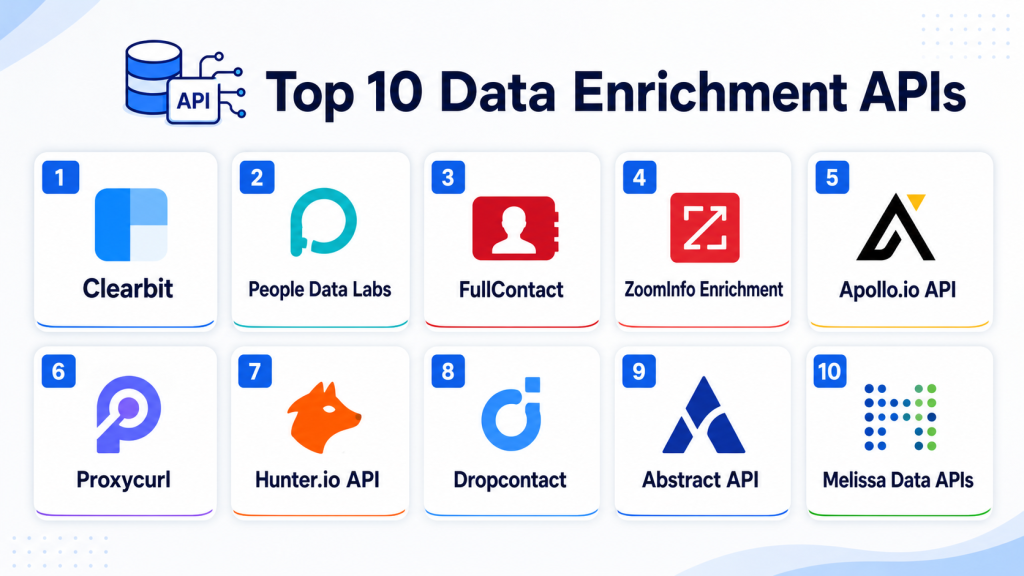
Top 10 Data Enrichment APIs
#1 — Clearbit
Short description: Clearbit is a data enrichment platform focused on company, contact, domain, and firmographic enrichment for sales, marketing, and revenue operations teams. It is commonly used for real-time form enrichment, lead routing, segmentation, website personalization, and CRM data improvement. Clearbit is especially useful for teams that want enrichment embedded directly into business workflows through APIs and integrations.
Key Features
- Company and person enrichment
- Domain-based company lookup
- Real-time lead enrichment
- Firmographic data attributes
- API-based enrichment workflows
- CRM and marketing automation integrations
- Segmentation and routing support
Pros
- Strong API-first enrichment experience
- Useful for inbound lead qualification and routing
- Good fit for revenue operations and growth teams
Cons
- Data coverage may vary by market and company type
- Advanced workflows may require technical setup
- Some teams may need additional prospecting data sources
Platforms / Deployment
Cloud
API-based deployment
Web-based access may vary by package
Security & Compliance
Security and compliance details should be validated directly. Buyers should confirm access controls, data handling practices, encryption, retention, user permissions, and compliance requirements for their use case.
Integrations & Ecosystem
Clearbit fits well into revenue, marketing, sales, and data workflows. It can enrich leads at the point of capture and help operations teams route, score, and segment prospects automatically.
- CRM systems
- Marketing automation tools
- Website forms
- Data warehouses
- Lead routing workflows
- API-based internal applications
Support & Community
Clearbit provides API documentation, onboarding resources, support options, and implementation guidance. Support depth may vary by package and customer size.
#2 — People Data Labs
Short description: People Data Labs is a data platform that provides person and company enrichment through APIs, datasets, and bulk data workflows. It is designed for technical, data, product, and revenue operations teams that need scalable enrichment infrastructure. It is best suited for teams building enrichment directly into data pipelines, internal tools, analytics workflows, or customer-facing applications.
Key Features
- Person enrichment API
- Company enrichment API
- Bulk enrichment workflows
- Identity matching and normalization
- Profile and firmographic attributes
- Dataset access options
- Data infrastructure support for internal systems
Pros
- Strong API and bulk enrichment flexibility
- Useful for data teams and technical workflows
- Supports large-scale enrichment and internal applications
Cons
- Less beginner-friendly than sales-facing tools
- Requires technical implementation resources
- Data coverage and compliance fit should be tested carefully
Platforms / Deployment
Cloud
API-based deployment
Bulk data workflow support
Security & Compliance
Security and compliance details should be reviewed directly. Buyers should validate data sourcing, processing, retention, encryption, permissions, access controls, and regional privacy requirements.
Integrations & Ecosystem
People Data Labs works best in API-driven environments where enrichment is part of a broader data infrastructure. It can support internal applications, analytics systems, CRM hygiene, and customer data workflows.
- Data warehouses
- CRM enrichment pipelines
- Internal applications
- Customer data platforms
- Analytics systems
- API-driven product workflows
Support & Community
People Data Labs provides API documentation, technical resources, support options, and implementation guidance. Support depth may depend on data volume and package.
#3 — FullContact
Short description: FullContact is a data enrichment and identity resolution platform that helps teams enrich customer profiles, contacts, and identity records. It is useful for businesses that need contact enrichment, audience insights, profile completion, and customer data improvement. FullContact is especially relevant for teams that want identity-focused enrichment rather than only B2B prospecting data.
Key Features
- Contact enrichment
- Identity resolution support
- Profile and audience enrichment
- Customer data enhancement
- API-based enrichment
- Data matching and normalization
- CRM and customer data workflow support
Pros
- Strong for identity and profile enrichment
- Useful for customer data improvement and matching
- API-friendly for technical teams
Cons
- May not be the best standalone B2B prospecting database
- Some workflows require technical implementation
- Buyers should validate specific attribute coverage
Platforms / Deployment
Cloud
API-based deployment
Web-based access may vary by package
Security & Compliance
Security and compliance details should be validated directly. Buyers should review permissions, encryption, retention, privacy obligations, data handling, and access governance.
Integrations & Ecosystem
FullContact fits well into customer data, analytics, CRM, and identity enrichment workflows. It can help teams improve profile completeness and connect fragmented identity signals.
- CRM systems
- Customer data platforms
- Data warehouses
- Internal applications
- Analytics systems
- Identity resolution workflows
Support & Community
FullContact provides API documentation, support resources, implementation guidance, and customer assistance. Support level may vary by plan and technical scope.
#4 — ZoomInfo Enrichment
Short description: ZoomInfo Enrichment helps B2B teams enrich CRM, marketing, and sales records with company and contact intelligence. It is useful for organizations that need broad B2B data coverage, account intelligence, prospect details, and ongoing database improvement. ZoomInfo is especially strong for sales and marketing teams that want enrichment connected with prospecting and revenue workflows.
Key Features
- Contact and company enrichment
- Firmographic and demographic attributes
- Account and buyer intelligence
- CRM enrichment workflows
- Data cleansing and update support
- Sales intelligence integration
- Workflow automation for revenue teams
Pros
- Strong B2B data coverage
- Useful for both enrichment and prospecting
- Good fit for enterprise and mid-market sales teams
Cons
- Pricing may be high for small teams
- Data accuracy may vary by region and persona
- Buyers should manage usage and governance carefully
Platforms / Deployment
Cloud
Web-based platform
API and CRM enrichment options may vary by package
Security & Compliance
ZoomInfo provides business and enterprise administration features. Buyers should validate data handling practices, user permissions, retention settings, access controls, and compliance requirements directly.
Integrations & Ecosystem
ZoomInfo integrates enrichment with sales intelligence, CRM cleanup, prospecting, and marketing workflows. It works best when enriched records are used for segmentation, routing, scoring, and sales action.
- Salesforce
- HubSpot
- Sales engagement tools
- Marketing automation platforms
- Data enrichment workflows
- Revenue operations systems
Support & Community
ZoomInfo provides onboarding, documentation, customer support, training resources, and account management options. Support depth may vary by package and contract.
#5 — Apollo.io API
Short description: Apollo.io API supports B2B data workflows for prospecting, enrichment, and sales engagement use cases. Apollo.io is popular with startups, SMBs, and sales teams that need contact and company data combined with outreach workflows. Its API and enrichment capabilities can help teams automate contact lookup, improve records, and support outbound pipeline generation.
Key Features
- Contact and company data access
- Enrichment support for sales workflows
- Prospect search and filtering
- CRM data improvement workflows
- Email and outreach ecosystem support
- Data export and automation options
- Sales intelligence attributes
Pros
- Good value for outbound sales teams
- Combines enrichment with sales engagement workflows
- Practical for SMBs and growth teams
Cons
- Data accuracy may vary by region and segment
- Enterprise governance should be validated
- API use cases may depend on plan and limits
Platforms / Deployment
Cloud
Web-based platform
API availability may vary by package
Security & Compliance
Security and compliance details should be verified directly. Buyers should validate data handling, access permissions, email compliance, retention, and administrative controls.
Integrations & Ecosystem
Apollo.io connects enrichment with outbound prospecting, CRM updates, and sales engagement workflows. It is useful when teams want data and outreach inside a connected sales stack.
- CRM systems
- Email tools
- Sales engagement workflows
- Prospecting systems
- Workflow automation tools
- Reporting workflows
Support & Community
Apollo.io provides documentation, onboarding resources, support options, and product education materials. Support depth may vary by plan and business size.
#6 — Proxycurl
Short description: Proxycurl is a professional profile and company data API that helps developers enrich people and company records using publicly available professional data. It is commonly used for recruitment tools, sales intelligence workflows, market research, profile enrichment, and data applications. Proxycurl is best suited for technical teams that want API access to professional identity and company information.
Key Features
- Person profile enrichment
- Company profile enrichment
- Professional identity data
- Employee and role-related data support
- API-first access
- Bulk enrichment workflows
- Useful for recruitment, sales, and analytics applications
Pros
- Strong API-first professional data access
- Useful for developer-led enrichment use cases
- Good fit for profile and company data workflows
Cons
- Requires technical implementation
- Not ideal for non-technical teams seeking a simple sales interface
- Buyers should validate data coverage and compliance fit
Platforms / Deployment
Cloud
API-based deployment
Developer-focused workflows
Security & Compliance
Security and compliance details should be validated directly. Buyers should review data sourcing, privacy obligations, retention policies, access controls, and usage restrictions.
Integrations & Ecosystem
Proxycurl is best used in developer-built systems, internal applications, recruitment platforms, sales intelligence tools, and analytics workflows that need profile and company enrichment.
- Internal applications
- Recruiting systems
- Sales intelligence workflows
- Data warehouses
- API pipelines
- Analytics products
Support & Community
Proxycurl provides developer documentation, API guidance, support options, and technical resources. Support depth may vary by usage level.
#7 — Hunter.io API
Short description: Hunter.io API helps teams find, verify, and enrich professional email-related data for sales, recruiting, marketing, and outreach workflows. It is especially useful for domain-based email discovery, email verification, and lead data completion. Hunter.io is a practical choice for teams that need focused email enrichment rather than broad company intelligence.
Key Features
- Domain-based email discovery
- Email verification API
- Lead enrichment support
- Company domain research
- Bulk email lookup workflows
- API access for developers
- CRM and outreach workflow support
Pros
- Strong for email discovery and verification
- Easy to understand and implement
- Useful for outbound and recruiting workflows
Cons
- Narrower enrichment scope than full B2B data platforms
- Data coverage depends on domain and public availability
- Not ideal for deep firmographic or technographic enrichment
Platforms / Deployment
Cloud
Web-based platform
API-based deployment
Security & Compliance
Security and compliance details should be verified directly. Buyers should review email data usage, privacy requirements, permissions, retention, and outreach compliance needs.
Integrations & Ecosystem
Hunter.io fits into outbound sales, recruiting, email verification, and CRM hygiene workflows. It is best used when email discovery and validation are the primary enrichment needs.
- CRM systems
- Outreach tools
- Recruiting workflows
- Email verification workflows
- API pipelines
- Lead generation systems
Support & Community
Hunter.io provides documentation, API resources, help articles, and support options. Support level may vary by plan.
#8 — Dropcontact
Short description: Dropcontact is a B2B data enrichment and email verification tool focused on CRM enrichment, contact cleanup, deduplication, and privacy-conscious data workflows. It helps teams improve contact records, find professional email addresses, clean duplicates, and update CRM data. It is useful for sales and marketing teams that need data quality improvements with automated enrichment workflows.
Key Features
- B2B contact enrichment
- Email finding and verification
- CRM data cleanup
- Duplicate detection and merging support
- Company data enrichment
- API and integration support
- Automated data quality workflows
Pros
- Strong for CRM hygiene and contact cleanup
- Useful for email verification and enrichment
- Practical for sales and marketing operations teams
Cons
- Coverage may vary by market and region
- May not match larger data platforms for global breadth
- Buyers should validate API limits and attribute coverage
Platforms / Deployment
Cloud
Web-based platform
API and CRM integration support
Security & Compliance
Security and compliance details should be validated directly. Buyers should review privacy practices, data handling, access controls, retention, and compliance requirements.
Integrations & Ecosystem
Dropcontact fits into CRM enrichment, data cleaning, email verification, and sales operations workflows. It is especially useful for teams that want cleaner records and reduced duplicates.
- CRM systems
- Sales tools
- Email workflows
- Data cleanup processes
- API workflows
- Marketing operations systems
Support & Community
Dropcontact provides documentation, support resources, onboarding guidance, and API materials. Support level may vary by package.
#9 — Abstract API
Short description: Abstract API offers developer-friendly APIs for data validation and enrichment use cases, including email validation, phone validation, IP geolocation, company enrichment, and other utility APIs. It is useful for developers building data quality checks into forms, onboarding flows, product workflows, and internal systems. Abstract API is best for teams that need modular enrichment and validation services.
Key Features
- Email validation API
- Phone validation API
- IP geolocation API
- Company enrichment support
- Developer-friendly API documentation
- Modular API services
- Useful for form and onboarding workflows
Pros
- Simple developer experience
- Good for modular validation and enrichment use cases
- Useful for product, growth, and engineering teams
Cons
- Not a full sales intelligence platform
- Enrichment depth varies by API type
- Teams may need multiple APIs for complete workflows
Platforms / Deployment
Cloud
API-based deployment
Developer-focused workflows
Security & Compliance
Security and compliance details should be verified directly. Buyers should validate data handling, retention, access controls, and privacy requirements for each API used.
Integrations & Ecosystem
Abstract API is designed for developers who want to add validation and enrichment into apps, forms, onboarding flows, and internal systems. It works well as a lightweight API layer.
- Web forms
- Product signup flows
- Internal tools
- CRM validation workflows
- Customer onboarding systems
- API-based applications
Support & Community
Abstract API provides developer documentation, examples, support resources, and technical guidance. Support depth may vary by plan.
#10 — Melissa Data APIs
Short description: Melissa Data APIs provide data quality, identity verification, address verification, contact enrichment, phone validation, email verification, and business data services. These APIs are often used by enterprises that need clean, verified, standardized, and enriched customer or business records. Melissa is especially useful for teams focused on data quality, verification, and compliance-aware record management.
Key Features
- Address verification and standardization
- Email and phone validation
- Identity and contact enrichment
- Business data enrichment
- Global data quality workflows
- API and batch processing options
- Data cleansing and deduplication support
Pros
- Strong data quality and verification capabilities
- Useful for enterprise customer and business data workflows
- Broad validation and cleansing feature set
Cons
- May be more data-quality-focused than sales-intelligence-focused
- Implementation can require data operations planning
- Buyers should validate coverage for specific countries and datasets
Platforms / Deployment
Cloud
API-based deployment
Batch processing options may be available
Security & Compliance
Security and compliance details should be verified directly. Buyers should validate data handling practices, permissions, encryption, retention, privacy obligations, and enterprise compliance needs.
Integrations & Ecosystem
Melissa Data APIs fit into CRM hygiene, customer onboarding, data quality, address validation, identity verification, and analytics workflows. They are useful when enrichment must be combined with validation and cleansing.
- CRM systems
- Customer databases
- Data warehouses
- Ecommerce workflows
- Onboarding systems
- Data quality pipelines
Support & Community
Melissa provides documentation, API resources, customer support, implementation guidance, and enterprise assistance. Support level may vary by package and deployment scope.
Comparison Table
| Tool Name | Best For | Platform(s) Supported | Deployment | Standout Feature | Public Rating |
|---|---|---|---|---|---|
| Clearbit | Real-time B2B lead and company enrichment | API, web-based access varies | Cloud | Form and firmographic enrichment | N/A |
| People Data Labs | API-driven person and company enrichment | API, data workflows | Cloud | Scalable data enrichment infrastructure | N/A |
| FullContact | Identity and profile enrichment | API, web-based access varies | Cloud | Identity resolution and profile completion | N/A |
| ZoomInfo Enrichment | B2B sales and CRM enrichment | Web-based, API options vary | Cloud | Broad contact and company intelligence | N/A |
| Apollo.io API | Outbound sales data enrichment | Web-based, API options vary | Cloud | Prospecting data plus outreach ecosystem | N/A |
| Proxycurl | Professional profile and company data APIs | API | Cloud | Developer-first professional data enrichment | N/A |
| Hunter.io API | Email discovery and verification | Web-based, API | Cloud | Domain-based email enrichment | N/A |
| Dropcontact | CRM cleanup and email enrichment | Web-based, API | Cloud | Contact cleanup and duplicate reduction | N/A |
| Abstract API | Modular validation and enrichment APIs | API | Cloud | Developer-friendly validation APIs | N/A |
| Melissa Data APIs | Data quality and verification workflows | API, batch workflows | Cloud | Address, identity, email, and phone validation | N/A |
Evaluation & Scoring of Data Enrichment APIs
| Tool Name | Core (25%) | Ease (15%) | Integrations (15%) | Security (10%) | Performance (10%) | Support (10%) | Value (15%) | Weighted Total (0–10) |
|---|---|---|---|---|---|---|---|---|
| Clearbit | 9 | 8 | 9 | 8 | 8 | 8 | 8 | 8.35 |
| People Data Labs | 9 | 6 | 8 | 8 | 8 | 7 | 8 | 7.85 |
| FullContact | 8 | 7 | 8 | 8 | 8 | 7 | 7 | 7.65 |
| ZoomInfo Enrichment | 10 | 8 | 9 | 8 | 9 | 8 | 7 | 8.50 |
| Apollo.io API | 8 | 8 | 8 | 7 | 8 | 8 | 9 | 8.10 |
| Proxycurl | 8 | 7 | 8 | 7 | 8 | 7 | 8 | 7.65 |
| Hunter.io API | 7 | 9 | 8 | 7 | 8 | 8 | 8 | 7.85 |
| Dropcontact | 8 | 8 | 8 | 8 | 8 | 8 | 8 | 8.00 |
| Abstract API | 7 | 9 | 7 | 7 | 8 | 8 | 9 | 7.80 |
| Melissa Data APIs | 9 | 7 | 8 | 8 | 9 | 8 | 7 | 8.10 |
These scores are comparative and should be used as a shortlist guide. Sales intelligence APIs may score higher for B2B contact and company data, while data quality APIs may score higher for validation and standardization. Developer-first platforms may offer more flexibility but require technical setup. The best Data Enrichment API depends on your data type, workflow, accuracy requirements, compliance obligations, and internal implementation capacity.
Which Data Enrichment API Is Right for You?
Solo / Freelancer
Solo users usually do not need a complex API-first enrichment platform unless they are building a product or automating a technical workflow. For simple email discovery or validation, Hunter.io API or Abstract API may be enough. If the goal is B2B prospecting, Apollo.io or a simple enrichment workflow may be more practical. Avoid enterprise APIs unless you have enough data volume and technical need.
SMB
SMBs should prioritize ease of use, pricing transparency, CRM compatibility, and practical enrichment results. Apollo.io API, Hunter.io API, Dropcontact, Abstract API, and Clearbit can be good options depending on the workflow. If the company needs simple contact enrichment, email verification, and CRM cleanup, choose a tool with strong usability. If the company needs real-time form enrichment, Clearbit may be a stronger fit.
Mid-Market
Mid-market teams usually need CRM enrichment, lead routing, data quality workflows, and automated sync across sales and marketing systems. Clearbit, ZoomInfo Enrichment, Apollo.io API, Dropcontact, FullContact, and Melissa Data APIs are strong candidates depending on the use case. Teams should test match rates, field accuracy, API response quality, and integration behavior before rollout.
Enterprise
Enterprises should prioritize governance, scalability, permissions, SLAs, compliance review, data coverage, and API reliability. ZoomInfo Enrichment, People Data Labs, FullContact, Melissa Data APIs, and Clearbit are strong enterprise candidates depending on whether the need is B2B enrichment, identity resolution, validation, or data infrastructure. Enterprise buyers should involve data teams, IT, legal, security, revenue operations, and privacy stakeholders before implementation.
Budget vs Premium
Budget-focused teams should choose tools that solve one clear problem, such as email verification, basic enrichment, CRM cleanup, or form enrichment. Hunter.io API, Abstract API, Apollo.io API, and Dropcontact may be practical starting points. Premium buyers should consider ZoomInfo Enrichment, Clearbit, People Data Labs, FullContact, or Melissa Data APIs when scale, governance, coverage, and integration depth matter more.
Feature Depth vs Ease of Use
If ease of use matters most, Hunter.io API, Abstract API, Apollo.io API, and Dropcontact are practical options. If feature depth matters more, ZoomInfo Enrichment, Clearbit, People Data Labs, FullContact, and Melissa Data APIs offer broader or more specialized enrichment capabilities. The right choice depends on whether the main need is B2B sales data, identity resolution, email validation, address verification, or API-driven data infrastructure.
Integrations & Scalability
Data Enrichment APIs should integrate with CRM systems, marketing automation tools, sales engagement platforms, data warehouses, CDPs, internal applications, and workflow automation systems. Scalable enrichment requires clear field mapping, deduplication rules, rate limit planning, monitoring, retry logic, and data refresh schedules. Teams should also plan how enriched data will be stored, updated, and governed over time.
Security & Compliance Needs
Data enrichment involves personal, company, identity, and behavioral data, so compliance review is essential. Buyers should validate data sourcing, consent requirements, retention policies, access controls, encryption, regional privacy obligations, and permitted use cases. Teams should avoid enriching data without clear business purpose, governance rules, and internal documentation.
Frequently Asked Questions
1. What are Data Enrichment APIs?
Data Enrichment APIs add missing or additional information to existing records through automated API calls.
They can enrich contacts, companies, emails, phone numbers, addresses, profiles, and customer records.
These APIs help teams improve data quality, segmentation, routing, personalization, and analytics.
2. How are Data Enrichment APIs different from lead enrichment tools?
Lead enrichment tools are often user-facing platforms for sales and marketing teams.
Data Enrichment APIs are more technical and can be embedded into apps, forms, workflows, CRMs, and data pipelines.
APIs are better when enrichment needs to happen automatically and at scale.
3. What data can be enriched through APIs?
Common enrichment data includes name, company, job title, industry, location, employee count, domain, email validity, phone status, and business profile details.
Some APIs also provide identity, firmographic, technographic, address, and company intelligence data.
The exact fields depend on the provider and data source.
4. Who should use Data Enrichment APIs?
Data teams, revenue operations teams, developers, marketing operations teams, product teams, and CRM administrators benefit most.
These APIs are useful when enrichment must happen inside automated workflows.
They are especially valuable for companies managing large lead, customer, or account databases.
5. How much do Data Enrichment APIs cost?
Pricing usually depends on API calls, credits, records enriched, match rates, data fields, support levels, and enterprise requirements.
Some vendors charge per request, while others use subscriptions or volume-based pricing.
Buyers should estimate monthly enrichment volume before selecting a plan.
6. Do Data Enrichment APIs integrate with CRM systems?
Yes, many enrichment APIs can connect directly or indirectly with CRM systems through native integrations, middleware, scripts, or data pipelines.
CRM enrichment helps keep lead, contact, account, and company records complete and accurate.
Teams should define field mapping and duplicate handling before syncing enriched data.
7. What mistakes should buyers avoid?
A common mistake is choosing an API without testing match accuracy on real records.
Another mistake is storing enriched data without governance, consent review, or field ownership.
Teams should also avoid enriching records if they do not have a clear plan for using the added data.
8. Are Data Enrichment APIs secure?
Many vendors provide security controls, but security depends on the API, plan, implementation, and data handling practices.
Buyers should validate encryption, authentication, logging, access controls, retention policies, and compliance obligations.
Security review is especially important when APIs process personal or customer data.
9. Can Data Enrichment APIs improve personalization?
Yes, enriched data can help personalize emails, website experiences, onboarding flows, sales outreach, and product messaging.
For example, teams can personalize based on company size, industry, role, location, or account type.
Personalization should remain relevant and respectful to avoid creating a negative customer experience.
10. What are alternatives to Data Enrichment APIs?
Alternatives include manual research, spreadsheet cleanup, CRM-only updates, sales intelligence platforms, data entry teams, and basic validation tools.
These may work for low-volume or one-time projects.
Data Enrichment APIs are better when teams need automation, scale, consistency, and integration with business systems.
Conclusion
Data Enrichment APIs help businesses transform incomplete records into more useful, structured, and actionable data. They support lead routing, CRM hygiene, customer segmentation, identity matching, personalization, analytics, and product workflows. Clearbit is a strong option for real-time B2B enrichment and revenue operations workflows. People Data Labs and FullContact are useful for API-driven identity, person, company, and profile enrichment at scale. ZoomInfo Enrichment and Apollo.io API are practical for B2B sales intelligence and prospecting-oriented data workflows. Proxycurl, Hunter.io API, Dropcontact, Abstract API, and Melissa Data APIs each serve specialized needs such as professional profile enrichment, email verification, CRM cleanup, validation, and data quality. The best API depends on your data type, match accuracy needs, technical resources, compliance requirements, and budget. Before choosing, test each API with real records, compare match quality, review documentation, and validate integration behavior.
This comparison makes it easier to choose the right prospecting automation tool for different business requirements.
From my experience, data freshness becomes a real issue over time. Even a small percentage of outdated records can affect targeting and decision-making more than expected.