Introduction
eBPF observability and runtime security tools enable deep visibility into system behavior by running safe, lightweight programs directly inside the operating system kernel. This allows teams to monitor applications, network traffic, and system calls without modifying application code or adding heavy instrumentation.
These tools are transforming modern observability by providing low-overhead, real-time telemetry across distributed systems, especially in Kubernetes and cloud-native environments. They are also widely used for runtime threat detection, anomaly monitoring, and security enforcement.
Common use cases include Kubernetes observability, performance profiling, runtime threat detection, network monitoring, and forensic analysis.
What buyers should evaluate:
- Depth of kernel-level visibility
- Performance overhead and efficiency
- Security detection and enforcement capabilities
- Integration with Kubernetes and cloud platforms
- Ease of deployment and automation
- Observability coverage metrics logs traces profiling
- Policy and runtime enforcement features
- Scalability for distributed systems
- Ecosystem maturity and community
- Compatibility with modern DevOps workflows
Best for: DevOps teams, SREs, platform engineers, security teams, and enterprises running Kubernetes or cloud-native systems.
Not ideal for: Small applications without complex infrastructure or teams not requiring deep system-level visibility.
Key Trends in eBPF Observability & Runtime Security Tools
- Shift from agent-based monitoring to kernel-level observability
- Rapid adoption in Kubernetes and cloud-native platforms
- Combining observability and runtime security in one stack
- Auto-instrumentation without code changes
- Growth of continuous profiling and performance analytics
- Integration with OpenTelemetry and modern observability stacks
- Increased use for zero-trust runtime security
- AI-assisted root cause analysis and anomaly detection
- Expansion into networking, security, and compliance use cases
- Lightweight alternative to traditional monitoring agents
How We Selected These Tools
- Adoption in cloud-native and Kubernetes ecosystems
- Strong eBPF-based observability and security capabilities
- Integration with DevOps, CI CD, and cloud platforms
- Performance efficiency and low overhead
- Ease of deployment and usability
- Security monitoring and enforcement features
- Scalability for enterprise environments
- Active development and ecosystem support
- Open-source and commercial balance
- Real-world production use cases
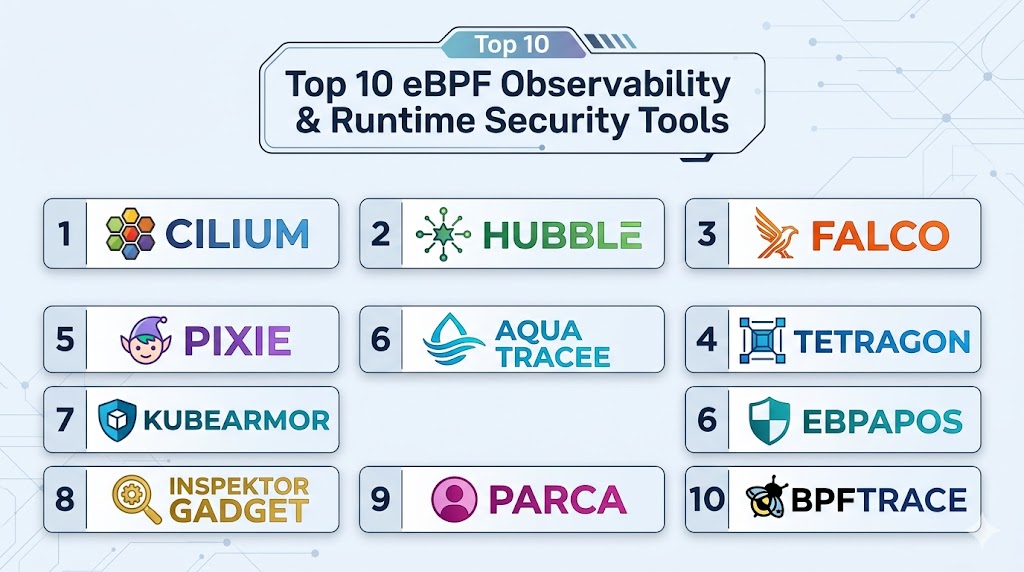
Top 10 eBPF Observability & Runtime Security Tools
1. Cilium and Hubble
Short description:
Cilium is a leading eBPF-powered networking, observability, and security platform for Kubernetes. Hubble provides real-time visibility into network flows and service communication. It is widely used for cloud-native environments. It is ideal for large-scale Kubernetes deployments.
Key Features
- eBPF-based networking
- Real-time network visibility
- Service dependency mapping
- Policy enforcement
- Layer 7 observability
- Integration with Prometheus and OpenTelemetry
- Runtime security capabilities
Pros
- Deep network visibility
- Strong Kubernetes integration
- Scalable
Cons
- Complex setup
- Requires Kubernetes knowledge
- Resource-intensive
Platforms / Deployment
Linux / Kubernetes
Deployment: Cloud / Self-hosted
Security & Compliance
Supports runtime enforcement and policy-based security
Integrations & Ecosystem
Integrates with cloud-native observability and networking stacks.
- Kubernetes
- Prometheus
- OpenTelemetry
- Grafana
- APIs
- DevOps tools
Support & Community
Very strong open-source and enterprise ecosystem
2. Falco
Short description:
Falco is a runtime security tool that detects suspicious activity using eBPF. It monitors system calls and container behavior. It is widely adopted for threat detection. It is ideal for security-focused teams.
Key Features
- Runtime threat detection
- Rule-based engine
- System call monitoring
- Kubernetes integration
- Alerting and logging
- Security policies
- Open-source
Pros
- Mature rule engine
- Strong security focus
- Easy integration
Cons
- Rule tuning required
- Limited observability features
- False positives possible
Platforms / Deployment
Linux / Kubernetes
Deployment: Self-hosted
Security & Compliance
Strong runtime security monitoring
Integrations & Ecosystem
Integrates with security and monitoring tools.
- Kubernetes
- SIEM systems
- DevOps tools
- APIs
- Logging platforms
- Cloud systems
Support & Community
Large and active community
3. Tetragon
Short description:
Tetragon is an eBPF-based runtime security and observability tool built on Cilium. It monitors process execution and enforces policies. It provides deep kernel-level insights. It is ideal for Kubernetes security.
Key Features
- Process lifecycle monitoring
- Runtime enforcement
- Security policies
- File and network monitoring
- Kernel-level visibility
- Kubernetes integration
- eBPF-based filtering
Pros
- Deep visibility
- Strong enforcement
- Cloud-native
Cons
- Requires Cilium ecosystem
- Complex setup
- Learning curve
Platforms / Deployment
Linux / Kubernetes
Deployment: Cloud / Self-hosted
Security & Compliance
Supports runtime enforcement and monitoring
Integrations & Ecosystem
Integrates with Kubernetes and security tools.
- Kubernetes
- APIs
- DevOps tools
- Security systems
- Monitoring platforms
- Cloud systems
Support & Community
Growing ecosystem
4. Pixie
Short description:
Pixie is an open-source observability tool that uses eBPF to automatically capture telemetry data without manual instrumentation. It provides deep insights into Kubernetes applications. It is ideal for developers and SREs.
Key Features
- Auto-instrumentation
- Real-time telemetry
- Service maps
- Distributed tracing
- Application profiling
- Kubernetes-native
- Scriptable observability
Pros
- No code changes required
- Developer-friendly
- Fast insights
Cons
- Kubernetes-focused
- Limited outside K8s
- Requires setup
Platforms / Deployment
Kubernetes / Linux
Deployment: Self-hosted
Security & Compliance
Not publicly stated
Integrations & Ecosystem
Integrates with observability and DevOps tools.
- Kubernetes
- APIs
- DevOps pipelines
- Monitoring tools
- Cloud platforms
- Data systems
Support & Community
Strong open-source community
5. Aqua Tracee
Short description:
Tracee is an eBPF-based runtime security and forensics tool. It captures system events and detects suspicious behavior. It is widely used for investigations. It is ideal for security operations teams.
Key Features
- Runtime event capture
- Behavioral detection
- Forensics capabilities
- Kubernetes support
- Security rules
- Event correlation
- Open-source
Pros
- Strong forensic capabilities
- Real-time detection
- Flexible
Cons
- Complex configuration
- Requires expertise
- Limited UI
Platforms / Deployment
Linux / Kubernetes
Deployment: Self-hosted
Security & Compliance
Supports runtime threat detection
Integrations & Ecosystem
Integrates with security and DevOps systems.
- Kubernetes
- SIEM tools
- APIs
- DevOps pipelines
- Monitoring systems
- Cloud platforms
Support & Community
Active community
6. Inspektor Gadget
Short description:
Inspektor Gadget is a collection of eBPF-based tools for debugging Kubernetes workloads. It provides targeted observability insights. It is ideal for troubleshooting. It helps developers debug issues quickly.
Key Features
- Debugging tools
- Kubernetes integration
- eBPF-based tracing
- Modular gadgets
- CLI tools
- Observability insights
- Lightweight
Pros
- Easy troubleshooting
- Modular design
- Lightweight
Cons
- Limited enterprise features
- CLI-focused
- Narrow scope
Platforms / Deployment
Linux / Kubernetes
Deployment: Self-hosted
Security & Compliance
Not publicly stated
Integrations & Ecosystem
Integrates with Kubernetes debugging workflows.
- Kubernetes
- Dev tools
- APIs
- Monitoring tools
- CLI tools
- Cloud systems
Support & Community
Active open-source community
7. Grafana Beyla
Short description:
Beyla is an eBPF-based auto-instrumentation tool for collecting application telemetry. It integrates with Grafana observability stack. It is ideal for modern observability pipelines.
Key Features
- Auto-instrumentation
- Metrics collection
- Distributed tracing
- Low overhead
- OpenTelemetry integration
- Kubernetes support
- Cloud-native
Pros
- Easy integration
- Low overhead
- Modern observability
Cons
- Limited standalone usage
- Requires Grafana ecosystem
- Newer tool
Platforms / Deployment
Linux / Kubernetes
Deployment: Cloud / Self-hosted
Security & Compliance
Not publicly stated
Integrations & Ecosystem
Integrates with observability stacks.
- Grafana
- OpenTelemetry
- Prometheus
- APIs
- DevOps tools
- Cloud platforms
Support & Community
Growing ecosystem
8. Parca
Short description:
Parca is a continuous profiling tool using eBPF for performance monitoring. It captures CPU and memory usage. It is ideal for performance optimization. It provides real-time insights.
Key Features
- Continuous profiling
- Flame graphs
- Low overhead
- Performance monitoring
- Kubernetes integration
- Open-source
- Real-time analysis
Pros
- Always-on profiling
- Low overhead
- Developer-friendly
Cons
- Limited security features
- Requires setup
- Niche use case
Platforms / Deployment
Linux / Kubernetes
Deployment: Self-hosted
Security & Compliance
Not publicly stated
Integrations & Ecosystem
Integrates with observability tools.
- Kubernetes
- APIs
- DevOps tools
- Monitoring systems
- Cloud platforms
- Profiling tools
Support & Community
Active community
9. Sysdig OSS
Short description:
Sysdig OSS is an open-source tool for system monitoring and troubleshooting using eBPF. It provides deep visibility into system calls. It is widely used in DevOps. It is ideal for troubleshooting.
Key Features
- System call capture
- Performance monitoring
- Troubleshooting tools
- Kubernetes integration
- CLI tools
- Real-time insights
- Open-source
Pros
- Deep visibility
- Flexible
- Proven tool
Cons
- CLI-heavy
- Complex
- Limited UI
Platforms / Deployment
Linux / Kubernetes
Deployment: Self-hosted
Security & Compliance
Supports runtime monitoring
Integrations & Ecosystem
Integrates with DevOps and monitoring tools.
- Kubernetes
- APIs
- DevOps tools
- Monitoring systems
- Cloud platforms
- Security tools
Support & Community
Strong community
10. KubeArmor
Short description:
KubeArmor is an eBPF-based runtime security tool for Kubernetes workloads. It enforces security policies. It provides visibility and protection. It is ideal for container security.
Key Features
- Runtime security
- Policy enforcement
- Kubernetes integration
- Threat detection
- File and process monitoring
- eBPF-based enforcement
- Cloud-native
Pros
- Strong security focus
- Kubernetes-native
- Flexible
Cons
- Kubernetes dependency
- Setup complexity
- Limited outside K8s
Platforms / Deployment
Linux / Kubernetes
Deployment: Cloud / Self-hosted
Security & Compliance
Supports runtime enforcement and security policies
Integrations & Ecosystem
Integrates with Kubernetes and security stacks.
- Kubernetes
- APIs
- DevOps tools
- Security platforms
- Monitoring tools
- Cloud systems
Support & Community
Growing adoption
Comparison Table
| Tool Name | Best For | Platform(s) Supported | Deployment | Standout Feature | Public Rating |
|---|---|---|---|---|---|
| Cilium | Networking & observability | Linux, Kubernetes | Hybrid | Service map & network visibility | N/A |
| Falco | Threat detection | Linux | Self-hosted | Rule engine | N/A |
| Tetragon | Runtime enforcement | Linux | Self-hosted | Kernel-level enforcement | N/A |
| Pixie | Developer observability | Linux | Cloud | Auto telemetry | N/A |
| Tracee | Security forensics | Linux | Self-hosted | Behavioral detection | N/A |
| Inspektor Gadget | Debugging | Linux | Self-hosted | Modular gadgets | N/A |
| Beyla | Auto instrumentation | Linux | Hybrid | OpenTelemetry support | N/A |
| Parca | Profiling | Linux | Self-hosted | Continuous profiling | N/A |
| Sysdig OSS | Troubleshooting | Linux | Self-hosted | Syscall capture | N/A |
| KubeArmor | Security enforcement | Linux | Hybrid | Policy-based protection | N/A |
Evaluation & Scoring of eBPF Observability Tools
| Tool Name | Core | Ease | Integrations | Security | Performance | Support | Value | Weighted Total |
|---|---|---|---|---|---|---|---|---|
| Cilium | 10 | 6 | 10 | 10 | 9 | 10 | 8 | 9.0 |
| Falco | 9 | 7 | 9 | 10 | 9 | 9 | 8 | 8.7 |
| Tetragon | 9 | 6 | 9 | 10 | 9 | 8 | 8 | 8.5 |
| Pixie | 9 | 9 | 8 | 7 | 8 | 8 | 9 | 8.4 |
| Tracee | 8 | 7 | 8 | 9 | 8 | 8 | 8 | 8.0 |
| Inspektor Gadget | 7 | 8 | 7 | 7 | 8 | 7 | 9 | 7.6 |
| Beyla | 8 | 8 | 9 | 7 | 8 | 8 | 8 | 8.1 |
| Parca | 8 | 8 | 8 | 6 | 9 | 8 | 9 | 8.0 |
| Sysdig OSS | 9 | 6 | 8 | 7 | 8 | 8 | 8 | 8.0 |
| KubeArmor | 8 | 7 | 8 | 9 | 8 | 8 | 8 | 8.1 |
These scores are comparative and reflect overall capabilities across observability, security, and performance. The best tool depends on your use case.
Which eBPF Tool Is Right for You
Solo / Freelancer
Use Pixie or Inspektor Gadget for simple debugging and observability.
SMB
Combine Pixie with Falco for observability and security.
Mid-Market
Use Cilium, Beyla, and Parca for scalable observability.
Enterprise
Adopt Cilium, Tetragon, and KubeArmor for full-stack observability and security.
Budget vs Premium
Most tools are open-source, making them cost-effective.
Feature Depth vs Ease of Use
Pixie is easy, while Cilium offers deep control.
Integrations & Scalability
Cilium and Grafana ecosystem tools lead in scalability.
Security & Compliance Needs
Falco, Tetragon, and KubeArmor provide strong runtime security.
Frequently Asked Questions
1. What is eBPF
eBPF is a technology that runs programs in the OS kernel for monitoring and security. It enables deep visibility without modifying applications. It is safe and efficient.
2. Why use eBPF for observability
It provides system-wide visibility with low overhead. It does not require instrumentation. It is ideal for modern systems.
3. Is eBPF secure
Yes, eBPF programs are verified before execution. They cannot harm the kernel. Security depends on implementation.
4. Can eBPF replace traditional monitoring
It complements and enhances traditional monitoring. It provides deeper insights. Many organizations use both.
5. Do these tools work with Kubernetes
Yes, most tools are designed for Kubernetes environments. They provide deep visibility and control.
6. Are these tools hard to use
Some tools require expertise. Others are easier with automation. Complexity varies.
7. Can eBPF detect threats
Yes, many tools include runtime security features. They detect anomalies and suspicious behavior.
8. What are the main benefits
Low overhead, deep visibility, and real-time insights. It improves observability and security.
9. Do I need special infrastructure
You need a compatible Linux kernel. Most modern systems support eBPF.
10. How do I choose the right tool
Evaluate your needs, infrastructure, and expertise. Test tools before adoption.
Conclusion
eBPF observability and runtime security tools are redefining how modern systems are monitored and protected. By operating directly in the kernel, these tools provide deep visibility into system behavior, network traffic, and application performance without requiring intrusive instrumentation. This makes them highly efficient and well-suited for cloud-native environments where performance and scalability are critical. The ecosystem offers a wide range of tools, from observability-focused solutions like Pixie and Parca to security-focused platforms like Falco and KubeArmor. Advanced tools like Cilium and Tetragon combine networking, observability, and security into a unified platform, making them ideal for large-scale enterprise deployments. Open-source options provide flexibility and cost efficiency, while integrated platforms offer ease of use and scalability.
The article is helpful, but debugging eBPF programs in production is still quite hard. When something goes wrong, visibility into what exactly failed isn’t always clear.