Introduction
Batch processing frameworks are software platforms that process large volumes of data in discrete chunks or “batches” rather than continuously. They are widely used for ETL (Extract, Transform, Load) jobs, reporting, financial calculations, data warehousing, and periodic analytics. Unlike real-time processing, batch processing is ideal when latency is not critical, but throughput and reliability are paramount.
Batch frameworks provide reliability, fault tolerance, and scalability, making them essential for organizations that need to process large datasets efficiently, often on scheduled intervals.
Real-world use cases include:
- Nightly ETL jobs loading data into warehouses.
- Aggregating sales, inventory, or financial data for reporting.
- Performing large-scale machine learning training on historical data.
- Running periodic compliance and audit reports.
- Data archival and backup transformations.
Key evaluation criteria for buyers:
- Scalability for large data volumes
- Fault tolerance and reliability
- Support for complex transformations and workflows
- Scheduling and orchestration capabilities
- Integration with data sources, warehouses, and cloud storage
- Performance monitoring and logging
- Ease of use for developers
- Security, governance, and compliance
- Cost-effectiveness
- Cloud, on-premises, or hybrid deployment options
Best for:
Batch processing frameworks are ideal for data engineers, analytics teams, and IT operations handling large datasets with predictable processing schedules.
Not ideal for:
Organizations that need real-time or low-latency processing for streaming data may require a real-time or stream processing framework instead.
Key Trends in Batch Processing Frameworks
- Unified batch and streaming frameworks for hybrid pipelines.
- Cloud-native batch processing for elastic scaling and reduced infrastructure management.
- Integration with big data ecosystems such as Hadoop, Spark, and cloud data warehouses.
- Enhanced scheduling and orchestration with workflow management tools.
- Support for AI and ML pipelines processing historical datasets.
- Observability and monitoring integrated for large-scale jobs.
- Low-code or high-level APIs to simplify pipeline development.
- Security and governance integrated into batch pipelines.
- Containerization and Kubernetes orchestration for modern deployment.
- Cost-optimization via spot instances or cloud resource scaling.
How We Selected These Tools (Methodology)
- Assessed processing speed and scalability for large datasets.
- Evaluated workflow orchestration and scheduling capabilities.
- Reviewed integration with storage, data lakes, and warehouses.
- Checked fault tolerance, logging, and monitoring features.
- Considered developer usability and API support.
- Examined security, governance, and compliance.
- Reviewed community support, documentation, and enterprise support options.
- Evaluated cloud, on-prem, and hybrid deployment flexibility.
- Factored cost-effectiveness and resource efficiency.
- Ensured relevance across SMB, mid-market, and enterprise contexts.
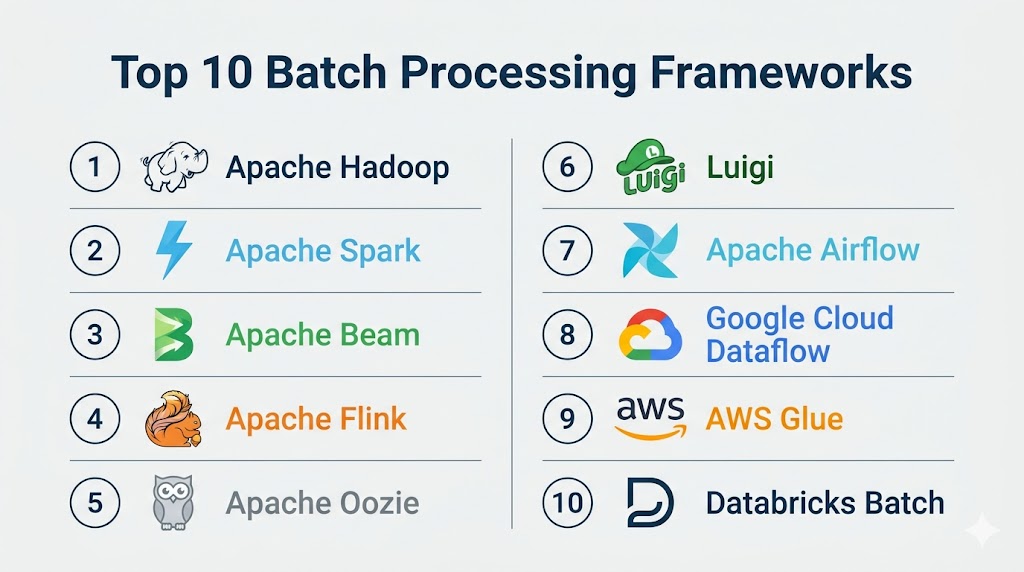
Top 10 Batch Processing Frameworks
#1 — Apache Hadoop
Short description: Hadoop is an open-source framework for distributed storage and batch processing of large datasets using the MapReduce programming model.
Key Features
- Distributed storage with HDFS
- MapReduce batch processing
- Fault tolerance with data replication
- Scalability across clusters
- Integration with Hive, Pig, and Spark
- Wide ecosystem of Hadoop tools
Pros
- Handles massive datasets
- Mature and well-supported
Cons
- Complex setup and maintenance
- MapReduce programming can be verbose
Platforms / Deployment
- Linux / Cloud / On-prem / Hybrid
Security & Compliance
- Kerberos authentication, HDFS permissions
- Compliance depends on deployment
Integrations & Ecosystem
- Hive, Pig, Spark, HBase, BI tools
Support & Community
- Large open-source community
- Enterprise support via Hadoop vendors
#2 — Apache Spark
Short description: Apache Spark is a unified analytics engine for batch and stream processing, optimized for large-scale data.
Key Features
- In-memory batch processing for speed
- APIs in Java, Scala, Python, R
- Fault-tolerant and scalable
- Integration with Hadoop, Hive, HDFS
- Advanced analytics support (MLlib, GraphX)
Pros
- Fast and flexible
- Supports batch, streaming, and machine learning
Cons
- Requires cluster management
- Memory-intensive workloads
Platforms / Deployment
- Linux / Cloud / On-prem / Hybrid
Security & Compliance
- Kerberos, SSL, RBAC
- Compliance depends on setup
Integrations & Ecosystem
- Hadoop, Kafka, Hive, BI tools
Support & Community
- Large open-source community
- Managed offerings (Databricks)
#3 — Apache Beam
Short description: Apache Beam provides a unified programming model for batch and stream processing across multiple execution engines.
Key Features
- Unified APIs for batch and streaming
- Multiple execution engines (Flink, Spark, Dataflow)
- Windowing and event-time processing
- SDKs in Java, Python, Go
Pros
- Flexible execution across engines
- Simplifies hybrid pipelines
Cons
- Requires execution engine for runtime
- Steep learning curve
Platforms / Deployment
- Linux / Cloud / On-prem / Hybrid
Security & Compliance
- Engine-dependent
- Supports encryption and access controls
Integrations & Ecosystem
- Kafka, cloud storage, warehouses, BI tools
Support & Community
- Open-source community
- Documentation and examples
#4 — Apache Flink
Short description: Flink offers both batch and stream processing, with low-latency and high-throughput capabilities.
Key Features
- Unified batch/stream processing
- Fault tolerance and distributed execution
- Event-time processing and windowing
- APIs for Java, Scala, Python
Pros
- High performance
- Supports complex batch analytics
Cons
- Operational complexity
- Learning curve for batch pipelines
Platforms / Deployment
- Linux / Cloud / On-prem / Hybrid
Security & Compliance
- Depends on deployment
- Supports encryption
Integrations & Ecosystem
- Hadoop, Kafka, storage systems
Support & Community
- Open-source community
- Vendor support via managed options
#5 — Apache Oozie
Short description: Oozie is a workflow scheduler for managing Hadoop batch jobs.
Key Features
- Workflow orchestration for Hadoop jobs
- Supports MapReduce, Spark, Hive, Pig
- Time and data-based triggers
- Extensible with custom actions
Pros
- Simplifies complex batch workflows
- Well-integrated with Hadoop ecosystem
Cons
- Hadoop-specific
- Limited to orchestration, not processing
Platforms / Deployment
- Linux / On-prem / Hybrid
Security & Compliance
- Kerberos authentication
- Depends on Hadoop deployment
Integrations & Ecosystem
- Hadoop ecosystem: Spark, Hive, Pig, HDFS
Support & Community
- Open-source support
- Documentation available
#6 — Luigi
Short description: Luigi is a Python-based workflow orchestration framework for batch jobs.
Key Features
- Task dependency management
- Workflow visualization
- Supports Hadoop, Spark, and custom tasks
- Retry and failure handling
Pros
- Python-native and easy to script
- Flexible for custom pipelines
Cons
- Not a processing engine
- Limited UI and monitoring
Platforms / Deployment
- Linux / Cloud / On-prem
Security & Compliance
- Depends on deployment
- Supports basic authentication
Integrations & Ecosystem
- Hadoop, Spark, databases, cloud storage
Support & Community
- Open-source community
- Growing adoption
#7 — Airflow
Short description: Apache Airflow is a platform to programmatically author, schedule, and monitor batch workflows.
Key Features
- DAG-based workflow orchestration
- Python API for tasks
- Scheduling, retries, and monitoring
- Supports Kubernetes, Spark, Hive
Pros
- Flexible and highly extensible
- Active community
Cons
- Requires operational management
- Can be complex for beginners
Platforms / Deployment
- Linux / Cloud / On-prem / Hybrid
Security & Compliance
- RBAC, encryption
- Compliance via underlying systems
Integrations & Ecosystem
- Hadoop, Spark, cloud services, databases
Support & Community
- Large open-source community
- Commercial managed options
#8 — Google Cloud Dataflow
Short description: Dataflow provides fully managed batch and streaming processing using Apache Beam.
Key Features
- Serverless execution
- Unified batch and streaming
- Autoscaling compute resources
- Integrates with GCP storage and BigQuery
Pros
- No infrastructure management
- Highly scalable
Cons
- Cloud-only
- Learning Beam APIs required
Platforms / Deployment
- Cloud
Security & Compliance
- IAM, encryption
- Cloud compliance features
Integrations & Ecosystem
- BigQuery, Pub/Sub, cloud storage
Support & Community
- Google Cloud support
- Growing user community
#9 — AWS Glue
Short description: AWS Glue is a serverless ETL service supporting batch processing and workflow orchestration.
Key Features
- Automated ETL scripts
- Serverless batch processing
- Integration with S3, Redshift, RDS
- Job scheduling and monitoring
Pros
- Fully managed, reduces operational burden
- Tight AWS integration
Cons
- Cloud-only
- Limited for non-AWS environments
Platforms / Deployment
- Cloud
Security & Compliance
- IAM, encryption
- SOC 2, compliance via AWS
Integrations & Ecosystem
- AWS ecosystem, BI tools, warehouses
Support & Community
- AWS support
- Active community
#10 — Databricks Batch
Short description: Databricks provides batch processing on a unified Lakehouse platform, supporting large-scale analytics.
Key Features
- Scalable compute clusters
- Python, Scala, SQL, R APIs
- Integration with Delta Lake
- Workflow scheduling
Pros
- Unified analytics and batch processing
- Easy to scale for large datasets
Cons
- Cloud-dependent
- Higher cost for large workloads
Platforms / Deployment
- Cloud
Security & Compliance
- IAM, encryption, RBAC
- SOC 2, compliance via Databricks
Integrations & Ecosystem
- Delta Lake, BI tools, cloud storage
Support & Community
- Enterprise support
- Databricks community
Comparison Table (Top 10)
| Tool Name | Best For | Platform(s) Supported | Deployment | Standout Feature | Public Rating |
|---|---|---|---|---|---|
| Apache Hadoop | Distributed batch | Linux | Cloud / On-prem / Hybrid | HDFS + MapReduce | N/A |
| Apache Spark | Unified analytics | Linux | Cloud / On-prem / Hybrid | In-memory batch | N/A |
| Apache Beam | Cross-platform batch | Linux | Cloud / On-prem / Hybrid | Unified APIs | N/A |
| Apache Flink | Stream & batch | Linux | Cloud / On-prem / Hybrid | Unified processing | N/A |
| Apache Oozie | Hadoop workflows | Linux | On-prem / Hybrid | Job orchestration | N/A |
| Luigi | Python workflows | Linux | Cloud / On-prem | Task dependencies | N/A |
| Airflow | DAG orchestration | Linux | Cloud / On-prem / Hybrid | Flexible scheduling | N/A |
| Google Cloud Dataflow | Cloud batch/stream | Cloud | Cloud | Serverless Beam | N/A |
| AWS Glue | Cloud ETL | Cloud | Cloud | Managed ETL & batch | N/A |
| Databricks Batch | Lakehouse batch | Cloud | Cloud | Delta Lake + batch | N/A |
Evaluation & Scoring of Batch Processing Frameworks
| Tool Name | Core (25%) | Ease (15%) | Integrations (15%) | Security (10%) | Performance (10%) | Support (10%) | Value (15%) | Weighted Total (0–10) |
|---|---|---|---|---|---|---|---|---|
| Hadoop | 9 | 6 | 8 | 7 | 8 | 7 | 6 | 7.6 |
| Spark | 9 | 7 | 8 | 7 | 9 | 7 | 7 | 7.8 |
| Beam | 8 | 7 | 8 | 7 | 8 | 7 | 6 | 7.3 |
| Flink | 8 | 6 | 8 | 7 | 8 | 7 | 6 | 7.2 |
| Oozie | 7 | 6 | 7 | 7 | 7 | 6 | 6 | 6.7 |
| Luigi | 7 | 8 | 7 | 6 | 7 | 6 | 6 | 6.8 |
| Airflow | 8 | 7 | 8 | 7 | 8 | 7 | 6 | 7.2 |
| Dataflow | 8 | 8 | 8 | 8 | 8 | 7 | 7 | 7.6 |
| AWS Glue | 8 | 8 | 8 | 8 | 8 | 7 | 7 | 7.6 |
| Databricks Batch | 9 | 7 | 8 | 8 | 9 | 7 | 7 | 7.9 |
Which Batch Processing Framework Is Right for You?
Solo / Freelancer
Luigi or Airflow provides lightweight, Python-friendly batch orchestration.
SMB
Cloud-managed options like AWS Glue or Google Dataflow reduce operational overhead.
Mid-Market
Apache Spark or Databricks Batch balances speed, scalability, and analytics integration.
Enterprise
Apache Hadoop, Flink, or Beam deliver enterprise-grade fault tolerance, scale, and unified batch/stream processing.
Budget vs Premium
Open-source frameworks reduce licensing cost but increase operational effort. Managed cloud frameworks reduce operations but may have higher recurring costs.
Feature Depth vs Ease of Use
Frameworks like Spark and Beam offer advanced processing capabilities but require expertise. Cloud-managed frameworks simplify adoption.
Integrations & Scalability
Ensure framework connects with warehouses, BI tools, and storage for scalable batch workflows.
Security & Compliance Needs
Select frameworks with access controls, encryption, and compliance features for sensitive data processing.
Frequently Asked Questions (FAQs)
What is a batch processing framework?
A platform to process large datasets in discrete chunks or batches, typically on scheduled intervals.
How is it different from stream processing?
Batch frameworks process data periodically, while stream processing handles data continuously with low latency.
Can small teams use these frameworks?
Yes, cloud-managed options like AWS Glue or Google Dataflow reduce operational complexity for small teams.
Are batch frameworks secure?
Many provide encryption, access control, and integration with compliance standards.
Do they support analytics pipelines?
Yes, they support ETL, data aggregation, and analytics workflows.
Can these frameworks scale?
Open-source frameworks like Hadoop and Spark scale across clusters; cloud-managed options auto-scale.
How long does deployment take?
Managed cloud solutions can be deployed quickly; self-hosted clusters take longer.
Can they process historical and new data?
Yes, batch frameworks excel at processing both historical and accumulated datasets.
Are they suitable for AI/ML?
Yes, batch processing is ideal for training models on large historical datasets.
How do I choose the right framework?
Consider data volume, latency needs, cloud/on-prem deployment, ease of use, and cost.
Conclusion
Batch processing frameworks remain essential for organizations handling large volumes of data where latency is not critical. Small teams can benefit from Python-friendly workflow orchestrators like Luigi and Airflow, while SMBs may prefer cloud-managed options such as AWS Glue or Google Dataflow for reduced operational complexity. Mid-market organizations benefit from Apache Spark or Databricks Batch for fast, scalable, and analytics-ready processing. Enterprises with large datasets and complex pipelines may rely on Apache Hadoop, Flink, or Beam for fault-tolerant, scalable, and unified batch and stream processing. Choosing the right framework involves evaluating throughput, scalability, operational complexity, integrations, and security. Pilot testing with key workflows is recommended before full deployment. Properly selected batch frameworks enable efficient ETL, analytics, and ML workloads, driving informed business decisions across all functional areas.