Introduction
Graph Database Platforms are specialized databases designed to store and manage data in the form of nodes, edges, and relationships. Unlike traditional relational databases that rely on tables, graph databases focus on connections between data points, making them ideal for complex, highly connected datasets.
In modern applications, data is not just about records—it is about relationships. Whether it is social networks, fraud detection, recommendation systems, or knowledge graphs, graph databases help uncover hidden patterns by analyzing how data is interconnected.
Common real-world use cases include:
- Social networking platforms and friend recommendations
- Fraud detection and financial transaction analysis
- Knowledge graphs and semantic search systems
- Network and IT infrastructure mapping
- Identity and access management systems
- Recommendation engines (products, content, services)
Key evaluation criteria include:
- Query language efficiency (Cypher, Gremlin, SPARQL, etc.)
- Relationship traversal performance
- Scalability and distributed architecture
- Data modeling flexibility
- Real-time query performance
- Security and access control
- Integration with analytics and AI systems
- Ease of development and learning curve
Best for: Data engineers, AI teams, enterprises handling highly connected data, and applications requiring deep relationship analysis.
Not ideal for: Simple CRUD applications, flat data models, or small systems with minimal relationships.
Key Trends in Graph Database Platforms
- Increasing adoption in AI-driven knowledge graphs
- Growth of fraud detection and cybersecurity use cases
- Integration with machine learning and semantic reasoning systems
- Hybrid databases combining graph + document + key-value models
- Expansion of real-time graph analytics
- Cloud-native graph database services becoming standard
- Support for large-scale distributed graph processing
- Strong use in recommendation engines and personalization systems
- Increased adoption in enterprise data fabric architectures
- Improved query languages and standardization efforts
How We Selected These Tools (Methodology)
- Industry adoption and enterprise usage
- Performance in relationship-heavy workloads
- Scalability across large distributed datasets
- Query language expressiveness and ease of use
- Security and compliance readiness
- Integration with AI, ML, and analytics ecosystems
- Support for real-time graph processing
- Community and vendor ecosystem maturity
- Deployment flexibility (cloud, hybrid, self-hosted)
- Innovation in graph processing capabilities
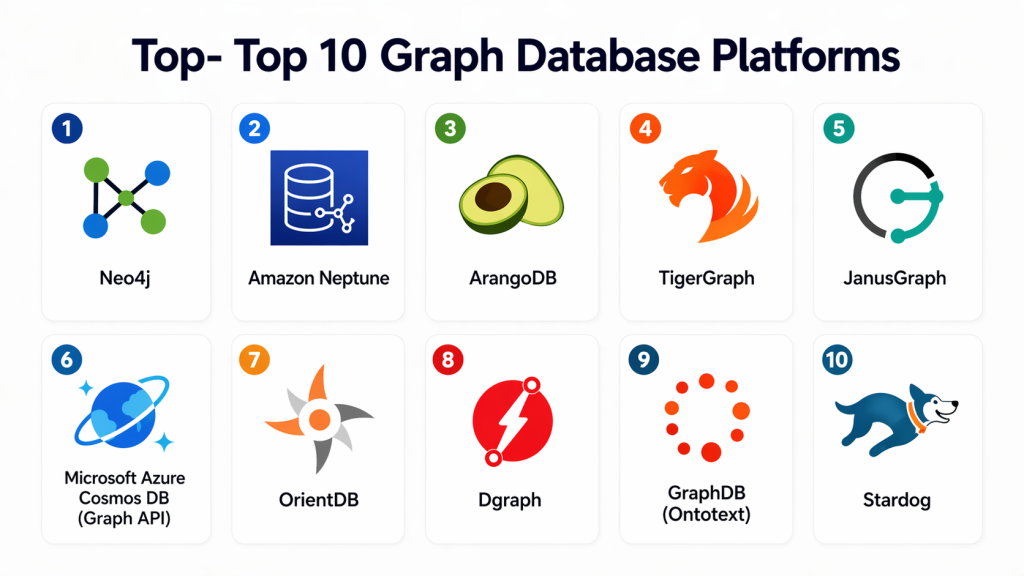
Top 10 Graph Database Platforms
1 — Neo4j
Neo4j is the most widely used graph database platform designed for highly connected data and real-time relationship traversal.
Key Features
- Native graph storage engine
- Cypher query language
- Fast relationship traversal
- Graph analytics capabilities
- ACID compliance support
- Visualization tools
- Clustering and scaling support
Pros
- Extremely mature ecosystem
- Powerful and intuitive query language
- Excellent visualization support
Cons
- Resource-heavy at scale
- Licensing complexity for enterprise features
Platforms / Deployment
- Cloud / Self-hosted / Hybrid
Security & Compliance
- Role-based access control
- Encryption in transit and at rest
- Enterprise compliance features available
Integrations & Ecosystem
- AI and ML pipelines
- Data analytics tools
- Business intelligence platforms
- Knowledge graph systems
Support & Community
Strong enterprise support with large global developer community.
2 — Amazon Neptune
Amazon Neptune is a fully managed graph database service optimized for cloud-native applications.
Key Features
- Fully managed graph database
- Supports Gremlin and SPARQL
- High availability architecture
- Automatic backups
- Multi-region replication
- Low-latency queries
- Scalable graph processing
Pros
- No infrastructure management
- Strong AWS integration
- Highly scalable and reliable
Cons
- Vendor lock-in
- Limited portability outside AWS
Platforms / Deployment
- Cloud (AWS)
Security & Compliance
- IAM-based access control
- Encryption by default
- Strong AWS compliance coverage
Integrations & Ecosystem
- AWS analytics services
- Serverless applications
- Machine learning pipelines
Support & Community
Enterprise-grade AWS support.
3 — ArangoDB
ArangoDB is a multi-model database supporting graph, document, and key-value data models.
Key Features
- Multi-model architecture
- AQL query language
- Native graph processing
- Distributed scaling support
- Full-text search
- Hybrid data modeling
- Flexible schema design
Pros
- Highly flexible data model
- Combines multiple database types
- Strong performance
Cons
- Learning curve for AQL
- Complex configuration in distributed setups
Platforms / Deployment
- Cloud / Self-hosted / Hybrid
Security & Compliance
- Authentication and role-based access
- Encryption support
Integrations & Ecosystem
- Analytics tools
- AI systems
- Microservices architectures
Support & Community
Strong open-source and enterprise support.
4 — TigerGraph
TigerGraph is a high-performance distributed graph database designed for real-time analytics.
Key Features
- Parallel graph processing engine
- Real-time deep link analytics
- Scalable distributed architecture
- Graph algorithms library
- Native SQL-like query language
- Streaming data support
- High-speed traversal engine
Pros
- Extremely fast analytics
- Built for large-scale graphs
- Strong real-time processing
Cons
- Complex setup
- Enterprise focus limits accessibility
Platforms / Deployment
- Cloud / Self-hosted
Security & Compliance
- Role-based access control
- Encryption and enterprise security options
Integrations & Ecosystem
- Data science tools
- Fraud detection systems
- AI pipelines
Support & Community
Strong enterprise support and specialized use-case focus.
5 — JanusGraph
JanusGraph is an open-source distributed graph database designed for scalability and big data integration.
Key Features
- Distributed graph storage
- Integration with backend storage systems
- Gremlin query language
- Horizontal scalability
- Big data compatibility
- Modular architecture
- Real-time graph queries
Pros
- Highly scalable
- Flexible backend storage options
- Open-source ecosystem
Cons
- Requires external storage systems
- Complex setup
Platforms / Deployment
- Self-hosted / Hybrid
Security & Compliance
- Depends on backend configuration
- Enterprise setups required
Integrations & Ecosystem
- Hadoop ecosystem
- Cassandra backend
- Big data pipelines
Support & Community
Strong open-source community.
6 — Azure Cosmos DB (Graph API)
Cosmos DB provides graph database capabilities through Gremlin API support.
Key Features
- Global distribution
- Multi-model support
- Gremlin-based graph queries
- Low-latency access
- Auto scaling
- Multiple consistency models
- Change feed support
Pros
- Global scalability
- Strong Azure integration
- Fully managed service
Cons
- Complex pricing
- Platform dependency
Platforms / Deployment
- Cloud (Azure)
Security & Compliance
- Enterprise-grade security
- Full compliance coverage
Integrations & Ecosystem
- Azure AI services
- Analytics tools
- Enterprise applications
Support & Community
Enterprise Microsoft support.
7 — OrientDB
OrientDB is a multi-model database combining graph and document database capabilities.
Key Features
- Multi-model support
- Graph and document storage
- SQL-like query language
- Distributed architecture
- ACID transactions
- Indexing support
- Flexible schema design
Pros
- Flexible data modeling
- Combines graph + document
- Lightweight architecture
Cons
- Smaller ecosystem
- Limited enterprise adoption
Platforms / Deployment
- Cloud / Self-hosted
Security & Compliance
- Basic authentication
- Encryption support
Integrations & Ecosystem
- Web applications
- Analytics systems
- Custom applications
Support & Community
Moderate open-source community.
8 — Dgraph
Dgraph is a distributed graph database designed for high performance and scalability.
Key Features
- Native distributed graph architecture
- GraphQL-based query language
- High-performance indexing
- Horizontal scaling
- Real-time queries
- Built-in caching
- Cloud-native design
Pros
- Fast and scalable
- Modern query language
- Developer-friendly
Cons
- Smaller ecosystem
- Limited enterprise maturity
Platforms / Deployment
- Cloud / Self-hosted
Security & Compliance
- Authentication and access control
- Encryption support
Integrations & Ecosystem
- GraphQL APIs
- Modern web applications
- Microservices
Support & Community
Growing open-source community.
9 — GraphDB (Ontotext)
GraphDB is a semantic graph database focused on knowledge graphs and RDF data.
Key Features
- RDF-based graph storage
- SPARQL query support
- Semantic reasoning
- Knowledge graph capabilities
- Ontology support
- High-performance indexing
- Data linking capabilities
Pros
- Strong semantic search support
- Ideal for knowledge graphs
- Advanced reasoning engine
Cons
- Niche use case
- Complex learning curve
Platforms / Deployment
- Cloud / Self-hosted
Security & Compliance
- Enterprise security features
- Role-based access control
Integrations & Ecosystem
- AI knowledge systems
- Semantic web applications
- Data integration platforms
Support & Community
Strong enterprise and research adoption.
10 — Stardog
Stardog is a knowledge graph platform designed for enterprise data integration and reasoning.
Key Features
- Knowledge graph engine
- Data virtualization
- Semantic reasoning
- Graph + relational integration
- Query federation
- AI-ready data layer
- Enterprise modeling tools
Pros
- Strong enterprise knowledge graph support
- Advanced reasoning capabilities
- Unified data integration
Cons
- High complexity
- Enterprise-focused pricing
Platforms / Deployment
- Cloud / Self-hosted / Hybrid
Security & Compliance
- Enterprise-grade security
- Role-based controls
- Encryption support
Integrations & Ecosystem
- Data lakes
- AI systems
- Enterprise analytics
Support & Community
Strong enterprise-level support.
Comparison Table (Top 10)
| Tool | Best For | Platform | Deployment | Standout Feature | Public Rating |
|---|---|---|---|---|---|
| Neo4j | General graph apps | Cross-platform | Cloud/Self | Cypher language | N/A |
| Amazon Neptune | AWS apps | AWS | Cloud | Managed graph DB | N/A |
| ArangoDB | Multi-model systems | Cross-platform | Hybrid | Multi-model DB | N/A |
| TigerGraph | Real-time analytics | Cross-platform | Hybrid | Deep link analytics | N/A |
| JanusGraph | Big data graphs | Cross-platform | Hybrid | Distributed graph | N/A |
| Cosmos DB | Global apps | Azure | Cloud | Multi-model support | N/A |
| OrientDB | Flexible apps | Cross-platform | Hybrid | Graph + document | N/A |
| Dgraph | Modern apps | Cross-platform | Cloud/Self | GraphQL-based | N/A |
| GraphDB | Knowledge graphs | Cross-platform | Hybrid | Semantic reasoning | N/A |
| Stardog | Enterprise knowledge | Cross-platform | Hybrid | Data virtualization | N/A |
Evaluation & Scoring
| Tool | Core (25%) | Ease (15%) | Integrations (15%) | Security (10%) | Performance (10%) | Support (10%) | Value (15%) | Total |
|---|---|---|---|---|---|---|---|---|
| Neo4j | 9 | 8 | 9 | 8 | 9 | 9 | 8 | 8.7 |
| Amazon Neptune | 8 | 9 | 9 | 9 | 9 | 9 | 7 | 8.6 |
| ArangoDB | 9 | 7 | 8 | 8 | 8 | 8 | 9 | 8.3 |
| TigerGraph | 9 | 7 | 8 | 8 | 10 | 8 | 7 | 8.4 |
| JanusGraph | 8 | 6 | 8 | 7 | 9 | 7 | 9 | 7.7 |
| Cosmos DB | 9 | 8 | 9 | 9 | 9 | 9 | 7 | 8.7 |
| OrientDB | 7 | 7 | 7 | 7 | 7 | 7 | 8 | 7.2 |
| Dgraph | 8 | 8 | 8 | 8 | 9 | 8 | 8 | 8.3 |
| GraphDB | 8 | 6 | 8 | 8 | 8 | 8 | 7 | 7.6 |
| Stardog | 9 | 6 | 8 | 9 | 8 | 9 | 7 | 8.0 |
Which Graph Database Platform Should You Choose?
Solo / Developer
Neo4j, Dgraph, OrientDB
SMB
Neo4j, ArangoDB, Dgraph
Mid-Market
TigerGraph, JanusGraph, ArangoDB
Enterprise
Neo4j, Cosmos DB, Stardog, Amazon Neptune
Budget vs Premium
- Budget-friendly: Neo4j Community, JanusGraph
- Premium: Stardog, Cosmos DB, TigerGraph
Ease vs Power
- Easy: Neo4j, Neptune
- Advanced: TigerGraph, JanusGraph, Stardog
Frequently Asked Questions
1. What is a graph database?
It is a database that stores data in nodes and relationships instead of tables.
2. Why use a graph database?
It helps analyze complex relationships efficiently.
3. What is Neo4j used for?
It is used for fraud detection, recommendations, and knowledge graphs.
4. Are graph databases fast?
Yes, especially for relationship-heavy queries.
5. What is Cypher?
It is a query language used by Neo4j for graph queries.
6. Is graph database better than relational?
It depends on use case; graph databases excel in relationship-heavy data.
7. Can graph databases scale?
Yes, many support distributed scaling.
8. What industries use graph databases?
Finance, healthcare, social media, and cybersecurity.
9. Are graph databases secure?
Yes, enterprise-grade systems include encryption and access controls.
10. What is a knowledge graph?
It is a structured graph representing relationships between entities and concepts.
Conclusion
Graph Database Platforms are essential for modern applications that depend heavily on relationships and connected data. From fraud detection systems to recommendation engines and AI knowledge graphs, they enable deep insights that traditional databases cannot efficiently provide. Each platform offers unique strengths depending on scalability, performance, and use case requirements. Choosing the right tool depends on your architecture complexity, data relationships, and enterprise needs. A pilot-based evaluation is the best way to finalize the right platform for production environments.