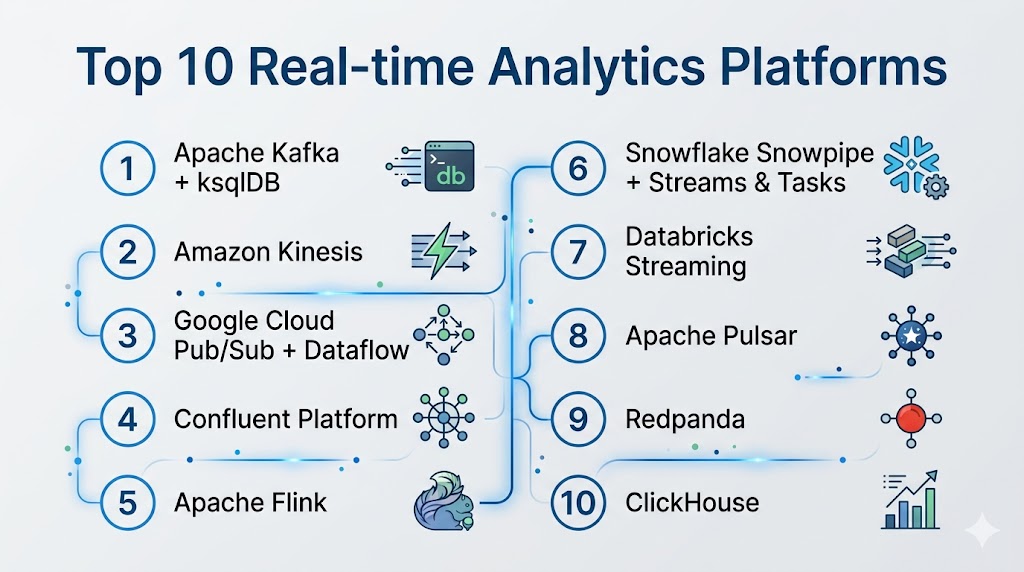
Introduction
Real‑time analytics platforms are tools that allow organizations to collect, process, analyze, and visualize data instantly as it is generated. Unlike traditional batch analytics, real‑time analytics delivers insights with minimal latency, enabling businesses to react quickly to changing conditions, identify anomalies, and make decisions based on up‑to‑the‑moment information.
In today’s increasingly data‑driven world, latency matters. From fraud detection to operational monitoring and customer experience optimization, real‑time analytics is a strategic capability across industries.
Real‑world use cases include:
- Detecting and blocking fraudulent transactions instantly.
- Monitoring application performance and system health in real time.
- Personalizing customer interactions based on live behavior.
- Tracking IoT device data to prevent equipment failure.
- Analyzing streaming marketing campaign performance live.
Key evaluation criteria for buyers:
- Latency and throughput capabilities
- Scalability and fault tolerance
- Real‑time ingestion and processing support
- Built‑in dashboards and streaming analytics
- Integration with source systems and data warehouses
- Alerting and anomaly detection
- Ease of use and developer tooling
- Cost and total infrastructure footprint
- Security, governance, and compliance
Best for:
Real‑time analytics platforms are ideal for data engineers, analytics leaders, operations teams, CIOs/CTOs, and product managers in organizations that need immediate insights from streaming or high‑velocity data.
Not ideal for:
Small organizations with low data volume or minimal time sensitivity may not need true real‑time platforms; traditional BI or batch analytics might suffice.
Key Trends in Real‑time Analytics Platforms
- Unified streaming and batch analytics: Platforms combining real‑time streams with historical data analytics.
- AI‑assisted anomaly detection: Automated detection of unusual patterns in streaming data.
- Cloud‑native, scalable architectures: Serverless and container‑based platforms for elastic scaling.
- Edge analytics: Processing data close to source for ultra‑fast insights (e.g., IoT).
- Event‑driven computing models: Platforms designed around event streams instead of batch jobs.
- Low‑code real‑time pipelines: Tools lowering the barrier for real‑time development.
- Integration with modern modern data stack: Connectors to warehouses, lakes, and BI tools.
- Real‑time alerting and notification streams: Alerts via messaging, SMS, dashboards.
- Fine‑grained security and governance: Encryption, role‑based access, audit logs.
- Cost‑efficient scaling: Pay‑as‑you‑go and usage‑based pricing for fluctuating workloads.
How We Selected These Tools (Methodology)
- Assessed real‑time ingestion and streaming support (Kafka, Kinesis, Pub/Sub).
- Evaluated latency thresholds and throughput capabilities.
- Reviewed analytics features, including dashboards, anomaly detection, and alerting.
- Checked integration ecosystem with data pipelines, warehouses, and BI tools.
- Analyzed scalability and resilience under peak loads.
- Factored developer experience and ease of deployment.
- Considered security and governance features (RBAC, encryption).
- Reviewed performance and reliability in production usage.
- Evaluated support and documentation quality.
- Ensured broad applicability from SMB to enterprise contexts.
Top 10 Real‑time Analytics Platforms
#1 — Apache Kafka + ksqlDB
Short description: Apache Kafka combined with ksqlDB provides a powerful open‑source streaming data platform with SQL‑based real‑time analytics.
Key Features
- Distributed pub/sub messaging with log retention
- Real‑time stream processing with ksqlDB
- High throughput and low latency
- Durable, fault‑tolerant architecture
- Integration with connectors and sinks
- Scales horizontally
- Event‑driven analytics
Pros
- Extremely scalable and resilient
- Rich open‑source ecosystem
Cons
- Operational complexity for deployments
- Requires engineering expertise
Platforms / Deployment
- Linux / Cloud / On‑prem / Hybrid
Security & Compliance
- SSL/TLS, ACLs, encryption
- Depends on stack configuration
Integrations & Ecosystem
- Connects to databases, warehouses, BI, and legacy systems
- Kafka connectors for ingestion and sinks
Support & Community
- Large open‑source community
- Vendor support available from cloud providers
#2 — Amazon Kinesis
Short description: Amazon Kinesis is a managed streaming data service for ingesting, processing, and analyzing real‑time data at scale.
Key Features
- Real‑time ingestion and processing
- Elastic scaling
- Multiple consumer and analytics options
- Serverless operation
- Integration with cloud analytics
Pros
- Fully managed, low operations overhead
- Tight cloud ecosystem integration
Cons
- Cloud‑centric architecture
- Cost can grow with high throughput
Platforms / Deployment
- Cloud
Security & Compliance
- IAM, encryption, VPC integration
- Compliance depends on cloud controls
Integrations & Ecosystem
- Connects to cloud analytics, storage, BI tools
Support & Community
- Cloud provider support
- Broad user base
#3 — Google Cloud Pub/Sub + Dataflow
Short description: Google Cloud Pub/Sub with Dataflow provides enterprise‑grade real‑time analytics and stream processing.
Key Features
- Globally distributed messaging
- Unified stream and batch processing
- Windowing and event‑time analytics
- Serverless scalability
- Integration with cloud analytics
Pros
- Unified model for batch and streaming
- Simplifies real‑time pipelines
Cons
- Cloud‑only environment
- May require learning proprietary paradigms
Platforms / Deployment
- Cloud
Security & Compliance
- IAM, encryption
- Compliance enabled via cloud controls
Integrations & Ecosystem
- Cloud analytics and BI platforms
Support & Community
- Provider support
- Growing community
#4 — Confluent Platform
Short description: Confluent extends Apache Kafka with enterprise features for real‑time analytics, governance, and connectors.
Key Features
- Enterprise connectors and schema registry
- ksqlDB streaming analytics
- Monitoring and management tools
- Cloud and hybrid support
- Event mesh and multi‑region replication
Pros
- Enterprise grade Kafka distribution
- Rich tooling for observability
Cons
- Higher cost for enterprise bundles
- Operational overhead remains
Platforms / Deployment
- Cloud / On‑prem / Hybrid
Security & Compliance
- RBAC, encryption, audit logs
- SOC 2 and compliance support
Integrations & Ecosystem
- Connectors to every major data source
Support & Community
- Professional support
- Active enterprise community
#5 — Apache Flink
Short description: Apache Flink is an open‑source stream processing engine for real‑time analytics with powerful windowing and stateful processing.
Key Features
- Event‑time processing
- Stateful stream processing
- Low‑latency analytics
- Fault tolerance
- Integration with streaming ecosystems
Pros
- Excellent stream processing capabilities
- Flexible APIs
Cons
- High engineering requirements
- Operational support needed
Platforms / Deployment
- Linux / Cloud / On‑prem / Hybrid
Security & Compliance
- Depends on environment
- Integrates with security stack
Integrations & Ecosystem
- Kafka, storage, BI tools
Support & Community
- Large open‑source community
- Vendor support via managed offerings
#6 — Snowflake Snowpipe + Streams & Tasks
Short description: Snowflake’s real‑time ingestion and processing features allow streaming data ingestion and continuous analytics.
Key Features
- Snowpipe for continuous loads
- Streams & Tasks for real‑time processing
- Unified data platform
- Scalable compute
- Query acceleration
Pros
- Combines real‑time with analytical queries
- Easy integration with datasets
Cons
- Cost for compute and credits
- Not pure streaming engine
Platforms / Deployment
- Cloud
Security & Compliance
- SSO, encryption, RBAC
- SOC 2, compliance
Integrations & Ecosystem
- Cloud warehouses, BI tools
Support & Community
- Enterprise support
- Large user base
#7 — Databricks Streaming
Short description: Databricks provides real‑time analytics via structured streaming on top of unified lakehouse architecture.
Key Features
- Stream processing embedded in Unified Lakehouse
- Auto‑scaling compute
- Real‑time dashboards
- Delta Lake integration
- AI/ML model deployment
Pros
- Unified BI + analytics + streaming
- Scalable and flexible
Cons
- Complex to tune for latency
- Higher cost
Platforms / Deployment
- Cloud
Security & Compliance
- SSO, encryption, RBAC
- Compliance features
Integrations & Ecosystem
- Connects to data lakes/warehouses
Support & Community
- Enterprise support tiers
- Active community
#8 — Apache Pulsar
Short description: Apache Pulsar is a cloud‑native messaging and streaming platform with native support for multi‑tenant real‑time analytics.
Key Features
- Distributed messaging
- Multi‑tenant architecture
- Tiered storage integration
- Event streaming with low latency
Pros
- Flexible, multi‑tenant design
- Strong performance
Cons
- Smaller ecosystem than Kafka
- Operationally complex
Platforms / Deployment
- Cloud / On‑prem / Hybrid
Security & Compliance
- Encryption, RBAC via add‑ons
- Compliance depends on environment
Integrations & Ecosystem
- Connectors for databases and BI tools
Support & Community
- Community support
- Managed offerings
#9 — Redpanda
Short description: Redpanda offers a Kafka‑compatible streaming platform optimized for performance and simplicity.
Key Features
- Kafka API compatibility
- High throughput and low latency
- Single binary deployment
- Minimal operational dependencies
Pros
- Simplifies streaming operations
- Fast performance
Cons
- Smaller ecosystem
- Less mature tooling
Platforms / Deployment
- Cloud / On‑prem
Security & Compliance
- Encryption, RBAC via integration
- Compliance varies
Integrations & Ecosystem
- Kafka ecosystem integrations
Support & Community
- Growing community
- Commercial support available
#10 — ClickHouse
Short description: ClickHouse is a columnar analytics database optimized for real‑time analytical queries at high scale.
Key Features
- Real‑time query performance
- Columnar storage
- Distributed scaling
- Real‑time dashboards and analytics
Pros
- Extremely fast analytical queries
- Handles high concurrency
Cons
- Not a full streaming engine
- Requires design expertise
Platforms / Deployment
- Web / Linux / Cloud
Security & Compliance
- Access controls, encryption
- Compliance depends on setup
Integrations & Ecosystem
- BI tools and analytic connectors
Support & Community
- Active community
- Professional support
Comparison Table (Top 10)
| Tool Name | Best For | Platform(s) Supported | Deployment | Standout Feature | Public Rating |
|---|---|---|---|---|---|
| Apache Kafka + ksqlDB | Streaming backbone | Linux | Cloud / On‑prem / Hybrid | SQL streaming | N/A |
| Amazon Kinesis | Cloud streaming | Cloud | Cloud | Managed scaling | N/A |
| GCP Pub/Sub + Dataflow | Unified stream/batch | Cloud | Cloud | Global messaging | N/A |
| Confluent Platform | Enterprise streaming ops | Cloud / On‑prem / Hybrid | Hybrid | Connectors & governance | N/A |
| Apache Flink | Stream processing | Linux | Cloud / On‑prem / Hybrid | Stateful processing | N/A |
| Snowflake Snowpipe + Streams & Tasks | Real‑time + analytics | Cloud | Cloud | Unified streaming + SQL | N/A |
| Databricks Streaming | Lakehouse real‑time | Cloud | Cloud | Unified analytics | N/A |
| Apache Pulsar | Multi‑tenant streaming | Cloud / On‑prem / Hybrid | Hybrid | Tiered storage | N/A |
| Redpanda | Kafka‑compatible streaming | Cloud / On‑prem | Hybrid | Simplicity & speed | N/A |
| ClickHouse | Real‑time queries | Web / Linux | Cloud / On‑prem | High‑speed analytics | N/A |
Evaluation & Scoring of Real‑time Analytics Platforms
| Tool Name | Core (25%) | Ease (15%) | Integrations (15%) | Security (10%) | Performance (10%) | Support (10%) | Value (15%) | Weighted Total (0–10) |
|---|---|---|---|---|---|---|---|---|
| Apache Kafka + ksqlDB | 9 | 6 | 9 | 8 | 9 | 7 | 7 | 8.1 |
| Amazon Kinesis | 8 | 8 | 8 | 8 | 8 | 8 | 7 | 7.9 |
| GCP Pub/Sub + Dataflow | 8 | 7 | 8 | 8 | 8 | 7 | 7 | 7.7 |
| Confluent Platform | 9 | 7 | 9 | 9 | 9 | 8 | 6 | 8.3 |
| Apache Flink | 9 | 6 | 8 | 7 | 9 | 7 | 6 | 7.8 |
| Snowflake Streams & Tasks | 8 | 8 | 8 | 9 | 8 | 8 | 7 | 8.0 |
| Databricks Streaming | 8 | 7 | 8 | 8 | 8 | 7 | 7 | 7.7 |
| Apache Pulsar | 8 | 6 | 8 | 7 | 8 | 7 | 6 | 7.4 |
| Redpanda | 7 | 8 | 7 | 7 | 8 | 6 | 7 | 7.2 |
| ClickHouse | 8 | 7 | 7 | 8 | 9 | 7 | 7 | 7.9 |
Which Real‑time Analytics Platform Is Right for You?
Solo / Freelancer
For lightweight real‑time needs, Redpanda or ClickHouse provide fast insights with lower setup complexity.
SMB
Amazon Kinesis or Snowflake Streams & Tasks offer managed scalability with less operational burden.
Mid‑Market
GCP Pub/Sub + Dataflow and Databricks Streaming balance real‑time capabilities with analytics workloads.
Enterprise
Large organizations with complex ecosystems benefit from Confluent Platform, Apache Kafka + ksqlDB, or Apache Flink for high throughput and full ecosystem support.
Budget vs Premium
Budget‑conscious teams might start with Redpanda or ClickHouse, while premium, enterprise use cases suit Confluent or Kafka ecosystems.
Feature Depth vs Ease of Use
Apache Kafka and Flink deliver deep streaming capabilities but require expertise; managed services like Kinesis and Snowflake reduce operational complexity.
Integrations & Scalability
Platforms with rich connectors and cloud integrations ensure seamless scaling as data demands grow.
Security & Compliance Needs
Prioritize RBAC, encryption, and audit capabilities as data velocity and sensitivity increase.
Frequently Asked Questions (FAQs)
What is a real‑time analytics platform?
A real‑time analytics platform ingests and processes data instantly, providing insights with minimal delay, unlike batch analytics which runs at scheduled intervals.
How is real‑time analytics different from streaming?
Streaming focuses on data movement, while real‑time analytics emphasizes analytical processing and insight delivery as it arrives.
Do real‑time tools replace traditional BI?
They complement BI tools by providing immediate insights; traditional BI handles historical analysis.
Are these platforms secure?
Most enterprise platforms offer encryption, role‑based access, and audit controls, but security depends on deployment and configuration.
Is real‑time analytics cost‑effective?
Costs vary; managed services reduce operational overhead but may require careful usage monitoring to control expenses.
How complex are deployments?
Some platforms are turnkey (managed cloud), while others (open‑source) need engineering and infrastructure expertise.
Can small teams use these tools?
Yes, lighter and managed platforms like Redpanda or Kinesis can serve small teams with modest real‑time needs.
What integrations are essential?
Connectors to data warehouses, BI tools, ETL, and event sources help operationalize analytics.
Do these tools support dashboards?
Many include dashboarding or integrate with visualization platforms for real‑time displays.
How do I evaluate latency?
Check throughput, event time processing, windowing, and end‑to‑end pipeline delays.
Conclusion
Real‑time analytics platforms are essential for organizations that need instant insights from streaming data to power operations, customer experiences, and competitive advantage. Choosing the right platform depends on your scale, team expertise, and integration footprint. Smaller teams can leverage simpler platforms like Redpanda or ClickHouse, while managed services such as Amazon Kinesis or Snowflake Streams & Tasks reduce operational overhead. Mid‑market organizations may find balanced power and ease with Google Cloud Pub/Sub + Dataflow or Databricks Streaming, whereas large enterprises benefit from full‑featured ecosystems like Confluent Platform, Apache Kafka + ksqlDB, or Apache Flink for high throughput and complex analytics. Evaluate latency, scalability, security, and total cost when selecting a solution, and consider running pilots with critical data sources to validate architectures. With real‑time insights, organizations achieve faster decisions, improved operational awareness, and stronger customer engagement, positioning them for success in dynamic markets.