Introduction
Feature Store Platforms are specialized systems designed to manage, store, and serve machine learning features for both training and inference. They act as a centralized layer between raw data pipelines and machine learning models, ensuring consistency, reuse, and governance of features across teams and workflows.
In modern ML systems, feature engineering is one of the most time-consuming and error-prone steps. Feature stores solve this by providing standardized pipelines, versioning, and real-time serving capabilities, enabling teams to accelerate model development while maintaining data integrity.
Real-world use cases include:
- Real-time fraud detection using consistent features across models
- Recommendation systems with low-latency feature serving
- Customer analytics and personalization pipelines
- Predictive maintenance using IoT feature streams
- Credit scoring and risk modeling with governed feature pipelines
Key evaluation criteria for buyers:
- Feature ingestion and transformation capabilities
- Online and offline feature serving
- Feature versioning and lineage tracking
- Integration with ML pipelines and frameworks
- Real-time vs batch feature support
- Scalability and latency performance
- Security, governance, and compliance
- Ease of use and developer experience
- Deployment flexibility (cloud/on-prem/hybrid)
- Cost and operational complexity
Best for:
Feature stores are ideal for ML engineers, data engineers, and data science teams building scalable and production-ready ML pipelines.
Not ideal for:
Organizations with small datasets or minimal ML maturity may not need a dedicated feature store and can rely on simple data pipelines.
Key Trends in Feature Store Platforms
- Real-time feature serving for low-latency inference systems
- Unified online + offline feature stores for consistency
- Integration with MLOps and model monitoring tools
- Feature lineage and governance tracking
- Cloud-native feature stores with managed infrastructure
- Support for streaming data pipelines
- Feature reuse across teams and models
- Integration with data lakes and warehouses
- Low-latency APIs for real-time applications
- Security and compliance for enterprise ML systems
How We Selected These Tools (Methodology)
- Evaluated online and offline feature serving capabilities
- Assessed integration with ML frameworks and pipelines
- Reviewed feature versioning, lineage, and governance features
- Checked real-time and batch processing support
- Considered scalability and performance for production workloads
- Examined security, compliance, and access control features
- Evaluated ease of use and developer experience
- Reviewed community support and enterprise backing
- Considered open-source vs managed platforms
- Ensured applicability across SMB, mid-market, and enterprise use cases
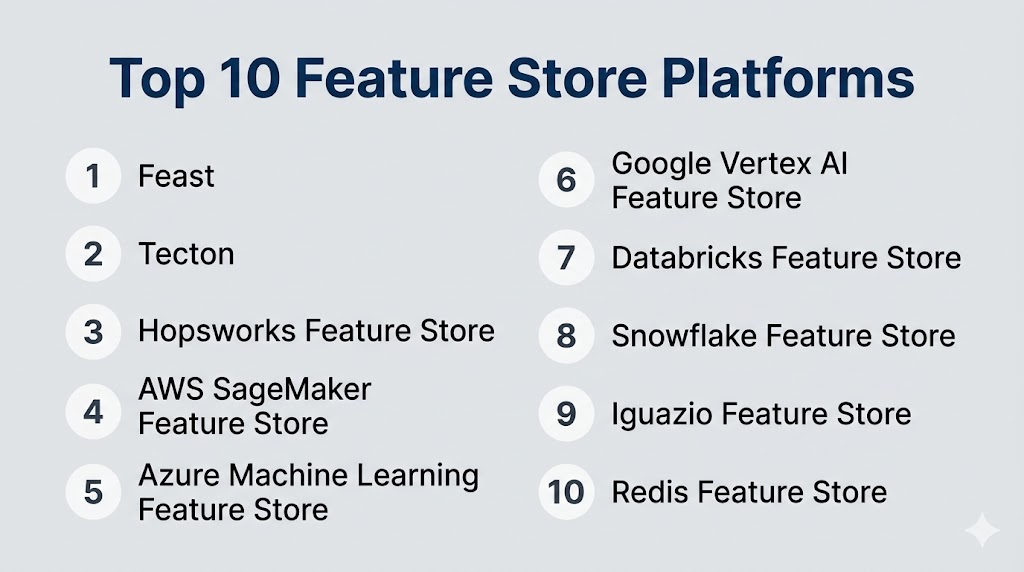
Top 10 Feature Store Platforms
#1 — Feast
Short description (3-4 lines): Feast is an open-source feature store designed to manage and serve ML features for both batch and real-time use cases. It is widely adopted for its flexibility and integration with modern ML stacks.
Key Features
- Online and offline feature serving
- Feature versioning and lineage
- Integration with cloud and data warehouses
- Python SDK for feature management
- Real-time and batch pipelines
- Open-source extensibility
Pros
- Flexible and open-source
- Strong community support
Cons
- Requires setup and maintenance
- Limited enterprise automation
Platforms / Deployment
- Linux / Cloud / On-prem / Hybrid
Security & Compliance
- Depends on deployment
- Supports RBAC via integrations
Integrations & Ecosystem
- Spark, Kafka, cloud storage, ML frameworks
Support & Community
- Active open-source community
#2 — Tecton
Short description: Tecton is an enterprise feature platform designed for real-time ML with strong governance and automation capabilities.
Key Features
- Real-time feature pipelines
- Feature versioning and monitoring
- Automated feature engineering
- Integration with ML pipelines
- Low-latency serving APIs
Pros
- Enterprise-ready
- Strong real-time capabilities
Cons
- High cost
- Vendor dependency
Platforms / Deployment
- Cloud
Security & Compliance
- Encryption, RBAC
- Enterprise compliance support
Integrations & Ecosystem
- Spark, Kafka, data warehouses
Support & Community
- Enterprise support
#3 — Hopsworks Feature Store
Short description: Hopsworks provides a feature store integrated with a data platform, supporting large-scale ML workloads.
Key Features
- Online and offline feature store
- Feature lineage tracking
- Real-time data ingestion
- Integration with Hadoop and Spark
- Model training pipelines
Pros
- Scalable for big data
- Strong data governance
Cons
- Complex setup
- Requires infrastructure knowledge
Platforms / Deployment
- Cloud / On-prem / Hybrid
Security & Compliance
- RBAC, encryption
Integrations & Ecosystem
- Spark, Kafka, ML frameworks
Support & Community
- Enterprise + community support
#4 — AWS SageMaker Feature Store
Short description: SageMaker Feature Store is a managed feature store service for building, storing, and serving ML features on AWS.
Key Features
- Managed online and offline store
- Feature versioning
- Integration with SageMaker pipelines
- Low-latency feature retrieval
- Data lineage tracking
Pros
- Fully managed
- Scalable cloud infrastructure
Cons
- AWS-only
- Cost scaling
Platforms / Deployment
- Cloud
Security & Compliance
- IAM, encryption
- Enterprise compliance
Integrations & Ecosystem
- AWS services, ML pipelines
Support & Community
- AWS support
#5 — Azure Machine Learning Feature Store
Short description: Azure ML Feature Store provides centralized feature management within the Azure ecosystem.
Key Features
- Feature sharing and reuse
- Integration with Azure ML pipelines
- Online and offline storage
- Data lineage tracking
- Real-time feature serving
Pros
- Integrated with Azure ecosystem
- Scalable
Cons
- Azure-only
- Learning curve
Platforms / Deployment
- Cloud
Security & Compliance
- RBAC, encryption
Integrations & Ecosystem
- Azure Data Lake, pipelines
Support & Community
- Microsoft support
#6 — Google Vertex AI Feature Store
Short description: Vertex AI Feature Store provides scalable feature storage and serving with real-time access.
Key Features
- Low-latency feature serving
- Integration with Vertex AI pipelines
- Feature monitoring and versioning
- Real-time and batch support
- Data governance tools
Pros
- Fully managed
- High scalability
Cons
- Cloud-only
- Vendor lock-in
Platforms / Deployment
- Cloud
Security & Compliance
- IAM, encryption
Integrations & Ecosystem
- BigQuery, pipelines
Support & Community
- Google Cloud support
#7 — Databricks Feature Store
Short description: Databricks Feature Store integrates with the Lakehouse platform for unified data and ML workflows.
Key Features
- Feature management within Lakehouse
- Integration with Delta Lake
- Model training pipelines
- Feature versioning
- Real-time serving
Pros
- Unified data + ML platform
- Strong analytics integration
Cons
- Cloud-first
- Cost considerations
Platforms / Deployment
- Cloud
Security & Compliance
- RBAC, encryption
Integrations & Ecosystem
- Spark, Delta Lake
Support & Community
- Enterprise support
#8 — Snowflake Feature Store
Short description: Snowflake Feature Store enables feature management directly within the Snowflake data cloud.
Key Features
- Native integration with Snowflake
- Feature pipelines and transformations
- Batch and real-time support
- Data governance and lineage
- SQL-based workflows
Pros
- Strong data warehouse integration
- Easy SQL-based usage
Cons
- Snowflake dependency
- Limited ML-specific tooling
Platforms / Deployment
- Cloud
Security & Compliance
- Encryption, RBAC
Integrations & Ecosystem
- Snowflake ecosystem
Support & Community
- Enterprise support
#9 — Iguazio Feature Store
Short description: Iguazio provides a real-time feature store for AI applications with strong performance and scalability.
Key Features
- Real-time feature serving
- Integration with ML pipelines
- Data ingestion and transformation
- Feature versioning
- High-performance storage
Pros
- Real-time optimized
- High scalability
Cons
- Complex setup
- Enterprise-focused
Platforms / Deployment
- Cloud / On-prem / Hybrid
Security & Compliance
- RBAC, encryption
Integrations & Ecosystem
- ML pipelines, data tools
Support & Community
- Enterprise support
#10 — Redis Feature Store
Short description: Redis is used as a high-performance feature store for low-latency real-time ML applications.
Key Features
- Ultra-low latency feature serving
- In-memory storage
- Real-time data updates
- Integration with ML pipelines
- High availability
Pros
- Extremely fast
- Ideal for real-time ML
Cons
- Limited offline capabilities
- Requires additional tooling
Platforms / Deployment
- Cloud / On-prem
Security & Compliance
- Encryption, RBAC
Integrations & Ecosystem
- ML frameworks, APIs
Support & Community
- Strong community
Comparison Table
| Tool | Best For | Platform | Deployment | Standout Feature | Rating |
|---|---|---|---|---|---|
| Feast | Open-source ML | Multi | Hybrid | Flexibility | N/A |
| Tecton | Enterprise ML | Cloud | Cloud | Real-time pipelines | N/A |
| Hopsworks | Big data ML | Multi | Hybrid | Data governance | N/A |
| SageMaker FS | AWS ML | Cloud | Cloud | Managed store | N/A |
| Azure FS | Azure ML | Cloud | Cloud | Integration | N/A |
| Vertex FS | GCP ML | Cloud | Cloud | Scalability | N/A |
| Databricks FS | Lakehouse ML | Cloud | Cloud | Unified platform | N/A |
| Snowflake FS | Data warehouse ML | Cloud | Cloud | SQL workflows | N/A |
| Iguazio | Real-time ML | Multi | Hybrid | Performance | N/A |
| Redis FS | Low-latency ML | Multi | Hybrid | Speed | N/A |
Evaluation & Scoring
| Tool | Core | Ease | Integration | Security | Performance | Support | Value | Total |
|---|---|---|---|---|---|---|---|---|
| Feast | 8 | 7 | 8 | 7 | 8 | 7 | 8 | 7.7 |
| Tecton | 9 | 8 | 8 | 8 | 9 | 8 | 7 | 8.3 |
| Hopsworks | 8 | 6 | 8 | 8 | 8 | 7 | 7 | 7.5 |
| SageMaker | 8 | 8 | 8 | 8 | 8 | 7 | 7 | 7.8 |
| Azure FS | 8 | 8 | 8 | 8 | 8 | 7 | 7 | 7.8 |
| Vertex FS | 8 | 8 | 8 | 8 | 8 | 7 | 7 | 7.8 |
| Databricks | 9 | 8 | 8 | 8 | 9 | 8 | 7 | 8.3 |
| Snowflake | 7 | 8 | 8 | 8 | 7 | 7 | 7 | 7.4 |
| Iguazio | 8 | 7 | 7 | 8 | 9 | 7 | 7 | 7.8 |
| Redis | 7 | 8 | 7 | 7 | 9 | 7 | 7 | 7.5 |
Which Feature Store Platform Is Right for You?
Solo / Freelancer
Feast is the best choice for flexibility and open-source usage.
SMB
SageMaker, Vertex AI, or Azure Feature Store simplifies deployment.
Mid-Market
Databricks or Hopsworks offers scalability and integration.
Enterprise
Tecton, Iguazio, or Snowflake provides governance and performance.
Frequently Asked Questions (FAQs)
What is a feature store?
A centralized system for storing and managing ML features for training and inference.
Why is it important?
It ensures consistency between training and production data.
Can feature stores work in real-time?
Yes, modern platforms support real-time feature serving.
Are they cloud-only?
Many are cloud-native, but some support hybrid deployments.
Do they integrate with ML pipelines?
Yes, they integrate with MLOps and ML frameworks.
Are they scalable?
Yes, most platforms scale for large datasets and real-time workloads.
Can they track feature lineage?
Yes, advanced feature stores include lineage tracking.
Are they secure?
Enterprise feature stores provide RBAC, encryption, and compliance.
Do small teams need them?
Not always; simple pipelines may suffice initially.
How to choose one?
Based on scale, real-time needs, cloud preference, and budget.
Conclusion
Feature store platforms play a crucial role in modern machine learning systems by enabling consistent, scalable, and reusable feature engineering across teams. Open-source tools like Feast provide flexibility for smaller teams, while managed platforms such as SageMaker, Vertex AI, and Azure Feature Store simplify deployment and scaling. Mid-market organizations benefit from platforms like Databricks and Hopsworks, which combine feature management with analytics and data processing capabilities. Enterprises with large-scale, real-time requirements can leverage Tecton, Iguazio, or Snowflake Feature Store for governance, performance, and advanced data management. Selecting the right feature store requires evaluating real-time capabilities, integration with ML pipelines, scalability, and security. A practical approach is to shortlist a few platforms, run pilot implementations, and validate performance with real workloads before full adoption.