Introduction
Identity Verification (IDV) Tools are digital solutions that confirm whether a person is who they claim to be using document verification, biometric authentication, and data validation techniques. These platforms play a critical role in preventing fraud, ensuring compliance, and enabling secure digital onboarding across industries.
Modern IDV tools use technologies like facial recognition, liveness detection, document scanning, and AI-based fraud detection to verify identities in real time. As online services expand, identity verification has become essential not just for compliance, but also for building trust and reducing risk.
Common Use Cases
- Customer onboarding and KYC verification
- Account creation and login authentication
- Fraud prevention and identity theft protection
- Age verification and access control
- Digital banking and fintech compliance
What Buyers Should Evaluate
- Accuracy of document and biometric verification
- Global coverage of identity databases
- Speed of real-time verification
- Integration flexibility (APIs, SDKs)
- Fraud detection capabilities
- Compliance support (KYC/AML)
- User experience and onboarding friction
- Scalability for large user bases
Best for: Fintech companies, banks, marketplaces, SaaS platforms, crypto exchanges, and any business onboarding users digitally.
Not ideal for: Small offline businesses or systems with minimal identity risk where manual verification is sufficient.
Key Trends in Identity Verification Tools
- AI-driven document and biometric verification
- Widespread adoption of facial recognition and liveness detection
- Real-time identity verification with instant approvals
- Integration with fraud detection and AML platforms
- API-first and cloud-native deployment models
- No-code verification workflow builders
- Continuous identity verification (not just onboarding)
- Increased focus on privacy-preserving verification methods
- Cross-platform identity verification (web, mobile, API)
- Rise of reusable digital identity ecosystems
How We Selected These Tools (Methodology)
- Strong adoption across fintech and digital platforms
- Proven identity verification accuracy and reliability
- Depth of features (biometrics, document verification, fraud detection)
- Integration capabilities and API ecosystem
- Performance and scalability for high-volume onboarding
- Security readiness and compliance alignment
- Flexibility for SMB, mid-market, and enterprise use
- Product maturity and innovation
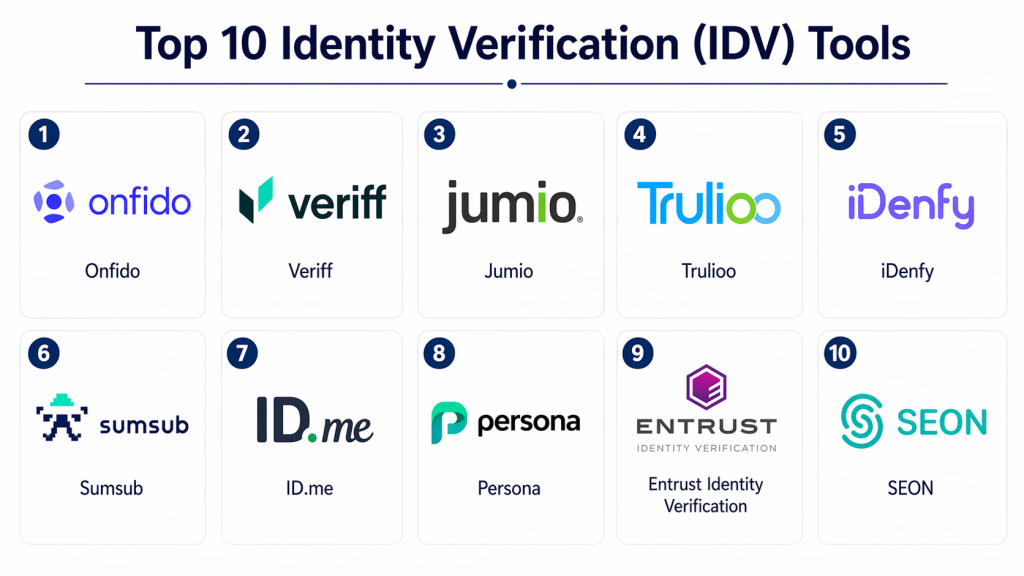
Top 10 Identity Verification (IDV) Tools
#1 — Onfido
Short description: AI-powered identity verification platform focused on document and biometric verification for digital onboarding.
Key Features
- Document verification
- Facial recognition
- Liveness detection
- Identity authentication
- Fraud detection
- Workflow automation
Pros
- Strong biometric capabilities
- Easy API integration
Cons
- Limited advanced AML features
- Pricing varies
Platforms / Deployment
Cloud
Security & Compliance
Not publicly stated
Integrations & Ecosystem
API-first platform with mobile and web SDKs.
- Mobile apps
- Web onboarding systems
- Fraud detection tools
Support & Community
Strong documentation and enterprise support.
#2 — Veriff
Short description: Identity verification platform offering global document verification and fraud prevention.
Key Features
- Document verification
- Biometric authentication
- Liveness detection
- Risk scoring
- Fraud prevention
Pros
- High accuracy
- Global coverage
Cons
- Premium pricing
- Requires integration effort
Platforms / Deployment
Cloud
Security & Compliance
Not publicly stated
Integrations & Ecosystem
- APIs
- Payment systems
- Onboarding platforms
Support & Community
Enterprise-level support.
#3 — Jumio
Short description: End-to-end identity verification solution combining AI, biometrics, and fraud detection.
Key Features
- ID verification
- Biometric authentication
- AML screening
- Risk scoring
- Fraud detection
Pros
- Strong AI capabilities
- Good user experience
Cons
- Higher cost
- Implementation effort
Platforms / Deployment
Cloud
Security & Compliance
Not publicly stated
Integrations & Ecosystem
- APIs
- Mobile SDKs
- Payment platforms
Support & Community
Comprehensive support services.
#4 — Trulioo
Short description: Global identity verification platform supporting KYC compliance across multiple regions.
Key Features
- Global identity verification
- Business verification
- AML screening
- API-based integration
- Data coverage across countries
Pros
- Wide global coverage
- Flexible APIs
Cons
- Complex pricing
- Requires setup
Platforms / Deployment
Cloud
Security & Compliance
Not publicly stated
Integrations & Ecosystem
- CRM systems
- Financial platforms
- APIs
Support & Community
Enterprise onboarding and support.
#5 — ID.me
Short description: Identity verification platform offering secure authentication and reusable identity credentials.
Key Features
- Multi-factor authentication
- Identity proofing
- Reusable digital identity
- Secure login systems
- Risk-based authentication
Pros
- Strong authentication model
- High user trust
Cons
- Limited customization
- Regional focus
Platforms / Deployment
Cloud
Security & Compliance
MFA, encryption (other details not publicly stated)
Integrations & Ecosystem
- Government systems
- Enterprise apps
- APIs
Support & Community
Strong ecosystem and documentation.
#6 — iDenfy
Short description: Cost-effective identity verification platform with AI-based document and biometric verification.
Key Features
- Document verification
- Facial recognition
- Liveness detection
- AML screening
- API integration
Pros
- Affordable for SMBs
- Easy deployment
Cons
- Limited enterprise depth
- Feature customization required
Platforms / Deployment
Cloud
Security & Compliance
Not publicly stated
Integrations & Ecosystem
- APIs
- Payment platforms
- CRM tools
Support & Community
Strong support and onboarding.
#7 — SEON
Short description: Fraud and identity verification platform focused on digital businesses and risk scoring.
Key Features
- Identity verification
- Data enrichment
- Device fingerprinting
- Fraud detection
- Real-time scoring
Pros
- Flexible rule engine
- Easy to use
Cons
- Limited enterprise features
- Requires tuning
Platforms / Deployment
Cloud
Security & Compliance
Not publicly stated
Integrations & Ecosystem
- APIs
- Payment platforms
- CRM systems
Support & Community
SMB-friendly support.
#8 — Entrust Identity Verification
Short description: Enterprise-grade identity verification solution supporting global onboarding and compliance.
Key Features
- AI-driven verification
- Document authentication
- Biometric verification
- Workflow orchestration
- Global coverage
Pros
- Enterprise-ready
- Scalable globally
Cons
- Complex setup
- Higher cost
Platforms / Deployment
Cloud
Security & Compliance
Not publicly stated
Integrations & Ecosystem
- Banking systems
- APIs
- Enterprise platforms
Support & Community
Enterprise-level support.
#9 — Microblink
Short description: Document verification platform specializing in OCR and ID scanning technologies.
Key Features
- OCR document scanning
- Identity data extraction
- Real-time verification
- Mobile SDK integration
- Fraud detection
Pros
- Strong document scanning
- Fast processing
Cons
- Limited AML features
- Requires integration
Platforms / Deployment
Cloud / SDK
Security & Compliance
Not publicly stated
Integrations & Ecosystem
- Mobile apps
- APIs
- Document systems
Support & Community
Good developer support.
#10 — Incode
Short description: End-to-end identity verification and authentication platform using AI and biometrics.
Key Features
- Facial recognition
- Document verification
- Liveness detection
- Risk scoring
- Fraud prevention
Pros
- Advanced AI models
- High accuracy
Cons
- Enterprise pricing
- Setup complexity
Platforms / Deployment
Cloud
Security & Compliance
Not publicly stated
Integrations & Ecosystem
- APIs
- Financial systems
- Onboarding tools
Support & Community
Enterprise support.
Comparison Table (Top 10)
| Tool Name | Best For | Platform(s) Supported | Deployment | Standout Feature | Public Rating |
|---|---|---|---|---|---|
| Onfido | Digital onboarding | Web/Mobile | Cloud | Biometric verification | N/A |
| Veriff | Global verification | Web | Cloud | High accuracy | N/A |
| Jumio | AI identity verification | Web/Mobile | Cloud | AI-based verification | N/A |
| Trulioo | Global KYC | Web | Cloud | Global data coverage | N/A |
| ID.me | Authentication | Web | Cloud | Reusable identity | N/A |
| iDenfy | SMB onboarding | Web | Cloud | Cost-effective solution | N/A |
| SEON | Fraud + IDV | Web | Cloud | Data enrichment | N/A |
| Entrust | Enterprise | Web | Cloud | Global onboarding | N/A |
| Microblink | Document scanning | Mobile/Web | Cloud | OCR technology | N/A |
| Incode | AI verification | Web | Cloud | Advanced biometrics | N/A |
Evaluation & Scoring of Identity Verification Tools
| Tool Name | Core (25%) | Ease (15%) | Integrations (15%) | Security (10%) | Performance (10%) | Support (10%) | Value (15%) | Weighted Total |
|---|---|---|---|---|---|---|---|---|
| Onfido | 9 | 9 | 8 | 8 | 9 | 8 | 7 | 8.5 |
| Veriff | 9 | 8 | 8 | 8 | 9 | 8 | 7 | 8.4 |
| Jumio | 9 | 8 | 8 | 8 | 8 | 8 | 7 | 8.3 |
| Trulioo | 9 | 7 | 9 | 8 | 8 | 8 | 7 | 8.3 |
| ID.me | 8 | 8 | 7 | 8 | 8 | 8 | 7 | 7.9 |
| iDenfy | 8 | 9 | 7 | 7 | 8 | 7 | 8 | 8.0 |
| SEON | 8 | 9 | 8 | 7 | 8 | 7 | 8 | 8.1 |
| Entrust | 9 | 7 | 8 | 8 | 9 | 8 | 6 | 8.1 |
| Microblink | 8 | 8 | 8 | 7 | 9 | 7 | 7 | 8.0 |
| Incode | 9 | 7 | 8 | 8 | 9 | 8 | 6 | 8.2 |
How to interpret scores:
These scores provide a comparative benchmark across features, usability, and value. Higher scores indicate balanced performance, but the best tool depends on your specific onboarding, compliance, and fraud risk requirements.
Which Identity Verification Tool Is Right for You?
Solo / Freelancer
Use simple tools like iDenfy or SEON for cost-effective verification.
SMB
Onfido, Veriff, and iDenfy provide strong usability and affordability.
Mid-Market
Jumio, Trulioo, and SEON offer scalability and integrations.
Enterprise
Entrust, Incode, and Jumio provide advanced features and global coverage.
Budget vs Premium
- Budget: iDenfy, SEON
- Premium: Jumio, Entrust
Feature Depth vs Ease of Use
- Easy: iDenfy, Onfido
- Advanced: Incode, Entrust
Integrations & Scalability
Choose API-first platforms like Trulioo or Jumio.
Security & Compliance Needs
Enterprise tools offer stronger compliance and audit capabilities.
Frequently Asked Questions (FAQs)
What is an Identity Verification tool?
A system that confirms a user’s identity using documents, biometrics, and data checks.
How do IDV tools work?
They verify IDs, match biometrics, and analyze risk signals to confirm identity.
Are IDV tools required for compliance?
Yes, especially for regulated industries like fintech and banking.
Do these tools support real-time verification?
Most modern tools provide real-time identity verification.
Can small businesses use IDV tools?
Yes, many tools are designed for SMBs with simple integration.
What technologies are used?
Biometrics, document scanning, AI, and database validation.
Are IDV tools secure?
Most offer strong security, but details vary by provider.
Can they reduce fraud?
Yes, they help prevent identity theft and fraud.
What integrations are supported?
APIs, CRMs, payment systems, and onboarding platforms.
Can these tools scale?
Yes, they are built for high-volume verification.
Conclusion
Identity Verification Tools are a foundational component of modern digital security and compliance strategies. They enable businesses to onboard users quickly while reducing fraud and maintaining regulatory alignment. The right solution depends on your business size, industry, and risk exposure, with some tools prioritizing ease of use and others offering advanced enterprise capabilities. Instead of choosing a single “best” option, focus on aligning features, integrations, and scalability with your operational needs. Start by testing a few platforms, validate their accuracy and user experience, and ensure they integrate seamlessly into your workflows before making a final decision.