Introduction
Data science platforms are integrated environments that allow organizations to collect, clean, analyze, and model data for actionable insights. These platforms provide tools for data wrangling, machine learning, statistical analysis, and visualization, streamlining workflows for data scientists, analysts, and engineers.
With the growth of big data, AI, and predictive analytics, data science platforms have become essential for companies seeking to leverage data for decision-making, operational efficiency, and product innovation.
Real-world use cases include:
- Building predictive models for customer churn or sales forecasting.
- Automating data preparation and feature engineering.
- Performing exploratory data analysis and visualization.
- Deploying machine learning models in production.
- Integrating analytics into business applications for insights.
Key evaluation criteria for buyers:
- End-to-end workflow support (data prep, modeling, deployment)
- Machine learning and AI capabilities
- Collaboration features for teams
- Integration with data sources and cloud services
- Scalability and performance
- Security, governance, and compliance
- Ease of use and developer support
- Deployment options (cloud, on-prem, hybrid)
- Cost and licensing flexibility
- Visualization and reporting capabilities
Best for:
Data science platforms are ideal for data scientists, machine learning engineers, analysts, and IT teams in organizations of all sizes looking to build predictive models and data-driven applications.
Not ideal for:
Organizations with minimal analytics requirements or that only need lightweight BI tools may not require a full-featured data science platform.
Key Trends in Data Science Platforms
- End-to-end AI/ML integration for seamless model development and deployment.
- Low-code/no-code capabilities to democratize data science for non-technical users.
- Cloud-native platforms with scalable compute and storage.
- Collaboration and version control for teams of data scientists.
- Automated machine learning (AutoML) for faster experimentation.
- Integration with streaming and batch data pipelines.
- MLOps support for continuous deployment of models.
- Explainable AI features for model transparency.
- Security, governance, and compliance for enterprise adoption.
- Embedded analytics and dashboards for sharing insights.
How We Selected These Tools (Methodology)
- Evaluated end-to-end data science capabilities, from data prep to deployment.
- Reviewed ML, AI, and AutoML features.
- Assessed team collaboration, versioning, and reproducibility.
- Checked integration with databases, cloud storage, and analytics pipelines.
- Considered scalability, performance, and large dataset handling.
- Examined MLOps and production deployment capabilities.
- Reviewed security, governance, and compliance features.
- Assessed ease of use and developer tooling.
- Considered community support, documentation, and vendor support.
- Ensured applicability across SMB, mid-market, and enterprise organizations.
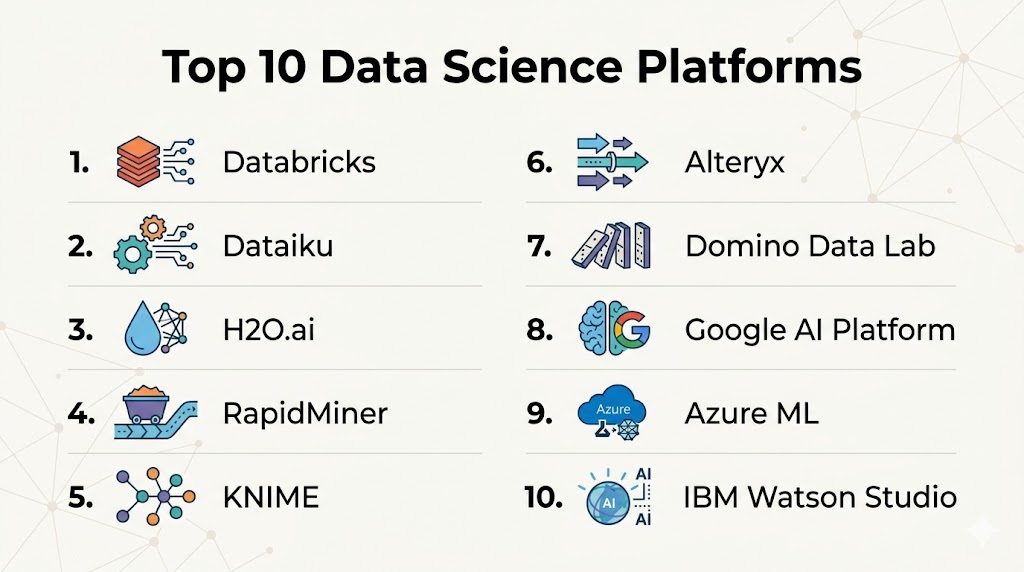
Top 10 Data Science Platforms
#1 — Databricks
Short description: Databricks is a unified data science and AI platform that integrates data engineering, ML, and analytics for large-scale projects.
Key Features
- Collaborative notebooks for Python, R, SQL, Scala
- Integration with Delta Lake and cloud storage
- AutoML and MLflow for model tracking
- Scalable compute clusters
- Stream and batch data processing
- MLOps and model deployment support
- Visualization dashboards
Pros
- Unified environment for data engineering and ML
- Highly scalable for enterprise workloads
Cons
- Cloud-only deployment
- Can be costly for large clusters
Platforms / Deployment
- Cloud
Security & Compliance
- RBAC, encryption, SOC 2, GDPR
Integrations & Ecosystem
- AWS, Azure, GCP, BI tools, ML libraries
Support & Community
- Enterprise support
- Large open-source community
#2 — Dataiku
Short description: Dataiku is an end-to-end data science platform that simplifies analytics, machine learning, and deployment for business and technical teams.
Key Features
- Visual workflows and code integration
- AutoML and model evaluation
- Collaboration for teams
- Cloud and on-prem deployment
- Data connectors for multiple sources
- Reporting and dashboards
Pros
- Easy-to-use interface for both technical and non-technical users
- Comprehensive end-to-end platform
Cons
- Enterprise pricing may be high
- Some advanced features require coding knowledge
Platforms / Deployment
- Cloud / On-prem / Hybrid
Security & Compliance
- SSO, RBAC, encryption
- SOC 2, GDPR
Integrations & Ecosystem
- SQL, Hadoop, Spark, cloud storage, BI tools
Support & Community
- Enterprise support
- Active community
#3 — H2O.ai
Short description: H2O.ai provides an AI and machine learning platform focused on scalable model building and deployment.
Key Features
- AutoML for rapid model development
- Python, R, and Java APIs
- Scalable distributed computing
- Model interpretability tools
- Cloud and on-prem deployment
Pros
- Efficient AutoML pipelines
- Highly scalable
Cons
- Limited visualization and dashboards
- Learning curve for non-technical users
Platforms / Deployment
- Cloud / On-prem / Hybrid
Security & Compliance
- Encryption, RBAC
- SOC 2 (enterprise edition)
Integrations & Ecosystem
- Hadoop, Spark, cloud storage, BI tools
Support & Community
- Professional support
- Open-source community
#4 — RapidMiner
Short description: RapidMiner is a data science platform with visual workflows, predictive analytics, and machine learning capabilities.
Key Features
- Drag-and-drop workflow creation
- AutoML and advanced modeling
- Integration with data sources and cloud platforms
- Collaboration tools
- Reporting and dashboards
Pros
- Beginner-friendly visual interface
- Supports complex ML workflows
Cons
- Limited flexibility compared to code-based platforms
- Performance may degrade on very large datasets
Platforms / Deployment
- Cloud / On-prem / Hybrid
Security & Compliance
- Encryption, SSO, RBAC
- SOC 2
Integrations & Ecosystem
- SQL, cloud storage, Spark, BI tools
Support & Community
- Enterprise support
- Community forums
#5 — KNIME
Short description: KNIME is an open-source data science platform for building workflows, analytics, and machine learning models.
Key Features
- Visual workflow editor
- Integration with Python, R, and Java
- AutoML capabilities
- Cloud and on-prem deployment
- Extensive library of nodes for analytics
Pros
- Free open-source option
- Flexible and extensible
Cons
- Large workflows can become complex
- UI may not be as polished as commercial solutions
Platforms / Deployment
- Cloud / On-prem / Hybrid
Security & Compliance
- Encryption, access control
- Compliance depends on environment
Integrations & Ecosystem
- Databases, cloud storage, BI tools, ML libraries
Support & Community
- Active community
- Commercial support available
#6 — Alteryx
Short description: Alteryx is a self-service data analytics and data science platform focused on workflow automation and predictive modeling.
Key Features
- Drag-and-drop workflow automation
- Predictive and prescriptive analytics
- Integration with multiple data sources
- Collaboration and sharing tools
- Cloud and on-prem deployment
Pros
- Simplifies data prep and analytics
- User-friendly for business analysts
Cons
- High cost for enterprise licenses
- Less flexible for complex coding workflows
Platforms / Deployment
- Cloud / On-prem / Hybrid
Security & Compliance
- SSO, RBAC, encryption
- SOC 2
Integrations & Ecosystem
- Databases, cloud storage, BI tools
Support & Community
- Enterprise support
- Knowledge base and community
#7 — Domino Data Lab
Short description: Domino provides a collaborative data science platform with model development, tracking, and deployment.
Key Features
- Notebook-based environment
- Versioning and collaboration
- Scalable compute clusters
- MLOps support for production deployment
- Integration with cloud and on-prem storage
Pros
- Strong team collaboration features
- Supports reproducibility and governance
Cons
- Cloud-focused, on-prem requires setup
- Enterprise pricing
Platforms / Deployment
- Cloud / On-prem / Hybrid
Security & Compliance
- RBAC, encryption, audit logs
- SOC 2, GDPR
Integrations & Ecosystem
- Spark, Hadoop, cloud storage, BI tools
Support & Community
- Professional support
- Active enterprise community
#8 — Google AI Platform
Short description: Google AI Platform provides cloud-native tools for data science, ML, and AI workflows.
Key Features
- AutoML and managed ML pipelines
- Jupyter notebooks
- Scalable compute and storage
- Integration with BigQuery, GCS, and TensorFlow
- Model deployment to cloud endpoints
Pros
- Fully managed and scalable
- Tight integration with Google Cloud ecosystem
Cons
- Cloud-only
- Vendor lock-in
Platforms / Deployment
- Cloud
Security & Compliance
- IAM, encryption, RBAC
- SOC 2, GDPR
Integrations & Ecosystem
- BigQuery, TensorFlow, cloud storage, BI tools
Support & Community
- Google Cloud support
- Community resources
#9 — Microsoft Azure Machine Learning
Short description: Azure ML is a cloud-based data science and ML platform for building, training, and deploying models.
Key Features
- AutoML and drag-and-drop designer
- Notebooks and SDKs in Python/R
- MLOps support for deployment
- Integration with Azure Data Services
- Collaboration for teams
Pros
- Fully managed cloud service
- Supports end-to-end ML lifecycle
Cons
- Cloud-only
- Learning curve for non-Azure users
Platforms / Deployment
- Cloud
Security & Compliance
- Encryption, RBAC, SSO
- SOC 2, GDPR
Integrations & Ecosystem
- Azure Data Lake, SQL, BI tools
Support & Community
- Enterprise support
- Active community
#10 — IBM Watson Studio
Short description: IBM Watson Studio is a cloud-based data science and AI platform for model development, deployment, and analytics.
Key Features
- Collaborative notebooks
- AutoAI and model training
- Integration with cloud storage and databases
- MLOps and deployment support
- Dashboards and visualization
Pros
- Strong enterprise features
- Collaboration and governance
Cons
- Cloud-only
- Higher cost for large teams
Platforms / Deployment
- Cloud / On-prem / Hybrid
Security & Compliance
- Encryption, RBAC, SSO
- SOC 2, GDPR
Integrations & Ecosystem
- Databases, cloud services, BI tools
Support & Community
- IBM enterprise support
- Knowledge base and forums
Comparison Table (Top 10)
| Tool Name | Best For | Platform(s) Supported | Deployment | Standout Feature | Public Rating |
|---|---|---|---|---|---|
| Databricks | Unified analytics | Cloud | Cloud | Delta Lake + ML | N/A |
| Dataiku | Collaborative ML | Cloud / On-prem / Hybrid | End-to-end workflows | N/A | |
| H2O.ai | AutoML | Cloud / On-prem / Hybrid | Scalable ML | N/A | |
| RapidMiner | Visual workflows | Cloud / On-prem / Hybrid | Drag-and-drop ML | N/A | |
| KNIME | Open-source analytics | Cloud / On-prem / Hybrid | Flexible nodes | N/A | |
| Alteryx | Self-service ML | Cloud / On-prem / Hybrid | Workflow automation | N/A | |
| Domino Data Lab | Collaboration | Cloud / On-prem / Hybrid | Reproducibility | N/A | |
| Google AI Platform | Cloud ML | Cloud | Cloud | AutoML + pipelines | N/A |
| Azure ML | Cloud ML | Cloud | Cloud | End-to-end ML lifecycle | N/A |
| IBM Watson Studio | Enterprise AI | Cloud / On-prem / Hybrid | Collaboration + AI | N/A |
Evaluation & Scoring of Data Science Platforms
| Tool Name | Core (25%) | Ease (15%) | Integrations (15%) | Security (10%) | Performance (10%) | Support (10%) | Value (15%) | Weighted Total (0–10) |
|---|---|---|---|---|---|---|---|---|
| Databricks | 9 | 8 | 8 | 8 | 9 | 8 | 7 | 8.3 |
| Dataiku | 8 | 8 | 8 | 8 | 8 | 8 | 7 | 8.0 |
| H2O.ai | 8 | 7 | 7 | 7 | 8 | 7 | 7 | 7.4 |
| RapidMiner | 7 | 8 | 7 | 7 | 7 | 7 | 6 | 7.1 |
| KNIME | 7 | 7 | 7 | 7 | 7 | 6 | 7 | 7.0 |
| Alteryx | 8 | 8 | 7 | 7 | 7 | 7 | 7 | 7.4 |
| Domino Data Lab | 8 | 7 | 7 | 8 | 8 | 7 | 7 | 7.5 |
| Google AI Platform | 8 | 8 | 8 | 8 | 8 | 7 | 7 | 7.7 |
| Azure ML | 8 | 8 | 8 | 8 | 8 | 7 | 7 | 7.7 |
| IBM Watson Studio | 8 | 7 | 8 | 8 | 8 | 7 | 7 | 7.6 |
Which Data Science Platform Is Right for You?
Solo / Freelancer
H2O.ai or KNIME provides free or low-cost tools with robust ML capabilities for individual data scientists.
SMB
RapidMiner, Alteryx, or Dataiku offers end-to-end workflows and ease of use for small teams.
Mid-Market
Databricks or Domino Data Lab supports scalable analytics, collaboration, and production ML workflows.
Enterprise
Google AI Platform, Azure ML, and IBM Watson Studio provide enterprise-grade scalability, security, and integrated MLOps capabilities.
Budget vs Premium
Open-source tools reduce licensing costs (KNIME, H2O.ai), while managed cloud platforms (Databricks, Google AI Platform) reduce operational complexity.
Feature Depth vs Ease of Use
Feature-rich platforms like Databricks and Dataiku provide end-to-end capabilities, while simpler platforms (RapidMiner, Alteryx) focus on accessibility for analysts.
Integrations & Scalability
Platforms should integrate with cloud storage, data warehouses, BI tools, and pipelines for end-to-end workflow efficiency.
Security & Compliance Needs
Select platforms with RBAC, encryption, SSO, and audit capabilities for enterprise and regulatory requirements.
Frequently Asked Questions (FAQs)
What is a data science platform?
It is an integrated environment for data preparation, analysis, machine learning, and deployment.
Can small teams use them?
Yes, lightweight or open-source platforms like KNIME or H2O.ai suit small teams.
Do these platforms support AutoML?
Many, including H2O.ai, Dataiku, and cloud ML services, offer AutoML for rapid model building.
Can non-technical users use them?
Platforms like Dataiku and Alteryx offer visual workflows for non-technical users.
Are they cloud or on-prem?
Many support both, including hybrid deployments for enterprise flexibility.
How do these platforms integrate with BI tools?
They connect to warehouses, cloud storage, and visualization tools via connectors and APIs.
Are these platforms scalable?
Yes, cloud-native platforms like Databricks, Azure ML, and Google AI Platform scale elastically.
Can models be deployed to production?
Yes, most platforms support MLOps workflows and production deployment.
Are they secure and compliant?
Enterprise platforms include encryption, RBAC, SSO, and audit logging for compliance.
How do I choose the right platform?
Consider team size, cloud preference, scalability, workflow complexity, and cost.
Conclusion
Data science platforms streamline analytics, machine learning, and AI workflows, enabling organizations to extract actionable insights from data efficiently. Small teams can leverage H2O.ai or KNIME for cost-effective and flexible modeling. SMBs may adopt RapidMiner, Alteryx, or Dataiku for collaborative workflows. Mid-market organizations benefit from Databricks or Domino Data Lab, offering scalable analytics, reproducibility, and MLOps capabilities. Enterprises with global-scale requirements can leverage Google AI Platform, Azure ML, or IBM Watson Studio for fully managed, secure, and compliant ML workflows. Choosing the right platform involves evaluating features, ease of use, scalability, integrations, security, and cost. Pilot testing with key data workflows ensures that selected platforms meet both technical and business requirements, enabling organizations to maximize the value of their data and models.