Introduction
Cloud Security Posture Management (CSPM) tools help organizations continuously monitor, detect, and remediate misconfigurations and compliance risks across cloud environments. As businesses adopt multi-cloud and hybrid cloud strategies, misconfigurations—such as open storage buckets, overly permissive IAM roles, or exposed APIs—have become one of the leading causes of security incidents. CSPM platforms address this by providing automated visibility, policy enforcement, and remediation guidance.
Unlike traditional security tools that focus on endpoints or networks, CSPM solutions are purpose-built for cloud-native environments like IaaS and PaaS. They integrate directly with cloud providers to assess configurations against best practices and compliance standards.
Common Use Cases
- Detecting misconfigured cloud resources
- Continuous compliance monitoring (GDPR, HIPAA, etc.)
- Securing multi-cloud environments
- Identifying excessive permissions and IAM risks
- Monitoring public exposure of cloud assets
What Buyers Should Evaluate
- Multi-cloud support (AWS, Azure, GCP)
- Policy library and compliance coverage
- Real-time monitoring and alerts
- Automation and remediation capabilities
- Ease of deployment and onboarding
- Integration with DevOps and security tools
- Scalability across cloud workloads
- Risk prioritization and context awareness
- Cost and operational overhead
Best for: Cloud security teams, DevOps engineers, CISOs, and organizations operating in multi-cloud or hybrid environments.
Not ideal for: Organizations without cloud infrastructure or those only needing traditional on-premise security tools.
Key Trends in CSPM Tools
- Shift toward CNAPP (Cloud-Native Application Protection Platforms)
- AI-driven risk prioritization and anomaly detection
- Integration with DevSecOps pipelines (shift-left security)
- Unified visibility across multi-cloud environments
- Agentless scanning models gaining popularity
- Automation of remediation workflows
- Focus on identity and access misconfigurations
- Real-time compliance monitoring
- Expansion into container and Kubernetes security
- API-first integrations for extensibility
How We Selected These Tools (Methodology)
- Strong market adoption and credibility
- Comprehensive cloud security coverage
- Proven multi-cloud capabilities
- Integration with cloud platforms and DevOps tools
- Availability of automation and remediation features
- Usability across different organization sizes
- Strong documentation and support ecosystems
- Balance between enterprise-grade and flexible solutions
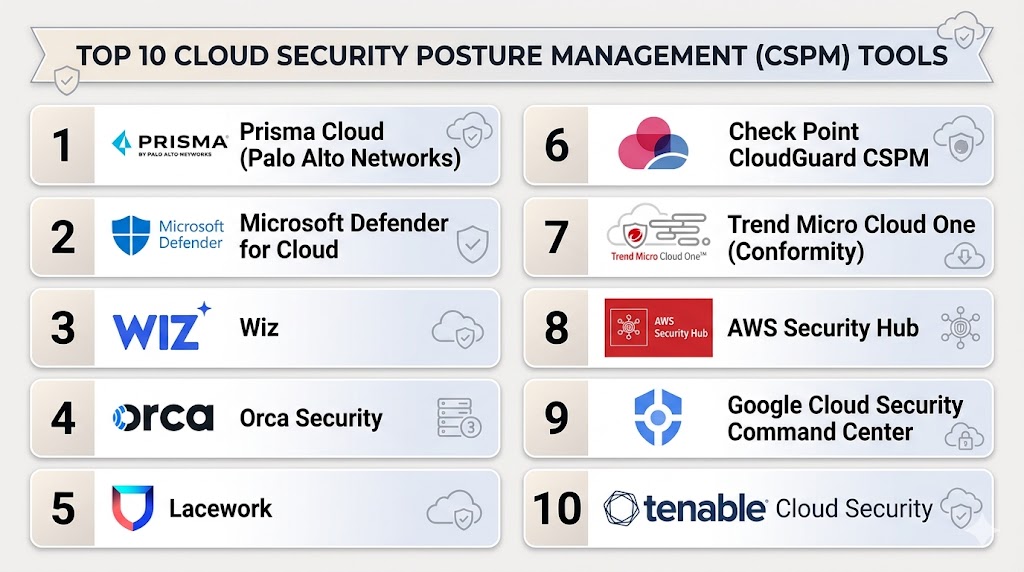
Top 10 Cloud Security Posture Management (CSPM) Tools
#1 — Prisma Cloud (Palo Alto Networks)
Short description: A comprehensive cloud security platform that provides CSPM along with broader cloud-native security capabilities.
Key Features
- Multi-cloud posture management
- Compliance monitoring
- Risk prioritization
- Identity and access analysis
- Threat detection
- Automation workflows
Pros
- Broad feature set
- Strong enterprise capabilities
Cons
- Complex setup
- Premium pricing
Platforms / Deployment
- Cloud
Security & Compliance
- RBAC, encryption
- Compliance frameworks supported
Integrations & Ecosystem
- Cloud providers
- SIEM tools
- APIs
- DevOps tools
Support & Community
Enterprise support with extensive documentation.
#2 — Microsoft Defender for Cloud
Short description: A cloud-native security solution providing CSPM and threat protection integrated with Microsoft ecosystem.
Key Features
- Multi-cloud security posture
- Continuous monitoring
- Compliance management
- Threat protection
- Risk assessment
- Integration with Azure
Pros
- Strong integration with Microsoft tools
- Easy deployment
Cons
- Best for Azure environments
- Limited outside ecosystem
Platforms / Deployment
- Cloud
Security & Compliance
- SSO, MFA, RBAC
- Compliance support varies
Integrations & Ecosystem
- Azure services
- Microsoft Defender suite
- APIs
Support & Community
Strong enterprise support.
#3 — Wiz
Short description: A modern cloud security platform offering agentless scanning and deep visibility across cloud environments.
Key Features
- Agentless scanning
- Risk prioritization
- Cloud asset visibility
- Attack path analysis
- Compliance monitoring
- Integration with DevOps
Pros
- Easy deployment
- Strong visualization
Cons
- Premium pricing
- Rapid growth may impact consistency
Platforms / Deployment
- Cloud
Security & Compliance
- Not publicly stated
Integrations & Ecosystem
- Cloud providers
- DevOps tools
- APIs
Support & Community
Strong enterprise support.
#4 — Orca Security
Short description: An agentless cloud security platform focused on deep visibility and risk prioritization.
Key Features
- Agentless scanning
- Full-stack visibility
- Risk prioritization
- Compliance checks
- Vulnerability detection
Pros
- No agent deployment required
- Deep visibility
Cons
- Premium pricing
- Requires tuning
Platforms / Deployment
- Cloud
Security & Compliance
- Not publicly stated
Integrations & Ecosystem
- Cloud platforms
- APIs
- Security tools
Support & Community
Enterprise support.
#5 — Lacework
Short description: A data-driven cloud security platform providing behavior-based threat detection and posture management.
Key Features
- Behavior analytics
- Compliance monitoring
- Cloud configuration assessment
- Threat detection
- Automation workflows
Pros
- Strong analytics
- Multi-cloud support
Cons
- Complex setup
- Learning curve
Platforms / Deployment
- Cloud
Security & Compliance
- Not publicly stated
Integrations & Ecosystem
- Cloud providers
- APIs
- DevOps tools
Support & Community
Strong support and documentation.
#6 — Check Point CloudGuard CSPM
Short description: A cloud security solution offering posture management and threat prevention.
Key Features
- Compliance monitoring
- Misconfiguration detection
- Risk assessment
- Multi-cloud support
- Automation
Pros
- Strong compliance features
- Enterprise-ready
Cons
- Complex configuration
- Requires expertise
Platforms / Deployment
- Cloud
Security & Compliance
- Compliance frameworks supported
Integrations & Ecosystem
- Cloud platforms
- APIs
- Security tools
Support & Community
Enterprise support.
#7 — Trend Micro Cloud One (Conformity)
Short description: A cloud security solution focused on configuration management and compliance monitoring.
Key Features
- Configuration monitoring
- Compliance checks
- Risk alerts
- Automation
- Multi-cloud support
Pros
- Easy to use
- Strong compliance focus
Cons
- Limited advanced features
- Less depth compared to competitors
Platforms / Deployment
- Cloud
Security & Compliance
- Not publicly stated
Integrations & Ecosystem
- Cloud platforms
- APIs
Support & Community
Good documentation and support.
#8 — AWS Security Hub
Short description: A native AWS service that provides centralized security and compliance insights.
Key Features
- AWS resource monitoring
- Compliance checks
- Security alerts
- Integration with AWS services
- Centralized dashboard
Pros
- Native AWS integration
- Easy setup
Cons
- Limited multi-cloud support
- AWS-focused
Platforms / Deployment
- Cloud
Security & Compliance
- AWS compliance frameworks supported
Integrations & Ecosystem
- AWS services
- APIs
Support & Community
Strong AWS ecosystem support.
#9 — Google Cloud Security Command Center
Short description: A native Google Cloud security platform for managing risks and compliance.
Key Features
- Asset discovery
- Risk assessment
- Compliance monitoring
- Threat detection
- Integration with GCP
Pros
- Native GCP integration
- Centralized visibility
Cons
- Limited outside GCP
- Requires GCP expertise
Platforms / Deployment
- Cloud
Security & Compliance
- Not publicly stated
Integrations & Ecosystem
- GCP services
- APIs
Support & Community
Strong Google Cloud support.
#10 — Tenable Cloud Security
Short description: A cloud security platform offering posture management and risk visibility.
Key Features
- Cloud configuration monitoring
- Risk prioritization
- Compliance checks
- Asset discovery
- Integration with Tenable ecosystem
Pros
- Strong vulnerability integration
- Scalable
Cons
- Requires integration setup
- Pricing varies
Platforms / Deployment
- Cloud
Security & Compliance
- Not publicly stated
Integrations & Ecosystem
- Tenable tools
- APIs
- Cloud providers
Support & Community
Enterprise support and documentation.
Comparison Table (Top 10)
| Tool Name | Best For | Platform(s) Supported | Deployment | Standout Feature | Public Rating |
|---|---|---|---|---|---|
| Prisma Cloud | Enterprise | Web | Cloud | Full-stack security | N/A |
| Microsoft Defender | Azure users | Web | Cloud | Native integration | N/A |
| Wiz | Modern cloud teams | Web | Cloud | Agentless scanning | N/A |
| Orca Security | Visibility | Web | Cloud | Deep scanning | N/A |
| Lacework | Analytics | Web | Cloud | Behavior analysis | N/A |
| CloudGuard CSPM | Compliance | Web | Cloud | Policy management | N/A |
| Trend Micro | SMB | Web | Cloud | Ease of use | N/A |
| AWS Security Hub | AWS users | Web | Cloud | Native AWS integration | N/A |
| Google SCC | GCP users | Web | Cloud | Native GCP tools | N/A |
| Tenable Cloud | Risk visibility | Web | Cloud | Vulnerability integration | N/A |
Evaluation & Scoring of CSPM Tools
| Tool Name | Core (25%) | Ease (15%) | Integrations (15%) | Security (10%) | Performance (10%) | Support (10%) | Value (15%) | Weighted Total |
|---|---|---|---|---|---|---|---|---|
| Prisma Cloud | 9 | 7 | 9 | 9 | 9 | 8 | 7 | 8.5 |
| Microsoft Defender | 8 | 8 | 9 | 9 | 8 | 8 | 8 | 8.3 |
| Wiz | 9 | 9 | 8 | 8 | 9 | 8 | 7 | 8.4 |
| Orca Security | 9 | 8 | 8 | 8 | 9 | 8 | 7 | 8.3 |
| Lacework | 8 | 7 | 8 | 8 | 8 | 8 | 7 | 7.9 |
| CloudGuard | 8 | 7 | 8 | 9 | 8 | 8 | 7 | 8.0 |
| Trend Micro | 7 | 8 | 7 | 7 | 7 | 7 | 8 | 7.4 |
| AWS Security Hub | 7 | 9 | 7 | 8 | 8 | 8 | 8 | 7.8 |
| Google SCC | 7 | 8 | 7 | 8 | 8 | 8 | 8 | 7.8 |
| Tenable Cloud | 8 | 7 | 8 | 8 | 8 | 8 | 7 | 7.9 |
How to interpret scores:
- Scores are comparative across tools
- Higher scores indicate stronger overall capabilities
- Enterprise tools lead in integrations and features
- Native cloud tools excel in ease of use
- Choose based on cloud environment and requirements
Which CSPM Tool Is Right for You?
Solo / Freelancer
Use AWS Security Hub or Trend Micro Cloud One for simplicity.
SMB
Use Trend Micro or Tenable Cloud Security.
Mid-Market
Use Wiz or Orca Security.
Enterprise
Use Prisma Cloud, Microsoft Defender, or CloudGuard CSPM.
Budget vs Premium
- Budget: AWS Security Hub, Google SCC
- Premium: Prisma Cloud, Wiz
Feature Depth vs Ease of Use
- Deep features: Prisma Cloud
- Ease of use: Wiz
Integrations & Scalability
Best: Microsoft Defender, Prisma Cloud
Security & Compliance Needs
Best: CloudGuard CSPM, Microsoft Defender
Frequently Asked Questions (FAQs)
1. What is CSPM?
It helps monitor and secure cloud configurations.
2. Why is CSPM important?
It prevents misconfigurations that lead to breaches.
3. Does CSPM support multi-cloud?
Yes, most tools support multiple cloud providers.
4. Are CSPM tools agentless?
Many modern tools are agentless.
5. Can CSPM tools automate fixes?
Some tools provide automated remediation.
6. Do they support compliance?
Yes, most tools include compliance checks.
7. Are CSPM tools expensive?
Pricing varies based on features and scale.
8. Who should use CSPM tools?
Organizations using cloud infrastructure.
9. Can CSPM integrate with DevOps?
Yes, most tools support DevOps workflows.
10. What is the biggest benefit?
Visibility into cloud security risks.
Conclusion
Cloud Security Posture Management tools are essential for maintaining secure and compliant cloud environments in today’s complex infrastructure landscape. By continuously monitoring configurations, identifying risks, and enabling faster remediation, these platforms help organizations prevent costly security incidents. While enterprise solutions provide advanced capabilities and deep integrations, smaller teams can still benefit from simpler tools that offer strong visibility and control. The best approach is to evaluate your cloud environment, shortlist a few CSPM tools, and test their effectiveness in real-world scenarios. Ultimately, the right tool is the one that aligns with your cloud strategy, security requirements, and operational workflows.