Introduction
Endpoint Protection Platforms (EPP) are cybersecurity solutions designed to protect devices like laptops, desktops, servers, and mobile devices from cyber threats such as malware, ransomware, and unauthorized access. These platforms combine multiple security technologies—like antivirus, firewall, intrusion prevention, and behavioral analytics—into a single unified system.
In today’s distributed work environments, endpoints have become one of the most common entry points for cyberattacks. As organizations rely more on cloud, remote work, and mobile devices, EPP tools are essential for maintaining security, visibility, and compliance across all endpoints.
Real-world use cases include:
- Protecting employee devices from malware and ransomware
- Securing remote work environments
- Monitoring endpoint activity for suspicious behavior
- Enforcing device security policies
- Preventing data breaches and unauthorized access
What buyers should evaluate:
- Malware and ransomware detection capabilities
- Behavioral analysis and AI-driven threat detection
- Centralized management and visibility
- Integration with EDR/XDR platforms
- Performance impact on devices
- Automation and response capabilities
- Cross-platform support (Windows, macOS, Linux, mobile)
- Reporting and compliance features
- Cost vs value
Best for: Enterprises, IT teams, MSPs, and organizations managing multiple devices across networks.
Not ideal for: Individuals or very small teams with minimal device exposure.
Key Trends in Endpoint Protection Platforms
- AI and machine learning-based threat detection
- Integration with Endpoint Detection & Response (EDR)
- Cloud-native endpoint security platforms
- Zero Trust endpoint security models
- Automated threat response and remediation
- Extended Detection and Response (XDR) adoption
- Protection for mobile and IoT devices
- Real-time threat intelligence integration
- Reduced reliance on signature-based detection
- Unified security platforms combining EPP + EDR
How We Selected These Tools (Methodology)
- Evaluated market adoption and vendor reputation
- Assessed threat detection and prevention capabilities
- Reviewed performance and reliability signals
- Considered integration with broader security ecosystems
- Compared ease of deployment and usability
- Included tools for enterprise and SMB use cases
- Analyzed scalability across hybrid environments
- Evaluated automation and response features
- Focused on real-world effectiveness against threats
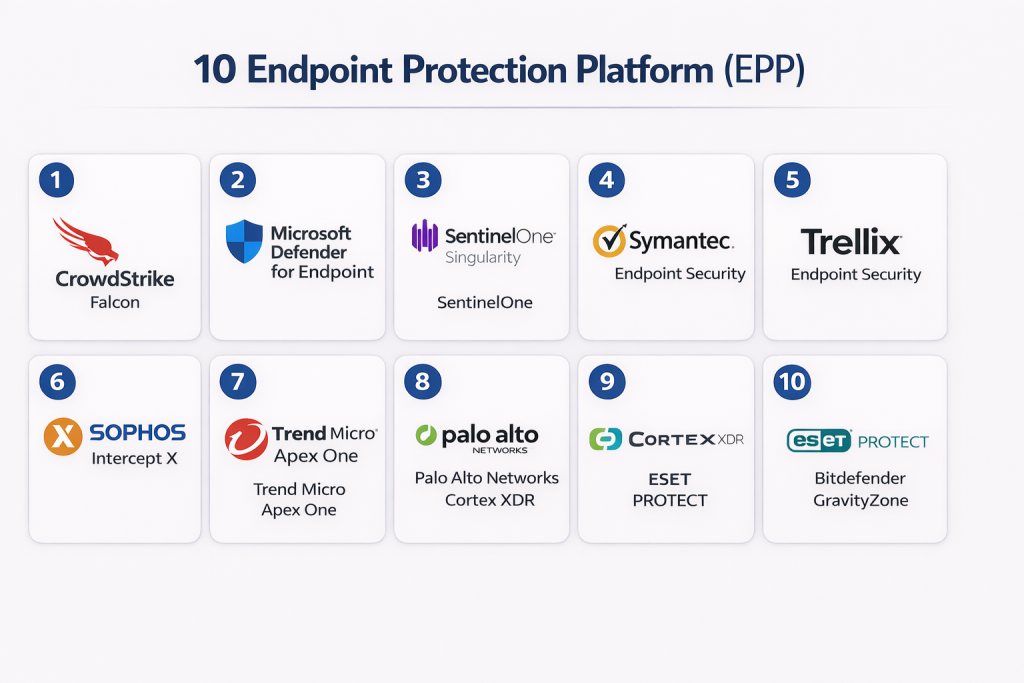
Top 10 Endpoint Protection Platforms (EPP)
#1 — CrowdStrike Falcon
Short description: A cloud-native endpoint security platform known for AI-driven threat detection and real-time response.
Key Features
- AI-powered threat detection
- Cloud-native architecture
- Real-time endpoint monitoring
- Threat intelligence integration
- EDR capabilities
- Automated response
Pros
- High detection accuracy
- Lightweight agent
Cons
- Premium pricing
- Requires expertise
Platforms / Deployment
Windows / macOS / Linux / Mobile
Cloud
Security & Compliance
RBAC, encryption (details not publicly stated)
Integrations & Ecosystem
Integrates with enterprise security stacks.
- APIs
- SIEM tools
- Cloud platforms
Support & Community
Strong enterprise support and ecosystem.
#2 — Microsoft Defender for Endpoint
Short description: A comprehensive endpoint security solution integrated with Microsoft ecosystem.
Key Features
- Threat detection and prevention
- Endpoint monitoring
- Vulnerability management
- Automated investigation
- Integration with Microsoft tools
Pros
- Strong integration with Microsoft
- Scalable
Cons
- Best within Microsoft ecosystem
- Licensing complexity
Platforms / Deployment
Windows / macOS / Linux / Android / iOS
Cloud
Security & Compliance
Not publicly stated
Integrations & Ecosystem
Deep Microsoft ecosystem integration.
- Azure
- Office apps
- APIs
Support & Community
Extensive support and documentation.
#3 — SentinelOne Singularity
Short description: An autonomous endpoint security platform with AI-driven detection and response.
Key Features
- AI-based threat detection
- Automated remediation
- Behavioral analysis
- Real-time monitoring
- EDR capabilities
Pros
- Autonomous response
- Strong analytics
Cons
- Complex setup
- Higher cost
Platforms / Deployment
Windows / macOS / Linux
Cloud
Security & Compliance
Not publicly stated
Integrations & Ecosystem
Integrates with security tools.
- APIs
- SIEM platforms
Support & Community
Strong enterprise support.
#4 — Sophos Intercept X
Short description: A robust endpoint protection tool with strong anti-ransomware capabilities.
Key Features
- Deep learning malware detection
- Anti-ransomware protection
- Exploit prevention
- Web filtering
- Centralized management
Pros
- Strong ransomware protection
- Easy to use
Cons
- Limited customization
- Pricing varies
Platforms / Deployment
Windows / macOS
Cloud / On-premises
Security & Compliance
Not publicly stated
Integrations & Ecosystem
Works within Sophos ecosystem.
- APIs
- Security tools
Support & Community
Good documentation and support.
#5 — Trend Micro Apex One
Short description: An enterprise endpoint security platform with advanced threat detection and automation.
Key Features
- Threat detection and response
- Behavioral monitoring
- Vulnerability protection
- Application control
- Centralized management
Pros
- Strong enterprise features
- Good automation
Cons
- Complex setup
- Resource usage
Platforms / Deployment
Windows / macOS
Cloud / On-premises
Security & Compliance
Not publicly stated
Integrations & Ecosystem
Supports enterprise integrations.
- APIs
- Security tools
Support & Community
Enterprise support available.
#6 — Symantec Endpoint Security (Broadcom)
Short description: A long-established endpoint protection platform with strong enterprise capabilities.
Key Features
- Malware protection
- Intrusion prevention
- Firewall
- Device control
- Threat intelligence
Pros
- Mature platform
- Strong protection
Cons
- Complex management
- Legacy components
Platforms / Deployment
Windows / macOS / Linux
Cloud / On-premises
Security & Compliance
Not publicly stated
Integrations & Ecosystem
Integrates with enterprise systems.
- APIs
- Security platforms
Support & Community
Enterprise-level support.
#7 — Bitdefender GravityZone
Short description: A powerful endpoint security solution known for strong malware detection.
Key Features
- Advanced malware detection
- Risk analytics
- Endpoint control
- Centralized management
- Automation
Pros
- High detection rates
- Good performance
Cons
- Complex interface
- Pricing tiers
Platforms / Deployment
Windows / macOS / Linux
Cloud / On-premises
Security & Compliance
Not publicly stated
Integrations & Ecosystem
Supports integration with security tools.
- APIs
- Cloud platforms
Support & Community
Good support and resources.
#8 — ESET Protect
Short description: A lightweight endpoint protection solution with strong detection and management capabilities.
Key Features
- Antivirus and anti-malware
- Device control
- Remote management
- Threat detection
- Low system impact
Pros
- Lightweight
- Easy deployment
Cons
- Limited advanced features
- Smaller ecosystem
Platforms / Deployment
Windows / macOS / Linux / Mobile
Cloud / On-premises
Security & Compliance
Not publicly stated
Integrations & Ecosystem
Supports integration with enterprise tools.
- APIs
- Security tools
Support & Community
Good support and documentation.
#9 — Cisco Secure Endpoint
Short description: An advanced endpoint security platform with behavioral analytics and threat intelligence.
Key Features
- Behavioral analytics
- Threat detection
- Automated response
- Retrospective analysis
- Centralized management
Pros
- Strong analytics
- Cross-platform support
Cons
- Complex setup
- Pricing not transparent
Platforms / Deployment
Windows / macOS / Linux / Mobile
Cloud / On-premises
Security & Compliance
Not publicly stated
Integrations & Ecosystem
Part of Cisco security ecosystem.
- APIs
- Network security tools
Support & Community
Enterprise support available.
#10 — Fortinet FortiClient
Short description: An endpoint security solution combining antivirus, VPN, and compliance features.
Key Features
- Antivirus and anti-malware
- VPN integration
- Web filtering
- Endpoint compliance
- Centralized management
Pros
- Integrated security features
- Strong network integration
Cons
- Limited advanced analytics
- Best within Fortinet ecosystem
Platforms / Deployment
Windows / macOS / Mobile
Cloud / On-premises
Security & Compliance
Not publicly stated
Integrations & Ecosystem
Works within Fortinet ecosystem.
- Network security tools
- APIs
Support & Community
Strong enterprise support.
Comparison Table (Top 10)
| Tool Name | Best For | Platform(s) Supported | Deployment | Standout Feature | Public Rating |
|---|---|---|---|---|---|
| CrowdStrike Falcon | Enterprise | Multi-platform | Cloud | AI detection | N/A |
| Microsoft Defender | Enterprise | Multi-platform | Cloud | Microsoft integration | N/A |
| SentinelOne | Enterprise | Multi-platform | Cloud | Autonomous response | N/A |
| Sophos Intercept X | SMB/Enterprise | Windows/macOS | Hybrid | Ransomware protection | N/A |
| Trend Micro Apex One | Enterprise | Multi-platform | Hybrid | Automation | N/A |
| Symantec Endpoint Security | Enterprise | Multi-platform | Hybrid | Mature platform | N/A |
| Bitdefender GravityZone | SMB/Enterprise | Multi-platform | Hybrid | Detection accuracy | N/A |
| ESET Protect | SMB | Multi-platform | Hybrid | Lightweight | N/A |
| Cisco Secure Endpoint | Enterprise | Multi-platform | Hybrid | Behavioral analytics | N/A |
| FortiClient | SMB/Enterprise | Multi-platform | Hybrid | VPN integration | N/A |
Evaluation & Scoring of Endpoint Protection Platforms
| Tool Name | Core (25%) | Ease (15%) | Integrations (15%) | Security (10%) | Performance (10%) | Support (10%) | Value (15%) | Weighted Total (0–10) |
|---|---|---|---|---|---|---|---|---|
| CrowdStrike | 9 | 8 | 9 | 9 | 9 | 8 | 7 | 8.6 |
| Microsoft Defender | 9 | 8 | 9 | 9 | 8 | 8 | 8 | 8.6 |
| SentinelOne | 9 | 7 | 8 | 9 | 9 | 8 | 7 | 8.3 |
| Sophos | 8 | 8 | 7 | 8 | 8 | 7 | 8 | 7.9 |
| Trend Micro | 8 | 7 | 8 | 8 | 8 | 7 | 7 | 7.8 |
| Symantec | 8 | 6 | 8 | 9 | 8 | 7 | 6 | 7.7 |
| Bitdefender | 8 | 7 | 7 | 8 | 8 | 7 | 8 | 7.8 |
| ESET | 7 | 9 | 6 | 7 | 8 | 7 | 9 | 7.8 |
| Cisco | 8 | 6 | 8 | 9 | 8 | 7 | 6 | 7.8 |
| Fortinet | 7 | 7 | 7 | 7 | 7 | 7 | 8 | 7.3 |
How to interpret these scores:
These scores are comparative and based on common enterprise scenarios. Higher scores indicate stronger capabilities overall, but the best choice depends on your infrastructure, team expertise, and security requirements.
Which Endpoint Protection Platform Is Right for You?
Solo / Freelancer
Basic antivirus tools are usually sufficient.
SMB
Bitdefender, ESET, and Sophos offer strong protection with ease of use.
Mid-Market
Trend Micro and Fortinet provide balanced performance and features.
Enterprise
CrowdStrike, Microsoft Defender, and SentinelOne offer advanced security and scalability.
Budget vs Premium
Budget tools focus on core protection, while premium tools provide AI-driven detection and automation.
Feature Depth vs Ease of Use
Advanced tools require expertise, while simpler tools prioritize usability.
Integrations & Scalability
Choose platforms that integrate with your existing security stack.
Security & Compliance Needs
Highly regulated industries should prioritize enterprise-grade EPP solutions.
Frequently Asked Questions (FAQs)
1. What is an Endpoint Protection Platform?
A solution that protects devices from cyber threats.
2. How is EPP different from antivirus?
EPP includes multiple security layers beyond antivirus.
3. Do EPP tools support cloud environments?
Yes, most modern platforms are cloud-based.
4. What is EDR in EPP?
Endpoint Detection and Response for advanced threat analysis.
5. Are EPP tools necessary for small businesses?
Yes, if they manage multiple devices.
6. Can EPP tools prevent ransomware?
Yes, many include anti-ransomware features.
7. Do EPP tools impact performance?
Modern tools are optimized for minimal impact.
8. Can EPP integrate with SIEM?
Yes, most enterprise tools support integration.
9. What is centralized management?
Managing all endpoints from a single dashboard.
10. How do I choose the right EPP?
Evaluate based on security, scalability, and integrations.
Conclusion
Endpoint Protection Platforms are a critical component of modern cybersecurity, providing comprehensive protection for devices across increasingly complex environments. As cyber threats continue to evolve, organizations must adopt solutions that go beyond traditional antivirus and offer real-time detection, automation, and centralized management. While enterprise-grade platforms deliver advanced capabilities and scalability, SMB-friendly tools provide strong protection with ease of use. The best approach is to assess your device landscape, shortlist a few tools, and run a pilot to ensure they meet your security, performance, and integration requirements.