Introduction
Data Catalog & Metadata Management Tools are platforms designed to organize, document, and manage metadata across an organization’s data ecosystem. They help teams discover data assets, understand data lineage, improve governance, and ensure consistent data usage across analytics, engineering, and business teams.
In modern enterprises, data is spread across warehouses, lakes, APIs, SaaS tools, and streaming systems. Without proper metadata management, data becomes hard to find, trust, or use effectively. Data catalog tools solve this by creating a centralized “data discovery layer” for all enterprise data.
Common use cases include:
- Data discovery and search
- Data governance and compliance
- Data lineage tracking
- Metadata management across systems
- Self-service analytics enablement
- Data classification and tagging
- Impact analysis for data changes
Key evaluation factors include:
- Metadata coverage and automation
- Data lineage visibility
- Integration with data platforms
- Search and discovery capabilities
- Governance and compliance features
- Collaboration and documentation tools
- Scalability across enterprise systems
- Ease of use and adoption
Best for data engineers, data analysts, data governance teams, and enterprise IT organizations. Not ideal for small systems with limited data sources.
Key Trends in Data Catalog & Metadata Management Tools
- AI-powered metadata discovery and tagging
- Automated data lineage tracking
- Strong integration with modern data stacks
- Unified governance and data observability platforms
- Increased focus on data democratization
- Self-service data discovery for business users
- Cloud-native metadata management systems
- Real-time metadata updates and monitoring
- Integration with AI and ML data pipelines
- Expansion of active metadata systems
How We Selected These Tools (Methodology)
- Market adoption across enterprise data ecosystems
- Metadata discovery and cataloging capabilities
- Data lineage tracking accuracy
- Integration with data warehouses and lakes
- Governance and compliance support
- Scalability across large environments
- Search and usability experience
- Automation and AI features
- Ecosystem maturity and vendor support
- Real-world enterprise usage
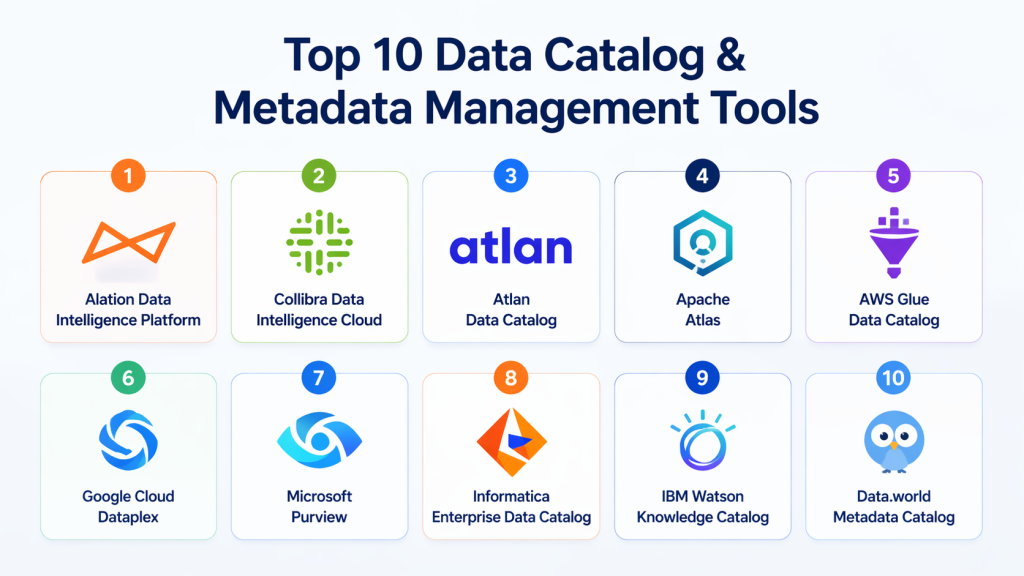
Top 10 Data Catalog & Metadata Management Tools
1 — Alation Data Intelligence Platform
Alation is one of the leading enterprise data catalog platforms focused on data discovery and governance.
Key Features
- AI-powered data cataloging
- Advanced data search and discovery
- Data lineage tracking
- Collaboration and annotation tools
- Governance workflows
- Metadata automation
- Usage analytics
Pros
- Strong enterprise adoption
- Excellent search experience
- Robust governance features
Cons
- High cost
- Complex implementation
Platforms / Deployment
Cloud / Hybrid
Security & Compliance
RBAC, encryption, enterprise compliance support
Integrations & Ecosystem
Data warehouses, BI tools, ETL systems, cloud platforms
Support & Community
Strong enterprise support
2 — Collibra Data Intelligence Cloud
Collibra is a leading data intelligence platform focused on governance and metadata management.
Key Features
- Centralized data catalog
- Data governance workflows
- Data lineage visualization
- Policy management
- Business glossary support
- Metadata automation
- Compliance tracking
Pros
- Strong governance capabilities
- Enterprise-grade scalability
- Rich metadata features
Cons
- Complex setup
- Expensive licensing
Platforms / Deployment
Cloud / Hybrid
Security & Compliance
Enterprise security, RBAC, compliance management
Integrations & Ecosystem
Data platforms, BI tools, ETL pipelines, cloud systems
Support & Community
Strong enterprise adoption
3 — Atlan Data Catalog
Atlan is a modern data collaboration and metadata platform built for fast-growing data teams.
Key Features
- Active metadata management
- Automated lineage tracking
- Data discovery and search
- Collaboration tools
- Workflow automation
- API-based integration
- Real-time metadata updates
Pros
- Easy to use interface
- Modern architecture
- Strong collaboration features
Cons
- Smaller enterprise footprint
- Limited legacy system support
Platforms / Deployment
Cloud
Security & Compliance
RBAC, encryption, enterprise compliance support
Integrations & Ecosystem
Modern data stacks, BI tools, cloud warehouses, ETL tools
Support & Community
Fast-growing enterprise adoption
4 — Apache Atlas
Apache Atlas is an open-source metadata management and governance framework.
Key Features
- Metadata classification
- Data lineage tracking
- Tagging and taxonomy management
- Governance policies
- Integration with Hadoop ecosystem
- Audit tracking
- Metadata API support
Pros
- Open-source flexibility
- Strong Hadoop integration
- Highly customizable
Cons
- Requires engineering effort
- UI is less modern
Platforms / Deployment
Self-hosted / Hybrid
Security & Compliance
Kerberos integration, RBAC support
Integrations & Ecosystem
Hadoop, Spark, big data systems, data pipelines
Support & Community
Strong open-source community
5 — AWS Glue Data Catalog
AWS Glue Data Catalog is a fully managed metadata repository for AWS data services.
Key Features
- Centralized metadata storage
- Schema discovery
- Data cataloging automation
- Integration with AWS analytics services
- Table and schema versioning
- Serverless architecture
- Data crawler support
Pros
- Fully managed service
- Strong AWS integration
- Easy to use
Cons
- AWS ecosystem lock-in
- Limited advanced governance features
Platforms / Deployment
Cloud (AWS)
Security & Compliance
IAM-based access, encryption, AWS compliance support
Integrations & Ecosystem
S3, Athena, Redshift, EMR, Glue ETL
Support & Community
Strong AWS enterprise support
6 — Google Cloud Dataplex
Dataplex is Google’s intelligent data management and metadata platform.
Key Features
- Unified data catalog
- Automated metadata discovery
- Data governance and policy enforcement
- Data quality monitoring
- Data lineage tracking
- Lake and warehouse integration
- AI-driven classification
Pros
- Strong Google Cloud integration
- Automated governance
- Scalable architecture
Cons
- Google dependency
- Complex pricing
Platforms / Deployment
Cloud
Security & Compliance
IAM controls, encryption, enterprise compliance
Integrations & Ecosystem
BigQuery, data lakes, AI tools, analytics systems
Support & Community
Strong Google enterprise support
7 — Microsoft Purview
Microsoft Purview is a unified data governance and metadata management solution.
Key Features
- Enterprise data catalog
- Automated data discovery
- Data lineage tracking
- Compliance and governance tools
- Data classification
- Hybrid data source integration
- Sensitivity labeling
Pros
- Strong Microsoft ecosystem integration
- Good governance capabilities
- Easy for Azure users
Cons
- Azure dependency
- Complex configuration
Platforms / Deployment
Cloud / Hybrid
Security & Compliance
Enterprise-grade security, RBAC, compliance management
Integrations & Ecosystem
Azure Synapse, Power BI, SQL Server, cloud services
Support & Community
Strong Microsoft enterprise support
8 — Informatica Enterprise Data Catalog
Informatica provides a powerful metadata management platform for enterprises.
Key Features
- AI-powered metadata discovery
- Data lineage tracking
- Data profiling
- Business glossary management
- Automated metadata ingestion
- Governance workflows
- Impact analysis
Pros
- Highly accurate metadata discovery
- Strong enterprise capabilities
- Scalable architecture
Cons
- Complex setup
- High cost
Platforms / Deployment
Cloud / On-premise / Hybrid
Security & Compliance
Enterprise RBAC, encryption, compliance support
Integrations & Ecosystem
Data warehouses, ETL tools, BI systems, enterprise apps
Support & Community
Strong enterprise support
9 — IBM Watson Knowledge Catalog
IBM Watson Knowledge Catalog is a metadata and governance platform with AI capabilities.
Key Features
- AI-driven metadata classification
- Data cataloging
- Governance policies
- Data lineage tracking
- Data quality integration
- Business glossary support
- Cloud Pak integration
Pros
- Strong AI capabilities
- Enterprise-grade governance
- Deep IBM ecosystem integration
Cons
- Complex setup
- High cost
Platforms / Deployment
Cloud / Hybrid
Security & Compliance
Advanced enterprise security, RBAC, compliance controls
Integrations & Ecosystem
IBM data platforms, analytics systems, cloud services
Support & Community
Strong IBM enterprise support
10 — Data.world Metadata Catalog
Data.world is a collaborative data catalog platform focused on knowledge graph-based metadata management.
Key Features
- Knowledge graph-based catalog
- Data discovery tools
- Collaboration and documentation
- Metadata enrichment
- API-first architecture
- Data lineage support
- Open data integration
Pros
- Strong collaboration features
- Easy data discovery
- Modern interface
Cons
- Smaller enterprise footprint
- Limited advanced governance tools
Platforms / Deployment
Cloud
Security & Compliance
Encryption, RBAC, enterprise security support
Integrations & Ecosystem
Data warehouses, BI tools, APIs, cloud platforms
Support & Community
Growing enterprise adoption
Comparison Table (Top 10)
| Tool | Best For | Platform | Deployment | Standout Feature | Public Rating |
|---|---|---|---|---|---|
| Alation | Enterprise cataloging | Cross-platform | Hybrid | AI search | N/A |
| Collibra | Governance | Cross-platform | Hybrid | Policy management | N/A |
| Atlan | Modern data teams | Cloud | Cloud | Active metadata | N/A |
| Apache Atlas | Open-source governance | Cross-platform | Hybrid | Hadoop integration | N/A |
| AWS Glue Catalog | AWS metadata | AWS | Cloud | Serverless catalog | N/A |
| Dataplex | Google ecosystem | Google Cloud | Cloud | Unified governance | N/A |
| Microsoft Purview | Azure governance | Azure | Cloud | Data classification | N/A |
| Informatica | Enterprise metadata | Cross-platform | Hybrid | AI discovery | N/A |
| IBM Watson Catalog | AI governance | Cross-platform | Hybrid | AI classification | N/A |
| Data.world | Collaboration | Cloud | Cloud | Knowledge graph | N/A |
Evaluation & Scoring
| Tool | Core (25%) | Ease (15%) | Integrations (15%) | Security (10%) | Performance (10%) | Support (10%) | Value (15%) | Total |
|---|---|---|---|---|---|---|---|---|
| Alation | 9 | 8 | 9 | 9 | 9 | 9 | 8 | 8.7 |
| Collibra | 9 | 7 | 9 | 9 | 9 | 9 | 7 | 8.5 |
| Atlan | 8 | 9 | 9 | 8 | 9 | 8 | 9 | 8.6 |
| Apache Atlas | 8 | 7 | 8 | 8 | 8 | 8 | 9 | 8.0 |
| AWS Glue | 9 | 8 | 9 | 9 | 9 | 9 | 8 | 8.7 |
| Dataplex | 9 | 8 | 9 | 9 | 9 | 9 | 8 | 8.7 |
| Purview | 9 | 8 | 9 | 9 | 9 | 9 | 8 | 8.7 |
| Informatica | 9 | 7 | 9 | 9 | 9 | 9 | 7 | 8.4 |
| IBM | 9 | 7 | 8 | 9 | 9 | 9 | 7 | 8.3 |
| Data.world | 8 | 9 | 8 | 8 | 8 | 8 | 8 | 8.1 |
Which Data Catalog Tool Should You Choose?
Solo teams and startups can start with Data.world or Apache Atlas for flexible metadata management. SMBs often prefer Atlan or AWS Glue Catalog for simplicity and integration. Mid-market organizations benefit from Microsoft Purview or Dataplex for governance and scalability. Enterprises typically choose Alation, Collibra, or Informatica for advanced metadata management and governance. Budget-friendly options include open-source Apache Atlas, while premium enterprise tools include Collibra and Alation. The right choice depends on governance needs, ecosystem complexity, and data maturity level.
Frequently Asked Questions
What is a data catalog?
It is a system that organizes and manages metadata across data systems.
Why are data catalogs important?
They help users discover, understand, and trust data.
What is metadata management?
It is the process of managing data about data.
Do data catalogs support lineage?
Yes, most modern tools include data lineage tracking.
Are data catalog tools cloud-based?
Many modern tools are cloud-native or hybrid.
Which tool is best for beginners?
Atlan and Data.world are easier to use.
Do these tools support AI?
Yes, many use AI for metadata discovery.
What industries use data catalogs?
Finance, healthcare, SaaS, retail, and enterprise IT.
Can they integrate with ETL tools?
Yes, they integrate with ETL and data pipelines.
Is Apache Atlas free?
Yes, it is an open-source tool.
Conclusion
Data Catalog & Metadata Management Tools are essential for modern organizations that manage large-scale data ecosystems. They help teams discover, understand, and govern data across multiple systems while improving collaboration and trust in data assets. These platforms play a key role in enabling self-service analytics, compliance, and data governance. Each tool offers different strengths depending on scalability, integration depth, and governance capabilities. Choosing the right solution depends on organizational data maturity and ecosystem complexity. A pilot deployment is recommended to evaluate fit before enterprise-wide adoption.