Introduction
Governance, Risk & Compliance (GRC) Platforms are enterprise solutions designed to help organizations manage policies, assess risks, ensure regulatory compliance, and streamline audit processes in a centralized system. Instead of relying on disconnected spreadsheets and manual workflows, GRC tools provide structured frameworks, automation, and real-time visibility across governance and risk functions.
As organizations operate in increasingly complex regulatory environments, the need for unified oversight has become critical. Modern GRC platforms leverage automation, analytics, and integrated workflows to monitor risks, enforce compliance, and support decision-making across departments such as IT, finance, legal, and operations.
Common Use Cases
- Managing enterprise risk and risk assessments
- Automating compliance workflows and reporting
- Conducting internal and external audits
- Policy management and governance tracking
- Third-party and vendor risk management
What Buyers Should Evaluate
- Risk assessment and scoring capabilities
- Compliance framework support and automation
- Policy and audit management features
- Integration with security and business systems
- Ease of use and workflow automation
- Scalability for enterprise environments
- Reporting, dashboards, and analytics
- Customization and flexibility
- Cost vs value
Best for: Enterprises, compliance teams, risk managers, auditors, and organizations operating under regulatory requirements.
Not ideal for: Small teams with minimal compliance needs or organizations with simple risk management processes.
Key Trends in GRC Platforms
- AI-driven risk assessment and predictive analytics
- Integration with cybersecurity and IT risk tools
- Cloud-native GRC platforms replacing legacy systems
- Automation of audit and compliance workflows
- Unified dashboards for risk visibility
- Expansion into ESG and third-party risk management
- Real-time risk monitoring and alerts
- API-driven integrations across enterprise systems
- Low-code/no-code customization for workflows
- Focus on scalability and global compliance
How We Selected These Tools (Methodology)
- Strong market adoption and industry recognition
- Proven GRC capabilities across governance, risk, and compliance
- Integration with enterprise systems and security tools
- Availability of automation and analytics features
- Support for multiple regulatory frameworks
- Suitability for mid-market to enterprise organizations
- Strong documentation and support ecosystems
- Balance between flexibility and usability
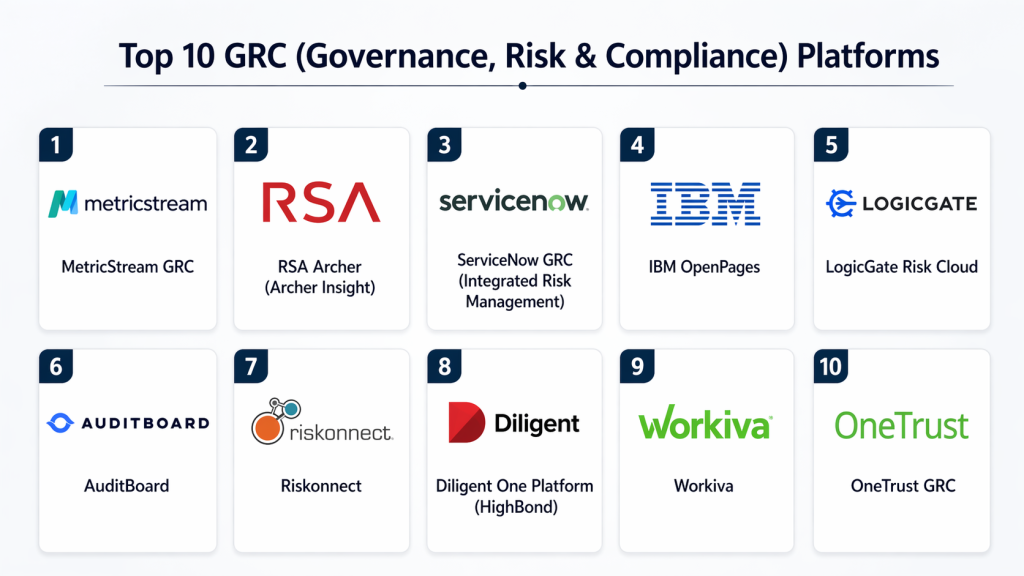
Top 10 GRC (Governance, Risk & Compliance) Platforms
#1 — MetricStream GRC
Short description: A comprehensive enterprise GRC platform offering end-to-end risk and compliance management.
Key Features
- Risk management
- Compliance tracking
- Policy management
- Audit management
- Third-party risk management
- Analytics and reporting
Pros
- Highly scalable
- Strong enterprise capabilities
Cons
- Complex implementation
- Premium pricing
Platforms / Deployment
- Cloud / Hybrid
Security & Compliance
- RBAC, encryption
- Compliance support varies
Integrations & Ecosystem
- APIs
- Enterprise systems
- Security tools
Support & Community
Enterprise-grade support.
#2 — RSA Archer (Archer Insight)
Short description: A widely used GRC platform known for flexibility and risk management capabilities.
Key Features
- Risk assessment
- Compliance management
- Audit workflows
- Policy management
- Reporting
Pros
- Highly customizable
- Strong risk capabilities
Cons
- Complex setup
- Requires expertise
Platforms / Deployment
- Cloud / On-prem
Security & Compliance
- Not publicly stated
Integrations & Ecosystem
- APIs
- Enterprise tools
Support & Community
Enterprise support.
#3 — ServiceNow GRC (Integrated Risk Management)
Short description: A GRC solution integrated into the ServiceNow platform for workflow automation.
Key Features
- Risk management
- Compliance automation
- Policy management
- Audit workflows
- Integration with ITSM
Pros
- Strong workflow automation
- Seamless integration
Cons
- Requires ServiceNow ecosystem
- Premium pricing
Platforms / Deployment
- Cloud
Security & Compliance
- Not publicly stated
Integrations & Ecosystem
- ServiceNow ecosystem
- APIs
Support & Community
Strong enterprise support.
#4 — IBM OpenPages
Short description: An AI-powered GRC platform focused on risk and compliance management.
Key Features
- Risk analytics
- Compliance management
- Policy tracking
- Audit workflows
- AI-driven insights
Pros
- Strong analytics
- Enterprise-ready
Cons
- Complex interface
- Requires training
Platforms / Deployment
- Cloud / Hybrid
Security & Compliance
- Not publicly stated
Integrations & Ecosystem
- IBM ecosystem
- APIs
Support & Community
Enterprise support.
#5 — LogicGate Risk Cloud
Short description: A flexible GRC platform with no-code workflow automation capabilities.
Key Features
- Risk management
- Workflow automation
- Compliance tracking
- Reporting
- Custom applications
Pros
- Highly flexible
- Easy customization
Cons
- Limited enterprise depth
- Growing ecosystem
Platforms / Deployment
- Cloud
Security & Compliance
- Not publicly stated
Integrations & Ecosystem
- APIs
- Business tools
Support & Community
Good support.
#6 — AuditBoard
Short description: A modern GRC platform focused on audit, risk, and compliance workflows.
Key Features
- Audit management
- Risk assessment
- Compliance tracking
- Reporting
- Workflow automation
Pros
- User-friendly
- Strong audit features
Cons
- Limited customization
- Premium pricing
Platforms / Deployment
- Cloud
Security & Compliance
- Not publicly stated
Integrations & Ecosystem
- APIs
- Enterprise tools
Support & Community
Strong support.
#7 — Riskonnect
Short description: A unified GRC platform for enterprise risk and compliance management.
Key Features
- Risk management
- Compliance tracking
- Incident management
- Reporting
- Workflow automation
Pros
- Strong enterprise features
- Scalable
Cons
- Complex setup
- Requires expertise
Platforms / Deployment
- Cloud
Security & Compliance
- Not publicly stated
Integrations & Ecosystem
- APIs
- Business systems
Support & Community
Enterprise support.
#8 — Diligent One Platform (HighBond)
Short description: A GRC platform combining governance, audit, and risk management.
Key Features
- Governance tracking
- Audit workflows
- Risk management
- Compliance tracking
- Reporting
Pros
- Strong governance features
- Integrated platform
Cons
- Requires training
- Complex setup
Platforms / Deployment
- Cloud
Security & Compliance
- Not publicly stated
Integrations & Ecosystem
- APIs
- Enterprise tools
Support & Community
Good support.
#9 — Workiva
Short description: A GRC and reporting platform focused on compliance and financial reporting.
Key Features
- Compliance management
- Reporting automation
- Risk tracking
- Workflow automation
- Data integration
Pros
- Strong reporting capabilities
- Easy collaboration
Cons
- Limited risk depth
- Premium pricing
Platforms / Deployment
- Cloud
Security & Compliance
- Not publicly stated
Integrations & Ecosystem
- APIs
- Business systems
Support & Community
Strong support.
#10 — OneTrust GRC
Short description: A GRC platform integrated with privacy and compliance management.
Key Features
- Risk management
- Compliance automation
- Policy management
- Reporting
- Integration with privacy tools
Pros
- Strong compliance features
- Integrated ecosystem
Cons
- Complex implementation
- Requires setup
Platforms / Deployment
- Cloud
Security & Compliance
- Not publicly stated
Integrations & Ecosystem
- APIs
- Enterprise tools
Support & Community
Enterprise support.
Comparison Table (Top 10)
| Tool Name | Best For | Platform(s) Supported | Deployment | Standout Feature | Public Rating |
|---|---|---|---|---|---|
| MetricStream | Enterprise | Web | Hybrid | Full GRC suite | N/A |
| RSA Archer | Customization | Web | Hybrid | Flexible workflows | N/A |
| ServiceNow | IT integration | Web | Cloud | Workflow automation | N/A |
| IBM OpenPages | Analytics | Web | Hybrid | AI insights | N/A |
| LogicGate | Flexibility | Web | Cloud | No-code workflows | N/A |
| AuditBoard | Audit teams | Web | Cloud | Audit management | N/A |
| Riskonnect | Enterprise | Web | Cloud | Unified risk view | N/A |
| Diligent | Governance | Web | Cloud | Governance tools | N/A |
| Workiva | Reporting | Web | Cloud | Compliance reporting | N/A |
| OneTrust | Compliance | Web | Cloud | Privacy integration | N/A |
Evaluation & Scoring of GRC Platforms
| Tool Name | Core (25%) | Ease (15%) | Integrations (15%) | Security (10%) | Performance (10%) | Support (10%) | Value (15%) | Weighted Total |
|---|---|---|---|---|---|---|---|---|
| MetricStream | 9 | 7 | 9 | 9 | 9 | 8 | 7 | 8.5 |
| RSA Archer | 9 | 7 | 9 | 9 | 9 | 8 | 7 | 8.5 |
| ServiceNow | 9 | 8 | 9 | 9 | 9 | 8 | 7 | 8.6 |
| IBM OpenPages | 9 | 7 | 8 | 9 | 9 | 8 | 7 | 8.4 |
| LogicGate | 8 | 9 | 8 | 8 | 8 | 8 | 8 | 8.2 |
| AuditBoard | 8 | 9 | 7 | 8 | 8 | 8 | 8 | 8.1 |
| Riskonnect | 8 | 7 | 8 | 8 | 8 | 8 | 7 | 7.9 |
| Diligent | 8 | 7 | 7 | 8 | 8 | 7 | 7 | 7.8 |
| Workiva | 8 | 8 | 8 | 8 | 8 | 8 | 7 | 8.0 |
| OneTrust | 8 | 7 | 8 | 8 | 8 | 8 | 7 | 7.9 |
How to interpret scores:
- Scores are comparative across tools
- Higher scores indicate stronger capabilities
- Enterprise tools excel in depth and integrations
- Flexible tools score higher in usability
- Choose based on your risk and compliance needs
Which GRC Platform Is Right for You?
Solo / Freelancer
Use lightweight tools or spreadsheets instead of full GRC platforms.
SMB
Use LogicGate or AuditBoard for simplicity.
Mid-Market
Use Workiva or Riskonnect.
Enterprise
Use ServiceNow, MetricStream, or RSA Archer.
Budget vs Premium
- Budget: LogicGate
- Premium: ServiceNow, MetricStream
Feature Depth vs Ease of Use
- Deep features: RSA Archer
- Ease of use: AuditBoard
Integrations & Scalability
Best: ServiceNow, MetricStream
Security & Compliance Needs
Best: IBM OpenPages, OneTrust
Frequently Asked Questions (FAQs)
1. What is a GRC platform?
It is a system for managing governance, risk, and compliance.
2. Why is GRC important?
It helps organizations manage risks and meet regulations.
3. Do GRC tools support compliance frameworks?
Yes, most tools support multiple frameworks.
4. Are GRC platforms cloud-based?
Many modern platforms are cloud-native.
5. Can GRC tools automate workflows?
Yes, automation is a key feature.
6. Are they expensive?
Pricing varies based on features.
7. Who uses GRC platforms?
Enterprises, compliance teams, and auditors.
8. Do they integrate with other systems?
Yes, integration is common.
9. Can GRC tools manage audits?
Yes, audit management is a core feature.
10. What is the biggest benefit?
Centralized risk and compliance management.
Conclusion
GRC platforms are essential for organizations looking to streamline governance, manage risks effectively, and ensure compliance with evolving regulatory requirements. By centralizing processes and automating workflows, these tools reduce manual effort, improve visibility, and enable better decision-making across the enterprise. As organizations face increasing complexity in both operations and compliance obligations, adopting a robust GRC platform becomes a strategic necessity rather than an option. While enterprise-grade solutions provide comprehensive capabilities and scalability, mid-sized organizations can still benefit from flexible and user-friendly platforms. The key is to assess your risk landscape, shortlist suitable tools, and validate how well they integrate with your existing systems and workflows before making a final decision.