Introduction
Data Lineage Tools are platforms that track how data moves, transforms, and flows across systems, from its origin to its final destination. They provide visibility into data pipelines, helping organizations understand where data comes from, how it changes, and where it is used.
In modern data ecosystems, data flows through warehouses, lakes, ETL pipelines, BI tools, APIs, and machine learning systems. Without lineage tracking, it becomes difficult to trust data, debug issues, or ensure compliance. Data lineage tools solve this by creating a visual and traceable map of all data movements.
Common use cases include:
- Data pipeline tracking and debugging
- Root cause analysis for data issues
- Regulatory compliance and auditing
- Impact analysis for schema or pipeline changes
- Data governance and ownership tracking
- BI report validation and trust building
Key evaluation factors include:
- Lineage depth (table-level vs column-level)
- Real-time vs batch tracking
- Integration with data stack tools
- Visualization and usability
- Automation and metadata extraction
- Governance and compliance features
- Scalability across enterprise systems
- Ease of implementation
Best for data engineers, data governance teams, analytics teams, and enterprises managing complex data pipelines. Not ideal for small-scale static datasets.
Key Trends in Data Lineage Tools
- AI-powered automated lineage mapping
- Real-time lineage tracking across pipelines
- Strong integration with data catalogs and observability tools
- Growth of active metadata systems
- Increased focus on column-level lineage
- End-to-end data stack visibility (ETL to BI tools)
- Cloud-native lineage platforms
- Integration with AI and ML workflows
- Strong compliance and audit-ready lineage systems
- Open-source lineage standards adoption
How We Selected These Tools (Methodology)
- Enterprise adoption and market presence
- Accuracy of lineage tracking
- Depth of lineage (table, column, field level)
- Integration with modern data stacks
- Scalability across large systems
- Automation and metadata extraction capabilities
- Visualization quality and usability
- Governance and compliance support
- Ecosystem maturity and vendor reliability
- Real-world production usage
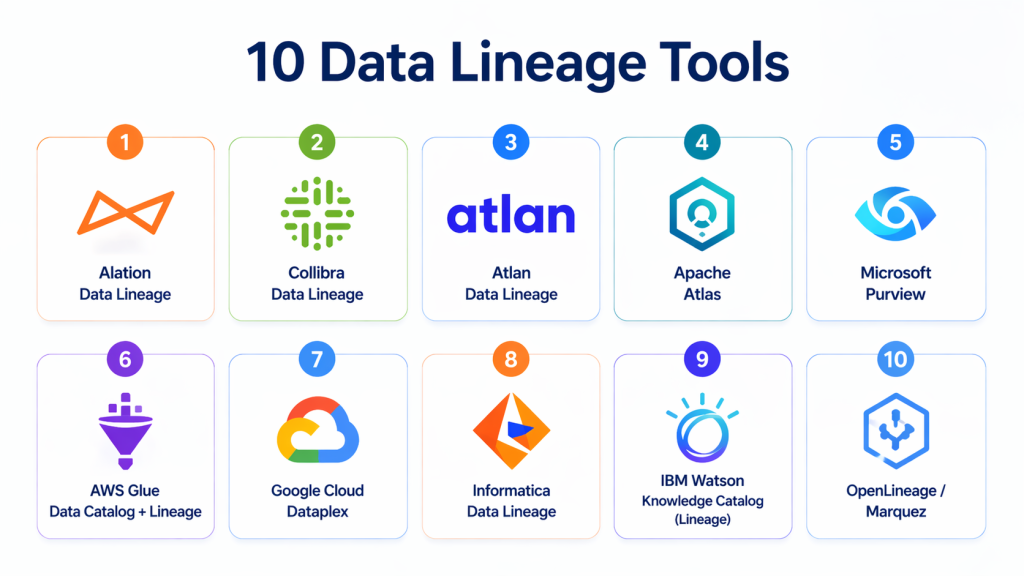
Top 10 Data Lineage Tools
1 — Alation Data Lineage
Alation is a leading data intelligence platform with strong lineage tracking and governance capabilities.
Key Features
- Automated data lineage discovery
- Business and technical lineage views
- Data catalog integration
- Metadata management
- Collaboration and annotation tools
- Governance workflows
- Usage analytics
Pros
- Strong enterprise adoption
- Excellent usability
- Powerful governance features
Cons
- High cost
- Complex setup
Platforms / Deployment
Cloud / Hybrid
Security & Compliance
RBAC, encryption, enterprise compliance support
Integrations & Ecosystem
BI tools, ETL systems, data warehouses, cloud platforms
Support & Community
Strong enterprise support
2 — Collibra Data Lineage
Collibra is a governance-focused platform with strong lineage visualization and metadata management.
Key Features
- End-to-end data lineage mapping
- Data governance workflows
- Business glossary integration
- Policy enforcement
- Metadata catalog
- Impact analysis
- Compliance tracking
Pros
- Strong governance capabilities
- Enterprise-grade scalability
- Detailed lineage visualization
Cons
- Complex implementation
- Expensive licensing
Platforms / Deployment
Cloud / Hybrid
Security & Compliance
Enterprise security, RBAC, compliance tools
Integrations & Ecosystem
Data warehouses, ETL tools, BI systems, cloud platforms
Support & Community
Strong enterprise adoption
3 — Atlan Data Lineage Platform
Atlan is a modern metadata and lineage platform built for agile data teams.
Key Features
- Active metadata tracking
- Automated lineage discovery
- Real-time updates
- Collaboration tools
- Data catalog integration
- Workflow automation
- API-based extensibility
Pros
- Easy to use
- Modern interface
- Strong collaboration features
Cons
- Smaller enterprise footprint
- Limited legacy system support
Platforms / Deployment
Cloud
Security & Compliance
RBAC, encryption, enterprise compliance support
Integrations & Ecosystem
Modern data stacks, BI tools, cloud warehouses, ETL systems
Support & Community
Fast-growing adoption
4 — Apache Atlas
Apache Atlas is an open-source metadata and lineage framework used in big data ecosystems.
Key Features
- Metadata classification
- Data lineage tracking
- Tagging and taxonomy
- Governance policies
- Hadoop integration
- Audit logging
- Metadata API
Pros
- Open-source flexibility
- Strong Hadoop ecosystem integration
- Highly customizable
Cons
- Requires engineering effort
- Less modern UI
Platforms / Deployment
Self-hosted / Hybrid
Security & Compliance
Kerberos authentication, RBAC support
Integrations & Ecosystem
Hadoop, Spark, big data pipelines, ETL systems
Support & Community
Strong open-source community
5 — Microsoft Purview
Microsoft Purview provides enterprise data governance with strong lineage tracking.
Key Features
- Automated data lineage mapping
- Data catalog integration
- Data classification
- Sensitivity labeling
- Governance policies
- Hybrid data support
- Impact analysis
Pros
- Strong Azure ecosystem integration
- Good governance capabilities
- Easy for Microsoft users
Cons
- Azure dependency
- Complex configuration
Platforms / Deployment
Cloud / Hybrid
Security & Compliance
Enterprise RBAC, encryption, compliance support
Integrations & Ecosystem
Azure Synapse, Power BI, SQL Server, cloud services
Support & Community
Strong Microsoft enterprise support
6 — AWS Glue Data Catalog + Lineage
AWS Glue provides metadata cataloging with lineage capabilities within AWS ecosystem.
Key Features
- Automated metadata extraction
- Data lineage tracking
- Schema discovery
- Serverless architecture
- Integration with AWS analytics
- ETL pipeline support
- Data catalog management
Pros
- Fully managed service
- Strong AWS integration
- Easy scalability
Cons
- AWS ecosystem lock-in
- Limited advanced governance
Platforms / Deployment
Cloud (AWS)
Security & Compliance
IAM-based security, encryption, AWS compliance support
Integrations & Ecosystem
S3, Athena, Redshift, EMR, Glue ETL
Support & Community
Strong AWS enterprise support
7 — Google Cloud Dataplex
Dataplex is Google’s unified data management and lineage platform.
Key Features
- Automated lineage tracking
- Data discovery and catalog
- Data governance policies
- Data quality monitoring
- AI-based classification
- Cross-system lineage
- Metadata management
Pros
- Strong Google Cloud integration
- Automated governance
- Scalable architecture
Cons
- Google dependency
- Pricing complexity
Platforms / Deployment
Cloud
Security & Compliance
IAM controls, encryption, enterprise compliance
Integrations & Ecosystem
BigQuery, cloud storage, AI tools, analytics systems
Support & Community
Strong Google enterprise support
8 — Informatica Data Lineage
Informatica provides enterprise-grade lineage tracking with deep metadata intelligence.
Key Features
- End-to-end lineage mapping
- AI-powered metadata discovery
- Impact analysis
- Data profiling
- Business glossary integration
- Governance workflows
- Automated metadata ingestion
Pros
- Highly accurate lineage
- Strong enterprise features
- Scalable architecture
Cons
- Complex setup
- High cost
Platforms / Deployment
Cloud / On-premise / Hybrid
Security & Compliance
Enterprise RBAC, encryption, compliance support
Integrations & Ecosystem
Data warehouses, ETL tools, BI platforms, enterprise systems
Support & Community
Strong enterprise support
9 — IBM Watson Knowledge Catalog
IBM Watson provides AI-powered metadata and lineage management.
Key Features
- AI-driven lineage mapping
- Data catalog integration
- Governance workflows
- Metadata classification
- Business glossary
- Data quality integration
- Cloud Pak support
Pros
- Strong AI capabilities
- Enterprise governance
- Deep IBM integration
Cons
- Complex setup
- High cost
Platforms / Deployment
Cloud / Hybrid
Security & Compliance
Advanced RBAC, encryption, compliance controls
Integrations & Ecosystem
IBM analytics systems, data platforms, enterprise tools
Support & Community
Strong IBM enterprise support
10 — OpenLineage + Marquez
OpenLineage is an open standard for data lineage collection and tracking.
Key Features
- Open lineage standard
- Pipeline metadata tracking
- Job and dataset lineage
- Integration with data tools
- Event-based tracking
- Open-source ecosystem
- Extensible framework
Pros
- Open-source flexibility
- Vendor-neutral standard
- Strong developer adoption
Cons
- Requires implementation effort
- No full UI platform
Platforms / Deployment
Self-hosted / Hybrid
Security & Compliance
Depends on implementation layer
Integrations & Ecosystem
Airflow, Spark, ETL tools, data pipelines
Support & Community
Strong open-source community
Comparison Table (Top 10)
| Tool | Best For | Platform | Deployment | Standout Feature | Public Rating |
|---|---|---|---|---|---|
| Alation | Enterprise lineage | Cross-platform | Hybrid | AI search lineage | N/A |
| Collibra | Governance | Cross-platform | Hybrid | Policy-driven lineage | N/A |
| Atlan | Modern teams | Cloud | Cloud | Active metadata | N/A |
| Apache Atlas | Open-source big data | Cross-platform | Hybrid | Hadoop lineage | N/A |
| Microsoft Purview | Azure governance | Azure | Cloud | Data classification | N/A |
| AWS Glue | AWS ecosystem | AWS | Cloud | Serverless lineage | N/A |
| Dataplex | Google ecosystem | Google Cloud | Cloud | Unified governance | N/A |
| Informatica | Enterprise metadata | Cross-platform | Hybrid | AI lineage mapping | N/A |
| IBM Watson | AI governance | Cross-platform | Hybrid | AI classification | N/A |
| OpenLineage | Open standard | Cross-platform | Hybrid | Vendor-neutral lineage | N/A |
Evaluation & Scoring
| Tool | Core (25%) | Ease (15%) | Integrations (15%) | Security (10%) | Performance (10%) | Support (10%) | Value (15%) | Total |
|---|---|---|---|---|---|---|---|---|
| Alation | 9 | 8 | 9 | 9 | 9 | 9 | 8 | 8.7 |
| Collibra | 9 | 7 | 9 | 9 | 9 | 9 | 7 | 8.5 |
| Atlan | 8 | 9 | 9 | 8 | 9 | 8 | 9 | 8.6 |
| Apache Atlas | 8 | 7 | 8 | 8 | 8 | 8 | 9 | 8.0 |
| Microsoft Purview | 9 | 8 | 9 | 9 | 9 | 9 | 8 | 8.7 |
| AWS Glue | 9 | 8 | 9 | 9 | 9 | 9 | 8 | 8.7 |
| Dataplex | 9 | 8 | 9 | 9 | 9 | 9 | 8 | 8.7 |
| Informatica | 9 | 7 | 9 | 9 | 9 | 9 | 7 | 8.4 |
| IBM Watson | 9 | 7 | 8 | 9 | 9 | 9 | 7 | 8.3 |
| OpenLineage | 8 | 7 | 8 | 8 | 8 | 8 | 9 | 8.0 |
Which Data Lineage Tool Should You Choose?
Solo developers and small teams can use OpenLineage or Apache Atlas for flexible lineage tracking. SMBs often prefer Atlan or AWS Glue for simplicity and cloud integration. Mid-market companies benefit from Microsoft Purview or Dataplex for scalable governance. Enterprises typically choose Alation, Collibra, or Informatica for advanced lineage and governance capabilities. Budget-friendly options include open-source tools, while premium enterprise tools include Collibra and Informatica. The choice depends on data complexity, governance needs, and ecosystem maturity.
Frequently Asked Questions
What is data lineage?
It is the tracking of data flow from source to destination.
Why is data lineage important?
It helps ensure data trust, governance, and compliance.
What does a data lineage tool do?
It visualizes how data moves and transforms across systems.
Is data lineage automated?
Yes, modern tools automate metadata collection.
What is column-level lineage?
It tracks data at the column or field level.
Which tool is best for beginners?
Atlan and AWS Glue are easier to use.
Do lineage tools support real-time tracking?
Yes, many modern tools do.
What industries use data lineage tools?
Finance, healthcare, SaaS, and enterprise IT.
Are open-source lineage tools available?
Yes, Apache Atlas and OpenLineage are open-source.
Can lineage tools integrate with ETL systems?
Yes, they commonly integrate with ETL pipelines.
Conclusion
Data Lineage Tools are essential for understanding how data moves across complex systems and ensuring trust in analytics and reporting. They help organizations improve data governance, troubleshoot issues faster, and maintain compliance with regulations. These tools also support better decision-making by making data flows transparent and traceable. Each platform offers different strengths depending on scalability, integration, and governance depth. Choosing the right tool depends on organizational maturity and ecosystem complexity. A pilot implementation is recommended before full-scale adoption.