Introduction
Container Security Tools are specialized solutions designed to protect containerized applications across their entire lifecycle—from development and image creation to deployment and runtime. As organizations increasingly adopt container technologies like Docker and Kubernetes, securing these dynamic environments has become a top priority. Containers introduce unique risks such as vulnerable images, misconfigurations, and runtime threats that traditional security tools are not designed to handle.
Modern container security tools address these challenges by offering image scanning, runtime protection, compliance monitoring, and DevSecOps integration. They help teams detect vulnerabilities early, enforce security policies, and monitor behavior in real time.
Common Use Cases
- Scanning container images for vulnerabilities before deployment
- Securing Kubernetes clusters and container orchestration environments
- Monitoring runtime behavior for threats and anomalies
- Enforcing compliance and security policies
- Integrating security into CI/CD pipelines
What Buyers Should Evaluate
- Image scanning capabilities and vulnerability databases
- Runtime protection and threat detection
- Kubernetes and orchestration support
- Integration with CI/CD pipelines
- Policy enforcement and compliance features
- Ease of deployment and management
- Scalability across environments
- Automation and remediation workflows
- Cost vs value
Best for: DevSecOps teams, cloud engineers, security teams, and organizations running containerized or Kubernetes-based applications.
Not ideal for: Organizations not using containers or those relying solely on traditional infrastructure.
Key Trends in Container Security Tools
- Shift toward CNAPP (unified cloud security platforms)
- Agentless and agent-based hybrid security models
- AI-driven threat detection and anomaly analysis
- Deep integration with Kubernetes and cloud-native stacks
- Shift-left security in CI/CD pipelines
- Runtime protection using behavioral analytics
- Focus on supply chain security and SBOMs
- Automated remediation and policy enforcement
- API-first design for integrations
- Real-time monitoring and alerting
How We Selected These Tools (Methodology)
- Strong industry adoption and credibility
- Proven container and Kubernetes security capabilities
- Comprehensive feature sets across lifecycle stages
- Integration with DevOps and cloud ecosystems
- Availability of automation and compliance features
- Suitability for different organization sizes
- Balance between enterprise and open-source tools
- Strong documentation and community support
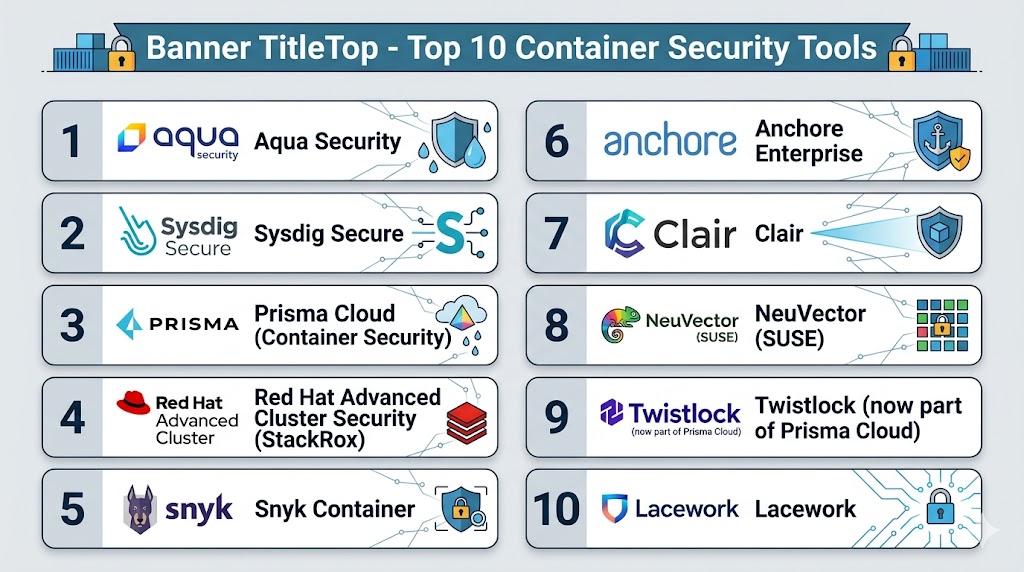
Top 10 Container Security Tools
#1 — Aqua Security
Short description: A leading container security platform offering full lifecycle protection for cloud-native applications.
Key Features
- Image scanning
- Runtime protection
- Kubernetes security
- Compliance monitoring
- Policy enforcement
- DevSecOps integration
Pros
- Strong container-focused capabilities
- Comprehensive security coverage
Cons
- Complex setup
- Requires expertise
Platforms / Deployment
- Cloud / Hybrid
Security & Compliance
- RBAC, encryption
- Compliance support varies
Integrations & Ecosystem
- Kubernetes
- CI/CD tools
- APIs
- Cloud platforms
Support & Community
Strong documentation and enterprise support.
#2 — Sysdig Secure
Short description: A container and Kubernetes security platform focused on runtime visibility and threat detection.
Key Features
- Runtime threat detection
- Kubernetes security
- Image scanning
- Compliance monitoring
- Risk prioritization
Pros
- Strong runtime protection
- Deep Kubernetes integration
Cons
- Learning curve
- Requires tuning
Platforms / Deployment
- Cloud
Security & Compliance
- Not publicly stated
Integrations & Ecosystem
- Kubernetes
- APIs
- DevOps tools
Support & Community
Good support and documentation.
#3 — Prisma Cloud (Container Security)
Short description: A comprehensive cloud security platform that includes container security capabilities.
Key Features
- Image scanning
- Runtime protection
- Compliance monitoring
- Risk prioritization
- DevOps integration
Pros
- Full-stack cloud security
- Strong enterprise capabilities
Cons
- Complex deployment
- Premium pricing
Platforms / Deployment
- Cloud
Security & Compliance
- RBAC, encryption
- Compliance frameworks supported
Integrations & Ecosystem
- Cloud platforms
- APIs
- CI/CD tools
Support & Community
Enterprise support.
#4 — Red Hat Advanced Cluster Security (StackRox)
Short description: A Kubernetes-native security platform designed for container environments.
Key Features
- Kubernetes security
- Image scanning
- Policy enforcement
- Runtime protection
- Risk analysis
Pros
- Kubernetes-native
- Strong policy controls
Cons
- Focused on Kubernetes
- Requires expertise
Platforms / Deployment
- Hybrid
Security & Compliance
- Not publicly stated
Integrations & Ecosystem
- Kubernetes
- OpenShift
- APIs
Support & Community
Strong enterprise and open-source support.
#5 — Snyk Container
Short description: A developer-friendly container security tool focused on vulnerability scanning and remediation.
Key Features
- Image vulnerability scanning
- Developer integrations
- Fix recommendations
- CI/CD integration
- Dependency analysis
Pros
- Easy to use
- Developer-focused
Cons
- Limited runtime protection
- Narrow scope
Platforms / Deployment
- Cloud
Security & Compliance
- Not publicly stated
Integrations & Ecosystem
- CI/CD tools
- Git platforms
- APIs
Support & Community
Strong developer community.
#6 — Anchore Enterprise
Short description: A container security platform focused on image scanning and policy enforcement.
Key Features
- Image scanning
- Policy enforcement
- SBOM generation
- Compliance checks
- Risk analysis
Pros
- Strong image scanning
- Flexible policies
Cons
- Limited runtime protection
- Requires configuration
Platforms / Deployment
- Cloud / Self-hosted
Security & Compliance
- Not publicly stated
Integrations & Ecosystem
- CI/CD tools
- APIs
- DevOps platforms
Support & Community
Good documentation and community.
#7 — Clair
Short description: An open-source container vulnerability scanner designed for analyzing container images.
Key Features
- Image vulnerability scanning
- Open-source database
- Integration support
- Automated updates
Pros
- Free and open-source
- Lightweight
Cons
- Limited features
- No runtime protection
Platforms / Deployment
- Linux
- Self-hosted
Security & Compliance
- Not publicly stated
Integrations & Ecosystem
- Container registries
- APIs
Support & Community
Active open-source community.
#8 — NeuVector (SUSE)
Short description: A container security platform providing runtime protection and network security.
Key Features
- Runtime protection
- Network segmentation
- Threat detection
- Compliance monitoring
- Kubernetes security
Pros
- Strong runtime controls
- Open-source availability
Cons
- Complex setup
- Requires expertise
Platforms / Deployment
- Cloud / Hybrid
Security & Compliance
- Not publicly stated
Integrations & Ecosystem
- Kubernetes
- APIs
Support & Community
Active community and enterprise support.
#9 — Twistlock (Prisma Cloud)
Short description: A container security solution integrated into Prisma Cloud for full lifecycle protection.
Key Features
- Image scanning
- Runtime protection
- Compliance monitoring
- Vulnerability management
- Risk prioritization
Pros
- Comprehensive features
- Enterprise-ready
Cons
- Requires Prisma Cloud
- Complex setup
Platforms / Deployment
- Cloud
Security & Compliance
- Not publicly stated
Integrations & Ecosystem
- Cloud platforms
- APIs
Support & Community
Enterprise support.
#10 — Lacework
Short description: A cloud security platform offering container and workload protection with behavioral analytics.
Key Features
- Behavioral analytics
- Container security
- Compliance monitoring
- Risk prioritization
- Threat detection
Pros
- Strong analytics
- Multi-cloud support
Cons
- Complex setup
- Learning curve
Platforms / Deployment
- Cloud
Security & Compliance
- Not publicly stated
Integrations & Ecosystem
- Cloud platforms
- APIs
- DevOps tools
Support & Community
Strong enterprise support.
Comparison Table (Top 10)
| Tool Name | Best For | Platform(s) Supported | Deployment | Standout Feature | Public Rating |
|---|---|---|---|---|---|
| Aqua Security | Enterprise | Web | Hybrid | Full lifecycle security | N/A |
| Sysdig Secure | Kubernetes | Web | Cloud | Runtime detection | N/A |
| Prisma Cloud | Full-stack security | Web | Cloud | Unified platform | N/A |
| Red Hat ACS | Kubernetes | Web | Hybrid | Policy enforcement | N/A |
| Snyk Container | Developers | Web | Cloud | Easy scanning | N/A |
| Anchore | Image scanning | Web | Hybrid | SBOM support | N/A |
| Clair | Open-source | Linux | Self-hosted | Lightweight scanning | N/A |
| NeuVector | Runtime security | Web | Hybrid | Network protection | N/A |
| Twistlock | Enterprise | Web | Cloud | Integrated security | N/A |
| Lacework | Analytics | Web | Cloud | Behavior analysis | N/A |
Evaluation & Scoring of Container Security Tools
| Tool Name | Core (25%) | Ease (15%) | Integrations (15%) | Security (10%) | Performance (10%) | Support (10%) | Value (15%) | Weighted Total |
|---|---|---|---|---|---|---|---|---|
| Aqua Security | 9 | 7 | 9 | 9 | 9 | 8 | 7 | 8.5 |
| Sysdig | 9 | 7 | 8 | 8 | 9 | 8 | 7 | 8.2 |
| Prisma Cloud | 9 | 7 | 9 | 9 | 9 | 8 | 7 | 8.5 |
| Red Hat ACS | 8 | 7 | 8 | 8 | 8 | 8 | 7 | 7.9 |
| Snyk | 8 | 9 | 8 | 7 | 8 | 8 | 8 | 8.2 |
| Anchore | 7 | 7 | 8 | 7 | 7 | 7 | 8 | 7.5 |
| Clair | 6 | 6 | 6 | 6 | 6 | 6 | 9 | 6.4 |
| NeuVector | 8 | 7 | 7 | 8 | 8 | 7 | 7 | 7.6 |
| Twistlock | 9 | 7 | 9 | 9 | 9 | 8 | 7 | 8.5 |
| Lacework | 8 | 7 | 8 | 8 | 8 | 8 | 7 | 7.9 |
How to interpret scores:
- Scores are comparative across tools
- Higher scores indicate stronger overall capabilities
- Enterprise tools lead in features and integrations
- Open-source tools offer better value but require expertise
- Choose based on your container strategy
Which Container Security Tool Is Right for You?
Solo / Freelancer
Use Clair or Snyk Container for lightweight scanning.
SMB
Use Snyk or Anchore for ease of use.
Mid-Market
Use Sysdig or NeuVector for balanced features.
Enterprise
Use Aqua Security or Prisma Cloud.
Budget vs Premium
- Budget: Clair, Anchore
- Premium: Aqua, Prisma
Feature Depth vs Ease of Use
- Deep features: Aqua
- Ease of use: Snyk
Integrations & Scalability
Best: Prisma Cloud, Sysdig
Security & Compliance Needs
Best: Aqua Security, Prisma Cloud
Frequently Asked Questions (FAQs)
1. What are container security tools?
They protect containerized applications across their lifecycle.
2. Why are they important?
They secure dynamic and cloud-native environments.
3. Do they support Kubernetes?
Yes, most tools support Kubernetes.
4. Are they developer-friendly?
Some tools like Snyk are developer-focused.
5. Can they detect runtime threats?
Yes, advanced tools provide runtime protection.
6. Are open-source tools enough?
Depends on requirements; enterprise tools offer more features.
7. Do they integrate with CI/CD?
Yes, most tools support CI/CD pipelines.
8. Are they expensive?
Pricing varies by features and scale.
9. Who should use them?
Organizations using containers and Kubernetes.
10. What is the biggest benefit?
Improved security across the container lifecycle.
Conclusion
Container Security Tools play a critical role in protecting modern cloud-native applications by addressing vulnerabilities at every stage of the container lifecycle. As organizations adopt Kubernetes and microservices architectures, the need for real-time visibility, automated security controls, and seamless DevOps integration becomes essential. While enterprise-grade tools offer comprehensive protection and scalability, smaller teams can still achieve strong security outcomes with focused, developer-friendly solutions. The best approach is to evaluate your container environment, shortlist a few tools, and validate how well they integrate into your existing workflows. Ultimately, choosing the right container security solution depends on your infrastructure complexity, security maturity, and operational goals.