Introduction
NoSQL Database Platforms are modern data storage systems designed to handle large-scale, unstructured, and rapidly changing data without relying on traditional relational table structures. These platforms support flexible schemas, horizontal scaling, and distributed architectures, making them essential for cloud-native and real-time applications.
In today’s data-driven environment, applications generate massive volumes of data from users, IoT devices, APIs, and AI systems. Traditional relational databases often struggle with this scale and flexibility, which makes NoSQL systems a preferred choice.
Common use cases include:
- Real-time analytics dashboards
- Social media platforms and messaging systems
- IoT data ingestion pipelines
- E-commerce product catalogs
- AI and machine learning data pipelines
Key evaluation criteria include scalability, performance, data model flexibility, security, integration ecosystem, deployment model, and operational complexity.
Best for: Developers, SaaS companies, data engineers, and enterprises building scalable distributed systems.
Not ideal for: Simple applications with fixed relational data structures or low-scale workloads.
Key Trends in NoSQL Database Platforms
- Growing adoption of multi-model databases
- Increasing demand for vector databases in AI workloads
- Serverless NoSQL architectures becoming standard
- Real-time streaming data integration expansion
- Strong shift toward multi-cloud and hybrid deployments
- AI-driven query optimization and automation
- Zero-trust security models in database systems
- Improved SQL compatibility layers in NoSQL engines
- Automated scaling and self-healing infrastructure
- Usage-based pricing models gaining popularity
How We Selected These Tools (Methodology)
- Market adoption and enterprise usage
- Scalability and performance benchmarks
- Data model flexibility and query capability
- Security and compliance readiness
- Integration ecosystem strength
- Cloud-native and distributed architecture support
- Developer experience and usability
- Community and vendor support strength
- Operational complexity and maintainability
- Innovation and future-readiness
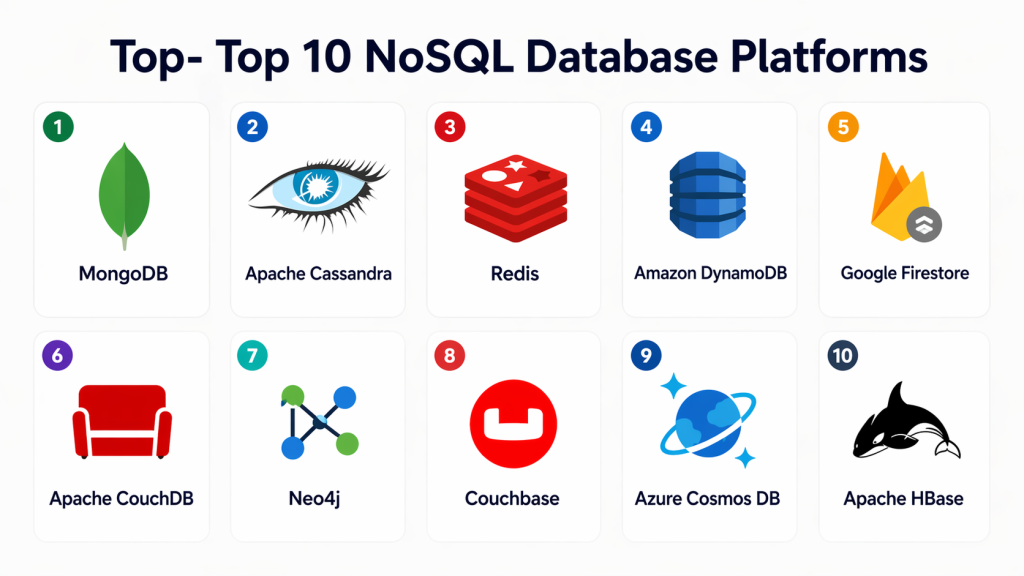
Top 10 NoSQL Database Platforms
1 — MongoDB
MongoDB is a leading document-based NoSQL database designed for flexibility, scalability, and modern application development.
Key Features
- Document-based JSON-like structure
- Horizontal scaling with sharding
- Replication and high availability
- Powerful aggregation pipeline
- Flexible schema design
- Indexing and search capabilities
- Multi-cloud support
Pros
- Highly flexible schema
- Strong developer ecosystem
- Scalable architecture
Cons
- Requires tuning for large workloads
- Resource-heavy at scale
Platforms / Deployment
- Cloud / Self-hosted / Hybrid
Security & Compliance
- RBAC, encryption, audit logs
- Compliance varies by deployment
Integrations & Ecosystem
- Cloud platforms
- Data pipelines
- Analytics tools
- Application frameworks
Support & Community
Large global adoption with strong enterprise support.
2 — Apache Cassandra
Cassandra is a distributed NoSQL database built for high availability and massive scalability.
Key Features
- Peer-to-peer architecture
- High write throughput
- Multi-data center replication
- Linear scalability
- Tunable consistency
- Fault tolerance
- Time-series optimization
Pros
- Extremely scalable
- No single point of failure
- High availability
Cons
- Complex configuration
- Limited query flexibility
Platforms / Deployment
- Self-hosted / Cloud / Hybrid
Security & Compliance
- Encryption support
- Enterprise RBAC options
Integrations & Ecosystem
- Big data systems
- Streaming tools
- Monitoring platforms
Support & Community
Strong open-source and enterprise ecosystem.
3 — Redis
Redis is an in-memory NoSQL database optimized for ultra-fast performance and real-time applications.
Key Features
- In-memory storage
- Key-value structure
- Pub/Sub messaging
- Caching system
- Persistence options
- Lua scripting
- Cluster support
Pros
- Extremely fast
- Simple architecture
- Ideal for real-time use cases
Cons
- Memory limitations
- Not ideal for large persistent datasets
Platforms / Deployment
- Cloud / Self-hosted / Hybrid
Security & Compliance
- TLS encryption
- Access control features
Integrations & Ecosystem
- Backend systems
- Caching layers
- Real-time apps
Support & Community
Very strong global community and enterprise offerings.
4 — Amazon DynamoDB
DynamoDB is a fully managed NoSQL database designed for serverless applications.
Key Features
- Fully managed service
- Auto scaling
- Low latency performance
- Global replication
- Event streaming
- Backup and restore
- Serverless architecture
Pros
- No infrastructure management
- Highly scalable
- Reliable performance
Cons
- Vendor lock-in
- Query limitations
Platforms / Deployment
- Cloud
Security & Compliance
- IAM-based access control
- Encryption by default
Integrations & Ecosystem
- Serverless applications
- Cloud-native systems
- Event-driven architectures
Support & Community
Enterprise-grade managed support.
5 — Apache CouchDB
CouchDB is a document-oriented database designed for offline-first applications and replication.
Key Features
- JSON document storage
- Multi-master replication
- Offline synchronization
- REST API
- Conflict resolution
- Eventual consistency
- Built-in UI
Pros
- Great for offline apps
- Simple API usage
- Flexible replication
Cons
- Limited scalability
- Basic querying
Platforms / Deployment
- Self-hosted / Cloud
Security & Compliance
- Basic authentication
- SSL support
Integrations & Ecosystem
- Mobile apps
- Web apps
- Sync systems
Support & Community
Active open-source community.
6 — Google Firestore
Firestore is a scalable document database optimized for mobile and web applications.
Key Features
- Real-time sync
- Auto scaling
- Offline support
- Document-based model
- Event triggers
- Strong query support
- Firebase integration
Pros
- Great for mobile apps
- Real-time updates
- Easy integration
Cons
- Vendor dependency
- Limited complex queries
Platforms / Deployment
- Cloud
Security & Compliance
- IAM security model
- Encryption at rest and transit
Integrations & Ecosystem
- Firebase tools
- Google Cloud
- Mobile SDKs
Support & Community
Strong Google ecosystem support.
7 — Neo4j
Neo4j is a graph database designed for highly connected data relationships.
Key Features
- Graph data model
- Cypher query language
- Relationship traversal
- Real-time graph analytics
- Visualization tools
- Clustering support
- Native graph engine
Pros
- Best for relationship-heavy data
- Powerful querying
- Strong visualization
Cons
- Niche use case
- Learning curve
Platforms / Deployment
- Cloud / Self-hosted / Hybrid
Security & Compliance
- RBAC and encryption
- Enterprise security options
Integrations & Ecosystem
- AI systems
- Fraud detection
- Knowledge graphs
Support & Community
Strong enterprise and developer ecosystem.
8 — Couchbase
Couchbase combines document storage with in-memory caching for high performance.
Key Features
- Multi-model support
- Built-in caching
- SQL-like query language
- Mobile sync
- Distributed architecture
- Auto failover
- Memory-first design
Pros
- High performance
- Flexible architecture
- Strong mobile support
Cons
- Complex setup
- Resource-heavy
Platforms / Deployment
- Cloud / Self-hosted / Hybrid
Security & Compliance
- Encryption and RBAC
- Enterprise controls
Integrations & Ecosystem
- Enterprise apps
- Analytics tools
- Mobile systems
Support & Community
Strong enterprise support.
9 — Azure Cosmos DB
Cosmos DB is a globally distributed NoSQL database with multi-model capabilities.
Key Features
- Multi-model support
- Global distribution
- Low latency
- Auto scaling
- Multiple consistency levels
- Change feed support
- SLA-backed performance
Pros
- Global scalability
- Strong Azure integration
- Flexible models
Cons
- Complex pricing
- Platform dependency
Platforms / Deployment
- Cloud
Security & Compliance
- Enterprise-grade security
- Full compliance coverage
Integrations & Ecosystem
- Azure services
- AI tools
- Analytics platforms
Support & Community
Enterprise Microsoft support.
10 — HBase
HBase is a column-family NoSQL database designed for big data workloads.
Key Features
- Columnar storage
- Hadoop integration
- High scalability
- Real-time access
- Fault tolerance
- Batch processing support
- Big data optimization
Pros
- Strong big data support
- Highly scalable
- Reliable architecture
Cons
- Complex setup
- Requires Hadoop ecosystem
Platforms / Deployment
- Self-hosted / Cloud / Hybrid
Security & Compliance
- Hadoop-based security
- Enterprise setup required
Integrations & Ecosystem
- Hadoop
- Spark
- Data lakes
Support & Community
Strong enterprise and open-source support.
Comparison Table (Top 10)
| Tool | Best For | Platform | Deployment | Standout Feature | Public Rating |
|---|---|---|---|---|---|
| MongoDB | General apps | Cross-platform | Cloud/Self | Flexible schema | N/A |
| Cassandra | Distributed systems | Cross-platform | Hybrid | High availability | N/A |
| Redis | Real-time apps | Cross-platform | Cloud/Self | In-memory speed | N/A |
| DynamoDB | Serverless apps | AWS | Cloud | Fully managed | N/A |
| CouchDB | Offline apps | Cross-platform | Cloud/Self | Replication | N/A |
| Firestore | Mobile apps | Google Cloud | Cloud | Real-time sync | N/A |
| Neo4j | Graph data | Cross-platform | Hybrid | Relationship model | N/A |
| Couchbase | Enterprise apps | Cross-platform | Hybrid | Memory-first design | N/A |
| Cosmos DB | Global apps | Azure | Cloud | Multi-model DB | N/A |
| HBase | Big data | Hadoop | Hybrid | Columnar scale | N/A |
Evaluation & Scoring
| Tool | Core (25%) | Ease (15%) | Integrations (15%) | Security (10%) | Performance (10%) | Support (10%) | Value (15%) | Total |
|---|---|---|---|---|---|---|---|---|
| MongoDB | 9 | 8 | 9 | 8 | 9 | 8 | 8 | 8.6 |
| Cassandra | 9 | 6 | 7 | 8 | 10 | 8 | 8 | 8.2 |
| Redis | 8 | 9 | 8 | 7 | 10 | 8 | 9 | 8.6 |
| DynamoDB | 8 | 9 | 9 | 9 | 9 | 9 | 7 | 8.7 |
| CouchDB | 7 | 8 | 7 | 7 | 6 | 7 | 8 | 7.2 |
| Firestore | 8 | 9 | 9 | 9 | 8 | 9 | 8 | 8.6 |
| Neo4j | 8 | 7 | 8 | 8 | 8 | 8 | 7 | 7.9 |
| Couchbase | 8 | 7 | 8 | 8 | 9 | 8 | 7 | 8.0 |
| Cosmos DB | 9 | 8 | 9 | 9 | 9 | 9 | 7 | 8.7 |
| HBase | 8 | 6 | 7 | 7 | 9 | 7 | 8 | 7.6 |
Which NoSQL Database Platform Should You Choose?
Solo / Freelancer
MongoDB, Redis, Firestore
SMB
MongoDB, Couchbase, Firestore
Mid-Market
Cassandra, Neo4j, Couchbase
Enterprise
Cosmos DB, DynamoDB, Cassandra, HBase
Budget vs Premium
- Budget: Redis, CouchDB, MongoDB Community
- Premium: Cosmos DB, DynamoDB, enterprise MongoDB
Ease vs Power
- Easy: Firestore, Redis, DynamoDB
- Advanced: Cassandra, HBase, Neo4j
Frequently Asked Questions
1. What is NoSQL used for?
It is used for handling large-scale, flexible, and unstructured data in modern applications.
2. Is NoSQL better than SQL?
It depends on use case. NoSQL is better for scalability and flexibility, while SQL is better for structured data.
3. Which NoSQL database is fastest?
Redis is widely known for extremely fast in-memory performance.
4. Is NoSQL good for big data?
Yes, it is commonly used in big data and distributed systems.
5. Can NoSQL handle transactions?
Some NoSQL databases support limited transactional capabilities.
6. Is MongoDB a NoSQL database?
Yes, MongoDB is a document-based NoSQL database.
7. What companies use NoSQL?
Large-scale tech platforms, SaaS companies, and enterprise systems use NoSQL widely.
8. Is NoSQL secure?
Yes, modern NoSQL platforms include encryption and access control features.
9. What is the main disadvantage of NoSQL?
It may lack complex relational querying and consistency in some systems.
10. Can NoSQL replace relational databases?
Not completely. Both are often used together depending on system requirements.
Conclusion
NoSQL Database Platforms play a critical role in modern data architecture by enabling scalability, flexibility, and real-time performance. Each platform serves a different purpose depending on workload and system design needs. While some excel in speed, others focus on distributed reliability or graph relationships. Choosing the right solution depends on application complexity, scalability needs, and ecosystem compatibility. A practical evaluation approach is to test 2–3 platforms before final adoption to ensure performance and integration fit.