Introduction
Model distillation and compression tooling helps organizations reduce the size, latency, memory usage, and infrastructure cost of machine learning and generative AI models while preserving acceptable accuracy and performance. These platforms and frameworks enable teams to optimize large language models, computer vision systems, and neural networks for production deployment across cloud, edge, mobile, and enterprise environments.
As AI models continue growing in size and computational complexity, organizations face rising GPU costs, slower inference speeds, and deployment challenges. Model compression technologies such as quantization, pruning, knowledge distillation, tensor optimization, and low-rank adaptation are becoming critical for efficient AI operations. These tooling platforms help enterprises deploy AI models faster, cheaper, and more reliably across production environments.
Common use cases include:
- Compressing large language models for inference
- Optimizing AI workloads for edge devices
- Reducing GPU infrastructure costs
- Accelerating real-time AI inference
- Mobile AI deployment optimization
- Fine-tuning compact AI models
- Improving AI serving efficiency
Key buyer evaluation criteria include:
- Quantization and pruning support
- LLM optimization capabilities
- Hardware compatibility
- Inference acceleration performance
- Framework interoperability
- Ease of deployment
- GPU and CPU optimization
- Scalability for enterprise workloads
- Monitoring and benchmarking support
- Integration ecosystem maturity
Best for: AI engineers, MLOps teams, platform engineering teams, edge AI developers, enterprise AI infrastructure teams, SaaS companies, AI startups, and organizations optimizing production AI systems.
Not ideal for: Teams running lightweight AI workloads with minimal infrastructure costs, organizations still in experimentation stages, or businesses that rely entirely on managed AI APIs without custom model deployment requirements.
Key Trends in Model Distillation & Compression Tooling
- Quantization is becoming a standard optimization method for large language model deployment.
- Smaller distilled models are increasingly replacing large foundation models for production inference.
- Edge AI optimization is rapidly expanding across IoT and mobile environments.
- Hardware-aware optimization is becoming critical for GPU and accelerator efficiency.
- Sparse model architectures are improving inference speed and memory utilization.
- Automated compression pipelines are integrating into MLOps workflows.
- Low-rank adaptation techniques are reducing fine-tuning costs.
- AI inference optimization for CPUs is gaining importance alongside GPU acceleration.
- Hybrid cloud and edge AI deployments are increasing demand for lightweight models.
- Compression-aware benchmarking is becoming part of enterprise AI governance workflows.
How We Selected These Tools Methodology
The tools in this list were selected using practical AI infrastructure and deployment-focused evaluation criteria:
- Market adoption and ecosystem momentum
- Model optimization feature completeness
- Support for quantization and pruning
- LLM compression capabilities
- Hardware optimization flexibility
- Integration ecosystem quality
- Enterprise deployment readiness
- Performance acceleration capabilities
- Open-source and enterprise support balance
- Developer usability and documentation quality
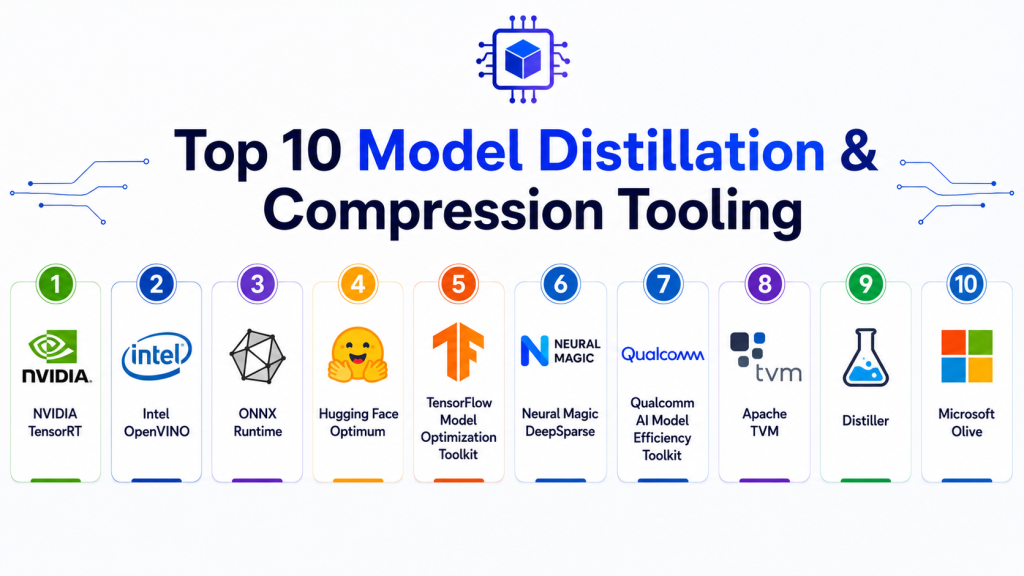
Top 10 Model Distillation & Compression Tooling
1- NVIDIA TensorRT
Short description: NVIDIA TensorRT is one of the most widely used AI inference optimization platforms for accelerating deep learning models on NVIDIA GPUs. It enables quantization, pruning, and runtime optimization for production AI deployments across cloud and edge environments.
Key Features
- GPU inference optimization
- FP16 and INT8 quantization
- Tensor optimization
- Dynamic batching
- Multi-framework compatibility
- Kernel auto-tuning
- High-performance inference acceleration
Pros
- Excellent GPU acceleration
- Strong enterprise adoption
- High-performance inference optimization
- Mature deployment ecosystem
Cons
- NVIDIA hardware dependency
- Complex tuning workflows
- Less suitable for CPU-focused deployments
- Advanced optimization requires expertise
Platforms / Deployment
Cloud / Self-hosted / Hybrid
Security & Compliance
Encryption compatibility, RBAC integration support, enterprise infrastructure security compatibility. Additional certifications not publicly stated.
Integrations & Ecosystem
TensorRT integrates deeply into NVIDIA AI infrastructure ecosystems and GPU-centric deployment pipelines.
- CUDA
- PyTorch
- TensorFlow
- ONNX
- Triton Inference Server
- Kubernetes
- NVIDIA AI Enterprise
Support & Community
Strong enterprise ecosystem with extensive documentation and broad AI infrastructure adoption.
2- Intel OpenVINO
Short description: OpenVINO is Intel’s AI optimization toolkit designed for accelerating inference across CPUs, GPUs, VPUs, and edge devices. It enables model compression, quantization, and hardware-aware deployment optimization.
Key Features
- CPU inference optimization
- Model quantization
- Edge AI acceleration
- Multi-device deployment
- Neural network compression
- Hardware-aware optimization
- Open-source toolkit
Pros
- Strong CPU optimization
- Excellent edge AI support
- Broad hardware flexibility
- Good open-source accessibility
Cons
- Less optimized for NVIDIA GPU ecosystems
- Some workflows require hardware expertise
- Enterprise tooling smaller than GPU-focused competitors
- Advanced tuning complexity
Platforms / Deployment
Cloud / Self-hosted / Hybrid
Security & Compliance
Infrastructure-level security compatibility and enterprise deployment support. Additional certifications not publicly stated.
Integrations & Ecosystem
OpenVINO integrates with Intel AI infrastructure and edge deployment ecosystems.
- TensorFlow
- PyTorch
- ONNX
- Kubernetes
- Intel CPUs
- Edge AI devices
- Open Neural Network Exchange
Support & Community
Strong enterprise and edge AI adoption with active open-source development.
3- ONNX Runtime
Short description: ONNX Runtime is a high-performance inference engine optimized for deploying compressed and accelerated machine learning models across multiple hardware platforms. It supports quantization and cross-framework interoperability.
Key Features
- Cross-platform inference
- Quantization support
- Hardware acceleration
- Multi-framework compatibility
- Graph optimization
- Runtime acceleration
- Lightweight deployment
Pros
- Broad interoperability
- Strong performance optimization
- Good hardware flexibility
- Lightweight runtime footprint
Cons
- Advanced optimization workflows can be technical
- Some enterprise tooling limited
- Requires framework conversion workflows
- Less governance tooling than enterprise platforms
Platforms / Deployment
Cloud / Self-hosted / Hybrid
Security & Compliance
Encryption compatibility and infrastructure-level security support. Additional certifications not publicly stated.
Integrations & Ecosystem
ONNX Runtime integrates with modern AI deployment ecosystems and hardware acceleration environments.
- PyTorch
- TensorFlow
- Azure
- NVIDIA GPUs
- Intel hardware
- Kubernetes
- Edge AI devices
Support & Community
Large open-source ecosystem with strong enterprise adoption across AI infrastructure teams.
4- Hugging Face Optimum
Short description: Hugging Face Optimum is a model optimization toolkit focused on accelerating transformer models and generative AI workloads across different hardware platforms. It simplifies quantization and inference optimization workflows.
Key Features
- Transformer optimization
- Quantization workflows
- Hardware acceleration support
- LLM optimization
- Inference acceleration
- Multi-backend compatibility
- Edge deployment optimization
Pros
- Excellent Hugging Face ecosystem integration
- Developer-friendly workflows
- Strong generative AI optimization
- Broad hardware support
Cons
- Best optimized for transformer ecosystems
- Some advanced tuning still evolving
- Enterprise governance features limited
- Dependency on Hugging Face workflows
Platforms / Deployment
Cloud / Self-hosted / Hybrid
Security & Compliance
Authentication compatibility and infrastructure-level security support. Additional certifications not publicly stated.
Integrations & Ecosystem
Optimum integrates naturally into transformer and generative AI development workflows.
- Transformers
- ONNX Runtime
- TensorRT
- Intel OpenVINO
- PyTorch
- AWS
- Azure
Support & Community
Very active open-source ecosystem with strong generative AI developer adoption.
5- TensorFlow Model Optimization Toolkit
Short description: TensorFlow Model Optimization Toolkit is a framework for quantization, pruning, and compression of TensorFlow models. It helps organizations reduce model size and improve inference efficiency.
Key Features
- Quantization-aware training
- Weight pruning
- Clustering optimization
- Compression workflows
- TensorFlow integration
- Edge AI optimization
- Deployment acceleration
Pros
- Strong TensorFlow ecosystem integration
- Good mobile AI optimization
- Mature compression workflows
- Lightweight deployment support
Cons
- Primarily TensorFlow-focused
- Less flexibility outside TensorFlow ecosystems
- Advanced workflows can become technical
- Limited enterprise governance features
Platforms / Deployment
Cloud / Self-hosted / Hybrid
Security & Compliance
Infrastructure-level security compatibility. Additional certifications not publicly stated.
Integrations & Ecosystem
The toolkit integrates deeply into TensorFlow deployment and mobile AI ecosystems.
- TensorFlow
- TensorFlow Lite
- Kubernetes
- Edge AI environments
- Mobile AI pipelines
- Google Cloud
- ONNX conversion workflows
Support & Community
Strong TensorFlow community support with broad educational resources.
6- Neural Magic DeepSparse
Short description: DeepSparse is an inference engine focused on sparse model optimization and CPU acceleration. It helps organizations deploy compressed AI models with improved inference efficiency on commodity hardware.
Key Features
- Sparse model acceleration
- CPU inference optimization
- Quantization support
- SparseML integration
- Runtime acceleration
- LLM optimization
- Hardware efficiency tuning
Pros
- Strong CPU optimization
- Reduced GPU dependency
- Good inference efficiency
- Cost-effective deployment capabilities
Cons
- Smaller ecosystem maturity
- Sparse workflows require expertise
- Limited compared to GPU-centric platforms
- Enterprise adoption still growing
Platforms / Deployment
Cloud / Self-hosted / Hybrid
Security & Compliance
Infrastructure-level security support and deployment compatibility. Additional certifications not publicly stated.
Integrations & Ecosystem
DeepSparse integrates with sparse model optimization and AI inference ecosystems.
- SparseML
- ONNX
- PyTorch
- Kubernetes
- CPU infrastructure
- Edge deployments
- AI serving platforms
Support & Community
Growing open-source ecosystem with increasing enterprise AI optimization adoption.
7- Qualcomm AI Model Efficiency Toolkit
Short description: Qualcomm AI Model Efficiency Toolkit is designed for compressing and optimizing AI models for edge devices and mobile environments. It supports quantization and deployment acceleration for low-power AI systems.
Key Features
- Edge AI optimization
- Quantization support
- Mobile AI acceleration
- Hardware-aware tuning
- Compression workflows
- Low-power inference optimization
- Deployment benchmarking
Pros
- Excellent mobile AI optimization
- Strong edge deployment support
- Efficient low-power inference
- Hardware-aware acceleration
Cons
- More specialized for edge environments
- Smaller enterprise ecosystem
- Limited cloud AI optimization focus
- Hardware-specific workflows
Platforms / Deployment
Self-hosted / Hybrid
Security & Compliance
Infrastructure-level security compatibility. Additional certifications not publicly stated.
Integrations & Ecosystem
Qualcomm’s toolkit integrates with mobile AI and edge deployment ecosystems.
- Qualcomm hardware
- TensorFlow
- ONNX
- Mobile AI frameworks
- Embedded AI systems
- Edge AI environments
- IoT pipelines
Support & Community
Strong mobile AI ecosystem support with growing edge AI adoption.
8- Apache TVM
Short description: Apache TVM is an open-source machine learning compiler stack designed for optimizing deep learning models across diverse hardware backends. It supports automated optimization and deployment acceleration.
Key Features
- Hardware-aware compilation
- Graph optimization
- Quantization support
- Auto-tuning workflows
- Multi-hardware compatibility
- Runtime optimization
- Edge deployment acceleration
Pros
- Strong hardware flexibility
- Open-source accessibility
- Powerful optimization capabilities
- Broad deployment compatibility
Cons
- Steep learning curve
- Requires compiler-level expertise
- Operational complexity
- Smaller enterprise support ecosystem
Platforms / Deployment
Cloud / Self-hosted / Hybrid
Security & Compliance
Infrastructure-level security compatibility. Additional certifications not publicly stated.
Integrations & Ecosystem
Apache TVM integrates with advanced AI optimization and compiler ecosystems.
- PyTorch
- TensorFlow
- ONNX
- CUDA
- Edge AI systems
- Kubernetes
- AI compilers
Support & Community
Active research and open-source community with strong academic and infrastructure interest.
9- Distiller by Intel Labs
Short description: Distiller is an open-source neural network compression framework focused on pruning, quantization, and distillation workflows. It helps developers optimize deep learning models for efficient inference.
Key Features
- Model pruning
- Quantization workflows
- Knowledge distillation
- Compression benchmarking
- Sparse model optimization
- PyTorch integration
- Lightweight deployment support
Pros
- Strong research-oriented workflows
- Open-source flexibility
- Good pruning capabilities
- Useful experimentation environment
Cons
- Smaller ecosystem momentum
- Limited enterprise operational tooling
- Technical learning curve
- Less production-focused than commercial platforms
Platforms / Deployment
Cloud / Self-hosted / Hybrid
Security & Compliance
Infrastructure-level security support. Additional certifications not publicly stated.
Integrations & Ecosystem
Distiller integrates with research and model optimization ecosystems.
- PyTorch
- ONNX
- Compression workflows
- AI research pipelines
- Sparse optimization systems
- Benchmarking environments
- Model deployment stacks
Support & Community
Smaller but active research-focused open-source ecosystem.
10- Microsoft Olive
Short description: Microsoft Olive is an AI model optimization framework designed to automate model compression, quantization, and deployment workflows for production AI systems across cloud and edge environments.
Key Features
- Automated optimization pipelines
- Quantization workflows
- Hardware-aware optimization
- LLM acceleration
- Azure integration
- ONNX optimization
- Deployment benchmarking
Pros
- Strong automation capabilities
- Good Azure ecosystem integration
- Simplified optimization workflows
- Broad hardware support
Cons
- Best optimized for Microsoft ecosystems
- Enterprise workflows still evolving
- Smaller ecosystem than older frameworks
- Advanced tuning may require expertise
Platforms / Deployment
Cloud / Self-hosted / Hybrid
Security & Compliance
Authentication compatibility, infrastructure-level security controls, encryption support.
Integrations & Ecosystem
Microsoft Olive integrates with AI deployment and Azure infrastructure ecosystems.
- Azure
- ONNX Runtime
- PyTorch
- TensorFlow
- Kubernetes
- Edge AI environments
- AI serving platforms
Support & Community
Growing ecosystem momentum with strong Microsoft AI infrastructure alignment.
Comparison Table Top 10
| Tool Name | Best For | Platforms Supported | Deployment | Standout Feature | Public Rating |
|---|---|---|---|---|---|
| NVIDIA TensorRT | GPU inference acceleration | Linux / Cloud | Hybrid | GPU optimization | N/A |
| Intel OpenVINO | CPU and edge AI optimization | Windows / Linux | Hybrid | CPU acceleration | N/A |
| ONNX Runtime | Cross-platform inference | Windows / Linux / Cloud | Hybrid | Hardware interoperability | N/A |
| Hugging Face Optimum | Transformer optimization | Linux / Cloud | Hybrid | LLM acceleration | N/A |
| TensorFlow Model Optimization Toolkit | TensorFlow compression | Linux / Cloud | Hybrid | Quantization-aware training | N/A |
| Neural Magic DeepSparse | Sparse CPU inference | Linux / Cloud | Hybrid | Sparse acceleration | N/A |
| Qualcomm AI Model Efficiency Toolkit | Mobile AI optimization | Linux / Embedded | Hybrid | Edge AI acceleration | N/A |
| Apache TVM | Hardware-aware AI compilation | Linux / Cloud | Hybrid | Auto-tuning optimization | N/A |
| Distiller | Research-focused compression | Linux / Cloud | Hybrid | Model pruning | N/A |
| Microsoft Olive | Automated AI optimization | Windows / Linux / Cloud | Hybrid | Automated optimization pipelines | N/A |
Evaluation & Scoring of Model Distillation & Compression Tooling
| Tool Name | Core 25% | Ease 15% | Integrations 15% | Security 10% | Performance 10% | Support 10% | Value 15% | Weighted Total |
|---|---|---|---|---|---|---|---|---|
| NVIDIA TensorRT | 9.7 | 7.5 | 9.2 | 8.8 | 9.8 | 9.0 | 8.0 | 9.0 |
| Intel OpenVINO | 9.0 | 8.0 | 8.8 | 8.2 | 9.0 | 8.5 | 8.9 | 8.7 |
| ONNX Runtime | 9.2 | 8.2 | 9.4 | 8.1 | 9.1 | 8.8 | 9.0 | 8.9 |
| Hugging Face Optimum | 8.9 | 8.8 | 8.9 | 7.8 | 8.9 | 8.7 | 8.8 | 8.7 |
| TensorFlow Model Optimization Toolkit | 8.7 | 8.1 | 8.5 | 7.9 | 8.6 | 8.5 | 8.9 | 8.5 |
| Neural Magic DeepSparse | 8.8 | 7.6 | 8.0 | 7.7 | 9.0 | 8.1 | 8.8 | 8.4 |
| Qualcomm AI Model Efficiency Toolkit | 8.5 | 7.8 | 7.9 | 7.5 | 8.8 | 7.9 | 8.7 | 8.2 |
| Apache TVM | 9.1 | 6.9 | 8.7 | 7.8 | 9.3 | 8.0 | 8.9 | 8.5 |
| Distiller | 8.3 | 7.2 | 7.8 | 7.4 | 8.5 | 7.7 | 8.9 | 8.0 |
| Microsoft Olive | 8.8 | 8.4 | 8.7 | 8.2 | 8.8 | 8.3 | 8.7 | 8.6 |
These scores are comparative and designed to help organizations evaluate strengths across optimization depth, deployment flexibility, performance acceleration, and ecosystem maturity. Higher scores do not automatically mean a universal winner because different tools prioritize different deployment scenarios. Some platforms focus heavily on GPU optimization, while others specialize in edge AI or cross-platform interoperability. Buyers should evaluate infrastructure strategy, hardware requirements, and operational complexity before selecting a tooling stack.
Which Model Distillation & Compression Tooling Is Right for You?
Solo / Freelancer
Independent AI developers and small teams often benefit from lightweight and developer-friendly optimization frameworks. Hugging Face Optimum and ONNX Runtime are strong choices for fast deployment and broad compatibility.
SMB
Small and medium-sized businesses usually prioritize deployment simplicity, infrastructure efficiency, and operational cost reduction. Intel OpenVINO and Microsoft Olive provide balanced optimization capabilities with manageable deployment complexity.
Mid-Market
Mid-market organizations often require scalable optimization workflows and multi-platform compatibility. Apache TVM and ONNX Runtime provide strong flexibility across deployment environments.
Enterprise
Large enterprises typically prioritize hardware acceleration, scalability, governance, and operational reliability. NVIDIA TensorRT and Intel OpenVINO are widely used for enterprise AI infrastructure optimization.
Budget vs Premium
Open-source tools like Apache TVM, ONNX Runtime, and Distiller can significantly reduce licensing costs but may require stronger engineering expertise. Enterprise ecosystems often provide better support and operational tooling but increase infrastructure investment.
Feature Depth vs Ease of Use
Advanced compiler and optimization frameworks provide deeper performance tuning but require greater technical expertise. Developer-friendly toolkits simplify deployment workflows but may offer less granular optimization control.
Integrations & Scalability
Organizations deploying AI at scale should prioritize tooling with strong integrations for Kubernetes, AI serving platforms, cloud infrastructure, and hardware accelerators.
Security & Compliance Needs
Regulated industries should prioritize frameworks compatible with enterprise infrastructure security, audit logging, encryption support, and governance tooling.
Frequently Asked Questions FAQs
1. What is model distillation?
Model distillation is a technique where a smaller model learns from a larger model to achieve similar performance while reducing inference cost and deployment complexity.
2. Why is AI model compression important?
Compression reduces model size, improves inference speed, lowers infrastructure costs, and enables deployment on edge devices and resource-constrained environments.
3. What is quantization in AI optimization?
Quantization reduces numerical precision in neural networks to improve inference speed and reduce memory usage while maintaining acceptable accuracy levels.
4. Can compressed models maintain good accuracy?
Yes, modern compression techniques can significantly reduce model size while preserving strong performance for many production AI workloads.
5. Which hardware benefits most from optimization tooling?
GPUs, CPUs, edge accelerators, mobile AI chips, and embedded AI systems can all benefit from optimized inference workflows.
6. Are these tools suitable for large language models?
Yes, many modern optimization platforms now support LLM quantization, distillation, pruning, and inference acceleration workflows.
7. What are common mistakes in model compression projects?
Common mistakes include over-aggressive quantization, ignoring benchmarking workflows, failing to test real-world workloads, and optimizing only for latency without considering accuracy trade-offs.
8. Is ONNX important for AI optimization?
ONNX has become an important interoperability standard because it enables models to move across frameworks and hardware environments more efficiently.
9. Can model optimization reduce cloud infrastructure costs?
Yes, optimized models often reduce GPU usage, memory consumption, and inference latency, significantly lowering cloud AI operational costs.
10. Which tooling is best for edge AI deployments?
Intel OpenVINO, Qualcomm AI Model Efficiency Toolkit, and TensorFlow optimization workflows are commonly used for edge AI deployment scenarios.
Conclusion
Model distillation and compression tooling has become a critical part of modern AI infrastructure as organizations scale generative AI, edge AI, and production machine learning workloads. These platforms help reduce inference cost, improve latency, optimize hardware utilization, and enable deployment across cloud, mobile, and embedded environments. The best tooling depends on deployment architecture, hardware strategy, optimization requirements, and operational maturity. GPU-focused ecosystems often prioritize maximum inference acceleration, while edge AI frameworks focus more on lightweight deployment and power efficiency. Open-source optimization frameworks provide flexibility and cost efficiency, while enterprise ecosystems offer stronger operational tooling and support. The most effective approach is to shortlist a few optimization platforms that align with your infrastructure strategy, benchmark them against real-world workloads, validate compatibility with serving environments, and measure performance improvements before scaling production deployments.