Introduction
AI evaluation and benchmarking frameworks are platforms and toolkits designed to measure the quality, reliability, safety, accuracy, and performance of machine learning models and large language models. These frameworks help organizations validate AI systems before deployment and continuously monitor performance in production environments. As generative AI adoption grows, enterprises increasingly need reliable methods to test hallucinations, factual accuracy, latency, reasoning quality, safety guardrails, and retrieval performance.
Modern AI systems are becoming more complex, especially with retrieval-augmented generation pipelines, agentic AI workflows, multimodal systems, and enterprise copilots. Traditional testing methods are no longer enough for evaluating dynamic AI behaviors. AI evaluation frameworks now play a critical role in ensuring production-grade reliability, governance, and operational trust.
Real-world use cases include:
- Benchmarking large language models
- Evaluating retrieval-augmented generation systems
- AI safety and hallucination testing
- Prompt quality validation
- Monitoring production AI drift
- Regression testing for AI applications
- Human feedback alignment workflows
Key buyer evaluation criteria include:
- Evaluation metric flexibility
- LLM and RAG benchmarking support
- Observability and tracing capabilities
- Integration ecosystem maturity
- Experiment tracking and versioning
- Scalability for production workloads
- Security and governance features
- Support for automated evaluation pipelines
- Developer usability
- Cost efficiency and deployment flexibility
Best for: AI engineers, MLOps teams, platform engineering teams, AI startups, SaaS companies, enterprise AI governance teams, research organizations, and businesses deploying production generative AI systems.
Not ideal for: Teams only running lightweight AI experiments, organizations without active AI deployment workflows, or companies that only consume third-party AI APIs without model evaluation requirements.
Key Trends in AI Evaluation & Benchmarking Frameworks
- RAG evaluation frameworks are rapidly becoming a standard requirement for enterprise AI deployments.
- Automated hallucination detection is evolving into a major enterprise priority.
- Human-in-the-loop evaluation workflows are becoming more integrated with AI observability systems.
- Synthetic dataset generation is increasingly used for scalable benchmark testing.
- AI evaluation pipelines are becoming integrated into CI/CD workflows.
- Multi-model benchmarking across providers is becoming common for cost and quality optimization.
- LLM judges and AI-based evaluators are increasingly replacing manual testing workflows.
- AI governance and compliance reporting are becoming more important in regulated industries.
- Real-time production evaluation and drift monitoring are expanding rapidly.
- Multimodal AI evaluation support is becoming a differentiating capability.
How We Selected These Tools Methodology
The frameworks in this list were selected using practical enterprise and developer-focused evaluation criteria:
- Market adoption and ecosystem momentum
- Evaluation feature completeness
- RAG and LLM benchmarking support
- Observability and tracing depth
- Scalability and operational readiness
- Integration ecosystem quality
- Open-source and enterprise flexibility
- Developer usability and documentation quality
- Governance and monitoring capabilities
- Community support and innovation pace
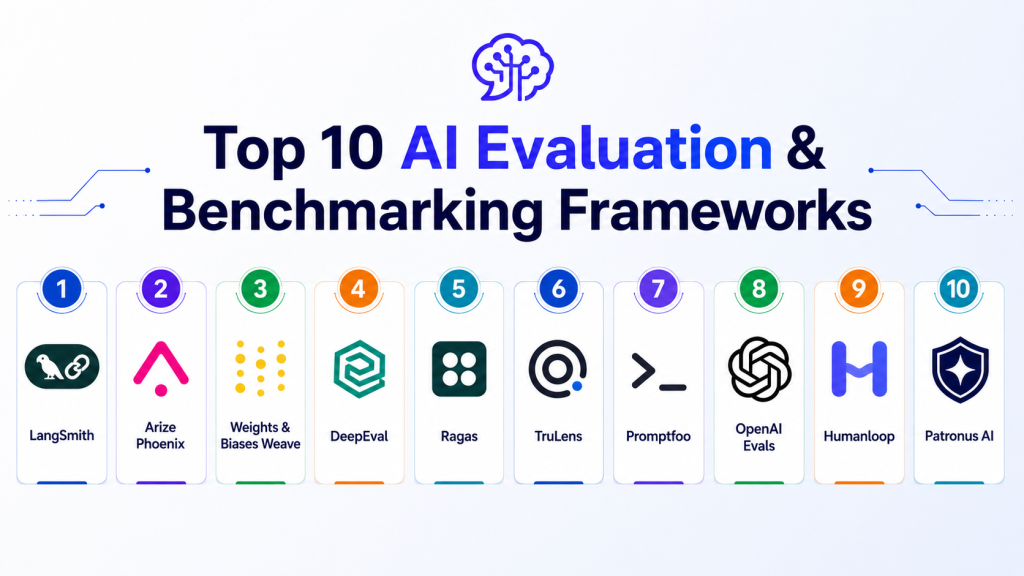
Top 10 AI Evaluation & Benchmarking Frameworks
1- LangSmith
Short description: LangSmith is a widely adopted AI observability and evaluation platform built for testing, monitoring, debugging, and improving large language model applications. It is especially popular among teams building retrieval-augmented generation systems and agentic AI workflows.
Key Features
- LLM tracing and observability
- Prompt testing workflows
- RAG evaluation support
- Experiment tracking
- Dataset management
- Human feedback collection
- Automated regression testing
Pros
- Strong observability experience
- Excellent LangChain integration
- Good debugging capabilities
- Enterprise-friendly workflow support
Cons
- Best optimized for LangChain ecosystems
- Advanced enterprise scaling may require tuning
- Some features still evolving
- Pricing may increase for large workloads
Platforms / Deployment
Cloud / Hybrid
Security & Compliance
Authentication support, RBAC controls, audit logging compatibility, encryption support. Additional certifications not publicly stated.
Integrations & Ecosystem
LangSmith integrates deeply with modern LLM development workflows and orchestration ecosystems.
- LangChain
- OpenAI
- Anthropic
- Vector databases
- Python SDKs
- CI/CD pipelines
- Observability tools
Support & Community
Large developer community with strong documentation and active ecosystem growth.
2- Arize Phoenix
Short description: Arize Phoenix is an open-source AI observability and evaluation platform focused on LLM tracing, monitoring, and benchmarking. It helps teams analyze AI application performance, hallucinations, retrieval quality, and operational reliability.
Key Features
- LLM observability
- RAG evaluation workflows
- Embedding analysis
- Tracing and monitoring
- Hallucination detection
- Drift analysis
- Root-cause debugging
Pros
- Strong observability tooling
- Excellent RAG monitoring
- Open-source flexibility
- Good visualization capabilities
Cons
- Requires infrastructure familiarity
- Enterprise governance features still evolving
- Learning curve for beginners
- Advanced integrations may require customization
Platforms / Deployment
Cloud / Self-hosted / Hybrid
Security & Compliance
Authentication support, encryption compatibility, audit logging support. Additional certifications not publicly stated.
Integrations & Ecosystem
Phoenix integrates naturally into AI observability and production monitoring environments.
- OpenAI
- LangChain
- LlamaIndex
- Vector databases
- Kubernetes
- Monitoring platforms
- ML pipelines
Support & Community
Strong open-source momentum with growing enterprise adoption and active developer support.
3- Weights & Biases Weave
Short description: Weights & Biases Weave is an AI application evaluation and observability framework designed for monitoring, benchmarking, and improving LLM applications. It extends experiment tracking capabilities into generative AI workflows.
Key Features
- LLM evaluation workflows
- Experiment tracking
- Prompt monitoring
- Tracing and observability
- Dataset versioning
- Benchmark comparisons
- Collaborative analytics
Pros
- Mature experiment tracking ecosystem
- Strong visualization features
- Good collaborative workflows
- Flexible benchmarking support
Cons
- Some advanced workflows can become complex
- Enterprise pricing may scale quickly
- Requires workflow configuration effort
- Learning curve for advanced analytics
Platforms / Deployment
Cloud / Hybrid
Security & Compliance
Authentication support, RBAC compatibility, encryption support. Additional certifications not publicly stated.
Integrations & Ecosystem
Weights & Biases integrates with AI experimentation and MLOps ecosystems.
- PyTorch
- TensorFlow
- OpenAI
- Hugging Face
- LangChain
- CI/CD tools
- Cloud ML platforms
Support & Community
Strong enterprise adoption with extensive documentation and large AI research community engagement.
4- DeepEval
Short description: DeepEval is an open-source LLM evaluation framework designed for automated benchmarking, hallucination testing, and AI quality validation. It is popular among developers building production generative AI applications.
Key Features
- Automated LLM evaluations
- Hallucination detection
- Benchmark testing
- Safety evaluations
- Regression testing
- RAG assessment workflows
- CI/CD integration
Pros
- Developer-friendly workflows
- Strong automated testing capabilities
- Open-source flexibility
- Good CI/CD compatibility
Cons
- Smaller enterprise ecosystem
- Advanced governance features limited
- Observability depth still growing
- Requires engineering familiarity
Platforms / Deployment
Cloud / Self-hosted / Hybrid
Security & Compliance
API authentication compatibility and infrastructure-level security support. Additional certifications not publicly stated.
Integrations & Ecosystem
DeepEval integrates with modern generative AI development and testing pipelines.
- OpenAI
- Anthropic
- LangChain
- Pytest
- CI/CD pipelines
- Python SDKs
- RAG frameworks
Support & Community
Growing open-source ecosystem with strong developer interest and active documentation updates.
5- Ragas
Short description: Ragas is a specialized framework for evaluating retrieval-augmented generation systems. It focuses on measuring retrieval quality, answer relevance, faithfulness, and contextual accuracy for RAG applications.
Key Features
- RAG benchmarking
- Context relevance scoring
- Faithfulness evaluation
- Retrieval quality analysis
- Answer correctness testing
- Automated scoring
- Dataset generation support
Pros
- Strong RAG specialization
- Lightweight deployment
- Open-source accessibility
- Good evaluation metrics
Cons
- Narrower focus than broader platforms
- Limited enterprise governance features
- Observability tooling limited
- Less suitable for general AI monitoring
Platforms / Deployment
Cloud / Self-hosted / Hybrid
Security & Compliance
Infrastructure-level security compatibility. Additional certifications not publicly stated.
Integrations & Ecosystem
Ragas integrates naturally with retrieval pipelines and RAG development workflows.
- LangChain
- LlamaIndex
- OpenAI
- Vector databases
- Python frameworks
- Hugging Face
- RAG pipelines
Support & Community
Strong adoption among RAG-focused developers and growing open-source ecosystem momentum.
6- TruLens
Short description: TruLens is an open-source framework designed for evaluating, tracking, and monitoring LLM applications. It helps organizations improve AI quality, transparency, and production reliability.
Key Features
- LLM feedback evaluation
- RAG benchmarking
- Observability workflows
- Hallucination analysis
- Prompt evaluation
- Production monitoring
- Human feedback integration
Pros
- Strong transparency tooling
- Open-source flexibility
- Good RAG support
- Useful production monitoring
Cons
- Smaller ecosystem compared to larger platforms
- Enterprise tooling still evolving
- Limited advanced governance
- Operational setup can require customization
Platforms / Deployment
Cloud / Self-hosted / Hybrid
Security & Compliance
Authentication compatibility, encryption support, infrastructure-level security controls.
Integrations & Ecosystem
TruLens integrates with modern LLM application development ecosystems.
- LangChain
- OpenAI
- LlamaIndex
- Hugging Face
- Vector databases
- Python SDKs
- AI monitoring tools
Support & Community
Active open-source development with growing community support.
7- Promptfoo
Short description: Promptfoo is a developer-focused testing and benchmarking framework designed for evaluating prompts, models, and LLM application quality. It emphasizes automated testing and side-by-side model comparisons.
Key Features
- Prompt benchmarking
- Model comparison workflows
- Regression testing
- Automated evaluations
- CI/CD support
- Dataset testing
- Security testing support
Pros
- Lightweight and simple
- Strong developer usability
- Good automation support
- Easy benchmarking workflows
Cons
- Limited enterprise observability
- Smaller governance ecosystem
- Advanced analytics are basic
- Not designed for deep production monitoring
Platforms / Deployment
Cloud / Self-hosted / Hybrid
Security & Compliance
Authentication support and infrastructure-level security compatibility. Additional certifications not publicly stated.
Integrations & Ecosystem
Promptfoo integrates with AI testing workflows and modern development pipelines.
- OpenAI
- Anthropic
- CI/CD platforms
- GitHub Actions
- LangChain
- Node.js frameworks
- Python SDKs
Support & Community
Rapidly growing developer ecosystem with strong documentation quality.
8- OpenAI Evals
Short description: OpenAI Evals is an open-source evaluation framework for benchmarking and testing large language models. It enables developers to measure model quality across custom tasks and benchmark datasets.
Key Features
- Benchmark testing
- Custom evaluation datasets
- LLM scoring workflows
- Automated testing
- Model comparison support
- Open-source framework
- Research-focused evaluation
Pros
- Strong benchmarking flexibility
- Open-source accessibility
- Good research workflows
- Custom evaluation support
Cons
- Limited enterprise tooling
- Observability features are basic
- Requires technical expertise
- Operational monitoring limited
Platforms / Deployment
Cloud / Self-hosted / Hybrid
Security & Compliance
Infrastructure-level security compatibility. Additional certifications not publicly stated.
Integrations & Ecosystem
OpenAI Evals integrates with research and benchmarking workflows for AI experimentation.
- OpenAI APIs
- Python frameworks
- Benchmark datasets
- AI research tooling
- LLM testing pipelines
- Developer SDKs
- Model experimentation environments
Support & Community
Strong research community engagement with active developer contributions.
9- Humanloop
Short description: Humanloop is an enterprise-focused LLM development and evaluation platform designed for prompt management, benchmarking, and human feedback workflows. It emphasizes governance and collaborative AI development.
Key Features
- Prompt management
- Human feedback workflows
- LLM benchmarking
- Experiment tracking
- Dataset management
- Governance workflows
- AI analytics
Pros
- Strong collaborative tooling
- Enterprise governance focus
- Good feedback workflows
- Useful prompt management
Cons
- Enterprise focus may increase complexity
- Smaller open-source ecosystem
- Some advanced workflows require configuration
- Pricing may not fit smaller teams
Platforms / Deployment
Cloud / Hybrid
Security & Compliance
Authentication controls, RBAC support, audit logging compatibility, encryption support.
Integrations & Ecosystem
Humanloop integrates with enterprise AI operations and collaborative development workflows.
- OpenAI
- Anthropic
- LangChain
- CI/CD tools
- Cloud infrastructure
- Developer SDKs
- AI pipelines
Support & Community
Enterprise-focused support with growing ecosystem adoption and strong onboarding resources.
10- Patronus AI
Short description: Patronus AI is an AI evaluation and safety platform focused on benchmarking, hallucination detection, and reliability testing for production AI applications. It helps organizations improve AI trustworthiness and operational quality.
Key Features
- AI safety evaluations
- Hallucination detection
- Benchmark testing
- Automated quality checks
- Production monitoring
- AI reliability analytics
- Governance workflows
Pros
- Strong AI safety focus
- Good enterprise reliability tooling
- Useful automated evaluations
- Growing governance capabilities
Cons
- Smaller ecosystem maturity
- Advanced integrations still expanding
- Limited open-source flexibility
- Enterprise pricing may vary
Platforms / Deployment
Cloud / Hybrid
Security & Compliance
Authentication support, encryption compatibility, audit logging support. Additional certifications not publicly stated.
Integrations & Ecosystem
Patronus AI integrates with enterprise AI reliability and monitoring ecosystems.
- OpenAI
- Anthropic
- LangChain
- Monitoring platforms
- AI deployment pipelines
- Cloud AI services
- Governance systems
Support & Community
Growing enterprise-focused ecosystem with increasing AI governance adoption.
Comparison Table Top 10
| Tool Name | Best For | Platforms Supported | Deployment | Standout Feature | Public Rating |
|---|---|---|---|---|---|
| LangSmith | LLM observability | Cloud / Linux | Hybrid | LLM tracing | N/A |
| Arize Phoenix | RAG monitoring | Cloud / Linux | Hybrid | AI observability | N/A |
| Weights & Biases Weave | Experiment tracking | Cloud / Linux | Hybrid | Benchmark analytics | N/A |
| DeepEval | Automated AI testing | Linux / Cloud | Hybrid | Hallucination testing | N/A |
| Ragas | RAG benchmarking | Linux / Cloud | Hybrid | Faithfulness evaluation | N/A |
| TruLens | AI transparency | Cloud / Linux | Hybrid | Feedback evaluation | N/A |
| Promptfoo | Prompt testing | Cloud / Linux | Hybrid | Model comparison | N/A |
| OpenAI Evals | Research benchmarking | Linux / Cloud | Hybrid | Custom benchmarks | N/A |
| Humanloop | Enterprise prompt workflows | Cloud | Hybrid | Human feedback loops | N/A |
| Patronus AI | AI safety validation | Cloud | Hybrid | AI reliability testing | N/A |
Evaluation & Scoring of AI Evaluation & Benchmarking Frameworks
| Tool Name | Core 25% | Ease 15% | Integrations 15% | Security 10% | Performance 10% | Support 10% | Value 15% | Weighted Total |
|---|---|---|---|---|---|---|---|---|
| LangSmith | 9.4 | 8.8 | 9.3 | 8.6 | 9.0 | 8.9 | 8.2 | 8.9 |
| Arize Phoenix | 9.0 | 8.0 | 8.8 | 8.2 | 8.8 | 8.5 | 8.7 | 8.6 |
| Weights & Biases Weave | 9.1 | 8.2 | 9.0 | 8.5 | 8.9 | 9.0 | 7.9 | 8.7 |
| DeepEval | 8.6 | 8.5 | 8.4 | 7.8 | 8.5 | 8.0 | 9.0 | 8.5 |
| Ragas | 8.4 | 8.7 | 8.2 | 7.4 | 8.3 | 7.8 | 9.1 | 8.3 |
| TruLens | 8.5 | 8.1 | 8.3 | 7.9 | 8.4 | 7.9 | 8.8 | 8.3 |
| Promptfoo | 8.3 | 9.0 | 8.1 | 7.5 | 8.2 | 7.8 | 9.2 | 8.4 |
| OpenAI Evals | 8.7 | 7.5 | 7.9 | 7.2 | 8.5 | 8.0 | 9.0 | 8.1 |
| Humanloop | 8.8 | 8.0 | 8.7 | 8.6 | 8.5 | 8.4 | 7.8 | 8.4 |
| Patronus AI | 8.9 | 8.1 | 8.5 | 8.7 | 8.8 | 8.2 | 7.9 | 8.5 |
These scores are comparative and designed to help buyers evaluate strengths across observability, benchmarking depth, scalability, integrations, and enterprise governance. Higher scores do not automatically mean a framework is universally better because different platforms prioritize different AI evaluation workflows. Some tools specialize in RAG benchmarking, while others focus more on observability, governance, or automated testing pipelines. Buyers should evaluate operational complexity, deployment strategy, and AI workload requirements before selecting a framework.
Which AI Evaluation & Benchmarking Frameworks Tool Is Right for You?
Solo / Freelancer
Independent developers and small AI builders often benefit from lightweight and flexible frameworks. Promptfoo, Ragas, and DeepEval are strong choices because they simplify testing and benchmarking without requiring heavy infrastructure management.
SMB
Small and medium-sized businesses usually prioritize deployment simplicity, automation, and observability. LangSmith and Arize Phoenix provide balanced evaluation, tracing, and production monitoring capabilities.
Mid-Market
Mid-market organizations often require better governance, scalability, and collaborative workflows. Weights & Biases Weave, Humanloop, and TruLens provide strong experimentation and evaluation ecosystems.
Enterprise
Large enterprises typically prioritize governance, observability, security, and production monitoring. LangSmith, Arize Phoenix, and Patronus AI are commonly suitable for enterprise AI operations.
Budget vs Premium
Open-source tools like DeepEval, Ragas, Promptfoo, and OpenAI Evals can reduce operational costs but may require more engineering effort. Enterprise-focused platforms provide deeper governance and collaboration capabilities but may increase licensing expenses.
Feature Depth vs Ease of Use
Developer-first tools simplify onboarding and automation, while enterprise platforms provide more advanced governance, tracing, and collaborative evaluation capabilities.
Integrations & Scalability
Organizations deploying large-scale AI systems should prioritize frameworks with strong integrations for CI/CD, observability, vector databases, and orchestration pipelines.
Security & Compliance Needs
Regulated industries should prioritize frameworks with audit logging, RBAC support, encryption compatibility, and governance-focused operational tooling.
Frequently Asked Questions FAQs
1. What is an AI evaluation framework?
An AI evaluation framework is a platform or toolkit used to measure the accuracy, reliability, safety, and quality of machine learning and generative AI systems in development and production environments.
2. Why are AI benchmarking tools important?
Benchmarking tools help organizations compare models, validate reliability, identify hallucinations, and ensure AI systems meet operational and business requirements before deployment.
3. What is RAG evaluation?
RAG evaluation measures how effectively retrieval-augmented generation systems retrieve relevant information and generate factually accurate responses based on retrieved context.
4. Can these frameworks support production AI monitoring?
Yes, many modern frameworks support production observability, tracing, drift analysis, and real-time evaluation for deployed AI systems.
5. What are common mistakes when evaluating AI systems?
Common mistakes include relying only on manual testing, ignoring hallucination risks, failing to monitor production drift, and using insufficient benchmark datasets.
6. Are open-source AI evaluation tools suitable for enterprises?
Yes, many enterprises successfully use open-source frameworks like Ragas, DeepEval, and Arize Phoenix, especially when combined with internal governance workflows.
7. What integrations matter most in AI evaluation platforms?
Important integrations include orchestration frameworks, vector databases, CI/CD pipelines, cloud AI services, observability platforms, and experiment tracking tools.
8. Can AI evaluation frameworks reduce hallucinations?
These frameworks cannot eliminate hallucinations directly, but they help identify, measure, monitor, and reduce hallucination risks through testing and evaluation workflows.
9. How difficult is it to implement AI benchmarking workflows?
Implementation complexity depends on the scale of AI systems, data pipelines, observability requirements, and integration architecture. Developer-focused tools usually simplify onboarding.
10. Which framework is best for enterprise generative AI systems?
The best framework depends on organizational priorities. LangSmith and Arize Phoenix are strong for observability, while Humanloop and Patronus AI focus more on governance and enterprise evaluation workflows.
Conclusion
AI evaluation and benchmarking frameworks have become essential for organizations deploying production-grade machine learning and generative AI systems. As AI applications become more complex, businesses increasingly require reliable methods for measuring hallucinations, retrieval quality, prompt effectiveness, safety risks, and operational reliability. The right framework depends on deployment scale, governance requirements, observability needs, and engineering maturity. Developer-focused open-source tools provide flexibility and cost efficiency, while enterprise platforms deliver stronger governance, collaboration, and monitoring capabilities. There is no universal best framework for every AI workload or organization. The most effective strategy is to shortlist a few frameworks that align with your AI architecture goals, test them with real-world workloads, validate integrations and operational workflows, and measure evaluation quality before scaling AI systems into production environments.