Introduction
Recommendation System Toolkits are platforms and libraries that help developers and organizations build systems capable of suggesting relevant items—such as products, content, or services—based on user behavior, preferences, and contextual data. These systems are widely used in e-commerce, streaming platforms, social media, and enterprise applications to enhance personalization and engagement.
With the rapid growth of AI and data-driven decision-making, recommendation systems have become a core component of digital experiences. Modern toolkits now leverage machine learning, deep learning, and real-time data processing to deliver highly personalized recommendations at scale.
Common use cases include:
- Product recommendations in e-commerce
- Content recommendations in media platforms
- Personalized marketing and ads
- Social media feed ranking
- Knowledge and content discovery systems
Key evaluation criteria:
- Algorithm support (collaborative, content-based, hybrid)
- Scalability and performance
- Integration with ML pipelines
- Real-time recommendation capabilities
- Ease of implementation and customization
- Data handling and preprocessing support
- Model evaluation and experimentation features
- Deployment flexibility
Best for: Data scientists, ML engineers, product teams, and enterprises building personalized user experiences across digital platforms.
Not ideal for: Small projects without sufficient user data or applications that do not require personalization.
Key Trends in Recommendation System Toolkits for Beyond
- Deep learning-based recommendation models
- Real-time personalization using streaming data
- Hybrid recommendation approaches combining multiple techniques
- Integration with AI agents and conversational systems
- Privacy-preserving recommendation techniques
- Context-aware and session-based recommendations
- Multi-modal recommendations (text, image, video)
- AutoML-driven recommendation pipelines
- Graph-based recommendation systems
- Scalable cloud-native recommendation platforms
How We Selected These Tools (Methodology)
- Evaluated adoption across ML and data science communities
- Assessed support for recommendation algorithms
- Compared scalability and production readiness
- Reviewed integration with ML frameworks and pipelines
- Analyzed ease of use and flexibility
- Included both open-source and managed solutions
- Considered real-world enterprise usage
- Balanced innovation with maturity
- Focused on practical implementation scenarios
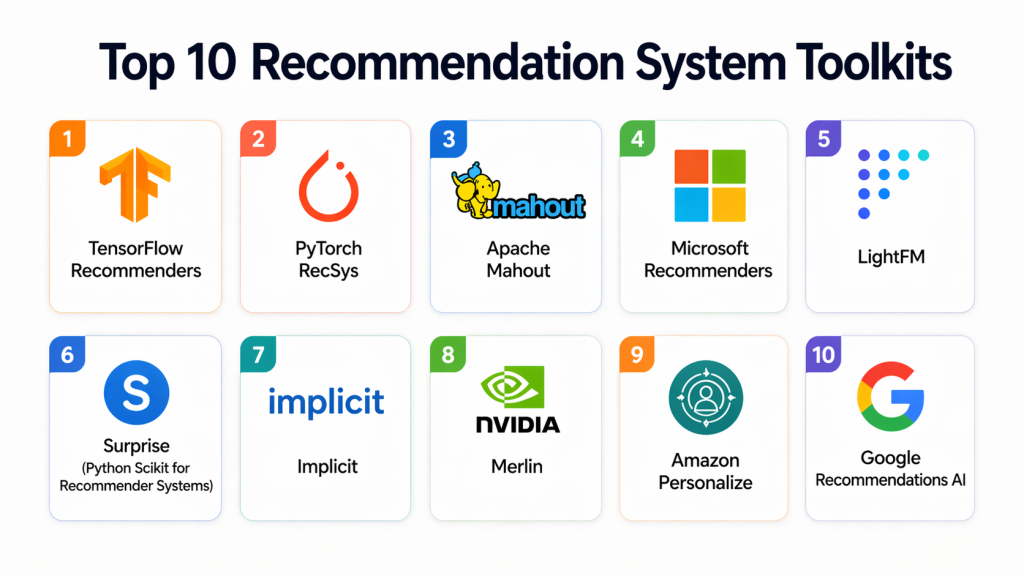
Top 10 Recommendation System Toolkits
#1 — TensorFlow Recommenders
Short description:
TensorFlow Recommenders is a flexible library built on TensorFlow for developing scalable recommendation models using deep learning techniques.
Key Features
- Deep learning recommendation models
- Retrieval and ranking pipelines
- Integration with TensorFlow ecosystem
- Custom model building
- Scalable deployment
Pros
- Highly customizable
- Strong ecosystem support
Cons
- Requires ML expertise
- Complex setup
Platforms / Deployment
Cloud / Self-hosted
Security & Compliance
Varies / N/A
Integrations & Ecosystem
Integrates with TensorFlow tools and ML pipelines for end-to-end model development.
- TensorFlow
- Keras
- Data pipelines
Support & Community
Large developer community with strong documentation.
#2 — PyTorch RecSys
Short description:
PyTorch RecSys is a library designed for building recommendation systems with PyTorch, focusing on scalability and performance.
Key Features
- Deep learning models
- Distributed training
- GPU acceleration
- Customizable pipelines
- Integration with PyTorch
Pros
- High performance
- Flexible architecture
Cons
- Requires technical expertise
- Limited beginner support
Platforms / Deployment
Cloud / Self-hosted
Security & Compliance
Varies / N/A
Integrations & Ecosystem
Works within PyTorch ecosystem and supports scalable ML workflows.
- PyTorch
- CUDA
- ML pipelines
Support & Community
Active ML community.
#3 — Apache Mahout
Short description:
Apache Mahout is a scalable machine learning library that includes algorithms for collaborative filtering and recommendation systems.
Key Features
- Collaborative filtering
- Distributed processing
- Scalable architecture
- Integration with Hadoop
- ML algorithms
Pros
- Open-source
- Scalable
Cons
- Older ecosystem
- Limited modern features
Platforms / Deployment
Self-hosted
Security & Compliance
Varies / N/A
Integrations & Ecosystem
Integrates with big data platforms for large-scale processing.
- Hadoop
- Spark
Support & Community
Established open-source community.
#4 — Microsoft Recommenders
Short description:
Microsoft Recommenders is an open-source toolkit providing best practices and implementations for building recommendation systems.
Key Features
- Pre-built algorithms
- Evaluation tools
- Data processing pipelines
- Experiment tracking
- Integration with Azure
Pros
- Easy to start
- Well-documented
Cons
- Limited advanced customization
- Dependent on ecosystem
Platforms / Deployment
Cloud / Self-hosted
Security & Compliance
Varies / N/A
Integrations & Ecosystem
Integrates with Microsoft ecosystem and ML pipelines.
- Azure
- Python
Support & Community
Good documentation and community support.
#5 — LightFM
Short description:
LightFM is a Python library for building hybrid recommendation systems combining collaborative and content-based approaches.
Key Features
- Hybrid recommendation models
- Fast training
- Sparse data handling
- Custom loss functions
- Easy implementation
Pros
- Lightweight
- Efficient
Cons
- Limited scalability
- Fewer enterprise features
Platforms / Deployment
Self-hosted
Security & Compliance
Varies / N/A
Integrations & Ecosystem
Works with Python data science stack for quick experimentation.
- NumPy
- Pandas
Support & Community
Active developer community.
#6 — Surprise
Short description:
Surprise is a Python library focused on building and analyzing recommender systems with collaborative filtering techniques.
Key Features
- Collaborative filtering
- Dataset handling
- Evaluation tools
- Easy API
- Algorithm comparison
Pros
- Beginner-friendly
- Simple to use
Cons
- Limited scalability
- Not production-focused
Platforms / Deployment
Self-hosted
Security & Compliance
Varies / N/A
Integrations & Ecosystem
Integrates with Python ecosystem for experimentation and research.
- Python
- ML libraries
Support & Community
Strong academic and developer support.
#7 — Implicit
Short description:
Implicit is a fast Python library for building recommendation systems using implicit feedback data.
Key Features
- Implicit feedback models
- Matrix factorization
- GPU acceleration
- High performance
- Scalable algorithms
Pros
- Fast processing
- Optimized for large datasets
Cons
- Limited UI
- Requires technical expertise
Platforms / Deployment
Self-hosted
Security & Compliance
Varies / N/A
Integrations & Ecosystem
Works with data pipelines and ML workflows for large-scale recommendations.
- Python
- GPU tools
Support & Community
Active community.
#8 — NVIDIA Merlin
Short description:
NVIDIA Merlin is a framework for building high-performance recommendation systems using GPU acceleration and deep learning.
Key Features
- GPU-accelerated pipelines
- Deep learning models
- Real-time inference
- Feature engineering
- Scalable architecture
Pros
- High performance
- Enterprise-ready
Cons
- Requires GPU infrastructure
- Complex setup
Platforms / Deployment
Cloud / Self-hosted
Security & Compliance
Varies / N/A
Integrations & Ecosystem
Integrates with NVIDIA ecosystem and ML frameworks for high-performance workloads.
- CUDA
- TensorFlow
- PyTorch
Support & Community
Strong support with enterprise backing.
#9 — Amazon Personalize
Short description:
Amazon Personalize is a fully managed service that enables real-time personalized recommendations using AWS infrastructure.
Key Features
- Real-time recommendations
- Managed service
- Personalization models
- Scalability
- Easy deployment
Pros
- No infrastructure management
- Scalable
Cons
- AWS dependency
- Pricing considerations
Platforms / Deployment
Cloud
Security & Compliance
IAM, encryption
Integrations & Ecosystem
Deep integration with AWS services for seamless deployment.
- AWS
- APIs
Support & Community
Enterprise support from AWS.
#10 — Google Recommendations AI
Short description:
Google Recommendations AI provides personalized recommendation services powered by Google’s machine learning infrastructure.
Key Features
- AI-driven recommendations
- Real-time personalization
- Scalable infrastructure
- Pre-trained models
- Easy API integration
Pros
- High scalability
- Strong AI capabilities
Cons
- Google Cloud dependency
- Limited customization
Platforms / Deployment
Cloud
Security & Compliance
IAM, encryption
Integrations & Ecosystem
Integrates with Google Cloud and AI services for enterprise deployments.
- GCP
- APIs
Support & Community
Enterprise support from Google.
Comparison Table (Top 10)
| Tool Name | Best For | Platform(s) Supported | Deployment | Standout Feature | Public Rating |
|---|---|---|---|---|---|
| TensorFlow Recommenders | Deep learning | Python | Cloud/Self | Custom models | N/A |
| PyTorch RecSys | Performance | Python | Cloud/Self | GPU support | N/A |
| Apache Mahout | Big data | Hadoop | Self-hosted | Scalability | N/A |
| Microsoft Recommenders | Beginners | Python | Cloud/Self | Pre-built models | N/A |
| LightFM | Hybrid models | Python | Self-hosted | Lightweight | N/A |
| Surprise | Learning | Python | Self-hosted | Simplicity | N/A |
| Implicit | Large datasets | Python | Self-hosted | Speed | N/A |
| NVIDIA Merlin | GPU systems | Python | Cloud/Self | High performance | N/A |
| Amazon Personalize | Managed service | Web/API | Cloud | Real-time recs | N/A |
| Google Recommendations AI | Enterprise AI | Web/API | Cloud | AI personalization | N/A |
Evaluation & Scoring of Recommendation System Toolkits
| Tool Name | Core (25%) | Ease (15%) | Integrations (15%) | Security (10%) | Performance (10%) | Support (10%) | Value (15%) | Weighted Total (0–10) |
|---|---|---|---|---|---|---|---|---|
| TensorFlow Rec | 9 | 7 | 9 | 7 | 9 | 9 | 8 | 8.4 |
| PyTorch RecSys | 9 | 7 | 8 | 7 | 9 | 8 | 8 | 8.3 |
| Mahout | 8 | 6 | 7 | 6 | 8 | 7 | 8 | 7.5 |
| Microsoft Rec | 8 | 8 | 8 | 7 | 8 | 8 | 8 | 8.0 |
| LightFM | 7 | 9 | 7 | 6 | 7 | 7 | 9 | 7.6 |
| Surprise | 7 | 9 | 6 | 6 | 7 | 7 | 9 | 7.5 |
| Implicit | 8 | 7 | 7 | 6 | 9 | 7 | 8 | 7.9 |
| NVIDIA Merlin | 9 | 6 | 9 | 8 | 10 | 8 | 7 | 8.5 |
| Amazon Personalize | 9 | 9 | 9 | 9 | 9 | 9 | 7 | 8.8 |
| Google Rec AI | 9 | 9 | 9 | 9 | 9 | 9 | 7 | 8.8 |
How to interpret scores:
These scores provide a comparative view of each toolkit across key dimensions like functionality, usability, and scalability. Higher scores indicate well-rounded, production-ready solutions, while others may be better suited for experimentation or niche use cases.
Which Recommendation System Toolkit Is Right for You?
Solo / Freelancer
Use Surprise or LightFM for learning and experimentation with recommendation algorithms.
SMB
Microsoft Recommenders or TensorFlow Recommenders provide flexibility and scalability.
Mid-Market
PyTorch RecSys or Implicit offer strong performance with manageable complexity.
Enterprise
Amazon Personalize, Google Recommendations AI, and NVIDIA Merlin are best for large-scale deployments.
Budget vs Premium
- Budget: Surprise, LightFM
- Premium: Amazon Personalize, Google Recommendations AI
Feature Depth vs Ease of Use
- Deep features: TensorFlow, NVIDIA Merlin
- Easy to use: Surprise, Microsoft Recommenders
Integrations & Scalability
Choose tools with strong ecosystem support and cloud integration.
Security & Compliance Needs
Enterprise users should prioritize managed services with strong access controls and compliance features.
Frequently Asked Questions (FAQs)
What is a recommendation system toolkit?
It is a framework or platform used to build systems that suggest relevant items based on user behavior and data patterns.
What types of recommendation systems exist?
Common types include collaborative filtering, content-based, and hybrid systems.
Do I need large datasets?
Yes, better recommendations require sufficient user and interaction data.
Are these tools suitable for real-time systems?
Many modern tools support real-time recommendation capabilities.
Can I build recommendation systems without ML knowledge?
Some tools simplify the process, but ML knowledge improves results.
Which tool is best for beginners?
Surprise and LightFM are good starting points.
Are cloud-based tools better?
They simplify deployment but may limit customization.
What industries use recommendation systems?
E-commerce, media, finance, and social platforms widely use them.
How do I evaluate recommendation performance?
Metrics include precision, recall, and user engagement.
Can I switch tools later?
Yes, but migration may require model and data adjustments.
Conclusion
Recommendation System Toolkits play a crucial role in delivering personalized user experiences across modern digital platforms. As competition increases, businesses rely heavily on intelligent recommendations to improve engagement, retention, and revenue. These tools provide the foundation for building scalable and efficient recommendation engines tailored to different use cases. From lightweight libraries like LightFM and Surprise to enterprise-grade solutions like Amazon Personalize and Google Recommendations AI, the ecosystem offers a wide range of options. The right choice depends on your data volume, technical expertise, and scalability needs. Teams should focus on selecting tools that align with their infrastructure and long-term AI strategy. Testing multiple approaches and evaluating performance in real scenarios is essential for success. As AI continues to evolve, recommendation systems will become even more context-aware and intelligent. Investing in the right toolkit today can significantly enhance user experience and business outcomes. Start by identifying your use case, shortlist a few tools, and validate them through pilot implementations before scaling