Introduction
Knowledge Graph Construction Tools are platforms that help organizations build, manage, and query interconnected data models where relationships between entities are as important as the data itself. Instead of storing data in isolated tables, these tools create graph-based structures that connect people, places, concepts, and events in a meaningful way.
As organizations increasingly rely on AI, analytics, and semantic search, knowledge graphs have become a critical foundation for contextual intelligence. They power recommendation engines, fraud detection systems, enterprise search, and AI assistants by enabling machines to understand relationships rather than just raw data.
Common use cases include:
- Enterprise knowledge management and search
- AI-powered recommendation systems
- Fraud detection and risk analysis
- Semantic data integration across systems
- Natural language query and reasoning
Key evaluation criteria:
- Graph database performance and scalability
- Support for RDF, property graphs, and ontologies
- Query language support (SPARQL, Cypher, etc.)
- Integration with AI/ML pipelines
- Data ingestion and transformation capabilities
- Visualization and analytics tools
- Security and access control mechanisms
- Ease of deployment and maintenance
Best for: Enterprises, data engineers, AI/ML teams, research organizations, and industries like finance, healthcare, and e-commerce that rely on connected data insights.
Not ideal for: Small projects with simple relational data needs or teams without expertise in graph modeling.
Key Trends in Knowledge Graph Construction Tools for and Beyond
- AI-assisted ontology creation and graph modeling
- Integration with LLMs for semantic reasoning
- Real-time graph updates and streaming ingestion
- Hybrid graph + vector database architectures
- Automated entity resolution and linking
- Graph analytics combined with machine learning
- Cloud-native and managed graph services
- Knowledge graph APIs for application integration
- Increased focus on explainable AI using graph structures
- Semantic interoperability across enterprise systems
How We Selected These Tools (Methodology)
- Evaluated industry adoption and enterprise usage
- Assessed graph database and ontology capabilities
- Compared performance and scalability features
- Reviewed support for query languages and standards
- Analyzed integration with AI and data ecosystems
- Considered ease of use and developer experience
- Included both enterprise and open-source tools
- Balanced flexibility with production readiness
- Focused on real-world applicability
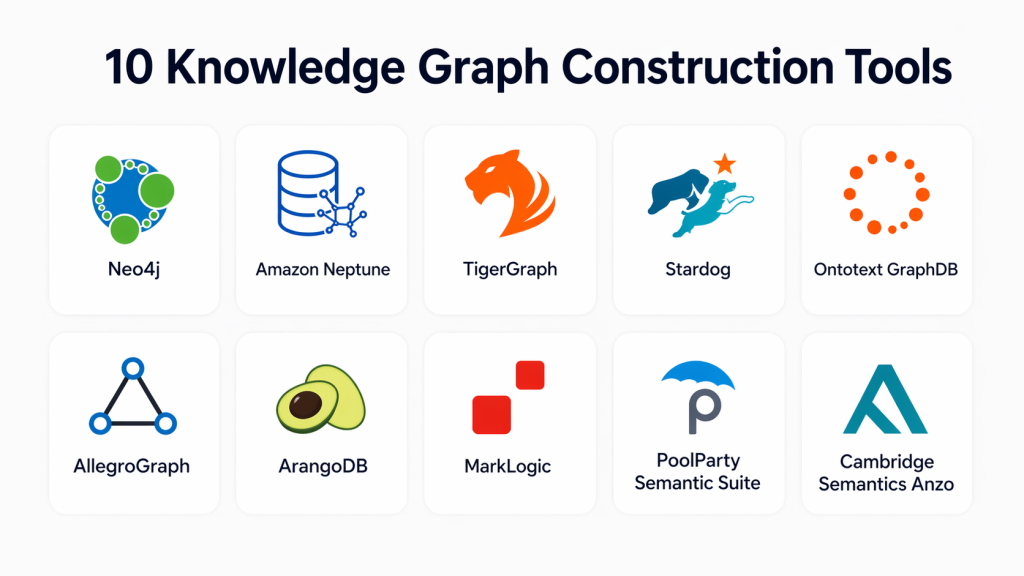
Top 10 Knowledge Graph Construction Tools
#1 — Neo4j
Short description:
Neo4j is one of the most widely used graph database platforms, known for its property graph model and powerful query capabilities. It is widely adopted for building scalable knowledge graphs and graph-based applications.
Key Features
- Property graph model
- Cypher query language
- Graph analytics and algorithms
- Visualization tools
- Scalable architecture
Pros
- Mature ecosystem
- Strong performance
Cons
- Licensing costs
- Learning curve for beginners
Platforms / Deployment
Cloud / Self-hosted
Security & Compliance
RBAC, encryption, audit logs
Integrations & Ecosystem
Neo4j integrates with data platforms, analytics tools, and AI frameworks for building end-to-end graph solutions.
- APIs
- Data pipelines
- BI tools
Support & Community
Large global community with extensive documentation.
#2 — Amazon Neptune
Short description:
Amazon Neptune is a fully managed graph database service that supports both RDF and property graph models, making it suitable for enterprise knowledge graph applications.
Key Features
- Managed graph database
- SPARQL and Gremlin support
- High availability
- Scalability
- Integration with AWS
Pros
- Fully managed service
- Strong cloud integration
Cons
- AWS dependency
- Pricing complexity
Platforms / Deployment
Cloud
Security & Compliance
Encryption, IAM, access controls
Integrations & Ecosystem
Deep integration with AWS ecosystem for seamless data and AI workflows.
- AWS services
- APIs
- Data lakes
Support & Community
Enterprise support from AWS.
#3 — TigerGraph
Short description:
TigerGraph is a high-performance graph database designed for real-time analytics and large-scale knowledge graph construction.
Key Features
- Distributed architecture
- Real-time analytics
- Parallel processing
- Graph query language (GSQL)
- High scalability
Pros
- High performance
- Suitable for large datasets
Cons
- Complex setup
- Requires expertise
Platforms / Deployment
Cloud / Self-hosted
Security & Compliance
RBAC, encryption
Integrations & Ecosystem
Integrates with enterprise data platforms and analytics tools for large-scale deployments.
- APIs
- Data pipelines
- ML tools
Support & Community
Enterprise-level support with growing community.
#4 — Stardog
Short description:
Stardog is a semantic graph platform that combines knowledge graphs with reasoning and data virtualization capabilities.
Key Features
- RDF and SPARQL support
- Reasoning engine
- Data virtualization
- Graph analytics
- Governance tools
Pros
- Strong semantic capabilities
- Enterprise-ready
Cons
- Cost considerations
- Learning curve
Platforms / Deployment
Cloud / Self-hosted
Security & Compliance
RBAC, encryption
Integrations & Ecosystem
Stardog integrates with enterprise data systems and supports semantic data integration.
- APIs
- Data sources
- BI tools
Support & Community
Enterprise support with documentation.
#5 — Ontotext GraphDB
Short description:
GraphDB is a semantic graph database designed for RDF data and knowledge graph applications with strong reasoning capabilities.
Key Features
- RDF storage
- SPARQL queries
- Reasoning engine
- Data linking
- Visualization tools
Pros
- Strong semantic support
- Mature platform
Cons
- Requires expertise
- UI limitations
Platforms / Deployment
Cloud / Self-hosted
Security & Compliance
RBAC, encryption
Integrations & Ecosystem
Supports integration with semantic web tools and enterprise systems.
- APIs
- Data platforms
Support & Community
Active community and enterprise support.
#6 — AllegroGraph
Short description:
AllegroGraph is a high-performance graph database focused on semantic graph processing and reasoning.
Key Features
- RDF support
- Reasoning capabilities
- Geospatial features
- Graph analytics
- Scalability
Pros
- Strong reasoning engine
- Good performance
Cons
- Limited modern UI
- Niche adoption
Platforms / Deployment
Cloud / Self-hosted
Security & Compliance
RBAC
Integrations & Ecosystem
Integrates with semantic tools and enterprise data systems.
- APIs
- Data pipelines
Support & Community
Moderate community support.
#7 — ArangoDB
Short description:
ArangoDB is a multi-model database supporting graph, document, and key-value data, making it versatile for knowledge graph construction.
Key Features
- Multi-model database
- Graph queries
- Flexible schema
- Scalability
- Built-in analytics
Pros
- Flexible data model
- Open-source option
Cons
- Less specialized for pure graph use
- Performance trade-offs
Platforms / Deployment
Cloud / Self-hosted
Security & Compliance
RBAC, encryption
Integrations & Ecosystem
Supports integration with modern data stacks and APIs for flexible applications.
- APIs
- Data pipelines
Support & Community
Active community and documentation.
#8 — MarkLogic
Short description:
MarkLogic is a multi-model database platform that supports knowledge graph construction alongside document and search capabilities.
Key Features
- Multi-model support
- Semantic graph capabilities
- Data integration
- Search and indexing
- Governance features
Pros
- Enterprise-grade
- Strong data integration
Cons
- Complex setup
- Higher cost
Platforms / Deployment
Cloud / Hybrid
Security & Compliance
RBAC, encryption, audit logs
Integrations & Ecosystem
Integrates with enterprise systems and supports complex data workflows.
- APIs
- Data platforms
Support & Community
Enterprise support with structured onboarding.
#9 — PoolParty Semantic Suite
Short description:
PoolParty is a semantic platform focused on taxonomy management and knowledge graph construction for enterprise use.
Key Features
- Taxonomy management
- Knowledge graph creation
- Semantic search
- Data linking
- Governance tools
Pros
- Strong taxonomy features
- User-friendly
Cons
- Limited scalability for large graphs
- Niche use cases
Platforms / Deployment
Cloud / Self-hosted
Security & Compliance
RBAC
Integrations & Ecosystem
Integrates with enterprise content systems and search platforms.
- APIs
- Content management systems
Support & Community
Moderate support and documentation.
#10 — Cambridge Semantics Anzo
Short description:
Anzo is a knowledge graph platform designed for enterprise data integration and analytics using semantic technologies.
Key Features
- Data integration
- Knowledge graph analytics
- RDF support
- Visualization tools
- Governance features
Pros
- Strong analytics capabilities
- Enterprise-focused
Cons
- Complex implementation
- Limited adoption
Platforms / Deployment
Cloud / Self-hosted
Security & Compliance
RBAC, encryption
Integrations & Ecosystem
Supports integration with enterprise data sources and analytics tools.
- APIs
- BI tools
Support & Community
Enterprise support with documentation.
Comparison Table (Top 10)
| Tool Name | Best For | Platform(s) Supported | Deployment | Standout Feature | Public Rating |
|---|---|---|---|---|---|
| Neo4j | Graph apps | Web/API | Cloud/Self | Cypher queries | N/A |
| Amazon Neptune | Enterprise cloud | Web | Cloud | Managed service | N/A |
| TigerGraph | Large-scale graphs | Web/API | Cloud/Self | Real-time analytics | N/A |
| Stardog | Semantic graphs | Web/API | Cloud/Self | Reasoning engine | N/A |
| GraphDB | RDF graphs | Web/API | Cloud/Self | SPARQL support | N/A |
| AllegroGraph | Semantic processing | Web/API | Cloud/Self | Reasoning | N/A |
| ArangoDB | Multi-model | Web/API | Cloud/Self | Flexible DB | N/A |
| MarkLogic | Enterprise data | Web/API | Cloud/Hybrid | Data integration | N/A |
| PoolParty | Taxonomy | Web | Cloud/Self | Semantic tools | N/A |
| Anzo | Analytics | Web/API | Cloud/Self | Data visualization | N/A |
Evaluation & Scoring of Knowledge Graph Construction Tools
| Tool Name | Core (25%) | Ease (15%) | Integrations (15%) | Security (10%) | Performance (10%) | Support (10%) | Value (15%) | Weighted Total (0–10) |
|---|---|---|---|---|---|---|---|---|
| Neo4j | 9 | 8 | 9 | 8 | 9 | 9 | 8 | 8.6 |
| Amazon Neptune | 9 | 8 | 9 | 9 | 9 | 9 | 7 | 8.7 |
| TigerGraph | 9 | 6 | 8 | 8 | 9 | 8 | 7 | 8.2 |
| Stardog | 8 | 7 | 8 | 8 | 8 | 8 | 7 | 7.9 |
| GraphDB | 8 | 7 | 7 | 8 | 8 | 7 | 8 | 7.8 |
| AllegroGraph | 7 | 6 | 7 | 7 | 8 | 6 | 8 | 7.2 |
| ArangoDB | 8 | 8 | 8 | 7 | 8 | 7 | 8 | 7.9 |
| MarkLogic | 9 | 6 | 8 | 9 | 9 | 8 | 7 | 8.2 |
| PoolParty | 7 | 8 | 7 | 7 | 7 | 6 | 8 | 7.3 |
| Anzo | 8 | 6 | 7 | 8 | 8 | 7 | 7 | 7.6 |
How to interpret scores:
These scores provide a comparative overview of each tool’s strengths across key dimensions like core features, usability, and ecosystem support. Higher scores indicate strong enterprise readiness and scalability, while slightly lower scores may still represent excellent niche solutions depending on your use case.
Which Knowledge Graph Construction Tools Tool Is Right for You?
Solo / Freelancer
ArangoDB or Neo4j Community Edition are good starting points due to flexibility and accessibility.
SMB
Neo4j and GraphDB provide a strong balance of usability and features.
Mid-Market
Stardog and ArangoDB offer scalable solutions with semantic capabilities.
Enterprise
Amazon Neptune, TigerGraph, and MarkLogic are ideal for large-scale deployments.
Budget vs Premium
- Budget: ArangoDB, AllegroGraph
- Premium: Neptune, TigerGraph
Feature Depth vs Ease of Use
- Deep features: Stardog, TigerGraph
- Easy to use: Neo4j, ArangoDB
Integrations & Scalability
Choose tools with strong API ecosystems and support for enterprise data pipelines.
Security & Compliance Needs
Enterprises should prioritize tools with strong access controls and governance features.
Frequently Asked Questions (FAQs)
What is a Knowledge Graph?
A knowledge graph is a structured representation of data where entities are connected through relationships, enabling better understanding and reasoning.
Why are knowledge graphs important?
They provide context-aware insights, improve AI systems, and enable advanced analytics.
What industries use knowledge graphs?
Finance, healthcare, e-commerce, and research industries widely use them.
Do I need coding knowledge?
Yes, most tools require some technical expertise in graph modeling and query languages.
What is the difference between RDF and property graphs?
RDF uses triples for semantic relationships, while property graphs allow attributes on nodes and edges.
Are knowledge graph tools scalable?
Yes, most enterprise tools are designed for large-scale data processing.
Can knowledge graphs integrate with AI?
Yes, they are commonly used with AI systems for reasoning and contextual understanding.
How secure are these platforms?
Security features vary but often include RBAC, encryption, and access controls.
How long does implementation take?
It depends on complexity, ranging from weeks to months.
Can I switch tools later?
Yes, but migration can be complex due to data structure differences.
Conclusion
Knowledge Graph Construction Tools are becoming essential for organizations that need to unlock deeper insights from connected data. As AI and analytics systems demand more context-aware intelligence, graph-based approaches provide a powerful way to model relationships and meaning across complex datasets. These tools enable businesses to move beyond traditional data storage and into a world where data can be understood, queried, and leveraged more intelligently. From open-source platforms like Neo4j and ArangoDB to enterprise-grade solutions like Amazon Neptune and TigerGraph, the ecosystem offers a wide range of options tailored to different needs. The right choice depends on your scale, technical expertise, and integration requirements. Organizations should carefully evaluate performance, query capabilities, and ecosystem compatibility before making a decision. Starting with a pilot project can help validate how well a tool fits your use case and data architecture. As knowledge graphs continue to evolve, their integration with AI and machine learning will unlock even greater value. Investing in the right platform today can significantly improve decision-making, automation, and innovation. Begin by shortlisting a few tools, testing them in real scenarios, and aligning them with your long-term data strategy.