Introduction
Trust & Safety Moderation Tools are specialized platforms designed to protect digital ecosystems—social media, marketplaces, gaming platforms, fintech apps, and online communities—from harmful content, fraud, abuse, misinformation, and policy violations. These systems combine AI-driven detection, human-in-the-loop workflows, and automated enforcement engines to ensure platforms remain safe, compliant, and trustworthy at scale.
In today’s digital environment, user-generated content is growing faster than any manual review system can handle. This makes Trust & Safety infrastructure essential for companies operating at scale. Modern platforms now rely heavily on AI models that can detect toxic behavior, spam, deepfakes, and policy violations in real time, significantly reducing moderation latency and operational costs.
Real-world use cases
- Moderating social media posts, comments, and livestreams
- Detecting fraud and abuse in fintech and marketplace transactions
- Preventing hate speech and harmful content in gaming communities
- Screening user-generated reviews and product listings
- Ensuring compliance with regional regulations (DSA, GDPR, etc.)
What buyers should evaluate
- AI detection accuracy (text, image, video, audio)
- Workflow orchestration and escalation rules
- Human-in-the-loop moderation support
- Real-time vs batch moderation capabilities
- Policy customization flexibility
- Integration with existing platforms and APIs
- Audit logs and compliance reporting
- Scalability for high-volume platforms
- False positive/negative handling
- Security and data privacy controls
Best for:
Trust & Safety Moderation Tools are best for large-scale digital platforms such as social networks, marketplaces, fintech apps, SaaS communities, gaming platforms, and UGC-heavy ecosystems.
Not ideal for:
Small static websites, low-traffic blogs, or platforms without user-generated content typically do not require dedicated Trust & Safety infrastructure.
Key Trends in Trust & Safety Moderation Tools
- AI-first moderation systems are replacing rule-only filters for faster detection
- Hybrid moderation (AI + human review) is becoming the global standard
- Real-time content scanning is replacing delayed moderation queues
- Generative AI detection is emerging to identify AI-generated harmful content
- Severity-based risk scoring models are improving enforcement precision
- Cross-platform moderation orchestration is enabling unified safety policies
- Soft moderation strategies (warnings instead of bans) are gaining traction
- Automation of escalation workflows reduces human moderator workload
- Multilingual moderation models are improving global safety coverage
- Regulatory-driven compliance tools are expanding due to stricter laws
How We Selected These Tools (Methodology)
- Prioritized widely adopted Trust & Safety platforms
- Included tools with strong AI moderation capabilities
- Evaluated scalability for enterprise-level traffic
- Focused on platforms supporting multi-modal moderation (text, image, video)
- Considered workflow automation and escalation capabilities
- Assessed integration readiness with modern digital ecosystems
- Included both enterprise vendors and AI-first moderation systems
- Evaluated policy customization and compliance readiness
- Reviewed operational efficiency in high-volume environments
- Balanced between legacy enterprise tools and emerging AI-native platforms
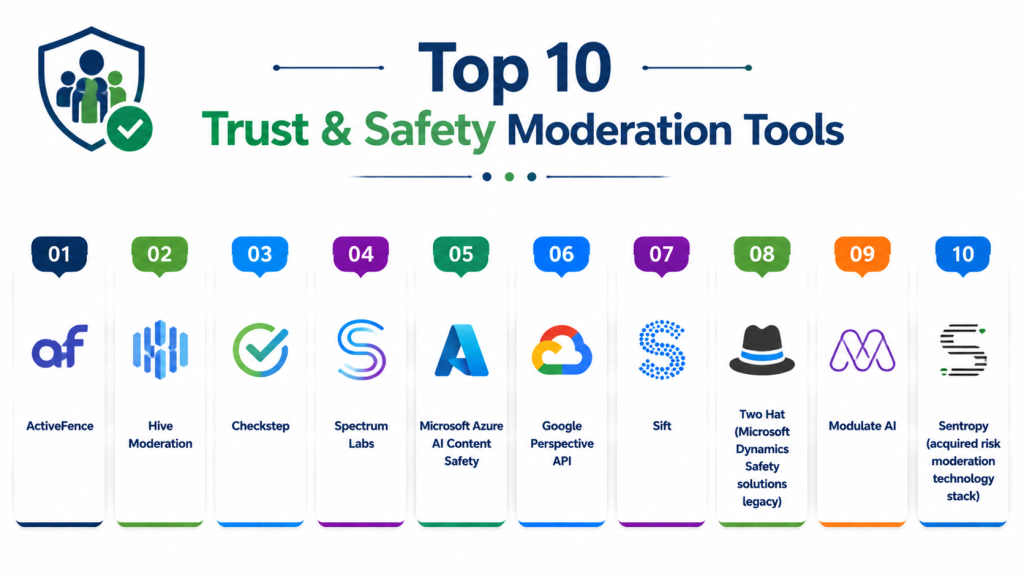
Top 10 Trust & Safety Moderation Tools
#1 — ActiveFence
Short description:
ActiveFence is an enterprise Trust & Safety intelligence platform focused on detecting online harm, fraud, and malicious behavior across large-scale digital ecosystems. It provides proactive threat detection using AI models and threat intelligence systems. It is widely used by platforms requiring high-security moderation. It is best suited for large-scale risk monitoring environments.
Key Features
- Real-time threat detection engine
- AI-based content classification models
- Fraud and abuse prevention systems
- Deepfake and synthetic content detection
- Policy enforcement automation
- Global threat intelligence feeds
- Risk scoring dashboards
Pros
- Strong enterprise-grade security focus
- Advanced AI threat detection capabilities
- Scales well for large digital ecosystems
Cons
- Complex implementation process
- Not optimized for small platforms
- Pricing transparency is limited
Platforms / Deployment
Cloud
Security & Compliance
Enterprise security controls, role-based access, and audit logging supported. Compliance certifications: Not publicly stated.
Integrations & Ecosystem
- Social media platforms
- Messaging systems
- Marketplace APIs
- Security orchestration tools
- Custom REST APIs
Support & Community
Enterprise onboarding and dedicated support available.
#2 — Hive Moderation
Short description:
Hive Moderation provides AI-powered content moderation APIs for detecting harmful text, images, and videos. It is widely used in social media, gaming, and UGC platforms. It focuses on scalable machine learning models for real-time moderation. It is best suited for AI-first moderation pipelines.
Key Features
- Multi-modal moderation (text, image, video)
- AI toxicity detection models
- Spam and abuse filtering
- Real-time API-based moderation
- Custom policy tuning
- Automated flagging workflows
- Scalable cloud infrastructure
Pros
- Strong AI moderation capabilities
- Easy API integration
- High scalability for UGC platforms
Cons
- Limited governance workflows compared to enterprise suites
- Requires tuning for domain accuracy
- Advanced compliance tools are limited
Platforms / Deployment
Cloud
Security & Compliance
Encryption and secure API access supported. Certifications: Not publicly stated.
Integrations & Ecosystem
- Developer APIs
- Content platforms
- Social apps
- CMS systems
- Messaging tools
Support & Community
Developer documentation and technical support available.
#3 — Besedo
Short description:
Besedo is a hybrid Trust & Safety platform combining AI moderation with human review services. It focuses on marketplaces, dating platforms, and UGC-heavy applications. It offers strong fraud detection and content filtering workflows. It is best suited for hybrid moderation operations.
Key Features
- Hybrid AI + human moderation
- Fraud detection systems
- Real-time content review queues
- Policy enforcement tools
- Risk scoring mechanisms
- Workflow automation
- Multilingual moderation support
Pros
- Strong human-in-the-loop moderation
- Good for marketplaces and dating platforms
- Flexible moderation workflows
Cons
- Less AI-heavy than newer platforms
- Slower scaling for fully automated use cases
- Enterprise customization varies
Platforms / Deployment
Cloud / Hybrid
Security & Compliance
Role-based access control and moderation audit logs supported.
Integrations & Ecosystem
- Marketplace platforms
- CRM systems
- Payment systems
- API integrations
- Third-party moderation tools
Support & Community
Operational support and onboarding assistance available.
#4 — Checkstep
Short description:
Checkstep is an AI-powered Trust & Safety platform designed for scalable content moderation across digital communities. It focuses on policy enforcement, automated detection, and compliance workflows. It supports multi-modal moderation capabilities. It is best suited for fast-scaling online platforms.
Key Features
- AI content moderation engine
- Policy management system
- Automated enforcement workflows
- Real-time moderation dashboard
- Multi-language content detection
- Community safety controls
- Compliance reporting tools
Pros
- Strong AI-driven moderation pipeline
- Easy policy configuration
- Suitable for scaling communities
Cons
- Enterprise feature depth varies
- Limited transparency on pricing
- Requires tuning for accuracy
Platforms / Deployment
Cloud
Security & Compliance
Secure authentication and audit logging supported. Certifications: Not publicly stated.
Integrations & Ecosystem
- Social platforms
- Community software
- API-based integrations
- Messaging systems
- Analytics tools
Support & Community
Documentation and onboarding support available.
#5 — Azure AI Content Safety
Short description:
Azure AI Content Safety is a cloud-based moderation service that detects harmful text and image content using machine learning models. It is designed for enterprise applications requiring scalable moderation infrastructure. It integrates deeply with cloud ecosystems. It is best suited for enterprise cloud-native applications.
Key Features
- Text and image safety detection APIs
- AI-based harmful content classification
- Real-time moderation capabilities
- Policy configuration tools
- Integration with cloud workflows
- Scalable inference engine
- Developer-friendly APIs
Pros
- Highly scalable cloud infrastructure
- Strong enterprise reliability
- Deep integration with cloud ecosystems
Cons
- Requires technical setup
- Limited out-of-box moderation workflows
- Cloud dependency
Platforms / Deployment
Cloud
Security & Compliance
Enterprise-grade security, encryption, and access controls supported.
Integrations & Ecosystem
- Cloud applications
- AI pipelines
- Security systems
- Data platforms
- API integrations
Support & Community
Enterprise support via cloud provider ecosystem.
#6 — Spectrum Labs
Short description:
Spectrum Labs provides AI-powered behavioral moderation focused on detecting toxicity, harassment, and harmful community behavior. It uses behavioral models instead of keyword filters. It is widely used in social platforms and gaming ecosystems. It is best suited for behavioral risk detection.
Key Features
- Behavioral AI detection models
- Toxicity and harassment detection
- Real-time moderation engine
- Community health analytics
- Risk scoring systems
- Policy enforcement tools
- Multi-language detection
Pros
- Strong behavioral analysis models
- Reduces false positives
- Good for social platforms
Cons
- Complex model tuning required
- Limited general-purpose tooling
- Not ideal for small platforms
Platforms / Deployment
Cloud
Security & Compliance
Enterprise security controls supported. Certifications: Not publicly stated.
Integrations & Ecosystem
- Social platforms
- Gaming systems
- Messaging apps
- APIs
- Moderation workflows
Support & Community
Enterprise support available.
#7 — LiveWorld
Short description:
LiveWorld combines human moderation services with AI-assisted Trust & Safety workflows. It focuses on brand safety, community moderation, and engagement moderation. It is widely used in regulated industries. It is best suited for hybrid moderation programs.
Key Features
- Human + AI moderation model
- Brand safety enforcement
- Community engagement monitoring
- Content filtering workflows
- Escalation systems
- Compliance monitoring tools
- Social media moderation support
Pros
- Strong human moderation expertise
- Good for regulated industries
- Flexible service model
Cons
- Less automation-heavy
- Slower scaling vs AI-first tools
- Service-based pricing model
Platforms / Deployment
Cloud / Hybrid
Security & Compliance
Role-based controls and secure workflows supported.
Integrations & Ecosystem
- Social platforms
- CRM systems
- Marketing tools
- API integrations
- Content systems
Support & Community
Managed services and operational support provided.
#8 — Amazon Rekognition
Short description:
Amazon Rekognition is a machine learning service that detects unsafe content in images and videos. It is widely used in enterprise applications requiring visual moderation. It supports scalable cloud-based moderation workflows. It is best suited for image and video safety detection.
Key Features
- Image and video moderation APIs
- Object and scene detection
- Explicit content detection
- Facial analysis tools
- Real-time processing
- Scalable cloud inference
- Custom moderation labels
Pros
- Highly scalable infrastructure
- Strong image/video detection
- Easy integration with AWS ecosystem
Cons
- Limited text moderation capabilities
- Requires engineering setup
- AWS dependency
Platforms / Deployment
Cloud
Security & Compliance
Enterprise-grade cloud security supported.
Integrations & Ecosystem
- AWS services
- AI pipelines
- Media platforms
- APIs
- Cloud storage systems
Support & Community
Cloud-based documentation and enterprise support available.
#9 — TaskUs Trust & Safety Services
Short description:
TaskUs provides outsourced Trust & Safety moderation services combining human reviewers with AI-assisted workflows. It focuses on large-scale moderation for social platforms and marketplaces. It supports multilingual global moderation teams. It is best suited for outsourced moderation operations.
Key Features
- Human moderation teams
- AI-assisted review systems
- Content policy enforcement
- Fraud detection support
- Global moderation coverage
- Workflow optimization tools
- Safety escalation handling
Pros
- Strong human moderation capability
- Scales globally
- Good for high-risk content environments
Cons
- Outsourcing dependency
- Less product control
- Variable automation levels
Platforms / Deployment
Service-based / Hybrid
Security & Compliance
Enterprise-grade operational controls supported.
Integrations & Ecosystem
- Social platforms
- Marketplace systems
- Messaging apps
- Enterprise workflows
- API integrations
Support & Community
Managed service support model.
#10 — DeepMod AI
Short description:
DeepMod AI is an AI-native moderation platform focused on real-time detection of toxic content, spam, and unsafe user behavior. It uses deep learning models to automate moderation decisions. It is designed for scalable digital platforms. It is best suited for AI-first moderation systems.
Key Features
- AI-based toxicity detection
- Real-time moderation engine
- Spam filtering models
- Behavioral analysis tools
- Policy-based automation
- Risk scoring system
- Multi-modal detection
Pros
- Fast AI-driven moderation
- Good scalability
- Flexible policy configuration
Cons
- Smaller ecosystem
- Limited enterprise maturity
- Requires model tuning
Platforms / Deployment
Cloud
Security & Compliance
Secure API-based access supported. Certifications: Not publicly stated.
Integrations & Ecosystem
- APIs
- Social platforms
- SaaS applications
- Messaging systems
- Analytics tools
Support & Community
Developer support and documentation available.
Comparison Table
| Tool Name | Best For | Platform Supported | Deployment | Standout Feature | Public Rating |
|---|---|---|---|---|---|
| ActiveFence | Enterprise risk intelligence | Web | Cloud | Threat intelligence engine | N/A |
| Hive Moderation | AI-first moderation APIs | Web | Cloud | Multi-modal AI moderation | N/A |
| Besedo | Hybrid moderation | Web | Cloud/Hybrid | Human + AI workflows | N/A |
| Checkstep | Scalable AI moderation | Web | Cloud | Policy automation engine | N/A |
| Azure AI Content Safety | Cloud enterprise apps | Web | Cloud | Scalable AI safety APIs | N/A |
| Spectrum Labs | Behavioral safety | Web | Cloud | Behavioral AI detection | N/A |
| LiveWorld | Brand safety moderation | Web | Cloud/Hybrid | Human moderation services | N/A |
| Amazon Rekognition | Image/video moderation | Web | Cloud | Visual AI detection | N/A |
| TaskUs | Outsourced moderation | Service | Hybrid | Global human moderation | N/A |
| DeepMod AI | AI-native moderation | Web | Cloud | Real-time AI moderation | N/A |
Evaluation & Scoring of Trust & Safety Moderation Tools
| Tool Name | Core (25%) | Ease (15%) | Integrations (15%) | Security (10%) | Performance (10%) | Support (10%) | Value (15%) | Weighted Total |
|---|---|---|---|---|---|---|---|---|
| ActiveFence | 9 | 7 | 8 | 9 | 9 | 8 | 7 | 8.4 |
| Hive Moderation | 8 | 9 | 8 | 8 | 9 | 8 | 9 | 8.5 |
| Besedo | 8 | 8 | 7 | 8 | 8 | 9 | 8 | 8.0 |
| Checkstep | 8 | 8 | 8 | 8 | 8 | 8 | 8 | 8.0 |
| Azure AI Content Safety | 9 | 7 | 9 | 9 | 9 | 8 | 8 | 8.6 |
| Spectrum Labs | 8 | 7 | 7 | 8 | 8 | 8 | 7 | 7.8 |
| LiveWorld | 7 | 8 | 7 | 8 | 7 | 9 | 7 | 7.6 |
| Amazon Rekognition | 9 | 8 | 9 | 9 | 9 | 8 | 8 | 8.7 |
| TaskUs | 8 | 8 | 7 | 8 | 7 | 9 | 7 | 7.8 |
| DeepMod AI | 8 | 8 | 8 | 8 | 8 | 8 | 8 | 8.0 |
Score Interpretation
- Scores reflect comparative evaluation across enterprise readiness, AI capability, and scalability.
- Higher scores indicate stronger AI moderation and infrastructure maturity.
- Mid-range tools often balance usability with moderate enterprise depth.
- Lower scores do not imply weak tools but narrower use-case focus.
- Enterprises should prioritize security, compliance, and scalability over ease alone.
- Final selection should align with content risk level and platform scale.
Which Trust & Safety Moderation Tool Is Right for You?
Solo / Freelancer
Lightweight platforms like Hive Moderation or basic API-based tools are sufficient for small-scale moderation needs.
SMB
Checkstep, Hive Moderation, and Betas of AI moderation APIs provide a balance of automation and cost efficiency.
Mid-Market
Besedo, Spectrum Labs, and LiveWorld offer strong hybrid moderation capabilities with scalable workflows.
Enterprise
ActiveFence, Azure AI Content Safety, and Amazon Rekognition provide deep scalability, compliance, and AI infrastructure.
Budget vs Premium
Budget solutions focus on API-based moderation, while premium tools provide full governance, AI intelligence, and human moderation layers.
Feature Depth vs Ease of Use
AI-first APIs are easier to integrate but less comprehensive; enterprise tools offer deeper policy control.
Integrations & Scalability
Choose platforms with strong API ecosystems and real-time moderation pipelines for scaling global traffic.
Security & Compliance Needs
Highly regulated industries must prioritize audit logs, encryption, and compliance-ready platforms.
Frequently Asked Questions
1. What are Trust & Safety Moderation Tools?
They are platforms that detect, filter, and manage harmful content using AI and human review systems.
2. How do these tools use AI?
They use machine learning models to detect spam, hate speech, fraud, and unsafe content in real time.
3. Do they replace human moderators?
No. Most systems use a hybrid model combining AI automation with human review.
4. What types of content do they analyze?
Text, images, videos, audio, and behavioral signals across platforms.
5. Are they suitable for small platforms?
Basic API tools can work, but full enterprise systems are often overkill for small apps.
6. What is the difference between moderation and Trust & Safety?
Moderation is content filtering, while Trust & Safety includes broader risk and fraud prevention systems.
7. Can these tools detect AI-generated content?
Some advanced platforms now include AI-content detection capabilities.
8. Are these tools compliant with regulations?
Many enterprise tools support compliance frameworks, but certification varies by vendor.
9. How do they handle false positives?
They use confidence scoring, human review escalation, and feedback loops.
10. What is the biggest challenge in Trust & Safety?
Balancing safety enforcement with user freedom and minimizing false positives.
Conclusion
Trust & Safety Moderation Tools have become essential infrastructure for any platform that relies on user-generated content. With rising volumes of online interactions, AI-driven moderation combined with human oversight is now the industry standard. These tools help organizations manage risk, enforce policies, and maintain safe digital environments at scale. From AI-native systems like Hive Moderation to enterprise-grade platforms like ActiveFence and Azure AI Content Safety, each tool offers different strengths depending on scale and complexity. The right choice depends on your platform size, content risk level, compliance needs, and integration requirements. As online ecosystems continue to expand, investing in robust Trust & Safety infrastructure is no longer optional—it is a core requirement for sustainable digital growth.